
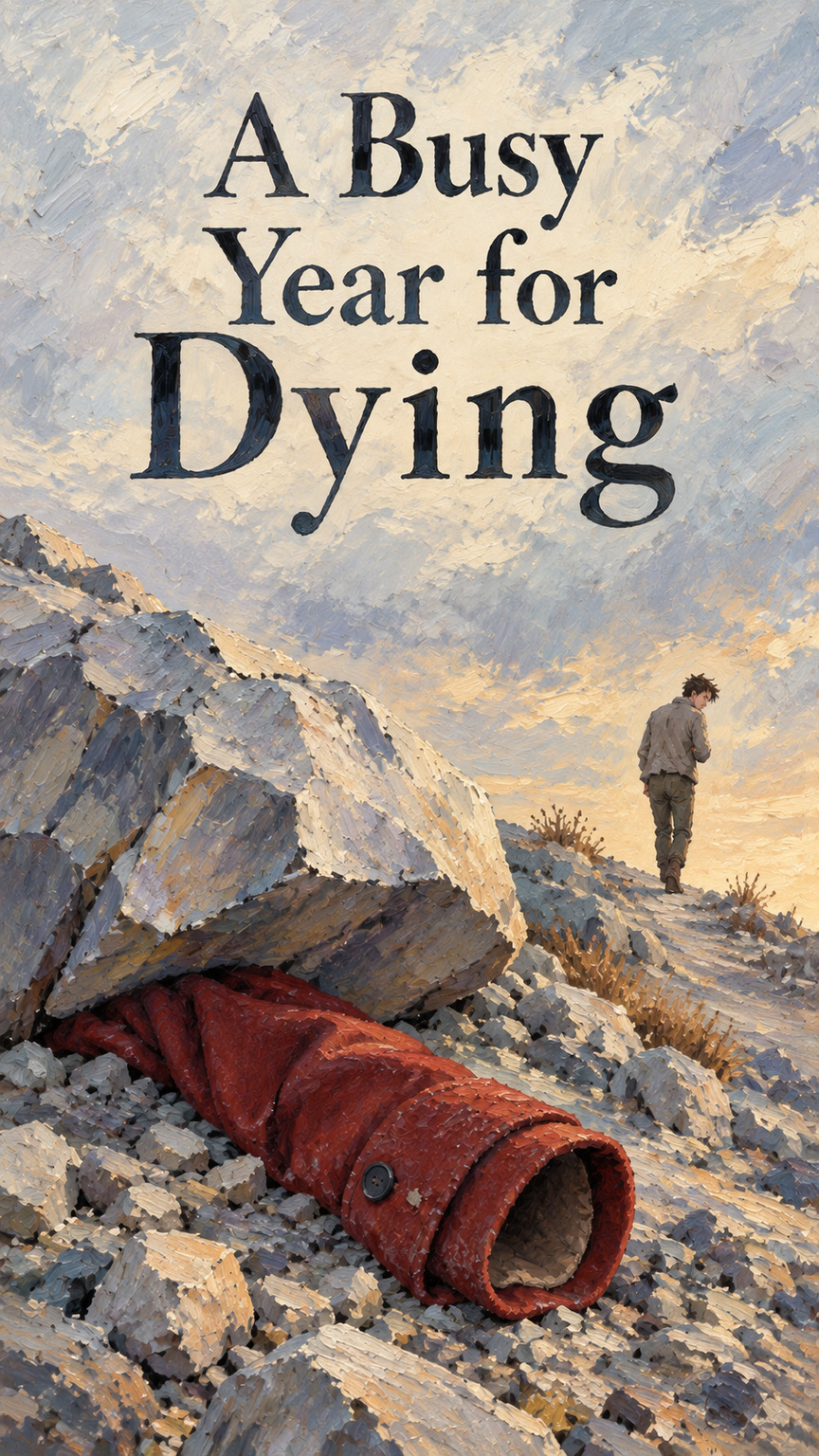
Kelro was still waiting for his left leg to straighten when somebody claimed his coat.
"Leave it," said another voice above the rubble. "We might get him out."
An iron bar scraped along the stone over his head. Kelro held his breath, although that was hardly necessary. A little gravel ticked against his cheek; then the bar withdrew and boots retreated across the scree. The quarry had been shedding pieces of itself all afternoon. Now even the men who had come to steal the cutting machinery were prepared to respect it.
"When we come back," the first man said. "I'm saying I want the coat."
Kelro closed his eyes. It was excellent wool, red outside, quilted within, with enough room in the shoulders to wear two shirts underneath. He had acquired it during a particularly good marriage eighty years ago. His body repaired itself. His possessions required looking after.
This was his fifth death that year.
Before the cities fell, he had generally managed thirty years between deaths. He would put on spectacles, acquire a slight stoop, complain about his knees, and eventually go on a journey from which he failed to return. Once he had left an entire shipping business to himself. There had been solicitors. He missed solicitors. A solicitor might remember a face for thirty years, but he would not follow it across a continent carrying its boots.
The collapse had seemed promising. Records burned; borders ceased to matter. Kelro had expected to keep one name for a century. Instead, everyone who remained traveled between the same few places, and they watched one another with the attention once reserved for royalty and public executions.
Yesterday a fragment of brittle metal had caught him across the forehead. The man in the yellow scarf had seen blood running into Kelro's eyebrow. A few minutes later, when Kelro forgot himself and wiped his face, the man had come close and pushed back his hair.
"Where's the cut?"
An ordinary question, and usually the beginning of trouble. Kelro had spent eleven months of an earlier life shut in a wealthy man's house while people argued about whether his blood would benefit their employer. They had fed him very well and refused to let him leave.
So this afternoon, when everyone ran from the groaning quarry face, Kelro had made sure they saw him hesitate in his red coat. He had stepped into the descending dust. Getting underneath a rock had been an unwelcome addition to the performance.
By dusk his leg would bear him. He worked free of his coat, which the fallen stone had caught by the hem, and crawled through a gap toward the far end of the quarry. Nothing but a sleeve was visible from above. They would have to shift a considerable weight to recover the rest.
On the ridge he looked back once. Then the cold got through his shirts, and he found it necessary to walk faster.
As Jalmot he lasted a fortnight.
He attached himself to Ruldo's wagon, which carried lamp oil, salt, six travelers, and a fiddle nobody could play. They stopped at a camp in the shell of a freight yard to trade for winter food. Kelro helped unload. When he complained about the questions people asked in the crowded tents, Ruldo found him an empty signal hut on a strip of cinders beyond the tents and lent him a blanket.
It was almost a home. The door latched. There was a shelf at the correct height for a cup.
On the ninth day Glessa arrived with a cart of clothes. His coat hung from the highest rail, shaking its empty sleeves in the wind. He went straight to it.
"That patch pulls," he said.
Glessa turned it around. She had a long pin between her lips and several shorter ones stuck in the cuff of her own coat.
"It's a large hole."
"You could have taken cloth from inside the pocket. Nobody would have seen it."
She removed the pin. "You can mend it how you like after you buy it."
The lining still had its small scorch mark beside the inner breast pocket. He touched it with a thumb.
"Two tins of fat," she said.
"For something pulled off a dead man?"
"I washed it."
"It used to have horn buttons."
Glessa looked at him. He let go of the lining.
"Coats of this quality generally did," he added.
"Then you'll know what they cost."
He had one tin of fat. She put the coat back on its rail.
Three days later he cut his wrist on torn metal beneath Ruldo's wagon. He clapped his other hand over it before Ruldo could look and accepted a strip of cloth. By supper he had thrown away the bandage and forgotten the injury. Ruldo noticed the bare wrist while passing him a bowl.
"Let me see that."
Kelro obediently held out the bowl.
"Your hand."
There was no mark. Ruldo turned it over once, looking for the injury that had soaked Kelro's sleeve.
"You heal quick."
"Always have."
"My sister has a sore on her leg. Nothing closes it. When we get north, could you have a look?"
Kelro drew his hand back. He had nothing to offer the sister. He could not even decide which parts of himself to repair; the little nick in his ear had healed six times after six attempts to look different.
"I'm no physician."
"I didn't say you were. Something you eat, perhaps."
"Whatever you put in that bowl."
Ruldo waited. Kelro ate, although the beans had burned to a black crust on one side. For years after the collapse he had expected hunger to become less offensive through familiarity. It hadn't.
Two nights later a gale tore a sheet of roofing loose from the signal hut. The sheet struck his lamp. He woke to heat and orange light, with his blanket burning at the foot of his bed.
By the time Ruldo shouted from the cinder strip, Kelro had reached the broken rear window. He could have answered. He could have climbed out and joined the men dragging the nearest tent farther away. Instead he left through the darkness behind the hut, crouched beyond the railway embankment, and kept going.
The burning blanket had been Ruldo's. That troubled him more than he cared to examine. His feet troubled him too; he had not found both boots. The next morning his remaining tin of fat bought a boot that was too big.
Orvett was clean-shaven, quiet, and going south. After eighteen days of abandoned camps and roads buried in ash, he came north again. The only pass still usable before snow delivered him to a trading gathering beside a broken freight engine.
Kelro counted the wagons. Twelve. There had been a town here, once, and twelve wagons would scarcely have supplied one street. Now they made a crowd he hoped to disappear into.
A man was trying to juggle three tin cups beside the engine. He caught two, picked up the third, and asked for contributions. Nobody moved. Farther along, a woman gave off little blue sparks between her palms to light a customer's pipe. The customer paid her with a button.
Kelro had just decided to spend his last beans on something hot when he saw the coat.
Glessa had mended the patch again. It hung straight now. He crossed to her cart before caution could remind him what coats had cost him lately.
"Better," he said.
She followed his gaze. "Still two tins."
She remembered the customer but apparently hadn't heard about the fire. He let his rehearsed story about a lost brother go unused.
Then Ruldo came around the engine with a sack over his shoulder.
He stopped. Set down the sack. Walked up to Kelro and touched his sleeve, lightly at first, as if confirming the presence of cloth.
"Jalmot?"
"Orvett," Kelro said. "My brother was Jalmot."
Ruldo kept hold of the sleeve.
"He mentioned you," Kelro added, which he regretted immediately.
"Did he? When?"
"Before we parted."
"I only met him five weeks ago."
"A different Ruldo, then."
Glessa had stopped rearranging her stock.
Ruldo said, "I haven't told you my name."
Kelro looked past his shoulder. The man in the yellow scarf was approaching them, smiling with the peculiar delight of someone who had recognized an acquaintance and did not yet remember why he shouldn't.
"Kelro! We thought you were under the quarry. How did you get out?"
Ruldo turned to him. "You know this man?"
"He was with us three weeks. That's his coat."
Glessa took it down from the rail and folded it over her arm.
"I bought it," she said.
"Nobody's disputing that," Kelro said, although he was. "There has been considerable confusion."
"We went back," said the man in the scarf. "We pulled out your coat. Couldn't find anything else."
"Thank you for trying."
"You could have come and told us."
Ruldo released the sleeve. He took a spoon from his pocket, a bent thing with a bit of cloth wrapped around its handle.
"This was outside your hut. I found it in the morning. Been carrying it because I didn't like to throw it away."
Kelro reached for the spoon. Ruldo closed his hand.
"I sat out there all night. Thought you might call from underneath. By morning we could get near enough to lift the roof. One of your boots under it, and ash. Nothing to bury."
"I wasn't underneath."
"I can see that now."
Kelro could usually meet displeasure with an account of difficult circumstances. Nothing he could safely say explained why he had heard Ruldo shouting and chosen to stay silent. He stood with his hand still extended until he noticed it and lowered it.
The juggler came over, carrying his cups. So did two women who had been sorting engine parts. Kelro wished the juggler success in a distant location.
"We had a drink for you," Ruldo said. "I told them you were coming north to help my sister."
"You asked me to look at her leg. I never promised I could cure it."
Ruldo regarded him. "So we're finished with the brother?"
"Yes," said Kelro.
Glessa laid the coat inside her cart. "And the wound on your head?" She nodded at the man in the scarf. "He told me about it when he sold me the coat. Blood all over you, then nothing."
"There was," the man said. "No cut when I looked."
"His wrist, too," said Ruldo. "Wouldn't let me look at it until later."
The small audience grew quiet. Kelro felt the old, familiar calculation begin around him: what he might be worth, what he might be made to do. The woman with the pipe-lighting sparks had only a threadbare shawl. Magic was common enough to be badly paid, but his particular variety attracted people with rooms that locked from outside.
Glessa looked from his unmarked forehead to his empty hands.
"Were you begging? Pretending you were hurt?"
The opening was so unexpected that he nearly denied it.
"No," he said carefully. "I used to perform."
That, at least, was true. There had been a theater, two hundred years ago, where he had been responsible for assassinations and very minor kings.
"Paint?" Glessa asked. "On your skin?"
He allowed her a small, reluctant nod.
The man in the scarf said, "What about the quarry?"
"You found an empty coat."
"But we saw you go in."
"And then you couldn't see anything. Dust everywhere."
That was true as well. Kelro almost felt honest.
Ruldo looked at Kelro's wrist, the one he had turned over by the wagon, and did not ask to see it again. He put the spoon away. "You did it on purpose. The hut. You meant us to think you were dead."
"The fire was an accident."
"You could still have called out."
"Yes," Kelro said.
Ruldo waited for more. Kelro looked at the spoon's outline in Ruldo's pocket and said nothing. Letting Ruldo mourn him had been preferable to being kept as a remedy.
Glessa reached into her cart and brought out a cracked tin of red lip salve.
"Show us."
The salve was stiff with cold. Kelro warmed a little between his fingers and put it across his brow. From three paces away, with his hand over it and the appropriate expression, it looked very well. He dipped a rag into Glessa's cup and wiped it off.
The man in the scarf stepped closer.
"You made a noise when that bit of metal hit you."
"I said I used to perform."
Somebody laughed. Kelro hoped the laugh would spread. It did, but Ruldo stayed beside the cart, his sack at his feet.
"Could you do the quarry again?" Glessa asked.
"Here?"
"There's old canvas. Plenty of things to fall over."
"I hardly need to demonstrate every possible disappearance."
"You said you could perform."
He looked toward the pass. A half-day's walk through the wind would take him out of sight of this gathering, after which there would be more wind, no food, and no new face waiting for him. Beside him was the cart with his winter coat. Behind it, the juggler had begun practicing with two cups instead of three.
"A brief demonstration," he said. "If someone can lend me a screen."
Glessa immediately began asking for payment from the people nearest her. When one protested that he had already seen the trick, she said the man was going to be buried alive next.
"Nothing heavy," Kelro told her.
"Empty tins," she said, pointing to a stack beside the engine.
Two clothes rails and a piece of canvas made the screen. Kelro arranged empty packing tins behind it, and the juggler lent him a straw-filled sack that ordinarily cushioned the cups. It would make a tolerable body if nobody insisted on knowing it personally. He borrowed trousers from Glessa's rail, drew them over the bottom, and reached for his coat.
Glessa held it away.
"No."
"They saw the red coat in the quarry. That's the point."
"It's not going under those tins. I've mended it twice."
She made him wrap the tins' bent edges in scraps of cloth, watched him cover the sack, and only then allowed him to dress it. He caught himself worrying about the new patch. She was being quite reasonable.
By the time he stepped in front of the canvas, the juggler was collecting contributions with all three cups.
Ruldo came up beside him.
"First you tell them."
"I'm going to explain the illusion."
"Tell them who you are. What you did."
Kelro glanced at the spectators. The two women had brought their engine parts to sit on. Someone had found a length of dry sausage. There was room for anger to become a great deal worse with an audience.
"My name is Kelro," he said. "Recently I traveled under the name Jalmot."
"And Orvett," Glessa called, remembering.
"Briefly."
"He let me sit beside his burnt hut until morning," Ruldo said. "Thought he was in there."
There were no laughs. Kelro waited while Ruldo looked at the people in front of him, making sure they had heard. Then Ruldo took up a place at the side of the screen.
Kelro bowed. It was a poor beginning, but in his experience there were few beginnings that a sufficient quantity of movement could not improve.
He went behind the canvas, put on a battered hat, and reappeared with the solemn gait of a man approaching unstable rocks. He had meant to give a short account of the dangers. The man in the scarf interrupted.
"We ran. You just stood there."
"I shall stand there presently."
"You were scratching your neck."
Kelro scratched his neck. This received more appreciation than his bow.
He retreated behind the screen and set the hat on the sack. The tins fell with a splendid crash. A red sleeve flopped out at the foot of the canvas, and the hat rolled out after it. Kelro left the dummy there and, doubled up behind the screen, made for the other end.
"He's down there," said a woman at the side.
"You can't stand there," he told her from his crouch.
"You didn't say."
"Nobody was standing at the back of the quarry!"
"There was a cliff," said the man in the scarf.
They moved her to the front. Kelro dragged the sack out, reset the tins, and began again. This time, when he emerged on the far side and dusted himself off, people clapped.
He held up the sack. "You recognize a hat and a coat. You think you've seen a man. By the time you can look properly, he's somewhere else."
"We never saw a body," the man in the scarf said to his neighbor. "Only the sleeve."
Kelro bowed again. The juggler's cups rattled. Glessa came forward and removed the coat before he could devise anything further for it to suffer.
"Now the burning," somebody called.
"I have no intention of setting fire to anything," Kelro said.
Glessa was already bringing him an orange shawl. She shook it. The loose fringe flickered in the light.
He looked at the shawl, the two rails, the sack sprawled at his feet. For a moment he was back in a theater that no longer existed, watching an audience settle for a burning city represented by three boys and a length of silk. They had enjoyed themselves. He had too, until the leading actor's grandchildren began asking questions.
"We'll need someone to wave that," he said.
After the second performance Glessa counted the takings on the folded canvas. There were beans, buttons, a tin of fat, and half the sausage. Kelro sat on a crate in his red coat. She had let him put it on while they discussed terms.
"Food, a place on the cart, and you keep the coat," she said. "Until the thaw. Two performances at each stop."
"One."
"They paid for two."
"They paid to watch an argument. The performances were incidental."
"Then we'll have an argument at each stop."
He tucked his hands under his arms. The coat was warming through. Across the gathering, Ruldo was showing the spoon to someone and pointing toward him. Kelro would have to become accustomed to accounts of his conduct delivered without consultation.
"No actual fire," he said. "No real stones. And I don't perform before breakfast."
Glessa gave him a piece of sausage. "Until the thaw?"
He chewed. Swallowed. "Until the thaw."
She went to settle with the juggler. Kelro had eaten the rest of his sausage when a fresh party arrived from the north. Glessa met them, pointed at the canvas, and returned with a pleased expression.
"Jalmot first this time. They heard about the fire on the way here."
He was already getting to his feet. "The quarry makes a better beginning. I have an entrance."
Ruldo had come to collect his own sack. He stopped beside the crate.
"You were asleep in the hut," he said. "Start there."
Kelro considered explaining the difficulty of opening a performance with an unconscious protagonist. Then he looked at Ruldo and thought better of it. He went behind the canvas, lay down in the warm coat, and began to snore.