A Crown for the Endless Fire
Deep beneath the mountains, you find a woman crowned in antlers and burning candles standing on a bridge above an endless fire.
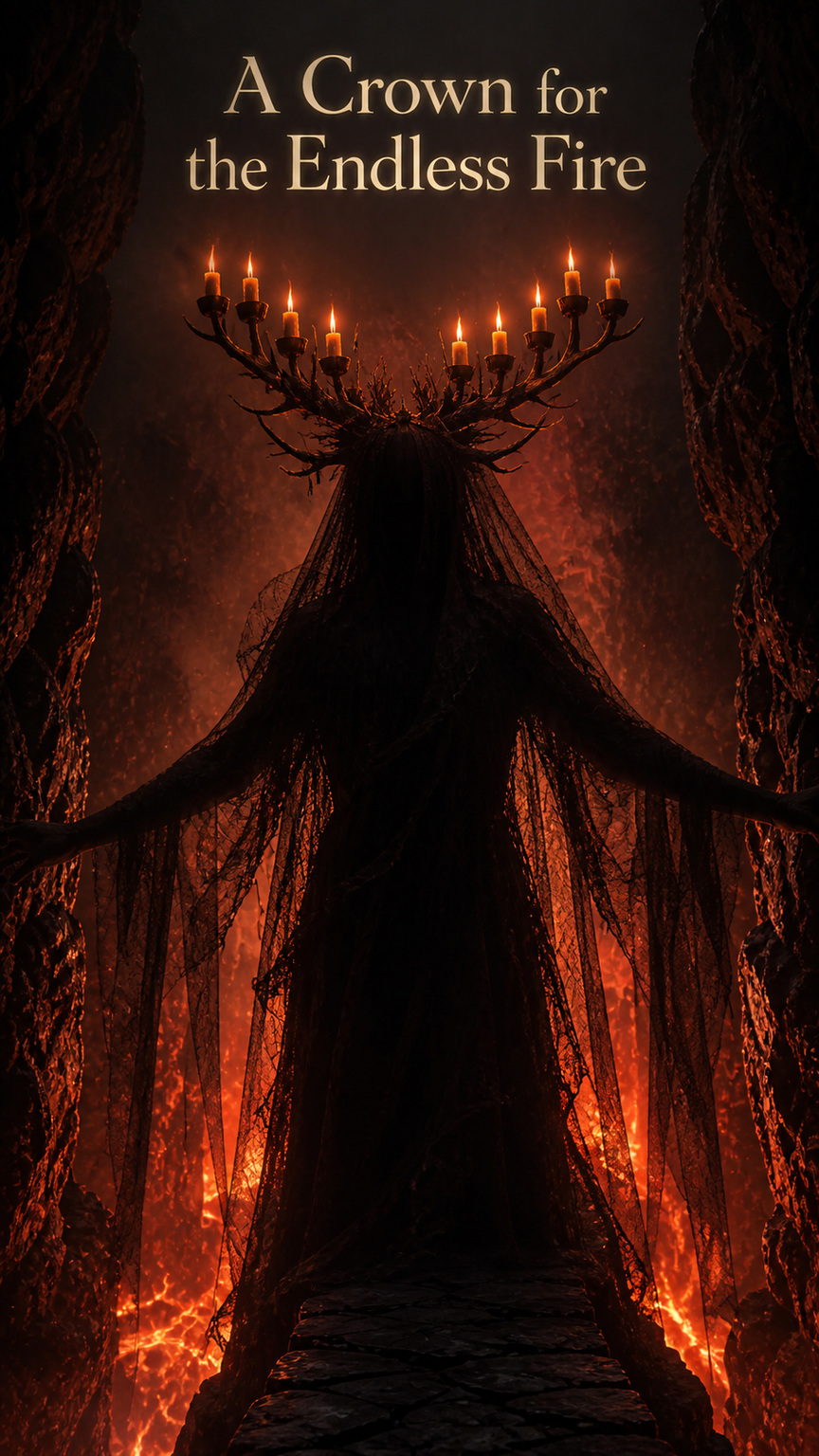
By the last surveyed gallery, my lamp flame had begun leaning uphill.
That was wrong. The mine drew from the upper vents in summer. Air should have slipped past my cheek toward the deep headings, cool enough to keep sweat from my collar until I reached the winzes. Instead it climbed out of the abandoned lower cut with a dry, mineral taste, as if the mountain had taken breath through hot teeth.
I was the mine’s ventwright, so I sent the last two muckers up and tied a red rag across the gallery. They objected because muckers object to any order that leaves someone else below. I told them I was checking a blocked vent, which was true as far as it went, and made them repeat that no one was to follow before morning.
Then I went down alone.
I carried two water skins, chalk, three iron wedges, a claw hammer, smoke cups, a folded neck cloth, and one rope. The rope was my return route. I doubled it around a stone horn at the top of the lower slot and fed both ends through my belt ring as I descended, so I could pull it free and take it home if the slot behaved. It did not behave. Heat came in fits. Each time the air stilled, the rock around me warmed; each time the draft rose, grit whispered upward past my ears.
At the bottom I struck a smoke cup. The gray thread flattened against the floor, hesitated, then fled back the way I had come.
“Blocked beyond,” I said, to learn whether the cut threw my words back. It did not.
The cut narrowed past any survey peg I knew. I went sideways for forty paces, paying rope behind me. Old chisel work showed under black glaze. The last seam had a pale crust around it, salt or something that only looked like salt, and the air leaking through was hot enough to tighten the skin across my knuckles.
Beyond that seam, the mountain stopped.
My lamp showed a black bridge, rail-less and no wider than two outstretched arms, running perhaps thirty paces into a gulf. It reached a square opening in the far wall. Beside that opening, an iron shutter stood closed across a shaft mouth.
Below the bridge was fire.
I could not see what burned. There were no beds of coal, no timbers, no floor. Flame moved far beneath me and close beneath me at once, folds of orange and white passing through a depth my eyes could not settle. It filled the gulf in both directions beyond my lamp. When I leaned out and looked down, the light went on until smoke and glare erased distance. I dropped a chalk chip. It flashed once, fell past sight, and gave me no sound back.
At the bridge’s center stood a woman.
Her boots were planted on a six-pointed mark. Both hands gripped a hooked iron pole set against the stone. An antler crown pressed into a thick pad around her head and neck. Exactly six candles burned in iron cups along the antlers. Their flames did not gutter in the furnace breath. Four bent toward the far wall. One stood high and thin. The candle third from her left leaned toward me and burned blue-white at its base.
The bridge shivered. Not much. Enough to blur the woman’s outline and set my teeth together. Her knees gave, caught, and held.
“Water,” she called. No greeting. Her voice carried raggedly over the low rush below. “Have you got any?”
“Two skins.”
“Where are you standing?”
“Near abutment. Mine side.”
“On the pale seam or behind it?”
I looked down. One boot had crossed the crusted line. “Behind now.”
She shifted one hand on the pole. The antlers dipped with her head, and her shoulders jerked as if someone had hung a new weight from them. “Good. Water first. Then smoke at that seam. Don’t seal it.”
She had asked a useful question before giving an order. That earned her the water, not the order.
I looped my return rope through the neck of one skin, went flat, and pushed the skin along the bridge. At eight paces the heat through the black stone forced me back onto my knees. I flicked the skin ahead. It skidded to within a pace of the central mark; she pinned its loop with the hooked pole and dragged it to her boots without moving them.
She drank badly: too fast, coughed, held the skin against one cheek, drank again.
“Small pulls,” I said.
“Come wear this and show me how.”
That was an ordinary enough complaint that some of my fear loosened.
I lit another smoke cup at the pale seam. The smoke drew into it, then split. Most ran upward into the mine. A smaller strand crawled under the bridge lip and vanished along the third of six dark ribs I could see beneath the deck. Those ribs ran the bridge’s length into sockets at either wall. The third had a bright crack just beyond the near abutment.
“Your bypass is shut,” I called, pointing to the shutter beyond her.
She drank once more before answering. “Jammed after the tremor.”
“How long?”
“Long enough.” She pressed the water skin against the back of her neck. Beside her boots lay a curved wick knife and another neck pad, black with sweat. Scorch marks crossed the center stone in short old arcs. “Smoke going under third?”
“Some. Crack in it.”
She shut her eyes for one breath, no more. “That rib’s cup went out at first. It came back blue.”
She meant the blue-white candle. I almost asked how the cup followed the rib, but the question would not move any air. “Which cup is third?”
She touched the blue-white flame’s iron stem, then pointed her pole toward the cracked rib. The flame leaned toward me as the hook passed below it.
“Direction is heat?” I asked.
“Hotter end. Height is what the rib carries. Blue at the foot means the stone’s going soft.” Her next breath stopped halfway. She forced it out. “Dark means the heat path broke. Don’t let one go dark.”
“And the antlers?”
“Get heavier when the six disagree.”
The gulf brightened. All six flames lengthened, and the bridge’s hum climbed through my palms. Lemra—I did not yet know her name—folded lower over the pole.
I knew leaking seams. A leak robbed a shaft of draw; close the leak, make the air take the proper road. The pale seam was narrow enough for my middle wedge. I wrapped my hand, set the iron point, and drove it twice.
The smoke thread shrank.
For half a breath, I felt right.
Then the third and fourth candles stretched higher than my hand. Blue-white climbed the third wick. A sound like a bow drawn across a copper rim came from under the bridge. The woman’s pole skated. One antler tip struck her shoulder, and she dropped to a knee without leaving the mark.
“Out,” she said.
I was already on the hammer. “Two blows.”
“Out. Now.”
I reversed the hammer and pulled. The wedge had taken a blue temper, and the seam held it as if pinched. I struck sideways once, twice. On the third blow it sprang free and spun toward the gulf. I caught it between both gloves, losing a strip of skin through the leather, and rolled away from the opening.
The seam inhaled. Smoke spilled under the lip again. The tall flames shortened one after another, but the third kept its blue root.
“I narrowed the wrong relief,” I said.
“Yes.”
There was no satisfaction in it. She was busy levering herself upright.
I set the warped wedge on bare stone where it could cool. “The shutter normally takes these surges.”
She nodded.
“You’re holding them across the ribs until it opens.”
“Not holding.” She adjusted the pad with two fingers. The pole shook against the deck. “Spreading. Badly now.”
“Can you leave the mark?”
She looked at the six flames instead of me.
I had my answer, though not from her. “Right. Third rib first.”
“Water,” she said.
I had missed what she needed while finishing my conclusion. I pushed the second skin out along the stone. This time I crawled ten paces before sending it, counting the bridge pulses through my elbows. It slid almost against her pole; she stopped it, wet the spare pad, and shoved the cool cloth under the crown’s rear band. A hiss came from damp wool. Her face eased for perhaps three breaths.
“What do I call you?” I asked.
“Lemra.”
“Uldek. I can sling the cracked rib at its root. Then I cross and work the shutter.”
“With what line?”
I put my hand on my return rope.
Her gaze followed it back to the narrow cut. “Is there another way up?”
“From your side?”
“Service stair. Longer.”
“Sound?”
“Last week.”
Not an assurance, but better than pretending.
I crawled back into the slot and pulled one end of the rope. It rasped over the stone horn above, then fell around my shoulders in a warm, dusty coil. Once it was down, the direct ascent was gone. I found the midpoint by matching ends, laid the rope across my knee, and cut it with my belt knife. Two lines would brace both sides of the split rib’s saddle. Neither would reach the horn again.
“Return route spent,” I said.
“I heard.” Lemra had turned one ear toward the dragging rope. “Third candle dropped a finger when you pulled.”
“Then watch it. Tell me if it rises.”
“Blue matters first.”
“Blue first. Height second. Dark, shout.”
At the bridge root, black scale hid two deck mouths beside the third rib. I scraped them clear. Each opened into a U-shaped maintenance chase: down around one side of the rib’s saddle, then out through a slot in the near abutment face within my hammer’s reach. A worn stone eye sat between each mouth and its matching slot. The crack lay between the two chases and opened and closed by the width of a fingernail. Chalk dust vanished into it with every opening.
I tied one of my small sound wedges to the first rope end as a messenger and dropped it point-first through the inner mouth. It rattled around the saddle. The tip appeared in the matching face slot; I caught it with the hammer claw and drew the rope through until it made a full sling beneath the rib. I brought both ends into the stone eye and hauled. The crack stopped breathing so widely.
The bridge tremor changed. Lemra struck the deck once with her pole.
“What?” I shouted.
She pointed to the crown. The blue-white base had narrowed.
I set the first knot and tied my other small sound wedge to the second line. The next furnace surge came without warning. Flame rolled up the gulf wall. The seated rope snapped taut across my palm; the bridge lifted under my braced knee, then dropped. Lemra said something I could not hear.
“Dark?” I yelled.
She shook her head hard, regretted it, and bent under the antlers. Two fingers pointed toward the outer edge. The fifth candle stood lower there.
“Sounder side?”
One sharp nod.
I fed the wedge through the outer mouth. When it appeared at the second face slot, I clawed it out and drew the rope around the other side of the saddle. I shifted its hauling end to the outer side of the stone eye, where Lemra had pointed, then tensioned and seated the second knot. The rope tremor steadied into three distinct beats: pull, rest, pull. The cracked rib no longer rang alone.
I crawled upright. Both rope halves remained under the bridge, already browning where heat touched them. There would be no taking them back.
“It will hold for a crossing,” I said.
“One?”
“Mine first. Yours if the shutter takes.”
“If it doesn’t?”
I checked the far opening, the thirty paces of bare stone, the fire. “Then I come back before the sling cooks.”
She checked the blue-white flame again and said nothing.
I wrapped my burnt palm, wetted my sleeves, and went low. The bridge had no rail. At rail height, square sockets stood empty and packed with black scale. I kept three points against the stone. At the sixth pace, heat pressed through my boots. At the tenth, the fire below opened white lanes inside the orange, and awe took my count away. I could see no bottom, no fuel, no wall closing under us. Just motion going down past what sight could keep.
“Uldek.”
Lemra’s voice brought back the bridge. I was at twelve.
“Two steps to me. Fireward edge is lower load.”
I looked at the candles. She had not said which was fireward.
“Your pole side?”
She stared, then slapped the pole against her right boot. I had missed the answer in what she could still do. I shifted right. The vibration softened.
At the central mark there was not room for dignity. Lemra could not move her boots. The antlers spread wider than her shoulders, six iron cups burning above them, and I had to pass beneath the lowest tine without touching crown or woman. I went on one hip along the outer edge. She lifted the hook clear. A drop from the water skin rolled across the bridge, steamed, and disappeared before reaching the side.
“Neck?” I asked.
“Later.”
“Can you keep the mark for sixty?”
“Stop counting me.”
“Forty, then.”
“Open the shutter.”
Her temper had more breath than her other words. That was useful.
I passed her and crawled the remaining fifteen paces. The far abutment was hotter. Three crown flames leaned after me, confirming it without a lecture. The shutter covered a side chimney cut upward through the wall. Its lifting bar had jumped its guide and bitten into a lip of softened stone. I struck smoke beneath it. The smoke flattened toward the bridge instead of rising into the chimney.
“Jammed at the guide,” I called.
Lemra lowered the pole, listening through it.
I set my smallest wedge under the bar and lifted until the shutter opened one finger. Air screamed through. The bridge tone rose instead of falling.
Lemra chopped her hand down.
I stopped. “One finger open.”
She held up two, pointed to the high candle on her right, then crossed her wrists.
“Two ribs crossed in load?”
She shook her head and struck the pole twice against the bridge, the second blow harder. The two high flames were not equal; one fluttered at twice the other’s beat.
“Twisting,” I said. “I opened too fast.”
Her shoulders sagged once in assent.
I let the shutter settle half a finger, moved the wedge to the far side of the bar, and lifted there. The opening widened crookedly—one finger at the near jamb, two at the far. The shriek became a rough draw. Smoke tore upward. Behind me the bridge dropped from a copper whine to a bass hum.
“Color?” I called.
Lemra looked from flame to flame. “Third—still blue. Less. Sixth amber edge.”
“I need the bar clear of the lip.”
“Small.”
“How small?”
She held thumb and forefinger apart, changed her mind, narrowed them to the width of the wick knife lying at her feet.
I worked by that measure. Lift the bar a knife-width. Wait through three bridge pulses. Move the wedge. Test smoke. Each gain strengthened the chimney draw, but twice the third rib complained through the rope sling and Lemra signaled me back. On the second retreat she did not speak. She touched the blue candle’s cup, then put her fist against her throat. I lowered the shutter until she could lift her chin again.
The next trough in the fire came as a dimming rather than silence. The orange folds sank somewhere below sight. The bridge vibration ran down through my soles and thinned.
“Now,” Lemra said.
I drove the wedge under the bar, put my shoulder to it, and freed the guide from the stone lip. The shutter jumped. I caught its chain before it could fly fully open and wrapped the chain twice around my forearm. Heat bit through the wet cloth.
“Three fingers,” I said. Numbers were easier than fear. “Holding three. Check one through six.”
Lemra raised her face to the crown. “One amber. Two amber. Three—” Her mouth stayed open, but no word came. She pointed to the third cup.
Its flame had gone upright and orange at the edges, blue no longer visible.
“Three amber,” I said for her. “Four?”
She touched four, then five, then six, giving one nod at each. All six flames stood straight and amber. None stretched above the others.
The bridge reached the bottom of its vibration. For a moment the rope sling under the third rib hung without quivering. The six flames stayed upright and amber. Then the next pulse came, smaller and even, and traveled through all six ribs together without bending them.
Lemra waited through it. She waited longer than I wanted, eyes moving over each flame while the chimney drew a steady hot wind past me. At last she put down the pole and took up the curved knife. One hand slid beneath the crown’s iron band, the other loosened a rear catch hidden in the wet pad.
“Stay there,” I said. “I’ll take weight when I reach you.”
“No.” The word came cleanly now. “Keep the shutter where it is.”
She bent her knees, lifted the antler crown with both hands, and set it into a low stone cradle beside the central mark. No flame jumped to her skin, to the bridge, or to me. The six candles simply shortened in the improved draft. Lemra capped them one by one with the bowl of the wick knife. Six threads of smoke drew toward the far chimney.
Without the crown she swayed as if the bridge had risen under her. Then she sat down hard and pressed both hands to the sides of her neck.
“Still forty,” I called.
“You stopped counting.” Her voice was fuller but rough.
“I resumed.”
“Open it one more knife-width. Slow.”
We left the shutter at four fingers on the far jamb and three on the near, its chain locked around a stone cleat. The bridge hum stayed low. I crossed back to Lemra, and she showed me how to lash the crown’s cradle closed without touching the hot cups. Both rope slings remained seated in their near-root stone eyes. At the far landing she pulled a maintenance chain. Iron lattices dropped across both bridge mouths, their descent visible through slots in the deck. We pinned the far chain and chalked the pin.
Then we took the service stair.
It was longer than my direct route by enough that I complained twice. Lemra complained five times: about the stair pitch, about my pace, about the makers putting rest niches on the hotter side, and twice about the water being warm. At each fork she chose the landing; whenever the stair warmed, I tested the wall seams. We stopped three times to wet her neck pad and once to retie my palm.
At the first cool junction, she sat with her back to the wall while I unwrapped the soaked neck pad. The skin beneath was bruised in two branching lines but unbroken. I folded my clean cloth into a broad collar, wet it with what remained in the second skin, and held it while she tied it loosely.
“Too tight?” I asked.
“Left side.”
I shifted the knot.
“Now it’s on the burn.”
“You have several.”
“That does make your work harder.”
She drank, this time in small pulls.
On the junction wall I drew the closure mark and wrote beneath it: BRIDGE SHUT. THIRD RIB ROPE-SLUNG. SIDE SHUTTER HELD UNEVEN, FOUR FINGERS FAR, THREE NEAR. NO ENTRY.
Under materials spent I added one return line, cut into two slings. Under materials retained I listed two good wedges and one heat-bent wedge, not for reuse. I had carried the warped one up in my tool wrap so no other ventwright would drive it into a seam and call it sound.
Lemra leaned over the list. “One full water skin.”
“Consumed in service.”
“By me.”
“That is still service.”
She considered the wording, took the chalk, and added a clean neck pad to the replacement list. Then she gave the chalk back and asked where I had put the second skin.
It was beside her boot. I pointed. She picked it up and finished what was left.