A Crown in the Bargain
"So...mind telling me what your plan is now that you married me, husband? Clearly, you did not put a ring on me because you were smitten with me." The Baroness asked the Crown Prince.
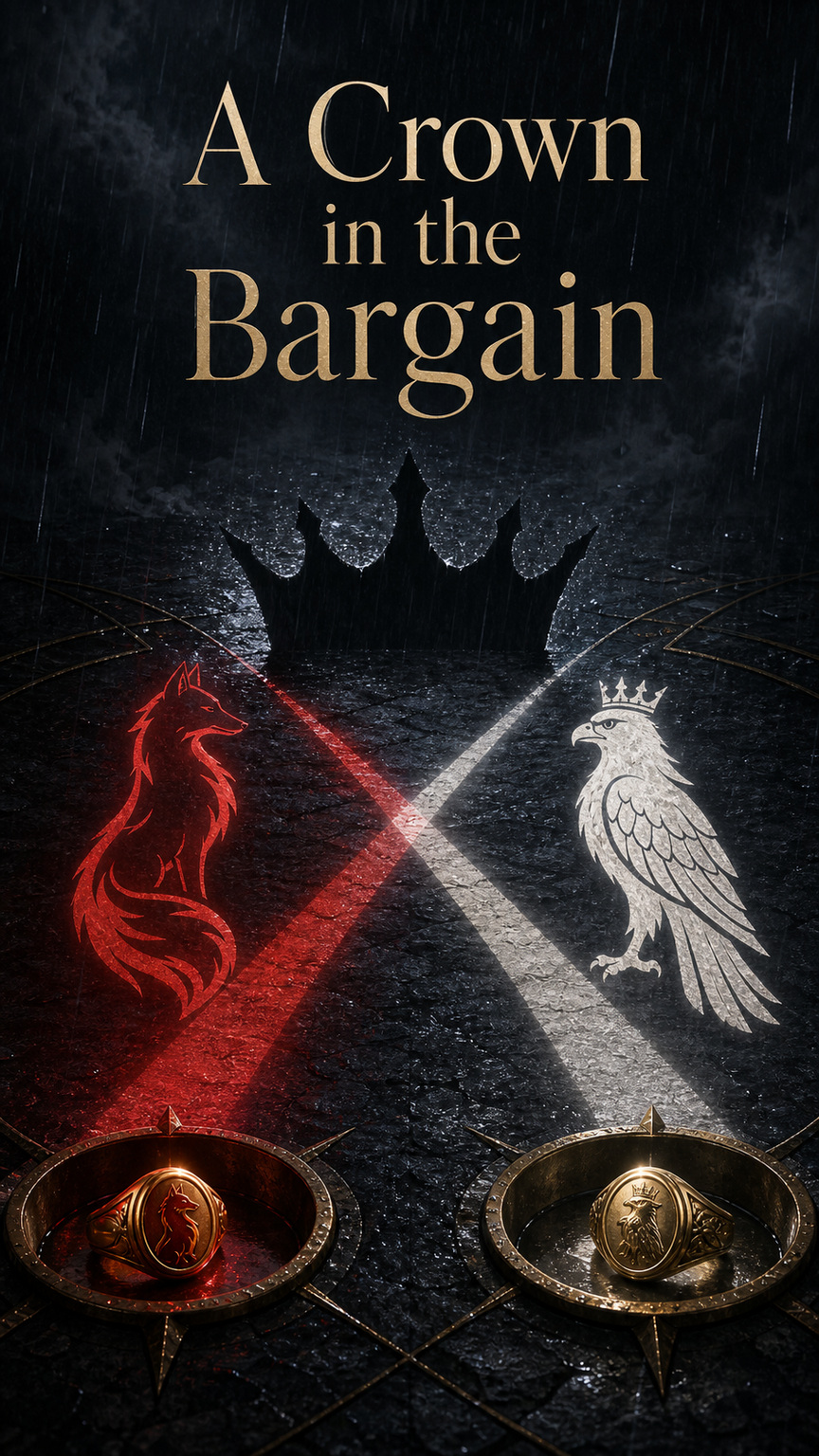
The new ring threw a red fox across Baroness Tareya Solvane’s knuckles.
It was only light. Hushglass in the marriage chamber gathered the lamps, sorted their colors through the cut stone in her signet, and laid the registered Solvane herald over her skin: fox, rain-furrow, three hill stars. Yet the little beast seemed to run when she turned her hand. Each circuit brought it closer to a white crown projected by Osvan’s ring onto the coverlet between them.
Four pale bars stood beneath the crown. One went dark as the west tower struck the quarter.
If the last bar vanished without both signets placed in the succession array, the ceremony would expire without fault. The law gave them until dawn to turn vows into a registered household. It did not make either of them finish.
Osvan had dismissed the musicians, the blessing clerk, the page carrying warmed wine, and everyone else entitled to witness two strangers become private. He had not removed his court coat. Rain had dried in black beads along its high collar. He sat at the edge of a cedar chair as if the chair belonged to a petitioner.
Tareya drew the marriage articles from beneath her traveling cloak and set them on the bed.
“So…mind telling me what your plan is now that you married me, husband? Clearly, you did not put a ring on me because you were smitten with me.”
His thumb stopped against the royal signet. The crown on the coverlet went still.
“There are three counts before the first-night interval closes,” he said. “At the second, the succession clerk opens the north relay. At the third—”
“That is a schedule.”
“Yes.”
“I asked for your plan.”
He looked toward the shuttered windows, though the rain there offered no counsel. “To enter our marriage into the succession register before dawn. Your herald would place the Solvane vote outside the regency council’s bloc. The general’s proposed match then lacks the houses required to compel a second betrothal hearing.”
There it was. Not a lover’s answer, but at least it belonged to the room.
Tareya lifted her hand. The fox stretched over the tendons. “What happens to this?”
“The stronger filing registers it beneath the royal crown.”
“Beneath.”
“In sequence, not in rank. The law calls the relation supportive.”
“My stewards call a road supportive when it remains under the cart. Who holds the road?”
Osvan’s mouth tightened. He had been fluent at the wedding table. He had numbered the council houses, the salt levies, and the years since a Solvane had entered Lumespire without having to check a single note. Now he glanced down at the articles as though an answer might have crawled under them.
“The crown household would gain authority to countersign appointments in the March,” he said.
“Which appointments?”
“Judges. Road wardens. Customs masters.”
“Who releases the storm reserve?”
“The crown treasury, after review.”
“Who decides whether a washed bridge is urgent?”
“The emergency comptroller.”
“In Lumespire.”
“Yes.”
Tareya slid the papers apart with one finger. The seventh sheet bore an embossed crown so faint it vanished unless she angled it toward the lantern. Her copy from the betrothal negotiations had contained six sheets.
“You promised protection without absorption.”
“I prepared both forms.”
“You gave me one.”
His eyes closed for less than a breath. “I expected to explain the seventh after the ceremony.”
“When removal of the ring would be called a public humiliation instead of a private refusal.”
“The law calls it no-fault dissolution until dawn.”
“People have mouths even where law has definitions.”
A soft knock interrupted him before he could make a count out of that too.
“Enter,” Tareya said.
Her attendant edged through the door sideways with a tray held above a stack of oilskin. Her gray hair had escaped its pins, and the cuffs of her blue gown were wet to the elbows.
“The west gutter has backed into the lower wardrobe,” she said. “Your other boots are on the hearth. These are still dry.”
She set down the boots, a folded rain mantle, and two thick slices of bread covered by a bowl to keep them warm. Only then did she glance at the lights on the coverlet.
“Bridge keeper says the upper walk is open,” she added. “For now.”
“Thank you.” Tareya touched the bread. Still warm. “Have you heard from Solvane?”
The attendant produced a weather slip from inside her sleeve. The relay ink had bled at one corner. “Northern farm culvert gone. East post road passable to single carts. No deaths reported by the ninth bell.”
Osvan rose. “The crown engineers can leave by noon.”
The attendant looked to Tareya, not him.
“Set my bridge clothes out,” Tareya said. “And eat something yourself.”
“Already stole the prince’s sugared pear.”
For the first time that night, Osvan appeared unsure whether he had been insulted. The attendant shut the door on his uncertainty.
Tareya broke the bread in half and gave him one piece. “Engineers by noon. On whose order?”
“Mine.”
“Tonight you have the authority?”
He did not take the bread. “I can issue a provisional dispatch. It lasts two days unless the regency countersigns.”
“And after we file the strong form?”
“The dispatch can be charged against the March reserve without the regency.”
“My reserve.”
“Yes.”
“So your protection is permission to spend my own storm money, once your comptroller agrees that my bridge is wet enough.”
“It also opens crown crews, stone allotments, draft teams, and military roads.”
“Which I need.” She pushed the bread into his hand. “Say all of it.”
Osvan stood with the heel of the loaf against his palm and rain shadowing his collar. “I need eight heralds to hold my claim through the king’s incapacity. I have seven. The council has offered me an eighth through the general’s daughter, with command of the palace guard attached to her house. If I refuse without another registered marriage, they can call a fitness hearing. If I accept, they gain the guard, the household appointments, and two of the three regency seals.”
“And you chose the March because our herald is independent.”
“Because your vote has never sat in a council bloc. Because you asked for roads, not ministries. Because your barony needs aid that the treasury can lawfully provide.” He paused. “And because you were unlikely to ask me to love you.”
That last sentence came out without the polish of the first three. It was not quite cruel. That made it worse.
Tareya folded the weather slip along its old crease. “You found a woman in need of stone and assumed she would be grateful for neglect.”
“I thought separate households would be a courtesy.”
“Did you ask where I wanted to live?”
“No.”
“Whether I wanted children?”
He tried to answer, stopped, and pressed the bread between both hands.
“Whether I wanted you at breakfast?”
“No.”
The tower bell sounded again. This time three notes followed the quarter strike: bridge warning, bridge warning, north relay advanced. The fox and crown broke apart on the coverlet, then re-formed with only two pale bars between them.
Another knock came, firmer than the attendant’s. The royal chamberlain opened the door precisely far enough to show his narrow face.
“Highness. Baroness. The north clerk has advanced the succession count due to lightning over the lower relay. The rooftop room must close in forty-two minutes. Gloves are required on the upper walk.”
“Send the clerk the strong articles,” Osvan said. “Tell him we are coming.”
Tareya lifted the seventh sheet. “Send nothing.”
The chamberlain’s gaze moved once between them. Protocol seemed to resist in every bone of him, but he bowed. “Nothing will be sent. I will have the roof lenses uncovered.”
“And the parallel form,” Tareya said. “Bring it.”
Osvan looked at her.
The chamberlain did not. “It is in the prince’s black dispatch case.”
“Then bring the case.”
When the door closed, Tareya put on the dry boots. She did not ask why the weaker form had been kept outside the chamber. She had begun the night with broad questions and received broad answers. The rain had narrowed both.
“What does parallel cost you?” she asked.
“Two votes at the accession hearing instead of one unified household vote. The opposition may challenge the separation. There are eleven plausible procedural outcomes, four of which end with the council suspending recognition until the king wakes or dies.”
“What does it cost the March?”
“Crown relief cannot be released through spousal authority. It requires a separate compact.”
“Can we sign one tonight?”
“We would need a relief ledger, two witnesses, the emergency seal—”
“Can we?”
He stared at the fox circling her hand. “Yes.”
“Then carry the ink.”
She took the articles and left the marriage chamber.
The lantern bridge ran from the royal apartments to the central spire, a glass-roofed walk suspended above three interior courts. Tonight its roof had been cranked open so the storm would not tear the panes from their lead. Rain came sideways through the ribs. Lines of herald light traveled under the floor, civil records relayed from tower to tower: green oxen for freight permits, silver moths for birth notices, blue dogs for watch rotations. Each pattern crossed beneath Tareya’s boots along the route its lenses provided.
Her attendant waited at the threshold with waxed gloves and the rain mantle. She fastened the throat clasp, then tugged it once.
“Too tight?”
“No.”
“You’ll say if it is.”
“I will.”
The attendant handed the second pair of gloves to Osvan. “Those buckle at the wrist. Not the elbow, Highness.”
He adjusted them without protest. The chamberlain arrived carrying the black dispatch case against his chest. A young lamp tender followed with a hooked pole and a sack of dry crystal wicks.
“Mind the third grate,” the tender said. “It jumps.”
Then they were moving.
On the bridge, their bodies took over from the articles. Wind shoved at Tareya’s right shoulder. Water ran from the lip of her hood and down the front of her mantle. Osvan took the outside rail, not gallantly but because he was taller and could brace the dispatch case when the chamberlain passed it forward. At the third grate, the floor kicked beneath their feet. Tareya caught the articles against her ribs. Osvan caught the chamberlain by the sleeve.
“Still forty-two minutes?” she called.
“Thirty-four,” the chamberlain called back.
“That isn’t how minutes work,” the attendant muttered.
“We spent eight of them.”
They reached the middle landing, where the storm had blown out two relay lamps. The tender knelt immediately, opened the brass housing, and began changing a wet wick. Red Solvane light came along the floor from the west tower, struck the dead section, and vanished.
Tareya stopped.
Osvan had gone three paces before he noticed. “What is it?”
She pointed at the blank glass. “A record can fail between here and there.”
“Yes. The registry repeats a signal through two alternate towers.”
“And if both fail?”
“The clerk reads the signed vellum.”
“So the light is evidence of placement. Not the placement itself.”
“Correct.”
“And no light means nothing except that no light arrived.”
“Correct.”
The answer came easily because this was machinery, not marriage. Osvan could stand in a storm and explain three routes for a signal. Ask him where his wife should eat breakfast and the prince of Avarnth lost his language.
The tender seated the new wick. The red fox leaped across the repaired pane.
Tareya started walking again. “How many rooms did you set aside for me?”
Osvan nearly missed the next grate. “Six.”
“Where?”
“The east apartments.”
“How many doors from your council room?”
“I don’t know.”
“Find out tomorrow.”
“If there is a tomorrow in this arrangement.”
“Tomorrow comes whether we file or not. I need to know who chooses the keys.”
He gave a short, unhappy breath. Not laughter, though it had passed near it.
At the spire entrance, the chamberlain and the tender hauled the black case through first. Osvan held the rain mantle clear of the latch while Tareya ducked inside. It was the smallest courtesy he had offered without prearranging it. She noticed and did not reward him for it.
The rooftop succession room was not grand. Its copper shutters stood folded against the round walls, leaving the lens array open to the weather. Six brass arms surrounded a slate table. Each ended in a shallow signet cup. Overhead, mirrors caught signals from the palace towers and cast them onto the floor in shifting columns. Animal heralds moved through one another without touching: a boar crossing a heron, a stag passing through a school of gold fish. At the center waited an unlit crown.
The chamberlain put the black case on the table. “Twenty-three minutes.”
The lamp tender wedged canvas over the western lens. Tareya’s attendant used a clean cloth to blot rain from the articles, muttering at every warped edge.
Osvan unlocked the case. Inside lay two forms and the royal emergency seal.
“Show me,” Tareya said.
He placed the strong form under the reading lens. Then he fitted his signet into the northern cup and nodded toward her hand.
“No.” She kept her ring. “Use the demonstration blanks.”
He took two pieces of cut glass from the case and set them into the cups. The array read their positions. White light gathered into a crowned hawk, Osvan’s house herald, and red shaped itself into Tareya’s fox. Under the strong form’s arrangement, the fox passed beneath the hawk’s wings. Its three hill stars rose into the crown and disappeared.
“Appointments?” she asked.
“Countersigned.”
“Reserve?”
“Crown review.”
“Customs?”
“Household authority after accession.”
“My assent?”
“Recorded with mine as a unified filing.”
“Legible separately?”
He did not answer.
Tareya removed her ring.
The projected fox vanished from her hand. Across the palace, red relay light ceased in window after window as the portable signet stopped offering a current registration position. The ring went cold in her palm, ordinary gold around an engraved stone.
The chamberlain’s fingers twitched toward the bell cord. He did not pull it.
Osvan stood on the far side of the slate table. He could have invoked the delay clause. He could have asked the chamberlain to witness confusion, illness, storm duress—eleven contingencies, perhaps more. Instead he picked up the strong form.
He tore it once through the embossed crown. The rain took one half from his hand and slapped it against the copper shutter.
“That copy was registered,” the chamberlain said, his voice clipped thinner than before. “It will require a destruction minute.”
“Write one,” Osvan said.
“On what authority?”
Osvan looked at the dead gold in Tareya’s palm. “Mine. While I have it.”
He placed his own ring in the northern cup.
The crowned hawk filled the floor alone. Without her supporting herald, its outer line flickered where the contested count remained incomplete. The device registered that Osvan Rhel had placed a signet at a particular cup at a particular time. It offered no opinion on whether he was brave, desperate, honest, or merely out of alternatives.
The chamberlain pulled the bell cord once. “Sole royal placement witnessed.”
Osvan’s fingers stayed spread on the slate. “There are four likely challenges if I file without a supporting marriage. Two can be answered by old household precedent. One delays the accession hearing. One—”
“Osvan.”
He stopped.
“Do you want me to stay married to you?”
Rain ticked against the brass arms. The lamp tender went very still behind the canvas. Tareya’s attendant kept blotting vellum.
“Yes,” Osvan said.
“Why?”
He looked toward the torn form, ready perhaps to retrieve policy from it. Nothing remained there but wet fibers.
“I need the March,” he said. “I need someone the council did not choose. I need—” His breath caught on the next count. “I would like the chance to learn which door you use. I don’t know what that is worth to you.”
Tareya set the ring beside the parallel form. “Open the relief compact.”
The chamberlain did. Osvan shifted the demonstration blanks into two cups opposite each other. The fox and hawk returned on separate arcs. Their lights crossed at the center of the array, red passing through white, neither swallowed. Tareya’s three stars remained visible above the Solvane line.
“My title remains outside the royal household,” she said.
“Yes.”
“My appointments?”
“Yours.”
“My customs gates?”
“Yours unless Parliament levies the whole kingdom.”
“Relief access?”
He opened the compact and began listing. “Crown engineering corps for thirty days. Up to twelve heavy draft teams. Slate from the eastern quarry allotment. Two thousand measures of grain at winter reserve price. Military road access without billet rights in Solvane villages. Review after—”
“Who directs the crews inside the March?”
“Your road wardens, with an engineer empowered to refuse an unsafe order.”
“Who pays?”
“The crown pays transport and wages. Solvane pays materials at cost over three years. If I fail the accession hearing, the debt remains with the royal treasury, not my successor’s right to your title.”
“Write that last part.”
He wrote it himself, his letters losing their courtly slope as the pen hurried. Tareya added culvert stone, bridge chain, and seed grain to the list. She struck military carts from village greens and gave them the abandoned wool yard instead. Osvan objected to five years of toll exemption; she reduced it to two and required crown wagons to carry March salt on the return journey. Neither called the compromise generous.
The chamberlain supplied dates. Tareya’s attendant sanded wet ink. The lamp tender announced, “South mirror slipping,” and climbed a short ladder to tighten its clamp while the hawk and fox bent across the floor.
“Seven minutes,” the chamberlain said.
Tareya read the compact from the first word to the last. Osvan began to speak twice and stopped both times. At the debt clause, she changed may not attach to does not attach. At the household clause, she added that residence at Lumespire created no transfer of jurisdiction.
“One question,” she said.
Osvan’s face had gone pale beneath the rain. “Yes.”
“If I keep rooms in the east apartments, who chooses my keys?”
His answer took longer than any law should have required. “You do.”
“Put it in the household minutes. Not the marriage compact.”
The chamberlain made the note.
Osvan signed the relief terms and pressed the emergency seal beside his name. Then he put the pen down and stepped away from the array, leaving the second cup empty.
No one urged her.
Tareya thought of the northern farm culvert, gone into black water. She thought of single carts feeling for the east road, of six rooms chosen without her, of the fox erased beneath white wings. She thought, too, of the strong form tearing in Osvan’s hands before he knew whether she would offer him anything in its place.
She slid her ring onto her finger. Red light returned, first against her skin and then along the distant towers.
She did not place it beside his. She set it into the western cup assigned by the parallel form.
The fox ran out across Lumespire. The hawk held its separate height. Their paths crossed above the central slate, and the relay carried both patterns into the rain.
The chamberlain pulled the bell cord twice. “Separate placements witnessed. Parallel household registered.”
The final pale bar under the crown went dark.
Tareya removed her ring from the cup and put it back on. Nothing tightened around her finger. No warmth entered her blood. The array had done its work and no more.
“Two ledgers,” she told the chamberlain. “The palace copy of Solvane storm roads for the last five years, and the crown corps dispatch ledger. Send them to the east apartments.”
“Before breakfast?”
“Before breakfast.”
Her attendant gathered the signed compact into oilskin. “Which room in the east apartments?”
Osvan looked at Tareya.
Below them, relay shutters opened one by one, passing a red fox and a white hawk toward opposite edges of the city.
“The one with the largest table,” Tareya said. “We have roads to mark.”