A Darkness Written Under Skin
Everyone in the world is born with a tattoo. The tattoo can be made from any kind of ink-like fluid and creates various possible abilities. You are the first to be born without one. Or so they thought until a black light was shined on you.
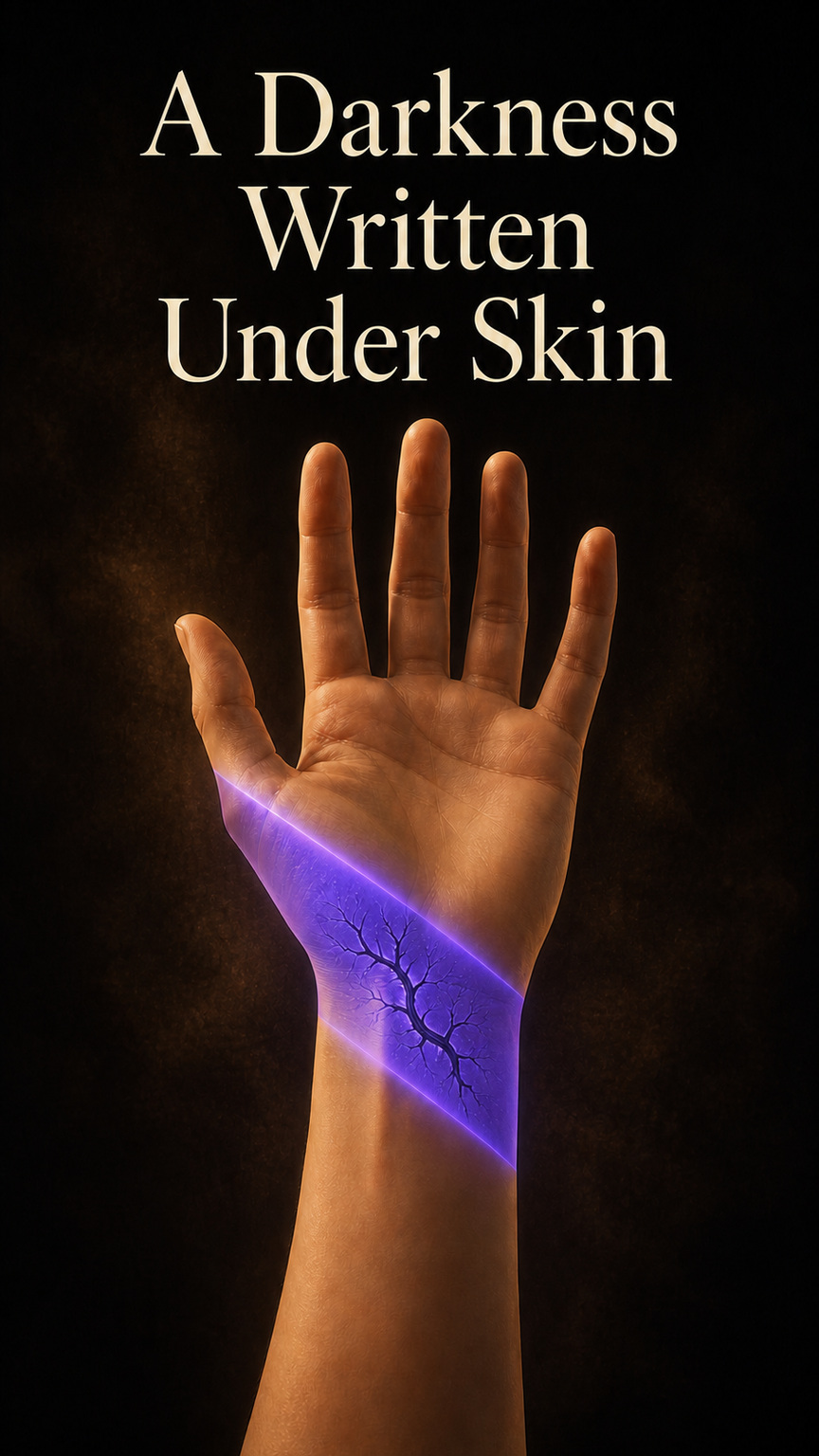
“Keep it flat,” the practitioner said. “You’ve moved twice.”
You flattened your palm on the dye table. The wood was cold despite the steam that had lived in the workroom all night. Under your wrist, old stains made a dull geography: madder red in the knife cuts, walnut brown around a peg hole, one thumb-shaped island of blue that your mother claimed had been there before you were born.
The practitioner drew a glass rod through the vial meant for tomorrow’s graft. The ink climbed after it in a gray thread, neither dripping nor quite holding. A good match, she had said twice already. Your mother still watched the gray thread as if it might answer something.
“Three days or five?” she asked. Her sleeves were rolled above the red-lake whorls at her elbows. Whenever she flexed her hands, the marks darkened and the damp cloth hanging behind her stopped bleeding color into color. “The clinic gave me both.”
“Three if you sit still for a living. Five for the vats.” The practitioner touched the thread to a square of test paper.
“Five,” your mother said, and pulled the aftercare sheet closer.
Your younger brother snorted from the other end of the table. He had been told to hold the black-light inspection lamp and had spent the last ten minutes trying its violet beam on everything except the vial. White lint flared on his shirt. A smear of soap shone along the basin. His own birth mark, a loop of amber resin running from palm to forearm, disappeared under the strange light instead of brightening.
“The soap’s glowing,” your brother said.
The practitioner held out her empty hand. He took another look at the basin before bringing the lamp back over the table.
Every child was born carrying some ink-like fluid in a pattern beneath or across the skin. Soot, resin, metal suspended in oil, substances with no names outside the families who passed them down: the fluid varied, and the pattern shaped the faculty. No one before you had been found empty.
The practitioner lifted the paper. The artificial ink had spread into a narrow fork and stopped within the chalk ring. Tomorrow, under numbing salve, she would feed it into channels cut shallowly along your inner arm. Months later, if your body accepted it, the graft would let you hold a chosen color steady while you worked: no drift in the bath, no pale seam where cloth folded against itself. Not the broad, effortless command your mother’s birth tattoo gave her. Something narrower. Something reliable. Something yours because you had signed for it and saved for it and spent six years saying you did not need it before admitting that you wanted it.
“Here,” the practitioner said, tapping the test paper.
Your brother aimed it at the paper. His wrist bumped yours.
Violet light spilled across your hand.
The practitioner’s glass rod halted against the paper.
At first you thought the gray graft ink had splashed. A black-violet stroke lay beneath the skin of your wrist, so dark it seemed cut into the bone. It curved once around the tendon. Fine branches broke from it and vanished at the edge of the beam.
Your brother moved the lamp.
The line moved with the light, appearing ahead of it and going invisible behind.
“Wait,” the practitioner said.
“What?” your mother asked.
“Don’t move the light.”
“I’m not.” Your brother’s voice had risen. The beam shook over your hand. The buried line trembled with it, now black, now bruised purple. “I didn’t spill anything.”
“Spill what?” your mother said.
“The stand,” the practitioner said. “Put the lamp in.”
No one did.
You took your hand off the table. The practitioner reached after it. You pulled your arm out of reach.
“Don’t,” you said.
Her hands stopped in the air. You turned your wrist yourself.
At last your brother obeyed. The workroom changed under the fixed violet glow. Detergent flashed in the grain of the table. The boiled linen around the graft tools became painfully white. Where the light found your forearm, the hidden stroke divided and divided again, fine as frost under a windowpane, except frost lay on a surface and this did not. You turned your arm. The pattern turned inside it.
Your mother came around the table, passed you, and slid the bolt across the workroom door.
“Turn it off,” she said.
“Not yet.”
The refusal surprised you. All your life other people had leaned closer to the absence, as if enough attention might produce what they expected. Now there was finally something to look at, and your mother wanted darkness back. You held your arm nearer the lamp.
“Anyone could come down.”
Your brother stared at your lit skin. “Does it hurt?”
You did not know whether he meant the line, the light, or finding it. “No.”
The practitioner slid the graft vial away from the beam and stoppered it. She bent close to the light without reaching for you.
“Could the lamp have made it?” your mother asked.
The practitioner looked up at her. “I don’t know what it is.”
“Turn it off,” you said.
The practitioner reached past the stand and clicked the switch. Ordinary yellow lamplight returned. Your skin was bare. Not faded, not pale: bare, as it had been in every mirror and every examination room of your life.
You rubbed your thumb over the place. Nothing rose under it.
The practitioner took a fresh cloth and held it up where you could see. “Water.”
You kept your wrist against your chest. She poured from the covered pitcher into a clean bowl and waited. At last you laid your arm on the table. The cloth passed over your wrist once, cool and rough. No color came away. Under violet light, the line returned with the same branches.
The practitioner put a clear glass plate between the lamp and your arm. The pattern remained. She nodded toward your other wrist. You gave it to the light. More black-violet lines rose there, thinner but unmistakable. At the bend of your elbow, the pattern climbed past your rolled sleeve.
“Enough,” you said.
She switched the lamp off at once.
The practitioner drew the dark cloth around the graft vial.
“Why are you packing it?” you asked.
“I’m not putting new ink through that.”
“Tomorrow?”
She shook her head. The graft had been mapped for tissue everyone believed empty. Whatever lay under your skin turned every shallow channel into a crossing she had not planned.
You had spent months saving for tomorrow. Now the morning coach would leave without you, and the cancellation made no sound beyond the stopper pressed into the vial.
For weeks you had measured tomorrow in clean bandages and coach times. You knew which hand would lift the kettle, how long you could sleep without rolling onto the new channels, which vat you would try first when they healed. None of that preparation had included wanting the graft after someone found the thing you were supposed to have wanted instead.
“Thank God,” your mother said.
“Don’t.”
“I didn’t mean—”
“I wanted it,” you said.
She had called you whole at clinic counters, at school meetings, in the kitchen after relatives tried to be kind. Now the edge of the aftercare sheet collapsed between her fingers.
“I know.” She folded the aftercare sheet across the middle, missed the crease, and folded it again.
Behind her, a drop fell from the draining cloth into the stone trough. Then another.
“Can you tell what it does?” your brother asked.
“Couldn’t tell you.”
Your brother rubbed his palm. “That winter the wall froze. When you slept in my bed.”
“What about it?”
“I couldn’t warm your feet. Not properly. I thought you were kicking it away.”
“You were eight.”
“Nine. And you did kick.”
Your mother looked sharply at the practitioner. “The stitches. The pain-worker kept saying you were fighting her.”
“I remember the stitches,” you said.
“And the naming oil,” she went on. “It wouldn’t stay on you. Then the fever—”
“The kettle burned me,” you said.
The burn had blistered two of your fingers for a week. Your mother looked at your hand as if it had interrupted her.
“That was boiling water.”
“I know.”
Your brother looked at you. “Did mine work? Other times, I mean.”
“Sometimes.”
“Sometimes?”
The practitioner set the unused graft tools back into their case, piece by piece. Their little metal mouths clicked against the felt.
“Try it now,” you said.
“No,” your brother said.
You held out your hand anyway.
“I burned the cuff.”
Until tonight he had told that story as a joke, changing whether the iron or the stove took the blame. Now he kept his thumb over the singed place as though it had become evidence against him.
“You said the iron did that,” your mother said.
“I don’t know what did it.”
“You use your mark in the setting bath every day.”
“That’s cloth.”
“Please,” you said.
He looked at your hand, then rubbed his amber-marked palm hard against his trousers.
The practitioner sat opposite him and offered her palm. “On me first.”
His amber loops darkened. Nothing came from them on their own. He drew a breath, pressed his fingers into hers, and warmth spread a pink flush up her hand.
“That’s enough.”
He let go. The practitioner rubbed her thumb across the warmed center of her palm, then moved out of your place at the table.
You put your palm against his. His skin was clammy.
“Your hand’s freezing,” he said.
“Start.”
The amber deepened. Warmth flowed into your palm, as ordinary-seeming as sun through a window, then climbed to your wrist. You had expected resistance and found none. The surprise loosened something in your shoulders.
“Oh,” you said.
“Too much?”
You shook your head. Warmth was still moving toward your wrist when the practitioner tapped the table at five. Your brother released you, looking relieved.
“Again,” you said. “With the lamp.”
“You felt it.”
“I want to see.”
The practitioner fitted the lamp into its stand. Black-violet branches appeared through your hand and ran up beneath your cuff. “Same hand,” she told him.
You remembered the pain-worker leaning over your split chin when you were eleven, her blue mark open across her throat, telling you to stop fighting the quiet she was offering. You had not known how to stop. You had only known you did not want her inside your hurt while she spoke as if your fear were disobedience.
Not him, you reminded yourself. The warmth.
You set your feet under the table. You watched the amber lines in his palm. When he touched you, you imagined a door you had never seen and made no picture of closing it. You simply held the edge of yourself where it was.
His mark darkened.
Pressure. Damp skin. No warmth.
Under the violet light, the lines within your palm drew tight around each place his fingers met yours. They did not flare or reach for him. They held.
Your brother swallowed. “I’m doing it.”
“Don’t force it,” the practitioner said.
“I’m not.” His fingers tightened anyway. “It’s warm on my side. It’s just—”
He tore his hand away before five and tucked it under his opposite arm.
“I didn’t want it,” you said.
He looked at you.
“The heat,” you said.
“I know.”
He said it too quickly and did not offer his hand again. The places where his palm had pressed yours cooled in separate damp patches.
The practitioner leaned toward the dark lines. “Again.”
“No,” you said.
“They said no,” your mother said.
The practitioner looked at you as if she had only just heard herself. Then she switched off the lamp.
Your brother fetched the little tin cup from beside the sink and held it between both palms. His amber loops darkened before he seemed to notice. The metal gave a soft tick.
He set it down too quickly. You moved it away from the edge of the table.
Heat entered your fingertips. Nothing beneath your skin answered it.
Your brother watched you put the cup down. Whatever had failed between your palms, it had not been warmth itself.
Afterward your brother tucked his hand under the other arm again.
Your mother reached for the inspection lamp. “The paper’s upstairs. We take both to the registry.”
“Leave it.”
“They’ll say we changed something. They’ll say the lamp was wrong, or you moved, or—”
“I’m not going to the registry.”
“You have to go somewhere.”
“The clinic. For the appointment.”
“And after?”
“I don’t know.”
She let go of the lamp. “It has already been twenty years.”
You had no answer that would make twenty years shorter. Your mother pressed one fingertip after another against her thumb, making a count only she understood.
“I kept every receipt,” she said. “Every stupid little bottle they told us to try.”
Your brother rubbed his hidden palm against his trousers. “You said you didn’t want it.”
“The heat.”
“I heard you.”
“Then what?”
He picked at a loose thread on his cuff. “Nothing.”
You wanted to tell him the first warmth had felt like relief. By the time the words arrived, he was worrying the thread loose, and saying them would have sounded like another correction.
The practitioner opened her case, took out the blank morning form, and wrote while the three of you watched. She turned it for you to read. Existing channel structure suspected. Planned graft contraindicated pending consultation. No claim about faculty. No description of the lamp.
“Does it have to say existing?” you asked.
“If it doesn’t, they’ll send another vial.”
“Nothing about the lamp.”
She drew a line through the blank space below the note.
You signed beneath her note. Your hand shook only when the pen left the paper.
Your mother noticed. “You’ve got ink.”
A black smear from the pen crossed the side of your thumb. She set the damp cloth beside your hand. You wiped the ordinary ink away yourself.
Across the table, your brother busied himself wrapping the cold inspection lamp in its frayed cord. He made a knot too tight, picked at it, and finally left it tangled.
The practitioner packed the sealed graft vial in ice for return to the clinic. Your mother covered the unused aftercare food and put the kettle back on the stove. Nobody suggested waking the house.
The bolt stayed across the workroom door. Each time a floorboard sounded overhead, your mother looked up, but she did not move toward it.
By the time gray morning reached the high windows, the workroom looked almost ready for an ordinary day. Tools cased. Cloth folded. Consultation form tucked inside your coat. The tin cup had cooled beside the form; you carried it to the sink with the other dishes.
Your brother switched off the lamp at the wall, though it had already been dark for half an hour.