A Knock in Someone Else's Sleep
The Entity was trapped and alone until the humans came. It tried to communicate with telepathy but it drove most insane. It soon learned only children could handle it in dreams. It eventually made a friend but they aged out. It now tries to get others to reach its friend through their dreams.
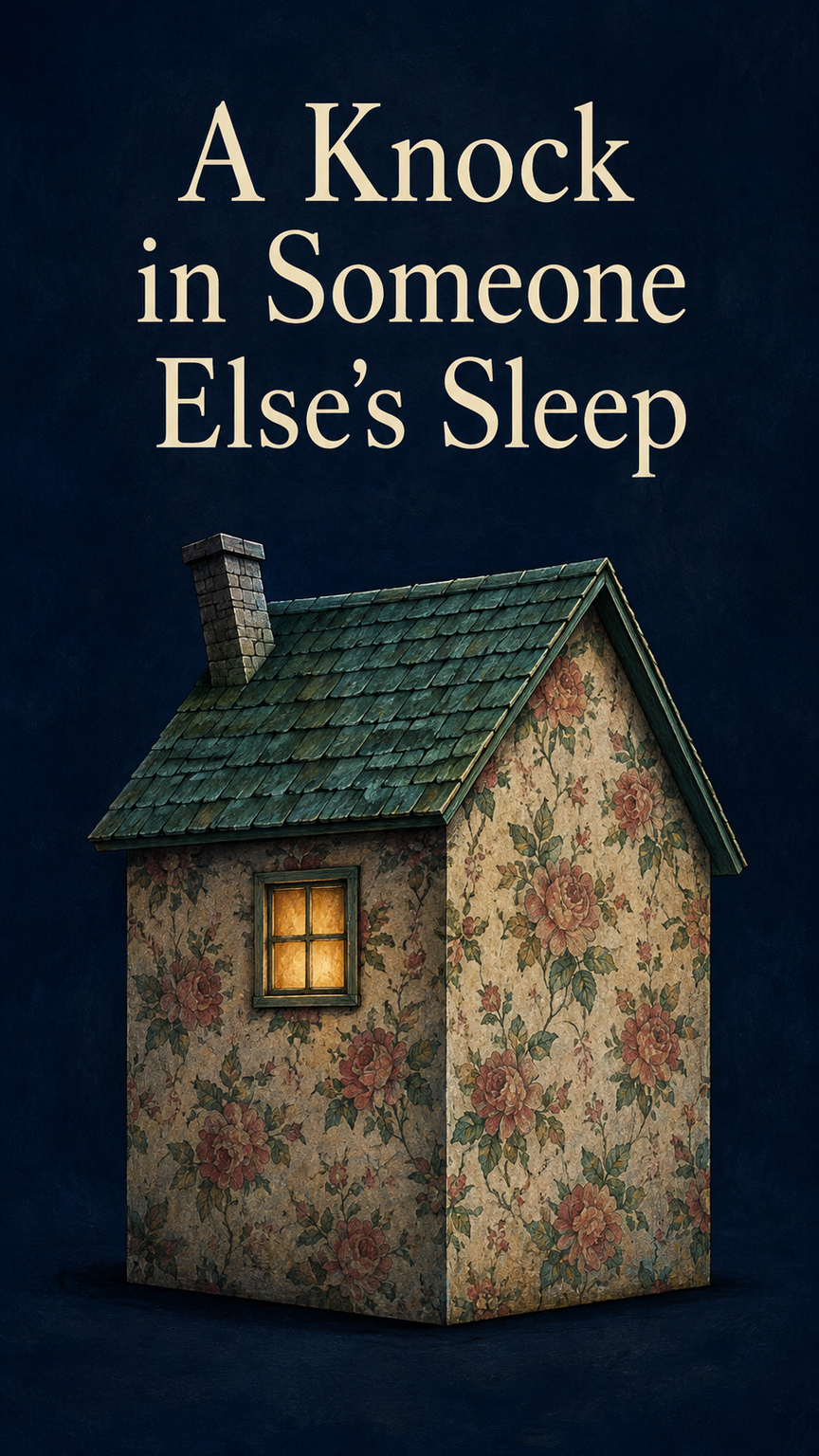
Cleo had almost reached the whale’s stomach when the stairs appeared.
She stopped on the bottom step. Above her, where there should have been a passage full of swallowed ships, stood a little house with green tiles and no door. The whale’s ribs supported its gutters.
“You’ve done it again,” she said.
The Entity had meant to wait until she finished exploring. But she was leaving in the morning, and the house had risen at the thought of it: every tile in place, the small chimney crooked to the left.
“Do you know someone who lived here?” it asked.
“You already asked. I said no.”
Cleo kicked the bottom step. It became a tooth, then a step again. She was nine, and on the previous two nights her dreams had accommodated anything the Entity put in them. This night she wanted the whale back.
It drew the house aside. The staircase dwindled to a ladder, which Cleo climbed, despite herself. At the top she pressed her face to a window.
The Entity felt her attention settle there. Far below her sleeping body, below the holiday cottages and the abandoned quarry, its own body lay pinched in a cavity no dream could enlarge. It could spend a night making skies for Cleo while the same narrow ridge of stone pressed between two of its living folds. Nothing it imagined moved that ridge.
“Who’s supposed to live in it?” Cleo asked.
“Garnet.”
“The girl.”
“Yes.”
“No. Still don’t.” She put her hand through the glass. “Why’s there wallpaper on the outside?”
“She was shut in, so she turned the house inside out.”
Cleo pulled herself through the window, leaving both shoes on the ladder. She liked to investigate rules. The Entity liked this about her, when it could remember to like something about her other than the possibility that she knew Garnet.
Once it had known nothing to ask for. There had been stone and the pressure of stone, a seep of warm minerals along its underside, the slow contraction by which its body fed. It could remember no entrance to the cavity. Something had enclosed it, or it had grown into an enclosure. That uncertainty had outlasted everything except the wish to meet something else alive.
Then humans cut into the hill.
They did not reach its prison. They came close enough for it to feel the quick separate insistence of their minds, and it poured itself toward them in welcome.
It had no word for welcome then. It gave them its body against the stone, its delight at their arrival, the whole length of its waiting. The first man’s mind filled with the clatter of a dropped chisel. Through the contact, the Entity felt his effort to find an edge to what was entering him. It mistook the effort for a reply and pressed closer.
By the time it withdrew, most of the people it had touched could no longer hold their lives together. It learned some of what that meant afterward. Children dreamed of a mother who could dress herself but could not recognize her kitchen; a father who woke certain he was buried, whose daughter sat with him while he found his bed again. One boy dreamed of the quarry foreman teaching him to tie his shoes, slowly, and then being unable to remember which shoe was his own.
The Entity had wanted company. Those people had already had company, and work, and kitchens they knew. It could not return what it had displaced.
The first child reached it during the last of those terrible attempts, asleep in a hut above the quarry. The child turned the Entity’s immensity into a staircase and ran up it. When the pressure became too great, the stairs sprouted cushions. She asked whether there was anything to eat at the top.
Her dream could change fast enough to receive it. Waking minds could not. Grown sleepers could not either; even the faintest approach met the same rigid distress, and it learned to stop. Among sleeping children its thoughts became things that could be touched, altered, or sent tumbling away. They were bewildered by it, sometimes frightened, often bored. They woke with their own minds intact.
It learned small approaches. A loose stair. A knock. It let them refuse.
Years passed before Garnet came. By then children had brought it windows, wheels, a name for rain. Garnet brought it rules.
“You make a house with no doors,” she had said, “and I get out. But I can only change one thing.”
She was seven. Her first house became a hat. She lifted it off her head and stood grinning under the sky.
The Entity made another, too large to be worn. Garnet turned it inside out. The wallpaper flowered on the outer walls and she found herself outside, with the bricks under her feet.
It had never thought of this. While its actual body lay unmoving, it held that inside-out house in amazement.
They took turns. Garnet built a house entirely of stairs, and the Entity changed which way was down. She accused it of changing more than one thing because there were so many stairs. For the remainder of that night she would allow it only bungalows.
Sometimes she arrived angry and did not want a game. Once she cried into a cupboard until it filled with water, then made the water salt because she had always wanted a sea of her own. She kept it in the cupboard for weeks. On other nights she described her day while the Entity practiced making the things in it. Its first boiled egg had a handle. Garnet liked it better that way.
She taught it to count years. It taught her nothing she could use at school. She complained about this without ceasing to come.
At twelve, she began losing whole rooms between one visit and the next. At thirteen, a floor it offered became floor and wall and the inside of her own mouth together. She could no longer let these all be true. She called for it to stop, and it withdrew so quickly that the house disappeared beneath her.
For a long time afterward her sleeping mind was still near. The Entity approached as faintly as it knew how, and felt her strain against even that. It left her alone. Other children had changed in the same way; being Garnet had not protected her.
Eventually she moved beyond its reach. A child who lived in her old room dreamed of helping carry out the last boxes. The Entity kept her house. It kept the cupboard with the tide in it, and the egg with the handle, and a room whose floor she had not yet managed to escape.
Cleo came back through the window and touched one of the wallpaper flowers.
“My Garnet does this with napkins,” she said. “She draws all the rooms, then folds it backward so everyone’s in the garden. It’s cheating because you’re meant to use a pencil.”
“What Garnet?”
“Next door. She looks after me on Tuesdays.”
“Is she thirteen?”
“No. She’s seventy-three.”
The house lost its roof. Cleo looked up at the exposed rafters, then at the whale’s ribs lifting and sinking above them.
“She’s old,” she said. “You said a girl.”
The Entity had counted sixty years. It had kept them somewhere quite separate from Garnet.
Cleo said she would tell her about the house when she got home. She was taking the early coach with her mother; by lunchtime they would be far from the quarry. The Entity would not be able to hear Cleo then, even if she fell asleep on Garnet’s lap.
“Can you tell her now?” it asked.
“She’s at home.”
“I know a way. If she’s asleep.”
It had discovered the way years after Garnet moved away, through a boy who wanted his absent brother to see a thing they had made. A child in contact with the Entity could find the sleep of someone they knew. They could take no piece of its mind safely; whatever they carried had to be remade from their own thoughts.
The boy’s brother had returned a rude drawing. The Entity still remembered the boy’s laughter as he reproduced it.
It had asked many children since then. Did they know Garnet? A girl of thirteen, with a gap where a tooth had never come? It had given them a description of someone who no longer existed in that form.
“How do I go?” Cleo asked.
“Think of finding her.”
Cleo put a finger into one nostril and considered. Beside the house, a landing appeared, with an umbrella dripping on its tiles. There was a brown door with a lock higher than Cleo could reach.
“That’s the old lock,” she said. “She doesn’t use it.”
The Entity could feel Cleo’s remembering, but nothing beyond the door. When she stepped through, the child would be in a part of sleep it could not enter. If she woke, the route would vanish.
“Tell her I kept the house she turned inside out,” it said.
Cleo knocked, waited, and went in.
The landing remained. The door shut. The Entity could no longer feel her attention on it.
Stone bore down between its folds. A thread of mineral water cooled along its underside. It examined the closed door, though there was no lock on this side to examine, no wood it could press against with its living body. It was waiting inside Cleo’s dream, in a house she had not wanted, beside a whale she had.
When she came back she was wearing enormous bedroom slippers.
“She says what’s in the cupboard?”
“The sea.”
“Oh. I said towels. She was cleaning a bathroom, so I thought she meant that sort of cupboard.”
The Entity opened the cupboard. A little tide ran across the floorboards and retreated, carrying a strand of weed.
Cleo crouched beside it. “Can we go in?”
“Tell her it’s the sea. She made it salt. Ask why she never came back.”
Cleo looked from the water to the door. “Then can we go in?”
“Yes.”
She left one slipper beside the cupboard. For a while the Entity watched water darken the cloth toe. It wanted to send the smell of salt after her, and the exact sound of Garnet’s laugh when she first stepped out of the hat. But those were its memories. They would reach Garnet with its weight behind them. It held them back.
Cleo returned without the other slipper.
“She says she did come back. She tried for ages, but you wouldn’t open up.” She sat on the floor and dipped her feet into the sea. “Did you not like her anymore?”
The Entity began to show her.
It gave her Garnet’s mind narrowing beyond its reach; the nights of approaching, drawing away, approaching again; the houses held ready afterward. They crowded around Cleo, small at first, then packed so closely that the whale became all roofs and chimneys. The same unentered room appeared in every window. Beneath it lay the waiting, as much a part of the Entity as the body inside the stone.
Cleo stood. The sea ran off her feet.
“I can’t tell her all that.”
There were more houses. The Entity had not understood until now how many nights she thought it had turned her away.
“Stop. I don’t know what you want me to say.”
It stopped. The houses hung around her. Between two roofs the whale’s tongue lay creased like an abandoned carpet.
“Make them go away.”
It took the extra houses away.
Cleo sat again, this time on the dry side of the cupboard. “She said other things. I forgot because you did that.”
The Entity waited while she picked a thread from the slipper’s toe.
“She drove buses,” Cleo said at last. “For years and years. She said to tell you about the bit where you turn around. At the end of the road. There was a house there that she always thought you’d like. I don’t know why. She didn’t say.”
Buses. Garnet had once made a bus whose top floor belonged to a different bus. The Entity had kept that, too. But somewhere she had held an actual wheel, stopped beside actual houses, and thought about showing one to it.
“What else?”
“I can’t remember.” Cleo pulled the thread until it snapped. “I don’t want to keep going backward and forward.”
It wanted to ask about every day Garnet had lived. It wanted the house at the turning place. It wanted to know if she still preferred eggs with handles. The questions arrived together, as its thoughts always did; choosing one felt like letting the others sink out of reach.
“Tell her I stopped because I was hurting her.”
Cleo looked at the places where the houses had been.
“Like that?”
“Worse. She couldn’t make it into houses anymore.”
“Will it do that to me?”
“It could, when you’re older. I’ll have to leave your sleep alone.”
Cleo was quiet. Then she said, “I’m going home tomorrow anyway.”
“Yes.”
She tried to put the wet slipper on. Its heel folded under her foot, and she kicked it into the cupboard.
“What do you want her to do?”
The Entity turned toward the room it had kept ready for sixty years. Garnet had been trying to turn its floor into something she could swim through. It remembered her standing ankle-deep in blue tiles, furious that the rest would not change.
It could send Cleo with instructions for finishing that move. It could ask whether Garnet remembered. But it wanted something it had never seen before: Garnet at the wheel of her bus, looking out at a house that might have pleased it.
“Ask her to make me a new house.”
“Then we’re doing the whale.”
“Yes.”
“And I’m allowed in the cupboard.”
The Entity tipped it gently onto its back. The sea rose to fill the opening, with room for Cleo to sit on the edge and dangle both legs when she returned. She inspected it, then went to the brown door.
It took her longer this time. Once, the remembered landing flickered. The Entity drew itself away from the edges of Cleo’s mind, afraid that its eagerness had become pressure again. The quarry, the cottages, the sleeping child’s small body remained where they were. The landing steadied.
Cleo returned carrying a toy bus she was still putting together.
“She made this. It’s the one she used to drive, except I couldn’t remember all the seats. She says put yourself in it.”
The bus had a silver bell. Cleo rang it three times before setting it down. As it grew, the Entity recognized the kind of vehicle children had shown it in their dreams. This one had a tear in the driver’s seat and a red cloth tied around the steering column.
“What did she say when you told her why I stopped?”
Cleo laid her hand on the bell but did not ring it.
“She didn’t say anything for a bit. Then she asked if I was all right. I said I was. Then she started making the bus.” Cleo pressed the bell once. “She told me about the egg, too. You made a handle so she could drink it.”
“Lift it. I thought it would be hot.”
“Well, she drank it.”
The Entity let that stand. Inside the bus, the driver’s seat warmed beneath its attention. It had no single shape to put there. It made a weight in the cushion, a place from which it might look out.
Around the bus Cleo built a room. Its ceiling rested on the roof, and the walls touched the windows. When she was finished, no door remained in either bus or room.
“You’re in a garage,” she said. “She says you’ve got to get the bus out. One change.”
The Entity considered turning the garage inside out. Garnet would expect that. It tried instead to imagine her driving a room.
It put wheels under the garage.
Cleo laughed as the whole room rolled down the whale’s tongue and out between its teeth. The bus went along inside it, and the walls stayed pressed to the windows.
“But it’s still in there.”
“Tell her I took the garage.”
“She’ll say you haven’t got out.”
“Tell her anyway.”
Cleo ran to the landing. The Entity waited in the driver’s seat, holding the room still. Through the windscreen it could see only plaster, close enough to touch. Yet it found itself arranging the weight in the cushion, trying a little to one side and then the other, as though Garnet might notice how it sat.
When Cleo returned, she was leading the whale. She folded one wall of the garage down, then climbed onto its head. It pressed its enormous face against the bus window, which softened and let the face through.
“She says you can take the garage, but you have to take the passengers.”
“Is the whale hers?”
“Mine. She said I could.”
The whale was wedged from cheek to cheek in the bus. There was no space to enlarge the seat without enlarging the garage as well. The Entity began to measure what would fit, then heard Cleo say that Garnet was waiting for its next move.
It changed the passenger seats into a sea.
The whale slid in. Its tail hit the bell, and Cleo whooped as cold water closed over the windows. The Entity held its place at the wheel. Beyond the plaster there would have to be a road; it asked Cleo to find out which way Garnet wanted to go.