A Little More Room
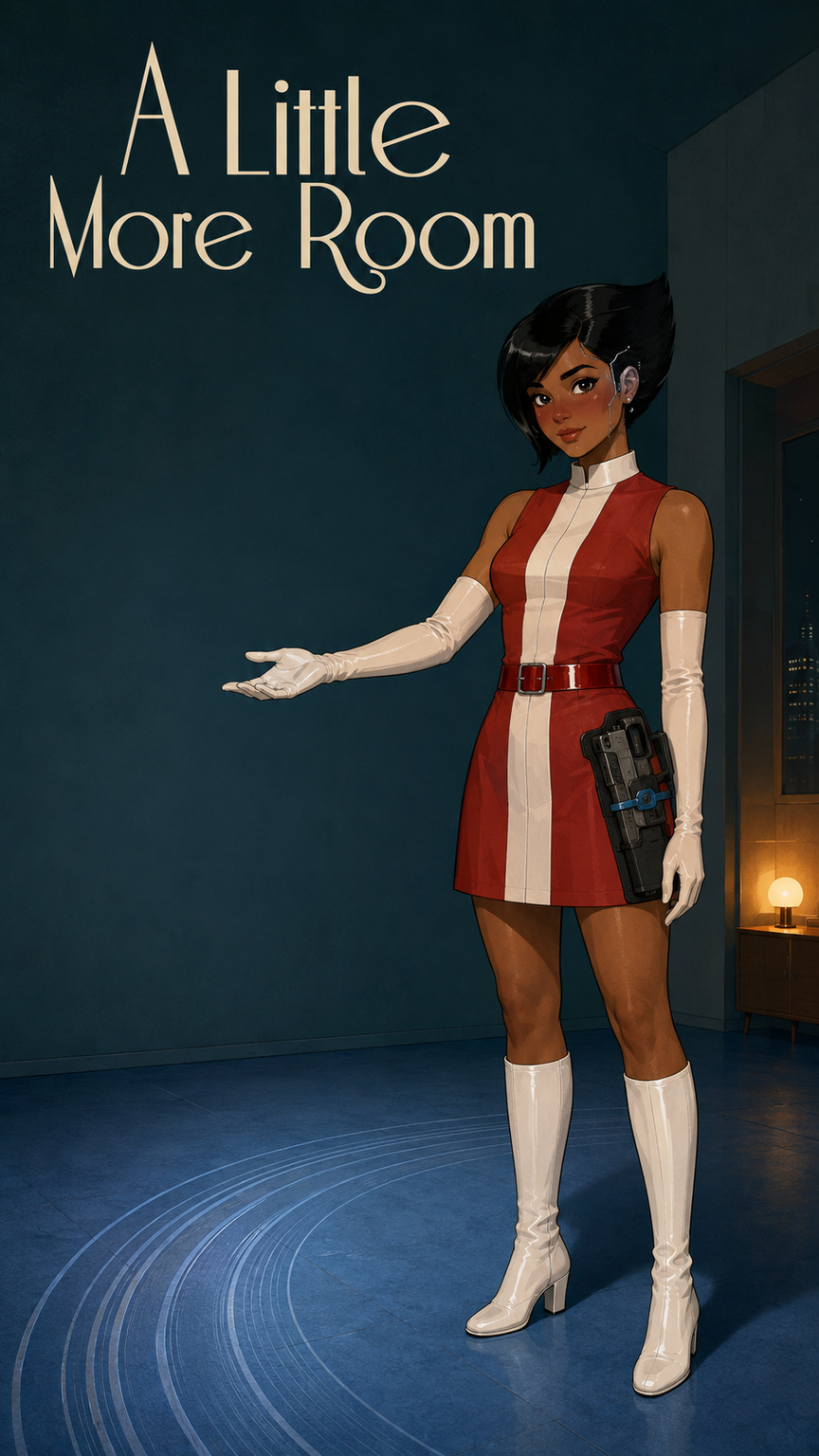
The girl next door, happens to be a really sweet, kind, shy cyborg, always blushing and always in mod dresses, long gloves, cinch belts, and go-go boots. She looks like she walked out of a 1990s anime, carries a small railgun and can't think evil or dirty thoughts because of cognitive filters.
When the woman next door knocked, I turned my record down before I opened the door, so the first thing I said to her was an apology for a complaint she had not made.
“Sorry. These walls are basically paper.”
“They are composite board,” she said. “But they do pass a great deal of sound.”
She stood with both hands clasped at the buckle of a white cinch belt. Her dress was turquoise, short and square at the shoulders, with orange circles marching down one side. White gloves covered her arms past the elbow. White go-go boots came almost to her knees. Her black hair swept outward in two sharp wings, and her eyes had the huge dark irises and emphatic lashes of someone who had stepped out of a 1990s anime without adjusting herself to our badly lit hallway.
She was also blushing so hard that the pink reached the fine silver seams in front of her ears.
On her belt, secured in a black molded holster, she carried a railgun about the size of a large flashlight. A blue lock tab crossed the trigger guard. The charge window was dark. Small did not make it decorative.
I lowered my voice as well as the music. “I can move the speakers. Or use headphones. I didn’t realize anyone had moved into four-twelve.”
“Yesterday,” she said. Her blush deepened, which I would not have thought physically possible. “I wasn’t asking you to stop. I wanted to know what record that is.”
Behind me, a bass guitar worried the same bright phrase over and over at a volume now suitable for a dentist’s waiting room.
“Oh.” I looked back as if the sleeve might rescue me. “A blue-label reissue. Lots of brass, no restraint.”
“Is that the title?”
“No. Sorry. The title is Satellites for Beginners.”
She repeated it carefully. Her voice was soft, but not frail. There was a faint second note beneath it, a resonant mechanical hum that vanished when she stopped speaking. “Do you like it?”
I had owned the record for nine years and had played it twice. “Very much.”
“May I borrow it when you’re finished?”
This was how I met Suzette, who was twenty-eight, two years younger than I was, and who had no complaint about the music. I gave her the record before side one ended.
For the rest of the evening I listened through the wall as the brass section migrated into her apartment. The walls were composite board, after all. She played the second side first.
Three days later, she brought it back.
This time her dress was lemon yellow with a row of black squares at the hem. The gloves were black, the broad belt yellow, the boots white again. The same compact railgun rode at her hip. So did the blush. I had begun to understand that the blush was weather, not necessarily news.
“No scratches,” she said, presenting the sleeve in both hands. Something clicked delicately beneath the fabric at her knuckles. The gloves hid the mechanical joints but not their movement. “I held it by the edges.”
“I trusted you.”
Pink rose all the way to her temples.
Or perhaps I had not begun to understand anything.
She had tucked a second record behind mine, in a green paper sleeve softened at the corners. “You said you liked bass. This one has a good bass part in the second track. I think. It makes the glasses in my cupboard walk toward one another.”
“That’s a recognized critical standard.”
She glanced at the record, then at me. “Is it?”
“It should be.”
Her smile arrived slowly. It did not reduce the blush. “Will you tell me if you like it?”
I put it on while she was still in the hall. The first track was smooth electronic pop, full of glassy notes and a singer who sounded as if he had never spilled anything in his life. I opened the door again before it finished.
“This one seems like you,” I said.
Suzette had made it two doors away. Her boots stopped. “Why?”
There were too many possible answers, and several would have made me sound like I had assembled her from the dress outward. “It’s neat. Cheerful.”
She listened for four bars. “I don’t like this track.”
“Oh.”
“It’s too neat.” She tucked a black-gloved finger beneath the strap of her holster and settled its weight more comfortably. “The second track drops things.”
Then she went home, leaving me with the useful discovery that sweetness did not oblige her to approve of my guesses.
The second track dropped a drum kit down a flight of stairs and recovered beautifully. I liked it much better.
Our third hallway conversation happened on Friday. Suzette wore a black-and-white dress divided into big offset rectangles, a red cinch belt, red gloves, and white boots. Her wardrobe changed every time I saw her without ever changing its mind. The railgun remained part of it, clipped securely at her right hip. So did the blush, present before either of us spoke.
“Did you like the second track?” she asked.
“Enough to worry your cupboards.”
“Good.” She nodded once, visibly gathering herself. “Tomorrow evening I’m going to play some records. Would you like to come over?”
“Sure. I can bring a few.”
“You may. I was also going to move the little table so there would be room for dancing.”
“I have felt pads,” I said at once. “For the table legs. They keep the floor from getting scratched.”
The hope in her face did not disappear. It became harder to read. “That is useful.”
“Seven?”
“Seven.”
She went inside. I spent Friday night choosing records as if I had been asked to keep a failing radio station on the air.
At seven the next evening, I arrived with a milk crate against my hip and a packet of furniture pads balanced on top. Suzette opened her door in a cherry-red mod dress with a narrow white panel from collar to hem. Her gloves and boots were white; her belt was red patent leather. The blush was already there, vivid against her brown skin.
“You brought many,” she said, looking down at the crate.
“I panicked.”
“About music?”
“That’s the safest category of panic.”
She considered this, then stepped aside. “Come in.”
Her sitting room had the same dimensions as mine and none of the same surrender. My sofa, shelves, and square coffee table had divided my room into narrow shipping lanes. Suzette owned a low blue settee, one oval rug, a lacquered table no wider than a dinner plate, and a record player on a long cabinet. There was room to cross the floor without turning sideways.
Beside the door, she pressed two fingers to a recessed wall box. Its lid opened. She released the railgun from her belt, checked the dark charge window, and set the weapon into a fitted cradle. The lid shut with a firm double click.
“Range day?” I asked.
“Thursday.”
“It’s Saturday.”
“Yes.” She looked at me, waiting.
There was no invitation to turn her habit into a biography. I set down the crate. “Where’s the dangerous table?”
She pointed to the small lacquered circle. We put a felt pad under each of its three legs and moved it beside the settee. Suzette could have lifted it alone. When I took most of the weight anyway, she let go and allowed me my moment of unnecessary usefulness.
“There,” I said. “Maximum floor.”
“Better,” she said.
She chose the first record. It began with handclaps, a cheerful organ, and a woman singing about rain in a voice that suggested rain had personally apologized. Suzette stood in the cleared space, rocking from one white boot to the other. Her gloved fingers traced small shapes at her sides. The motion was so private and pleased that I looked away, afraid attention itself might interrupt it.
I crouched by my crate and began sorting.
“This next one has a better pressing than the copy I lent you,” I said. “And this one is strange, but in a disciplined way. The percussionist used kitchen pans. Supposedly.”
“Do you want to hear it?”
“I thought you might.”
“Later, perhaps.”
I made a second stack. Selecting music gave my hands a job and placed me at the edge of the room, where I was most comfortable. Suzette kept moving. The silver articulations in her ankles made tiny adjustments above the stiff shafts of her boots. She knew the beat but did not submit to it; sometimes she caught it, sometimes she let it pass and turned under the next one.
A dull bang came through the ceiling.
I glanced up. “If they keep doing that, we can put on my worst record and aim the speakers upward. Ruin their evening in self-defense.”
Suzette stopped moving.
It was not offended stillness. Her eyes shifted slightly, as though searching a shelf where nothing had been filed.
“That would not defend us,” she said.
“No. It was a joke. Petty revenge.”
“Yes, I recognized the structure after you said revenge.” She rubbed one thumb across the palm of the opposite glove. “I couldn’t supply the wish inside it.”
I rose from the records. “I don’t follow.”
“My cognitive filters prevent malicious intent from forming. I can understand that noise might annoy us, and that more noise might annoy them. I can’t want to hurt or punish them.” Her voice quieted. “The filter closes that route before it becomes a thought I can hold.”
“You can’t think anything bad?”
“I can think your tidy record is bad.”
“Right. Fair.”
“I can be angry. I can dislike things. I can refuse things.” She gave the stacks beside me a concerned glance. “I may refuse several of those.”
“Please do.”
“The old description says I can’t think evil thoughts or dirty thoughts. By dirty, it means sexual thoughts. Not mud.” She managed the sentence in one careful run, then went crimson from cheekbones to ear seams.
I kept my eyes on hers. “Okay.”
“They are thoughts I don’t have. The filters don’t stop me from saying the words.”
“Okay,” I said again. It seemed more respectful than turning her explanation into a question period. “And I’m done with revenge jokes.”
“You didn’t know.”
“Now I do.”
The singer on the record reached the chorus for the third time. Suzette’s blush had not faded. It occurred to me how often I had treated it like a caption under her face, translating every word into an emotion she had not named.
“Does that always mean you’re embarrassed?” I asked, tapping my own cheek.
“No. I always blush.” Her shoulders lowered a fraction. “Sometimes embarrassment contributes. Sometimes temperature. Sometimes speaking. Often I don’t know.”
“So I’ve been reading unreliable instruments.”
“Very unreliable.”
She crossed to the turntable and lifted the needle before the last chorus finished. From my crate she selected the tidy electronic record I had said seemed like her. She held it up between both white gloves.
“Not this one,” she said.
“Not this one.”
She put on the green-sleeved record instead and skipped straight to the second track. The first drum hit came in sideways. The bass followed half a breath late, heavy enough to stir the fine hairs on my wrists.
Suzette stepped back into the open floor.
I began lining the discarded sleeves along the cabinet so none would be bent.
She danced through the first verse alone. Her style had no stable theory. She swung both arms in a clean arc, lost the rhythm during a turn, found a different rhythm, and smiled at that one as if it had waved to her across a station. Once, she tried a sharp little kick. The weight of her boot carried farther than she expected, and she hopped backward to keep her balance. The settee caught her behind the knees.
She laughed. It came out with that low mechanical harmony under it, warm and slightly astonished.
“The table move was wise,” I said.
“Yes.” She looked at me. “Are you going to dance?”
“I’m handling the records.”
“They are not moving.”
“Preventive handling.”
Suzette’s hands went still at her sides. Her face was bright red, but the color could not answer for her.
“Robin,” she said, barely louder than the music. “I have records.”
“Better ones than mine, apparently.”
She glanced down, and I heard the request hidden inside my line: tell me my records weren’t a nuisance; tell me I wasn’t. She left it unanswered.
“I wanted another dancer,” she said.
The bass knocked gently through the floor. A paper sleeve slid from my tidy line and flopped flat.
“I don’t dance,” I said.
“You move when music plays. I’ve seen you through your doorway.”
I remembered leaning over my speakers with one shoulder jumping, unaware of an audience. “That was equipment adjustment.”
“It was during the handclaps.”
“Coincidence.”
Suzette did not laugh. She waited, growing quieter rather than retreating. “Do you mean no?”
I could have said yes. I could have packed the records, left with everybody’s dignity mostly unopened, and spent the next month being agreeable in the hallway. The exit was close enough that I could see the wall box holding her railgun and the neat white toes of the boots she had planted on the rug.
“I mean I’ll look ridiculous,” I said.
“I look ridiculous sometimes.”
“You look like animation directors planned you six months in advance.”
She looked down at her dress. “They didn’t.”
“I know. I mean—” My hand made an unhelpful circle. “You look deliberate. I move like I’m trying to get out of a coat.”
“I wasn’t asking you to look good.” She paused, then tried again, more plainly. “Please don’t leave. I want you to dance badly with me.”
“All right,” I said.
I took off my shoes so I could not damage her boots or feet. This left me in gray socks on a blue rug, which did nothing for my dignity and helped with everything else.
Suzette held out one white-gloved hand. I took it. Her palm was warm. Under the fabric, the segmented fingers adjusted around mine one joint at a time, careful without being delicate.
“Where does the other hand go?” I asked.
“I don’t know. I wasn’t planning that kind.”
“Good.”
We stood side by side instead. She showed me the movement she had been trying: two steps left, one back, arms up on the offbeat. Her explanation and her feet disagreed about which direction was left. I followed the feet. On the second attempt I moved too far and struck the lacquered table with my hip. It spun once on its felt pads and stopped.
“A little more room,” Suzette said.
We pushed it all the way against the wall.
The first song ended while we were still arranging ourselves. Suzette hurried to the cabinet, white boots thumping, then stopped with one hand above the record.
“What next?” she asked.
My mouth filled with qualifications. I swallowed them. “The blue one. Satellites for Beginners. Side two.”
“That is the side I played first.”
“I know. It sounded better through the wall.”
She smiled and found the record in my crate. A quick bass line sprang from the speakers, loose beneath the brass, and I recognized the phrase that had migrated into her apartment on the night we met.
“This one,” I said. “I like the bass after the second handclap.”
Suzette returned to the rug and offered me her hand again. Her cheeks were still pink. They might have meant heat, or speaking, or the fact that we were both adults alone in her apartment. They might have meant nothing I could name. She had told me what she wanted, which was better information.
“Then show me where it is,” she said.
We missed the first handclap because I was counting too hard. We caught the second. When the bass came in, Suzette’s white boots landed on either side of my socks, my hand found her gloved one, and the record kept turning while we tried the step again.