A Little Winter for Sale
As a traveler, you've been exploring the desert for days, before coming upon a city so far from water, nestled against a mountainside. You find that in the mountains cave, is an ice dragon far from home, enjoying being paid to simply sell small bouts of it's power
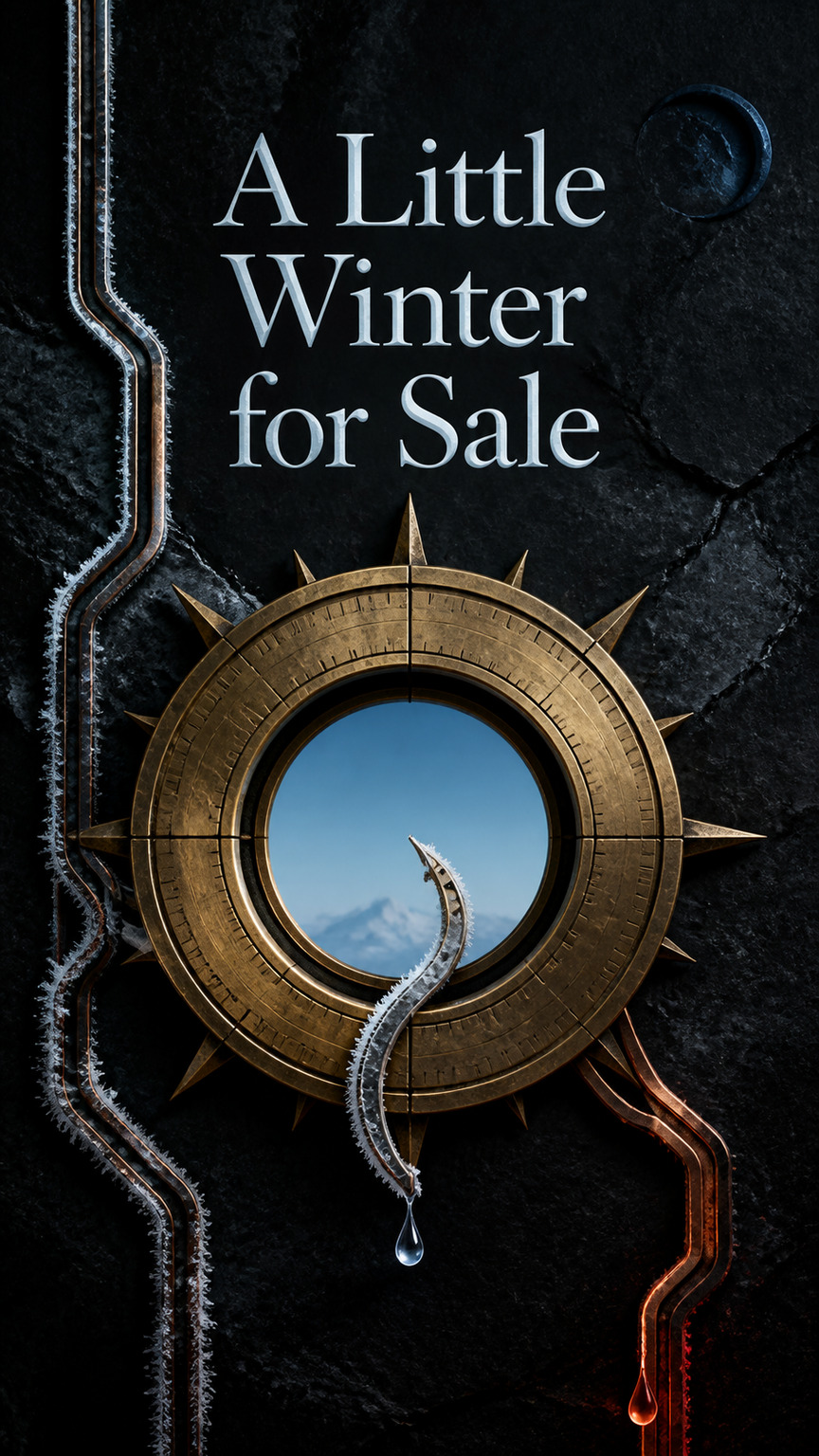
On the fourth day beyond the last mapped cistern, I found a city where no city had any right to be.
It clung to the lower face of a black mountain, pale walls crowded one above another in the narrow mercy of its shadow. Terraces flashed with copper. A line of green trees ran through the middle of it, offensively alive.
I checked my map, though I had checked it twice since dawn. No river. No spring. No lake blue enough to justify a goat, let alone five hundred roofs. Only the mountain, marked by an earlier surveyor as the Black Shoulder, and a warning that the western salt road ended in broken country.
My water skin gave me one mouthful. It tasted of leather, hot brass, and poor decisions.
Behind me, the southern sky had thickened to the color of a bruise. Glasswind. Even at that distance I could see the high glitter where grit turned in the sun. I had watched it growing all morning and continued west because I was Tair Ked, route surveyor, and because turning back had always felt like asking permission.
I took out my sunwheel. Its brass rim lay warm and familiar in my palm, its silver heart balancing the needle so delicately that my pulse made it tremble. Five years of bearings were cut into the outer rings in my own cramped hand: salt pans, wells, safe noon shadows, three roads that merchants insisted did not exist until they needed them. With the sunwheel and a clear horizon, I could earn water in any settlement worth reaching.
Without water, I had until noon to become a cautionary engraving on somebody else’s instrument.
I walked toward the impossible trees.
The gate stood open. White cloth had been tied over its ironwork against the coming wind. A woman in a dust veil took one look at me, held up a finger to silence whatever proud idiocy I was about to say, and put a clay cup in my hands.
The cup sweated.
I stared at the droplets running over my knuckles.
“Drink,” she said.
The water was so cold it hurt my teeth. I drank too quickly, stopped because she pinched the rim down, then drank again when she released it. The desert inside me contracted around that cup.
“Price?” I managed.
“After you keep it down.”
She poured a second measure, smaller than the first, and opened a narrow ledger. “Name?”
“You give water before asking that?”
“I asked after. We are very strict.”
“Tair Ked.”
She wrote it. Beside my name she marked the two measures with a square of blue chalk.
“Yara Mesk,” she said, tapping her own chest. “Waterkeeper. Those are on recoverable civic hospitality credit, at ration price. You can pay in coin or work when your hands stop shaking.”
My gratitude cooled. A debt entered in ink was still a hand around the ankle, however politely offered.
“I can pay now.”
“Your purse may be steady. You are not.” Yara corked the jar. “There will be work soon enough. The glasswind is early.”
Across the city, shutters were closing in a rising clatter. Above the rooftops, thin copper channels descended from the mountain, some beaded with condensation. I put two small coins on her ledger anyway.
She pushed one back. “That is double.”
“For speed.”
“Water does not become more watered because you are impatient.”
She recorded the first coin, then recorded the returned one. This seemed designed to annoy me with accuracy.
I followed her uphill.
Qarsis was not sustained by a miracle. It was sustained by several insufficient things lashed together with copper, lime, and aggressive bookkeeping.
Yara showed me the flat fields east of the wall, where hundreds of sloped glass panes drank damp from hot brine spread beneath them. The sun warmed the pans; vapor gathered under the glass and ran through clay gutters into covered cisterns. White crust furred every seam. Farther upslope, stone throats waited to catch the rare rain that struck the Black Shoulder and tried to escape.
“Stills and runoff give us about half an ordinary day,” Yara said. “More in a kind season. Less in a year with a sense of humor.”
“And the other half?”
She laid her palm on a copper pipe running down the lane.
It was cold.
Under its greenish skin, water ticked and whispered toward the lower cisterns. The return pipe beside it was warm and smelled faintly of salt.
“The mountain seeps brine,” she said. “Too bitter to drink. We lift it to the exchanger. Six batches a day give roughly four hundred litres each. Add the stills, stored runoff, and cistern carryover, and five hundred people receive twelve litres apiece.”
“Six batches of what?”
“You will ask less suspiciously if you drink another cup.”
“I ask everything suspiciously.”
“Yes. I had begun to notice.”
We climbed through terraces where covered jars stood at every doorway. No fountains splashed for beauty. Laundry water ran into garden troughs. A child somewhere behind a shutter complained about being called indoors, but no one wasted breath arguing with the darkening sky.
The cold pipe led toward a cave cut into the mountainside above the last houses. A stone arch at its mouth had one word carved into it: COLDMOUTH. Inside, channels crossed the floor toward a copper apparatus taller than I was. Brine filled a shallow enclosed basin. Ribs of hammered metal clasped it, all connected to a flared horn that pointed into the dark.
My suspicion, deprived of any sensible target, found a dragon.
Urumet lay beyond the exchanger on a shelf of black stone. Slate-blue scales overlapped from its long muzzle to the folded hooks of its wings. Hoarfrost edged every ridge. It could have crushed the copper horn under one foreclaw. Instead it was holding a square of paper delicately between two claws and reading it with an expression of profound injury.
“This receipt,” Urumet said, “does not include the grit surcharge.”
A thin clerk on the safe side of the exchanger consulted a slate. “The grit has not yet reached the intake.”
“I can taste tomorrow’s grit from here.”
“It is not tomorrow’s batch.”
“Then you may come back tomorrow and discover that foresight costs extra.”
Yara leaned toward me. “Urumet likes invoices.”
“Invoices,” the dragon said without looking up, “are civilization made portable.”
The clerk added a line. Urumet read it, made a pleased sound deep enough to ripple the brine, and pressed one clawtip into a pad of blue wax. It stamped the receipt with a neat crescent.
“Fourth stroke,” Yara said. “Four-count standard. Exchanger loaded and gates checked.”
The clerk pulled two levers. Brine flooded the copper ribs. A small bimetal tongue in the regulator lifted across a numbered slot.
Urumet rose.
Cold did not come from the machine. It came when Urumet opened its jaws and breathed one narrow, silent ribbon into the horn.
Yara counted aloud.
At one, frost raced over the copper ribs.
At two, the cave air turned white and my damp sleeves stiffened.
At three, clear ice thickened inside the basin while cloudy, concentrated brine squeezed through lower slots.
At four, the regulator tongue curled across the aperture. Urumet shut its jaws. The cold ceased.
For a moment the cave held its breath. Then drains opened and the bitter remnant hissed down the warm return channel. Workers behind the casing loosened the clean ice in slabs. Desert heat would melt those into drinking water before they reached the cisterns.
Along Urumet’s jaw, a line of hoarfrost had vanished. Heat shimmered faintly above its scales.
“Four today,” the dragon said. “Two remaining.”
The clerk hesitated. “The dye works asked whether a seventh might be reserved. They will pay the grit rate.”
“No.”
“Double.”
“Still no, but more offensively.”
Urumet settled back on the shelf. “Six strokes, then I spend the night shedding the heat. A seventh is bad for me, bad for the exchanger, and worst of all, unpriced by any responsible schedule.”
That last reason seemed to cheer it.
The clerk passed payment through a hatch: small coins, a paper twist of red pepper sweets, and a freight ledger. Urumet counted the coins twice, popped a sweet between its teeth, and opened the ledger to a page marked with northward routes. Its pleasure was so plain I felt foolish for having come uphill prepared to discover chains.
“You are not from here,” I said.
Urumet turned one pale eye on me. “Neither are you.”
“The frost suggested it.”
“The manners confirmed it.”
Yara made a noise that might have been a cough.
Urumet licked pepper sugar from one claw. “There is an ice shelf far north of every road on that ledger. I left it because I wished to leave. I work here because I like precise jobs, small luxuries, and customers who can be taught to fear amendments.”
Its claw rested on the northern page.
“I can enjoy Qarsis and miss home,” it said. “Even water manages to be more than one thing.”
The first grit struck the cave arch with a sound like dry rain.
The glasswind arrived all at once.
Daylight went copper. The mountain vanished behind its own dust. Wind drove shards of pale grit against the stone hard enough to spark, and the city below became a confusion of ropes, slamming shutters, and cloth snapping loose from the gate.
Yara ran for the exchanger controls. The clerk dropped the freight ledger and threw a cover over it. I had just bent to catch the northern page when something cracked above us.
A stone came through the outer screen.
It struck the regulator casing with a bright metallic snap. The bimetal tongue spun past my boot in two pieces.
Yara closed the brine gate. The basin shuddered as its flow stopped.
“Nobody touch the horn,” Urumet said.
The humor had gone out of its voice.
Yara opened the casing. The regulator’s brass frame had buckled inward. One half of the silver-backed tongue remained trapped beneath it, curled like a dead leaf.
“Can you aim without that?” I asked.
“Yes,” Urumet said. “I can also put my foot through your chest with admirable accuracy. Neither is relevant to whether it is safe.”
Yara traced the split with one finger. “Without a regulator, the stroke can freeze the feed throat before the brine clears. Pressure bursts the ribs. We lose the batch and perhaps the exchanger.”
“The two strokes are contracted,” Urumet said. “They are not contracted through broken equipment.”
Another impact rang from outside.
The glass still field had disappeared under moving dunes. Yara sent the clerk down with orders to seal the cistern vents and count every covered jar. When the clerk was gone, she stood very still beside the ruined regulator, doing figures against her thumb.
“Four thousand two hundred litres in emergency reserve,” she said. “A little more in household jars. The final two batches would add about eight hundred. Enough for one reduced day while the storm passes and we uncover the stills.”
“Without them?”
“Not enough without cutting everyone below safety, and not enough for the clearing crews.”
“A replacement?”
“Twelve caravan-days away, once caravans move.” She looked at my hands.
No. She looked at what I held.
I had drawn the sunwheel when the sky darkened. Its needle lay folded into its case, but the brass-and-silver center shone against my dusty palm.
Yara did not reach for it.
“May I examine your wheel?” she asked.
I closed my fingers.
The instrument had carried me across five years of country. Every calibration was mine. Every nick in its rim recalled a place where I had been thirsty, lost, paid, or right when a caravan master had been expensively wrong. It was not merely metal. It was proof that I could leave any obligation behind if I walked far enough.
“Why?”
“The heart is paired brass and silver, pressure-balanced. I could cut a regulator tongue from it.”
“And the wheel?”
“Would never take a true bearing again.”
The wind screamed across the cave mouth.
I thought of twelve litres multiplied by five hundred closed doors. I thought of the cold cup whose debt had irritated me more than dying alone would have. The answer came out before fear could make it smaller.
“Take it.”
Yara kept her hands at her sides. “At what price?”
“None.”
“That was not my question.”
“It is mine. I give it. You use it. No debt.”
Urumet’s tail struck the stone once.
“Absolutely not.”
I turned. “It is not yours.”
“Correct. That is why I object to your attempt to make its price everyone else’s problem.”
“People need water.”
“And therefore Yara may ask to buy your tool. She may not seize it. I may choose to complete two jobs. I may not be squeezed into a seventh. Emergency does not turn consent into a decorative flourish.”
“I consented.”
“To loss,” Urumet said. “Very grandly. You have not consented to being paid.”
I laughed once, because anger and fear had crowded everything else out of me. “Why should that concern you?”
Urumet drew the freight ledger from under its cover and tapped the northern page. “Because I am a professional.”
Yara set the broken regulator pieces on a workbench. Beside them she placed a small saw, a file, and her open ledger.
“If I cut the heart,” she said, “the city owes you its replacement value. You also lose time and earnings. Name those.”
I wanted to say nothing. Nothing was clean. Nothing could be refused later, called in, or held over me. If I walked out stripped of my livelihood, I could at least tell myself the loss belonged entirely to me.
Then I looked at Urumet’s blue-stamped receipts lined in a tidy stack. The dragon did not look owned. It looked recognized.
I opened my route book to the page where I had priced a new survey-grade sunwheel the year before and decided mine had another decade in it.
“A wheel of equal balance,” I said. My throat tightened around the number. “Delivered at city cost to the freight shelter beside the split-stone well, eight days up the existing north caravan road. Twenty days’ route wage for delay. Another twenty to recut my recorded bearings. Provisions to the shelter and while I wait there. I do not begin new survey work until the replacement is in my hands.”
Yara did not flinch. She worked the sum, showed me each line, then turned the ledger around.
“Fair,” she said. “The city agrees. Do you?”
The word weighed more than sacrifice.
“I agree.”
I signed Tair Ked beneath the blue square that had begun with two cups of water.
Only then did I lay the sunwheel on the bench.
Yara dismantled it with the care of someone preparing a body for burial and the speed of someone who had no time for grief. She freed the paired heart, marked a narrow curve against the surviving regulator half, and cut. The saw made a thin, intimate sound.
My five years of bearings fell still.
I did not look away.
Yara filed the new tongue, riveted it into the buckled frame, and tuned its resting angle by fractions against the numbered slot. I held the lamp. Urumet watched from beside the horn, correcting the alignment twice and refusing it a third time until Yara adjusted the stop.
Yara bolted a calibration strip alongside the tongue. One end went into warm return brine; against the other she packed shavings from the fourth batch of ice. As she moved the strip through four marked temperature steps, the paired metals bent the tongue across the slot. She warmed the casing, watched it return, then repeated the bench test.
“That matches the old travel,” Urumet said. “I accept Yara’s calibration.”
“I accept the repair for the two remaining contracted strokes,” it continued. “At the previously agreed grit surcharge. No extension.”
“The city agrees,” Yara said.
The three of us signed separate lines.
Then Urumet looked at me. “I also require a route surveyed north. Not a rescue. Not an escort. A commercial road for letters and light freight. The first leg requires no surveying: you follow the marked caravan road to the split-stone well and carry one letter. Your new wheel travels there on the first northbound freight after the road opens. Beyond the well, you survey only after it arrives.”
“The western salt road is my commission.”
“The western salt road is under several tons of ambitious glass.”
That was true.
Urumet pushed a small stack of its own coins across the bench. “First installment. You may refuse. You may counter.”
I named my weekly rate.
Urumet countered by adding meals but subtracting pepper sweets, which it called a specialist expense. I asked for half the delivery bonus in advance. Urumet asked what guarantee I offered.
“Five years of bearings,” I said, touching the empty rim of my sunwheel.
“Temporarily converted into municipal plumbing.”
“The best routes become infrastructure eventually.”
Urumet’s teeth showed. It stamped our receipt.
I read the handoff and start conditions back from it: known road first, letter delivered at the freight shelter, replacement wheel received there, new bearings afterward. Only then did I add my signature.
Yara loaded the exchanger.
For the fifth stroke, she counted and I watched the new tongue curl exactly across the fourth mark. Clean ice filled the basin. Concentrated brine drained away. Heat shimmered more strongly above Urumet’s back.
For the sixth, Urumet paused with its jaws at the horn.
“Brine gate?”
“Open and checked,” Yara said.
“Outlet?”
“Clear.”
“My fee?”
“Entered, including grit.”
Urumet breathed.
At four, the new tongue closed the aperture. Urumet stopped. No seventh stroke came. No desperate exception. Just the crackle of nearly four hundred litres of clean ice releasing from copper while the storm battered itself against the mountain.
The last hoarfrost along Urumet’s wings melted into dark beads.
“Sold out,” it said, and lay down with a sigh that stirred snow-dry dust across the floor. “Come back tomorrow.”
The glasswind spent itself by the following afternoon.
Urumet’s recovery had not taken that long. By dawn the heat shimmer above its scales was gone and hoarfrost had returned along its jaw. It pronounced the night’s shedding complete, then declined to discuss fresh work until the exchanger intake had been cleared and inspected.
Qarsis drank ten litres per person while the storm lasted. The sealed cisterns held. The final eight hundred litres gave the clearing crews enough to work without stealing from the old, the sick, or the small. When the sky cleared, people swept glittering dunes from the still panes, flushed grit from the gutters, and spread brine beneath the glass again.
By sunset, the first distilled drops were ticking into clay channels.
Yara gave me another cold cup. She opened the ledger before I could object and drew a line through my blue square.
“Hospitality credit paid on arrival,” she said. “This cup is included in your northbound provisions.”
“So the city is handing me water it already owes me.”
“You are learning civic finance.”
“It resembles hospitality performed by very patient ink.”
“That is the nicest thing anyone has said about my work today.”
My ruined sunwheel fit strangely in its case. The outer rings and five years of marks remained, but its center was an empty circle. Through it I could see a slice of the northern sky.
Urumet gave me a letter wrapped in waxed cloth. It bore no grand seal, only a blue claw crescent like the mark on a receipt. With it came a freight list, three pepper sweets for the road, and a warning that all three were separate items and only two were billable.
“Will you go back if I find the route?” I asked.
Urumet considered this while fitting coins into a little stack.
“Perhaps I will visit. Perhaps freight will travel better than I do. Perhaps someone from the ice will come south and complain about my prices.” Its pale eye narrowed happily. “A road creates choices. That is what I am buying.”
So I left Qarsis along a caravan road already marked by stone stakes, with the city’s signed promise to put a new sunwheel on the next freight caravan, Urumet’s first installment in my purse, and its letter tucked against my ribs. Eight days north, I would meet the wheel at the freight shelter. Only beyond that known road would I start cutting new bearings.
The Black Shoulder dwindled behind me. Below it, the still fields shone clean again. The copper return pipe carried bitterness downhill, the cold pipe carried drinking water, and high in the Coldmouth a fully recovered dragon had gone to bed after an ordinary day’s accounts.
For the first time in years, I could not cut a new bearing.
I had never been more certain what I was walking toward.