A Lock on the Inside
After your old master threw you out, you managed to convince another archmage to take you on as an apprentice. Their style is very different, much nicer and way more lenient. When you told them how your old teacher treated you, they were utterly horrified.
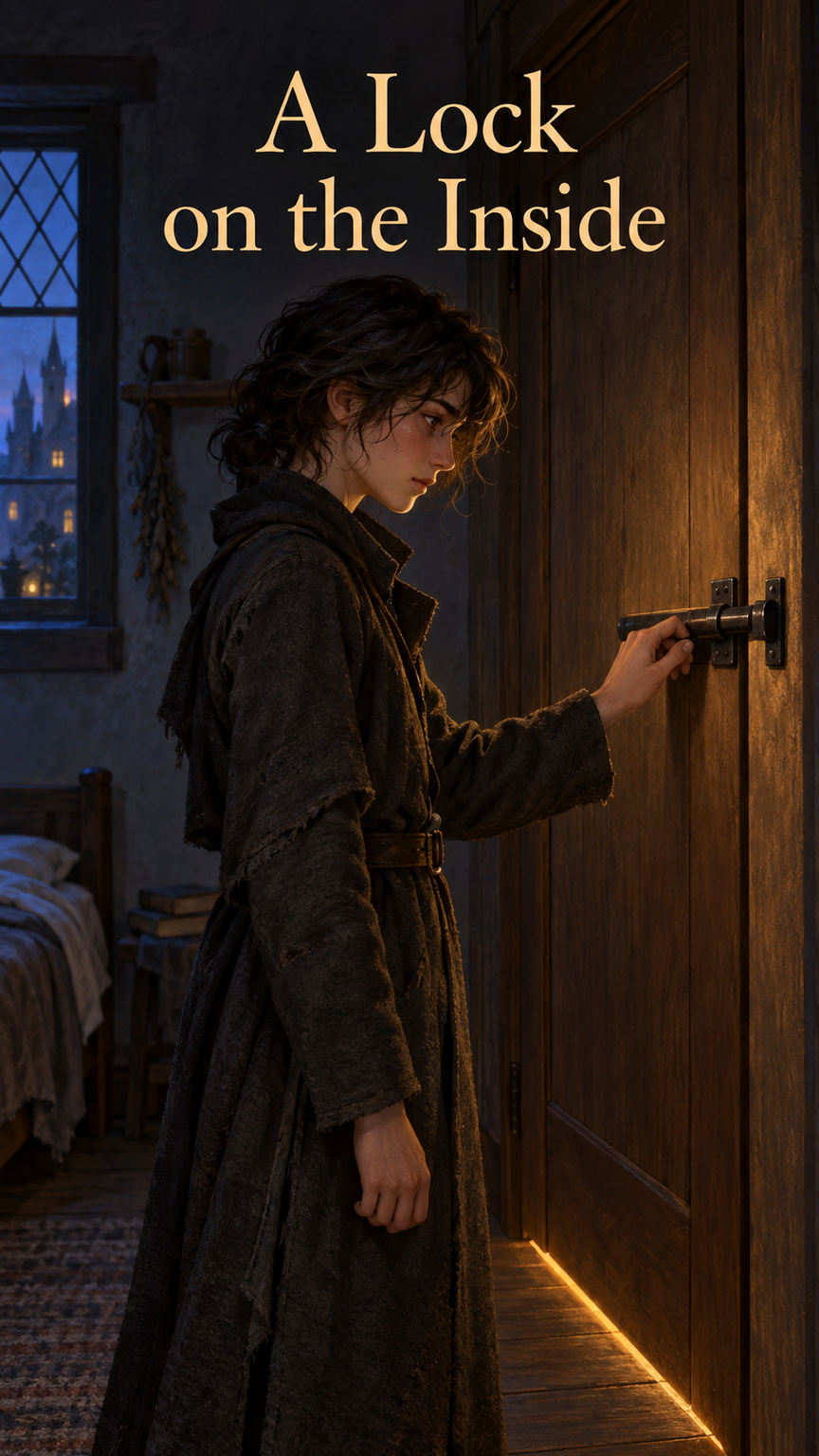
Kethra put the key in my palm before she asked me to prove anything.
It was a small iron key with a square bow, warm from her pocket. I turned it over twice, looking for a mark that would tell me which work it bought. Kethra waited. Her eyebrows rose.
I knew enough of the college hand to understand blunt nouns and warnings. Her quick grammar still escaped me, so she took up the slate that hung from her belt and wrote, in narrow white strokes: Your room. Second stair, last door. The bolt is on the inside.
“For the trial?” I asked.
She nodded.
“How long is the trial, Archmage?”
She wiped the slate with the side of her fist. Seven days. Then we decide about the next seven.
I had spent three mornings outside her workroom with my petition folded to a strip and tied with cord, the paper soft at every crease. It listed the forms I could copy, the warding inks I knew how to grind, the hours I was accustomed to keeping, and the meals I did not require when work ran late. I had rehearsed the part that mattered most.
“I can repay lodging through service until my voice is fully restored. I don’t expect a stipend, and if my first week is unsatisfactory, I will leave without dispute. My former master said I was quick once I understood the cost of mistakes. I can also scrub floors, tend fires, carry coal, and sleep in a workroom if the college has no proper bed to spare.”
Kethra read my mouth. She was mute, not deaf, though I had made that mistake during our first interview and earned a look sharp enough to pare bark. Now she lifted one hand and signed, slowly for me, “Enough.”
Then she pointed down the passage.
“Workroom?”
She shook her head and wrote, Food.
That was the first item in the account: one key, one week’s lodging, one midday meal, not yet earned.
The college kitchen had no ceremony in it. A pot of onion stew sat near the banked fire. Kethra ladled two bowls, saw me watching how deeply she filled mine, and added another spoonful. On the table were a green jar of pickles and a red jar of something hotter.
She pointed to both and signed, “Choose.”
“Whichever is already open.”
Both were open.
I chose green. Kethra pushed the red jar beside it anyway, a small crease at one corner of her mouth. I could not tell if this was humor or an examination of decisiveness, so I ate one of each. The red one made my eyes water. Kethra passed me the water jug and did not pretend not to notice.
Afterward she wrote, Lesson at second bell. Until then: room, walk, sleep. Do not polish the stair rail.
I glanced at the rail. I had only rubbed one thumb over a patch of tarnish.
Her crease deepened.
The room was larger than the cupboard I had proposed and smaller than anything so costly had a right to be. It held a narrow bed, a washstand, a peg, a table, and a window overlooking a roof crowded with rain-dark chimneys. The door had a keyhole on the corridor side and a plain iron bolt on mine. I shut myself in, slid the bolt, slid it back, and tested the handle. Then I opened the door and checked the passage. No outer bar. No staple for one.
There would be other means, of course. An archmage did not need a piece of iron to keep me where she wanted me. Still, I put the key in the inner pocket of my coat rather than my bundle. The distinction seemed worth recording.
I did not sleep. I folded my spare shirt into a tighter square, washed the road grit from my cuffs, and arrived at the workroom before the first stroke of the second bell had finished.
Kethra’s workroom was low-ceilinged and bright. Shelves held coils of speaking rail, chalk wrapped in paper, copper dishes, waxed thread, and brass nodes in fitted wooden boxes. Nothing matched the ornate apparatus I had imagined from an archmage’s rooms. On the central bench, she had set out one lamp with a clean wick, one palm-sized node, and a slate ruled into three boxes.
She touched two fingers to her throat, then pointed at me. In the first box she had written Voice today?
“Usable.”
In the second: Call limit?
“As many as required.”
She turned the slate toward herself, considered my answer, and drew an enormous zero with a throat underneath it. Then she crossed the zero out so hard the chalk squeaked.
“I have no set limit,” I amended. “My former training did not use one.”
Kethra wrote One in the third box.
I understood. A modest first test, with more available if I did well.
She taught the field signs next. A flat hand turning upward meant yes. One finger held across the wrist meant wait. Crossed hands meant stop. I knew the shapes, but Kethra made me repeat them until I stopped ornamenting yes with the little deferential dip my former master had required.
For stop, she crossed her hands once, cleanly. I straightened without meaning to, then copied it.
She pointed at my elbows and shook her head. I had made it too small. On my second attempt I held the cross at chest height.
She nodded, then tapped the lamp.
The exercise was no grander than the room. Kethra chalked a short geometry around the wick, laid two fingers beside the brass node, and set the registered name where I could read it: Practice Wick, Take Light. I was to touch the same node, authorize the cell with yes, and speak the whole name on one breath after her ready sign. Her shaping would supply everything but the living call. If I used wait, she would hold. If I used stop, she would end the cell.
She was still drawing the last of this on the slate when the node warmed beneath my fingertips. I gave yes at once.
Kethra pulled her hand away.
The warmth vanished. I snatched my own hand back and said, “I’m sorry.”
She signed too quickly. I caught before and finished and nothing between. Seeing my confusion, she wrote, You agreed before I finished explaining.
“I understood the task.”
Did you know the name?
“Not yet.”
She waited.
“But I knew I would agree.”
Kethra stared at me, then erased the entire cell with a felt block. Chalk dust clouded over the unlit wick. She redrew the geometry from the beginning.
That unsettled me more than a reprimand would have. The wasted work went nowhere in the account. She neither charged it to me nor named a way to repay it.
When the cell was ready again, she had me say the registered name without a link. The first two words came easily. On Take, something rough caught low in my throat.
Kethra’s hand rose: wait.
“Dust,” I said. “It has been like that since the road.”
She pointed to the water cup.
I drank. The water was cool enough to hurt. “Ready, Archmage.”
She touched her throat and gave me a questioning look.
“One call is well within my capacity.”
Kethra did not move for several breaths. Then she placed her fingers at the node again. I joined her. She marked the cell, and this time waited until I had read the name, looked at the lamp, and met her eyes.
I gave yes.
The call-link closed with a pressure like a second pulse under the brass. Pale lines gathered around Kethra’s fingers and ran through the chalked geometry. She was not making fire. She was holding power, direction, pattern, and that single harmless wick, all of it unfinished because I had not yet supplied the name.
She raised two fingers.
Twelve heartbeats was a generous window. I began on the first.
“Practice Wick, Take Li—”
My voice tore down the middle of the last word.
There was still air in me. I forced it upward. The sound that came out was thin and shapeless, not the registered name at all. The chalk lines flashed white and collapsed.
The wick stayed dark.
Kethra lurched against the bench. One hand caught the edge; the other closed around nothing. The lines under her skin faded, but a tremor remained in her fingers.
“Again,” I said. Each part of the word scraped. I reached for the node.
Her crossed hands struck the air between us.
Stop.
I froze.
She pointed at a stool. When I did not sit, she shoved it with her foot until its legs rasped against mine. Her face was pale with effort and irritated besides. I sat. She sat on the floor, which I had never seen a master do, braced her back against the cupboard, and breathed until the trembling eased.
I calculated the failure while we waited. The lamp was intact. The node had not cracked. The cell had released nothing, though its collapse had cost Kethra strength. My own voice had worsened, but that was not her loss. A week of coal carrying might balance the fatigue if she priced it kindly.
Kethra got up, wrote Lesson ended, and underlined it.
I bowed. There was no useful defense to make in the workroom.
By the time she followed me upstairs, my shirt and washing cloth were rolled inside my blanket, and the key lay on the table where she could see I had not taken it. I was tying the bundle with the cord from my petition.
Kethra stopped in the doorway. Her hands moved.
“I can be out before supper,” I said. “I know the room has already been prepared, so I will owe for that. If the kitchen needs wood split, I can do it before I go.”
She took out her slate. Why are you leaving?
“You ended the lesson.”
The lesson. She underlined the word twice.
“Yes, Archmage. I understand.”
Plain annoyance crossed her face. She pointed at the bed, then at the bundle, then spread both hands in a question.
“I failed the call.”
Cells fail.
“Callers fail cells.”
She scowled and wrote, Why did you force the word?
“You had given the ready sign.”
You could stop.
“Not after you had begun spending strength.”
Kethra made the sign for stop again, large and exact.
“I know the sign.”
She pointed to me, then made it once more.
“I could make it,” I said. “I did not need to. I nearly had the name.”
Her nostrils flared. She wrote more slowly. Did the call hurt when you practiced it?
“Only the usual amount.”
The chalk stopped.
Usual?
I had found the useful part at last. “My voice has failed before, and I recovered it. The first time took nine days. The second took twelve, but I had a fever then. This time I was put out before I could finish recovering, so the road delayed it. With shelter and regular work, I expect to be serviceable sooner.”
Kethra did not blink.
“I am not asking you to overlook a permanent defect.”
She set the slate down on the washstand with care. Her hands began to sign, then stopped. She picked it up again. Put out where?
“Of the practice room. Of the house, afterward.”
Practice room was locked?
“Only when a set was unfinished.”
Locked from which side?
“The corridor side.”
All the color left Kethra’s face. For one foolish instant I thought the failed cell had injured her more seriously than she had shown.
“It was not a punishment every time,” I said quickly. “Sometimes it was merely so I would not be distracted by meals. If I spoiled a line near supper, it was sensible to finish the copy before eating. If it took until morning, then breakfast was near enough.”
Kethra’s mouth opened. Her hands, usually quicker than any answer, hung at her sides. She backed into the washstand hard enough to rattle the basin.
I pressed on because I had persuaded Kethra once. If I kept speaking, perhaps I could do it again. “I am used to long hours. I worked three weeks with two fingers bound and did not spoil another holding line. When I asked to stop, I was given simpler copies until I learned not to ask. That is why I agreed quickly today. I thought you valued readiness.”
Kethra’s grip tightened on the slate. The chalk broke between her fingers. She flung the piece aside, took another, and wrote, He did this? Your master?
“He corrected it. Mostly. My hand is sound now.”
Her signs came so fast that I lost even the nouns. Master flashed once. Wrong. Something fierce about a door. Her hands cut the space between us, and her expression had become terrible.
I stepped back until the bed frame touched my calves. “I did not accuse him.”
Kethra stopped.
“I only explained the training. He threw me out when my voice made the exercises unprofitable. I should have told you before today’s lesson, but I thought nine days sounded like an excuse. I can take correction. I don’t want you to think I came here to speak badly of him.”
The slate slipped from Kethra’s hand and struck the floor flat. She looked at me, at the key on the table, at the open doorway behind her. Then she looked at her own hands.
She backed into the passage.
For several breaths she stood beyond the threshold, leaving the whole width of the doorway clear. When she came in again, it was only one step. She set the slate on the floor between us and crouched to write where I could read without approaching her.
My anger was at him.
She rubbed that out.
I frightened you.
“No, Archmage.”
Her stare made me correct myself.
“Not greatly.”
Kethra closed her eyes. When she opened them, she wrote, I should have stopped at “no limit.”
“I said I was able.”
Did you want to make the call?
The proper answer was yes. It waited behind my teeth, polished by years of use.
Kethra waited too.
“I wanted to stay,” I said.
Something in her face changed, not softened exactly. She sat down in the doorway and took the new archmage seal from her pocket. On a clean slip of paper she wrote my room number and seven days of board, then pressed the seal into a pool of blue wax. She put the sealed slip beside the key.
The account would not balance. I checked it twice anyway.
She pointed to the workroom below, then crossed her hands.
“No more magic today,” I said.
Her eyebrows rose, asking rather than praising.
“No more magic today,” I repeated. This time I did not add a condition.
Kethra nodded once. Then she pointed at the bed, at me, and held up one questioning finger.
“One night,” I said.
She held up one finger in return.
I expected her to explain tomorrow’s rules. Instead she wiped the slate, drew a rough picture of the green pickle jar beside a furious little flame, and pointed toward the kitchen.
Despite myself, I made a sound that would have been a laugh if my throat had permitted it. It hurt. Kethra’s smile vanished at once, and she signed wait before reaching for the water jug.
I almost apologized. I drank instead.
At dusk she knocked on my open doorframe with a supper tray balanced on one hand. I had left the door open because closing it before I had decided to stay felt dishonest. Kethra pointed into the room and raised her brows.
“Please leave it there,” I said.
She set the tray just inside, where I could reach it, and stepped away. No offense, no revised price. She signed good night from the passage and went down the stair.
The bolt was plain iron. Its screws were newer than the door, their slots still bright. I closed the door and pushed the bolt home. It made one small sound.
Later, footsteps passed twice in the corridor. Neither set stopped. I lay awake with the key under my hand and the bolt where I had left it, on my side of the door.