A Note of Spite
Defense spells applied like perfume. "My dear, you smell divine tonight. Is that a new protective enchantment you're wearing?"
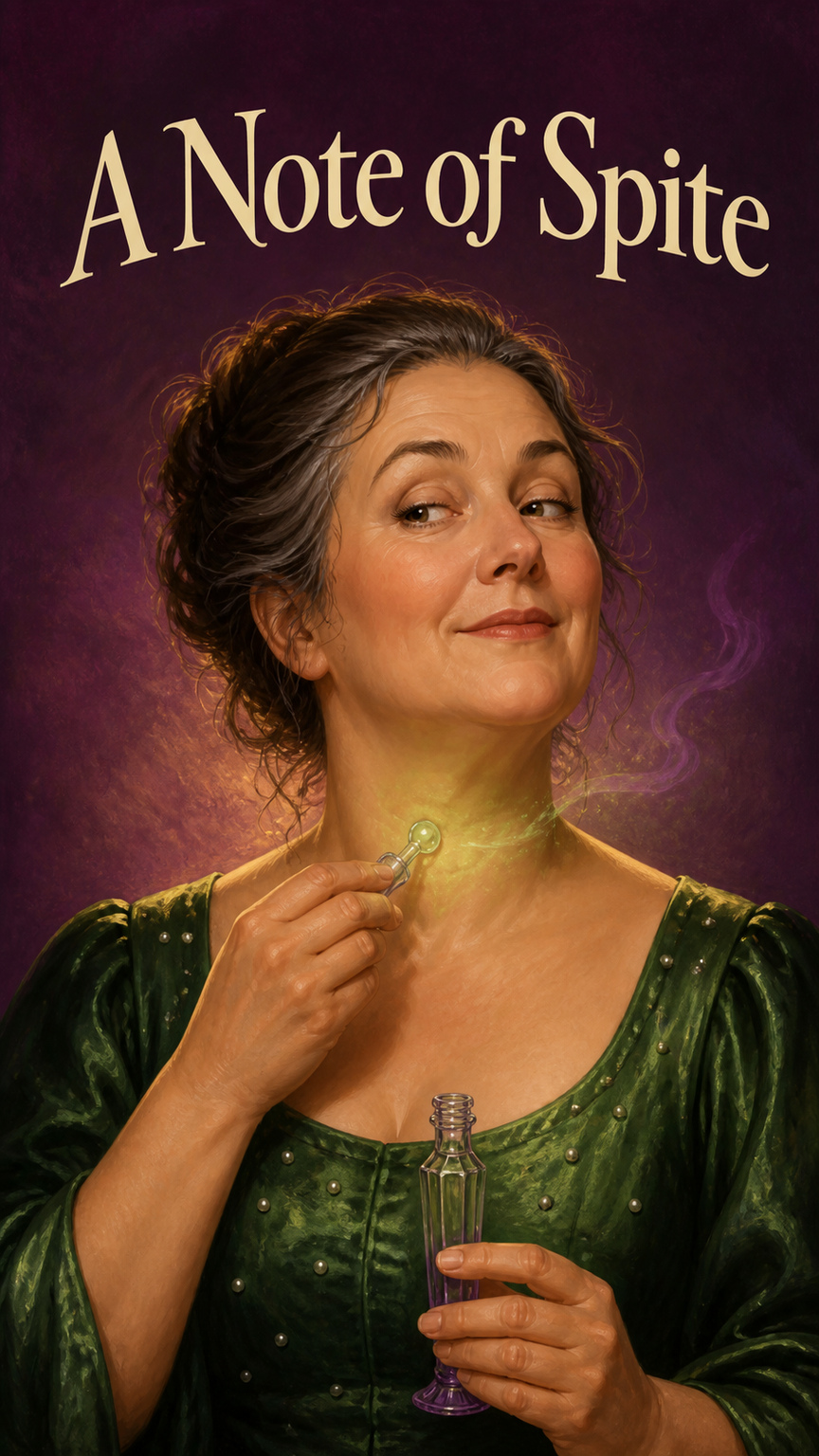
Lavinia had put on too much protection. Halfway up Clorinda’s stairs, in the heat from the candles on the landing, the neroli opened so violently that the gentleman behind her stopped to sneeze.
She moved aside to let him pass. A spark leaped from a wick toward her sleeve; she breathed out, felt the familiar cool tightening over her skin, and watched it die an inch from the lace. At least the blend worked. She had paid enough for it, though the perfumer had insisted the price was mostly for the flowers.
At the top of the stairs, three women were comparing wrists. One had worn a rain defense with so much moss in it that she smelled faintly flooded. Another was trying to tuck a handkerchief under a bracelet before its fresh anointing reached her pale cuff. Lavinia passed them with her hands well away from her own gown. She had chosen cream, a color which depended on other people’s good behavior.
Clorinda stood at the drawing-room door in a green dress Lavinia had never seen. Her bosom was sprinkled with little seed pearls. In the warm hollow above them, something delicious was flowering.
“My dear, you smell divine tonight. Is that a new protective enchantment you’re wearing?”
“Very new.” Clorinda offered her wrist.
Lavinia bent to it. Pear first, the firm flesh just under the skin; then violet, deep and powdery. She turned the wrist slightly, finding the warmth beneath.
“You’ve finally abandoned that dreadful almond.”
“You gave me the almond.”
“I was younger.”
“It was at midsummer.” Clorinda pressed her cheek to Lavinia’s, laughing. Her skin was hot. “I’m so glad you’re here. Look at my dress.”
Lavinia stepped back. The dress was good, which ought not to have surprised her. Clorinda generally dressed as if she expected to be called upon to carry something; tonight her sleeves ended at the elbow and the skirt swept clear of her shoes in front, showing green silk stockings. She had chosen the stockings herself, apparently. She revolved to display a row of small covered buttons.
“You can’t possibly do those up alone,” Lavinia said.
“I didn’t.”
“How promising.”
“My maid. Don’t be tiresome. There’s wine in the next room.”
Fifty suited Clorinda. She had told everyone she was fifty, written it on the invitations, and ordered a cake large enough to make concealment absurd. Lavinia, who was fifty-two and said so only when asked, had spent some pleasant afternoons threatening to arrange all fifty candles around a looking glass. Clorinda had threatened to invite a gentleman who read his own translations aloud. Neither threat had been carried out. The unoccupied corner by the piano was plainly waiting for them.
Lavinia took a glass and drifted back to the doorway. She liked watching Clorinda receive people. Nobody was allowed to get away with touching her fingers and murmuring; she drew them in, demanded to see a recovered ankle, remembered a marriage, sometimes the wrong marriage. Lavinia had been rescuing her from such mistakes for thirty years.
A woman in blue approached with a husband whose whiskers grew almost into his eyes. Clorinda held out both hands.
“How very delighted I am that you could—”
Lavinia pinched a fold of air between her finger and thumb, breathed a tiny working into it, and flicked.
The trick ought to have lifted come into a canary’s squeak. It was a little trick, their oldest: one syllable, nothing sore or lasting. Clorinda had once used it on Lavinia’s very sincere thanks to a committee. Both of them had been asked to leave.
“—come,” Clorinda finished, in her usual substantial voice.
A sharp green smell cut through the pear, like the snap of a leaf stem. Lavinia’s fingers tingled. The working came apart against Clorinda’s throat.
The woman in blue sniffed appreciatively. Clorinda glanced at Lavinia, then turned to her guests.
“I was just admiring it,” Lavinia said. “Such an unusual finish.”
“Is that the violet?” the woman asked.
“No,” said Clorinda. “It’s something else.”
“Does it keep mosquitoes off? We couldn’t sit out at all last week.”
“Only interference with the voice.”
Lavinia looked down at her wine. A throat defense. She had seen them sold for public speakers, though never in such a pretty fragrance. Usually they smelled of burnt fennel and the conviction that somebody else ought to stop talking.
“I wish I’d had it when my sister visited,” the woman said.
“It wouldn’t stop your sister,” Clorinda said. “Only a hex on your own voice.”
The woman was disappointed. Her husband had found a dish of olives and did not appear to have heard any of it. Clorinda steered them toward the wine, leaving Lavinia by the door with her unused laugh.
So that was tonight’s game. Clorinda had made arrangements. Lavinia lifted her glass to her, but Clorinda had turned away.
There were more chairs than usual in the drawing room. Several stood in rows facing the piano, and a low vase had been removed from its lid. Lavinia went to examine the little card propped on the music stand. Clorinda’s large handwriting announced a piano piece, a song, and supper. Beside the middle item, in smaller letters, she had added her own name.
Lavinia found her fastening a brooch on an elderly guest whose hands were unsteady.
“I see we’re to have music.”
“We are.” Clorinda squinted at the catch. “There. Will it do?”
“Too high,” the guest said.
Clorinda unfastened it again.
“And a song,” Lavinia said.
“Yes.”
“Which one? Am I to guess?”
“The soldier and the little dog.”
Lavinia laughed. They had learned it as girls, along with other songs their teacher had considered insufficiently elevated. A soldier serenaded his sweetheart beneath her window, boasted of all the things he dared, and was defeated by the smallest animal in the house. Clorinda had always given the soldier an enormous chest and no neck.
“Oh, we must do the march first. Do you remember? When we came in backward?”
“I’m only singing.”
“I could carry a sword. That poker would do.”
“There.” Clorinda stood back from the brooch. “Better?”
The elderly guest inspected herself in a small mirror and said it would have to be. As she moved away, Clorinda rubbed the dent the catch had made in her thumb.
“You’d miss the piano coming in,” she told Lavinia. “And I’ve practised it without a march.”
“You’ve practised?”
“Of course.”
Lavinia glanced at the card again. The name had been added in the same ink, with the same pen, but cramped into a space too small for it. She had imagined Clorinda writing the programme that afternoon, laughing at her own impulse. Apparently there had been rehearsals.
“With whom?”
“The gentleman who’s playing. He’s in the other room somewhere. A brown coat.”
“That does narrow it.”
“He has one eye.”
“Considerably.”
Clorinda did not laugh. She was looking down into her bag.
“Have you lost something?”
“My scent. No, here it is. Come through a moment. I want the glass.”
Lavinia followed her into the small room off the hall where guests left their wraps. Clorinda had put out cotton and little bowls of unscented oil for lifting away defenses that had spoiled on the journey. One shawl smelled powerfully of thunderstorms. Someone had left an open bottle beside it, and Clorinda corked that before attending to herself.
Her own bottle was narrow, with a violet glass foot. She touched the stopper beneath each ear, then to the hollow of her throat. With two fingers laid over her pulse, she drew a slow breath, supplying the force that the fresh oil would hold close to her skin. Pear filled the room. Without her, it would have been expensive oil in a bottle; on her, breathing and warm, it had just undone Lavinia’s neatest little hex.
“How long does it last?” Lavinia asked.
“A few hours. Less if it’s hot.”
“It’s very hot.”
“That’s why I’m doing it again.” Clorinda frowned at a glistening spot above the pearls. “Too much there?”
Lavinia held out her hand for the stopper. Clorinda gave it to her automatically. For a moment it was like their old preparations, the crowded glass, the whispered estimates of who might come, Clorinda unable to decide on earrings until Lavinia threatened to go without her. She used the flat edge of the stopper to lift the excess oil away before it could run into the dress.
“There. You’ll stain yourself otherwise.”
“Thank you.”
“You’ve gone to a great deal of trouble to prevent one squeak.”
Clorinda looked at her in the mirror.
“Yes.”
“I might have chosen something else.”
“I hoped you wouldn’t.”
Lavinia replaced the stopper. Somewhere outside, a guest launched into a story she had heard from him twice that month. She could have made a remark about that, and Clorinda would have laughed; she could practically feel the little doorway opening between them. But Clorinda was straightening her pearls.
“You know,” Lavinia said, “if you’re worried about the singing, we can make it funny from the beginning. A helmet, perhaps. I could find a saucepan.”
“It is funny.”
“Yes, but deliberately. I mean the entrance. Let them know what they’re getting.”
“They’re getting a song.”
“Of course. But you’ve never liked that part in the second verse. There’s no need to stand there and wrestle with it while everyone watches. We could come in with the saucepan and—”
“I don’t want the saucepan.”
“You haven’t seen it yet.”
Clorinda put the bottle in her bag.
“It might be a very good saucepan,” Lavinia added.
“I heard you.”
Lavinia turned toward the door. Across the hall, a footman was trying to find room on an already crowded tray for an abandoned glass. She waited until he had gone past.
“I wasn’t proposing to spoil it.”
“Then don’t.”
“I was proposing to help.”
Clorinda pulled a chair out from the wall and sat, carefully spreading the green skirt. Under its edge her foot began moving, heel planted, toe lifting and falling. Lavinia could hear a little tune in the rhythm. She had never particularly liked being the only person standing.
“How long have you been preparing this?”
“Since the spring.”
“The spring.”
“Not constantly. On Thursdays, mostly.”
“All those Thursdays.” Lavinia sat on a stool beside the washstand. “I thought you’d given it up. We both gave it up.”
“I gave up the lessons.”
Lavinia remembered why. There had been a recital, and Clorinda had lost her place. Lavinia, seated beside her to turn the pages, had sung the missing passage in the voice of their teacher. It had been very good. The girls in the back row had howled, and Clorinda had laughed so much that they never finished. They had gone home arm in arm, still doing the voice.
“You didn’t tell me you still sang.”
“You know I sing. You complain if I do it in a carriage.”
“Everyone complains about that. You’re very loud in a carriage.”
“Well.”
“It isn’t the same as this.”
“No.” Clorinda smoothed one of the folds of her skirt, then spoiled it with her thumb. “I wanted to do this.”
From the drawing room came three testing notes on the piano. Clorinda’s foot stopped.
Lavinia imagined her standing there, round-cheeked and eager, reaching for the upper note. The whiskered husband would go on chewing. Someone would look down into a glass. There would be a little silence where people decided how warmly to applaud. Lavinia knew exactly how to break that silence. She always had.
“I don’t see why you didn’t simply ask me to leave your voice alone.”
Clorinda opened her mouth, closed it, and rubbed a finger along her eyebrow.
“I didn’t want to argue about it before my birthday as well.”
Lavinia’s own perfume suddenly felt heavy. There was too much of it under her chin, and the little room was too warm.
“Well, I can go, if you’d prefer.”
“No. I wouldn’t.”
“You appear to have made all the arrangements.”
“It’s my house.” Clorinda looked exasperated, then almost immediately tired. “Oh, don’t go. Please. I wanted you here. I wanted you to hear it.”
She reached across and caught Lavinia’s fingers. The gesture was awkward from the chair, and Lavinia had to lean forward or let her hand be pulled off her lap.
“The whole thing,” Clorinda said. “I’ve done all this practising. Even the stupid bit with the dog.”
“That’s the best bit.”
“I know. But I can’t start there.”
There were voices in the hall. Clorinda released her and stood to let two arriving guests lay down their wraps. She took one woman’s hand in both of hers and exclaimed over a ring. The pear fragrance went with her into the doorway, leaving behind a little violet and the sharper smell clinging to the storm-scented shawl. Lavinia sat for a moment longer on the stool.
When she returned to the drawing room, the pianist was already playing. He was an old man in a brown coat, as described, with a black patch over one eye. Lavinia chose a chair near the front because it was empty and because choosing the back now would look like something. She put her bag on her knees and listened to the piece. It was longer than she expected. Several times it seemed about to end and thought better of it.
Clorinda sat against the wall with her hands clasped. Once she saw Lavinia and lifted her fingers, just off her lap. Lavinia nodded.
Then the piano piece really did end. There was applause, and Clorinda rose. Her skirt caught on the chair leg. She bent to free it, showing a stretch of green silk above her shoe, and Lavinia felt the person beside her turn for a comment.
There was an excellent one available about mounting a defense against furniture. Lavinia had only to murmur it. Nothing in Clorinda’s bottle could stop her.
But Clorinda had straightened. She was looking at the pianist, who was moving the music on the stand. Lavinia was trying to remember whether they used to begin after four bars or eight; by the time she remembered, her neighbor had turned away.
“A little slower,” Clorinda told the pianist.
He nodded and played the opening. She drew breath. Pear and violet reached Lavinia over the heads of the first row.
The first note was too small for the breath that had preceded it. Clorinda tried again on the next one, louder, and sang the soldier’s arrival at his sweetheart’s gate with her eyes fixed somewhere above the listeners. Her lower voice was pleasant. Lavinia had forgotten that. There was warmth in it, and a roughness near the bottom which made the soldier sound as though he had been travelling without much comfort.
He had crossed mountains and fought robbers. He had other accomplishments Lavinia missed because she was watching Clorinda’s hands. They had been pinned to her sides; now one lifted, palm up, making an uncertain mountain.
In the second verse the tune climbed. Here came the part Lavinia had offered to conceal beneath a saucepan. Clorinda looked at the pianist. He looked back. She took the phrase lower than Lavinia remembered, letting the piano carry the high notes over her. It was a different arrangement. Of course it was. They had had all those Thursdays.
The woman beside Lavinia shifted her feet. Behind them a glass clicked against another. Clorinda’s voice shook on a held note, and Lavinia discovered that she had tightened every muscle in her own throat, as if that might steady somebody else’s. She swallowed. She had missed the next line.
The soldier was at the gate now, calling on his sweetheart to admit him. Clorinda looked down at an imaginary latch, put her hand on it, and stopped.
The piano gave two quick, high notes.
Clorinda peered downward. Her chin went back into her neck. The splendid chest she had inflated during the first verse began to subside.
Lavinia knew what came next. She had known it for thirty years. But she did not know that Clorinda would try to step around the invisible little dog, find it occupying that part of the floor too, and retreat half a step into the tail of her own gown. The grand voice went thin with indignation. She demanded the removal of the animal. A second pair of notes answered her.
Then the soldier, who had faced lions and blades and tumbling rocks, attempted a friendly whistle. Almost no sound emerged.
Lavinia laughed. It broke out of her at an ugly volume. Clorinda glanced at her, and for an instant Lavinia thought she had spoiled it after all. But Clorinda held the look, drew herself up for another attempt, and produced an even smaller whistle.
The woman beside Lavinia laughed too. Someone farther back asked what had happened. Clorinda continued, pressing herself against the piano as her soldier begged to be admitted by another gate. The last line arrived in a rush; she nearly overtook the accompaniment and had to wait, visibly, for the final chord.
She bowed before it had quite finished.
People applauded. Some warmly, some because the song was over. The whiskered gentleman was clapping with the slow, conscientious air of somebody who had been elsewhere for most of it. Clorinda thanked the pianist, then bent to say something to him which Lavinia couldn’t hear. He laughed and shook his head.
Chairs scraped back. The door opened on the smell of supper, and the room began to rearrange itself around the possibility of food. Lavinia stayed seated. Clorinda came toward her, stopped to accept a compliment, and then came on, pink to the ears.
“Well?” she said.
Lavinia looked up at her. The pear had softened. Violet lingered about the warm green silk, and there was no bitter leaf in it now.
“That whistle.”
“I nearly couldn’t do it.”
“Do it again.”
Clorinda glanced toward the departing guests. Then she raised her magnificent soldier’s chest and tried, unsuccessfully, to summon a dog no larger than her shoe.
Lavinia covered her mouth. It was worse from this close. Clorinda began laughing too, losing the face she was trying to make, and caught hold of Lavinia’s shoulder.
“They’ll think that was you,” she said.
“I should like the credit.”
“Well, you can’t have it.” Clorinda gave her shoulder a small, possessive squeeze. “I practised.”