All Accounts Due
You have no magic, but as you've helped others you've amassed tons of favors, artifacts, etc. Today everyone woke up to find thier max mana is zero.
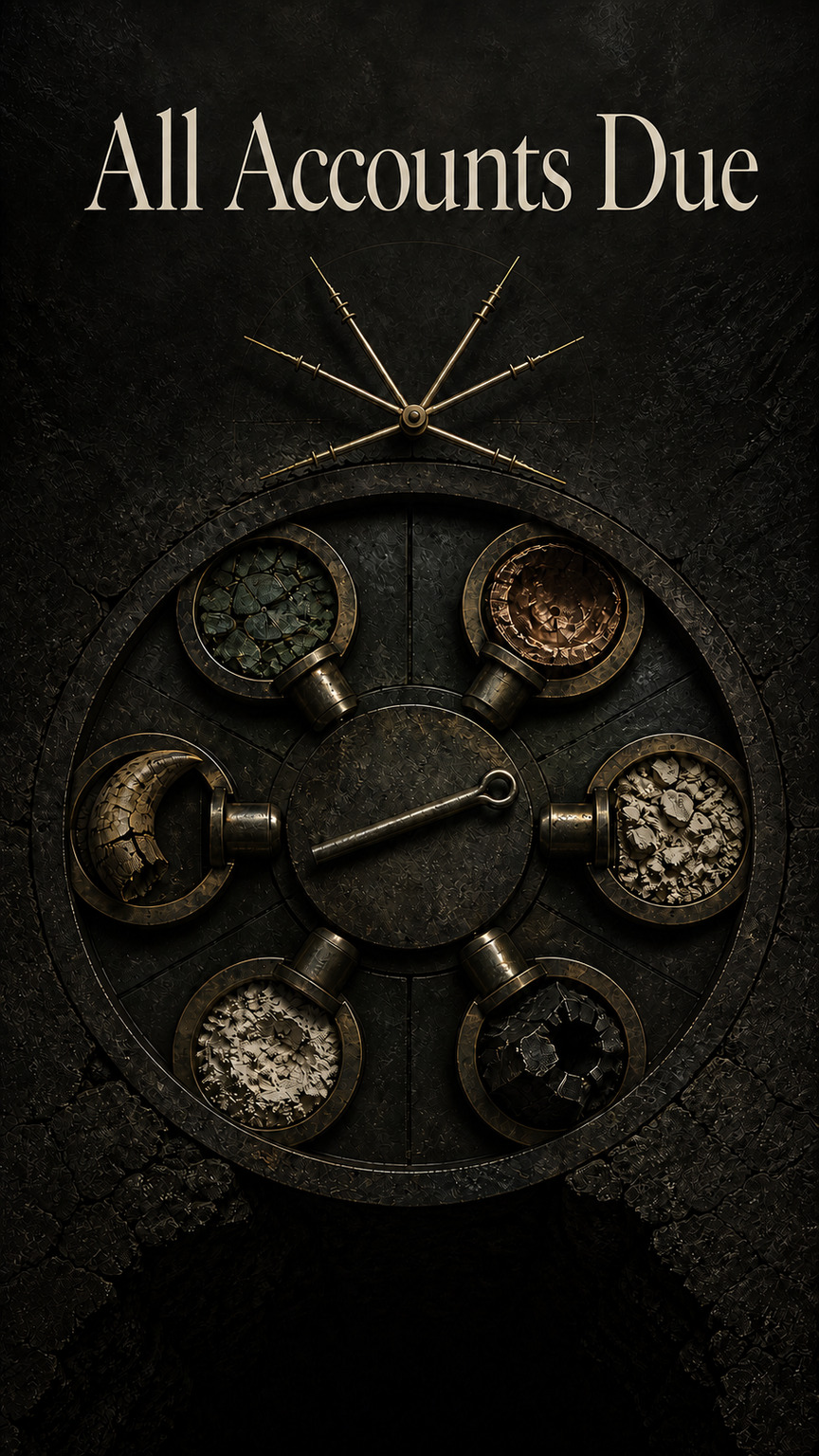
The Ithrom Array hung where six world-curves crossed, and every kind of magic in the material world had come to kill Faris.
One hand bruised, Faris crouched behind ordinary stone. Six empty sockets ringed the Unwritten Axis beside cradled keystones; the Parity Astrolabe hung above. Three body-lengths away, the Mortal Latch waited cradled: bearing unseated, selector upward, plungers apart, lever folded, cotter strapped. Eight relics converged accidentally over thirty-one years—nine since he learned of the Yoke, four since he found the junction.
Beyond, a luminous city walked; black fire ate a fortress; dragons stitched horizons; palaces filled three skies; an aurora held a mountain; soldiers exchanged organs and wings.
Six-practice engineers built the Array three hundred and two years earlier as a last resort against coupled roots. Route custodians held the timing instrument; graft keepers guarded the final junction, whose selector protected material bodies. No practice held both.
The Absolute Yoke descended through six wonders, borrowing grace for command, fire for appetite, flight for pursuit, rooms for prisons, weight for chains, gifts for forced flesh. The Bound Ascendancy wore all six at their meeting.
Born as armistice councils after route wars and furnace invasions, frightened rulers, priests, users, and magic-dependent peoples decided peace required every root to obey. Using stolen Array studies and living contributions taken or volunteered across all six systems, the Ascendancy would preserve the magical world by ending refusal.
“Leave the Latch,” it said through conscripted mouths. “There can still be order.”
Then Seyathi stepped through a tessellated wall and reached for the Missing Tessera.
Nine years earlier, at the Talarum Steps
The pilgrims had been kneeling for four days.
Their knees bled through their clothes, but Tessellate Grace cared less about pain than arrangement. Every attempt to rise completed another line in the prepared pavement, and the completed line bent their bodies back into worship. Seyathi stood beyond them inside a shelter of rotating mineral color. She was holding the greater pattern apart by a finger’s width. Sweat silvered her mouth. Each breath cost her another piece of her sense of place; when Faris shouted, she looked first in the wrong direction.
“Do not step on anything beautiful,” she called.
“That advice would have helped at the bottom.”
He lay flat in the drainage cut beside the stairs. He had no counter-pattern to wear and no inner gift for the pavement to recognize. That did not make him safe. A prepared surface could arrange an unmagical body as easily as a chair. He crawled where the mortar was still raw, testing it with the brass tongue from his sandal buckle. Plain grit crumbled. Worked grit hummed against the metal.
A blank white tile sat between him and the nearest pilgrim. No lines. No pigment. Faris put his palm on it.
The prepared underside turned him over and folded him to both knees.
His shoulder struck the step. His teeth met hard enough to fill his mouth with blood. The pilgrims’ hands rose together, compelled into the next figure, and the shelter around Seyathi narrowed.
“Blank side inward,” she said, voice tight. “You were meant to notice.”
“I noticed when my ankle turned.”
He tried to lift one knee. The tile corrected him by twisting his ankle until his heel fitted the design. Nothing in the pain was mystical. Tendons were tendons even when a goddess’s geometry chose how to pull them. Faris wedged the buckle tongue beneath his sole and used it as a lever, gaining less than a finger’s width. Enough to keep the joint from breaking. Not enough to stand.
One of the kneeling pilgrims moved one finger. Not up, which the pattern would have caught. Sideways, scraping at a seam beneath the lip of the stair. Faris followed the scratch with his eyes. A maintenance pin held the prepared facing to an ordinary support bed. No holy geometry protected the pin. It was only iron, green with damp.
Seyathi understood his look. “One breath,” she said. “After that, I will not know which way you are.”
She turned two fingers.
The colored shelter opened. For one breath the compulsion loosened, and every pilgrim sagged without being forced into the next posture. Faris tore the buckle from his sandal and struck the maintenance pin. Once. Twice. On the third blow it slid free. The facing dropped a thumb’s width, breaking the pattern’s continuity. Forty-three people fell out of worship at once.
The hidden lines on the tile flashed before they died. They were not devotional. They were a trial lattice for the Absolute Yoke.
Afterward, Seyathi could not find the stairs without Faris taking her elbow. She gave him the Missing Tessera, a square of matte mineral two fingers wide. It had been made for her two hundred and thirty-three years before, she said, and contained one finite direction of her grace.
“One day,” she told him, “you may ask me to arm it against the Yoke. Say exactly what you mean. A promise protects only its exact shape.”
At the Array, the unarmed Sole Chamber rang inside nine Yoke-folded rooms.
Twenty-four years earlier, at Mavorn Palace
Faris entered the palace prison dressed as a laundry porter, carrying wet sheets and the confidence of a man nobody important intended to remember.
Nine prison wings occupied the same foundation. King Malrec’s heartbeat chose which arrangement a corridor wore, and every arrangement beyond the base made that heart spend its years faster. With one beat, Faris passed cells full of debtors. With the next, the same doors held soldiers. Another beat revealed an empty banquet hall through the bars. Living people remained one body each, crossing between rooms only at permitted thresholds. The stone was less disciplined. It could be wall, stair, ceiling, and oubliette before a guard finished yawning. The king could maintain the palace’s grandeur only by aging inside it.
The Sole Chamber governed Manyroom from a bronze model no bigger than a thumb. Faris had been told to follow a scratched line along the base wall until it ended under the royal archive.
He followed the wrong scratch.
The next heartbeat put him inside a locked cell. The following one put the cell behind the kitchens. Then under a chapel. Then nowhere he could name. He dropped the sheets and felt along the base, but each wall carried decades of scratches. He could not tell signal from damage.
The prisoner sharing the cell watched him sniff the air.
“What?” Faris whispered.
The prisoner pointed through the wall, then pinched their nose and mimed eating.
Faris held up one finger for each shift and let the prisoner tap his wrist when a smell returned. On the seventh heartbeat, soup and lamp oil repeated together. On the ninth, wet wool came back without the soup. The scratched walls were meant to defeat sight, but cooks still burned onions on schedule and laundries still made steam. The prisoner smiled when Faris finally began counting the palace as work instead of wonder.
Meal smells. Grease when the kitchens were near. Damp grain by storage. Wax by the archive. Faris stopped looking for the right mark and waited through the pulse of rooms, tracking the ordinary things each arrangement could not quite hide. When wax and mouse droppings arrived together, he found the true scratch under his heel. It led to a loose base stone.
Behind it sat the Sole Chamber, made by the first palace architects four hundred and eighty-six years earlier. Faris closed his hand around it. Nine wings shuddered toward one plain arrangement.
He could have left during the confusion. Then a heartbeat made the wall beside him share space with King Malrec’s private room. Faris saw a blade emerging behind the king, its wielder hidden in another arrangement.
He threw the bronze model at Malrec’s head.
The king ducked to rebuke him. The assassin’s blade passed through the place his throat had been. Faris shouted where to strike, and the royal guard dragged the attacker across a threshold into one body and one room.
The prison settled. Every captive remained alive in the base structure. Faris was arrested before he reached the laundry door.
Malrec visited his cell three days later. “You stole the legal heart of my house.”
“I also threw it at you.”
“Yes. If treason must double as rescue, it might at least improve its manners.”
The king pardoned him, retained a witnessed claim, and granted one decision over the Chamber if that decision was made publicly and applied to the palace as well as its enemies.
At the Array, the Nearmost Vertebra knocked under the Yoke’s stolen gravity.
Fourteen years earlier, at the Aphalion Belt
Qeluun was too large for Faris to see as a body.
He saw a dark plain curving through the upper air, ribbed with pale sensory tissue. He saw storms dragged into crescents by a contraction somewhere beyond the horizon. He saw poacher rigs fixed to that living surface, their drills chewing for fragments that could alter weight. He felt each wound as a change in which direction his boots wanted to fall.
The Nearmost Vertebra was in his coat: a porous length of shed bone stolen from Qeluun ninety-seven years before Faris was born. He had recovered it from the poachers’ buyer. Returning it would have been simple if the rigs had not started drilling deeper when he arrived.
Faris crawled between them with an ordinary pry bar tied to his wrist. He cut power cables, opened fuel valves, and hammered wedges into drill gears. Magic shifted the sky around him. None of it made a rusted clamp less vulnerable to leverage.
At the fourth rig, he cut a tether he thought held the machine.
It held him.
The curved plain dropped away. Faris went outward, toward a seam of stars. The pry bar snapped to the end of its cord and spun behind him. His scream had no useful direction.
Qeluun contracted.
Weight returned sideways. Faris struck warm tissue, bounced, and caught the edge of a drilling frame. The catch tore both palms. Under him, the vast body pulsed. Three slow knocks traveled through the frame.
The poachers saw him hanging there and restarted the nearest drill. Its teeth did not need magic now; the flywheel already carried enough motion to cut. Qeluun shifted again, not to throw them off, but to bring Faris’s dangling pry bar within reach. The movement opened a tear in the pale tissue wider than a road. Faris understood the scale of the choice only when dark blood rose past him in floating beads.
“I don’t speak mountain,” Faris gasped.
One knock. Then two. Then a pressure beneath his left knee.
He understood enough. Qeluun could move masses, but every contraction tore more of the tender tissue the drills had exposed. Faris followed the pulses instead. Pry left. Brace right. Turn the bar. The clamps had been driven by spellwork, but they were physical iron once seated. One after another, they opened. The rigs drifted clear. The last drill stopped with its point resting against living flesh.
Faris placed the Nearmost Vertebra into the wound it had once bordered.
The slow voice reached him as pressure through bone.
SELL IT. COULD HAVE.
“It wasn’t mine.”
OURS. NOT NEEDED. SHED.
“Still not mine.”
Qeluun entrusted the bone back to him. One day, it would align one terminal change. Faris promised never to speak of Qeluun as terrain while asking it.
At the Array, Yoke-fire opened the unarmed Cold Maw.
Thirty-one years earlier, at the Ghorvane Underforge
Faris was young enough to believe a good plan became better when performed quickly.
The demon young were trapped in a root-furnace during a coup. Black fire burned inward through their bodies, consuming flesh to draw heat and mineral toward the moving forge. The usurpers had sealed the air shutters. The young could feed the furnace or suffocate beside it.
Faris followed a draft through machinery that rearranged itself around appetite. He held a strip of cloth near each seam and watched which way the loose end bent. Hot metal hunted his boots. Chains slithered toward the iron in his blood. He kept moving because stopping would let the forge decide what use to make of him.
He found a wheel beside a sealed hatch and turned it with both hands.
The hatch opened onto slag.
A half-forged predator came through, all wet alloy and borrowed teeth. Faris threw himself behind the wheel. The creature bit the axle in half. Its second lunge ended in Hurzai’s hand.
The demon lord crushed its head and burned the remains inward until nothing but a cold iron knot hit the floor. The effort took a strip of flesh from Hurzai’s arm. Black fire filled the wound, bright at the edges and lightless in the center.
“You opened waste,” Hurzai said. “Air is above. Your nose has cheated you.”
“Then I read the draft wrong.”
“Review while moving.” Hurzai kicked the iron knot into a gear train and jammed it. The forge convulsed around them. “I can consume a wall or carry you. Not both.”
Faris looked at the half-closed passage, then at the ladder rising through heat toward the shutters. “The wall.”
Hurzai burned a path for him. The fire ate a visible hollow from the demon lord’s side. Faris climbed through before the metal could flow back, knowing rescue had already placed him in debt and that the price was being paid in living flesh.
Hurzai could have left through the breach. Instead, the demon lord lifted Faris clear of the buckling gear train and showed him the real shutter chain. Faris climbed. He passed an artifact vault whose door had split in the fighting. Any one object inside could have bought him a quiet lifetime.
Below, the young struck the furnace wall with weakening hands.
Faris passed the vault.
He braced his feet on ordinary rivets and cranked the shutter until his shoulders failed. Hurzai took the wheel only after Faris had broken the seal. Fresh air crossed the furnace. The black flames steadied. The young survived, and what they shouted through the vents named the officers who had arranged the coup.
Later, Hurzai set the Cold Maw on a table between them. The paired heatless jaws had been forged by a predecessor six hundred and eleven years earlier. Turned inward, they preserved root authority over Inward Fire. Turned outward, they could reverse it once.
“Custody,” Hurzai said, “if you never call a terminal ending painless. One root act when you ask. You will name the meat cost first.”
At the Array, forced flesh made the unarmed Form flex.
Four years earlier, at the Keruvan Fold
Faris stole two relics from Jelveth Sorn because patrons were using Kindred Graft to turn consent into a ceremony performed after the cutting.
The Unhatched Form was a nonliving organoid shaped by six former keepers one hundred and forty-one years earlier. It stored possible exchanges without ever having been a person. The six-practice engineers had built the plainer Mortal Latch at the Array’s commissioning; by Keruvan it was two hundred and ninety-eight years old. They assigned its bearing, lever, plungers, selector, and cotter to graft-keeper custody because the selector protected material bodies. It originated no charge.
Faris got both into a canvas sack before Jelveth found him.
She pursued him through a sanctuary where every resident carried a chosen faculty from someone else. One man heard through the soles of his feet. A woman breathed water through living folds at her ribs. Two people shared the effort of one damaged heart. Jelveth tracked Faris using their offered senses, never taking more than each had consented to lend.
He climbed a support membrane and cut what he thought was an alarm filament.
The membrane sagged.
Borrowed muscles failed along the gallery. The shared heartbeat stumbled. Water struck the floor around the woman who could no longer use her gills. Faris reached the outer door with the relics and saw the whole sanctuary folding behind him.
He went back.
“You severed a load-bearing exchange,” Jelveth said. Her fingers were inside the living wall to the knuckle. “Put down the theft.”
“Tell me where to brace it.”
“You cannot perceive the strain.”
“I can perceive people falling.”
The woman with gills convulsed beside them. Jelveth pressed her free hand to the woman’s ribs and took the drowning reflex into her own lungs. Pain folded the keeper over, but her directions stayed clipped and exact. “Pole under the third seam. Not the red tissue. That is sensation. The gray band. Lift on my count.” Faris obeyed without pretending he understood the body he was helping hold together.
At her direction, he jammed ordinary poles between the gallery and its physical foundation. One split. He doubled the next with a bench leg. Jelveth rerouted sensation, muscle, and breath long enough for material supports to take the weight. Faris held a pole against his shoulder until the last resident crawled clear.
The patrons arrived claiming the keeper had endangered everyone by resisting their program. Faris still had their signed orders in his coat. He read them aloud.
Jelveth did not forgive him. She did establish a public bargain. He would repair the sanctuary, never call a fixed grafted body counterfeit, and hold lawful custody of the two relics. In return, she would perform one bounded root act after reading its selector herself.
At the Array, a Yoke-folded horizon stirred the unarmed Arc.
Eighteen years earlier, at the Skairrift
Ekkorath rescued Faris before Faris rescued Ekkorath.
The dragon was pinned inside a corridor knot around a falling ruin. Bent distance kept bringing the same broken towers back beneath them. Faris had no wings, magical or otherwise. He rode a slab of masonry with a ballast rope around his waist and tried not to look at the repeated sky.
His first knot slipped.
Ekkorath could have spent the remaining fold of one wing to free themself. Instead they snapped their neck across the gap and caught Faris against their scales. The motion tore cartilage along the trapped wing. Distance opened and closed inside the wound.
“You are falling toward the western edge of your own mistake,” Ekkorath said.
“Tell me which way is physical.”
“The beam beneath you still belongs to the ground. Follow its length before the western horizon folds over it.”
Faris crawled onto a grounded beam that passed through the knot. The magical horizons lied, showing cliffs above and valleys behind. Falling chips of stone did not lie. Each chip found ordinary down whenever it crossed the beam. Faris followed them to a physical pin holding two ruins in the same flight circuit.
Halfway there, the beam rolled. Faris flattened himself and looped the loose ballast rope around a crack rather than trusting another knot. Ekkorath’s trapped wing swept overhead, opening a destination that looked one step away and was probably a mile beneath them. Faris shut one eye. With depth reduced to shape and falling grit, the unenchanted beam was easier to read.
The dragon shouted headings. Faris translated them into left, right, duck, and hit this. He hammered the pin with a loose block until it bent. The circuit tore open. Ekkorath pulled their wing free and carried them both out while towers resumed their separate falls.
The Unflown Arc came loose from Ekkorath’s damaged flight horn during the escape. It held the Horizon Flight counter-circuit they had chosen not to spend on themself. They gave it to Faris as a rescue gift.
The Astrolabe was why Ekkorath had entered the ruin. Skairrift had been an Array calibration station; route custodians had sealed the instrument beneath a marked roof tile. The corridor knot buried the recess, but Ekkorath knew its marks. Built at the Array’s commissioning, the frame was then two hundred and eighty-four years old, with one passive indicator metal per root. Ekkorath lifted the tile; Faris freed its bent nail. He asked before taking the instrument, and Ekkorath made him name its cost.
“One flight,” the dragon said. “If you state every destination you will close and everyone you expect to fall.”
Now, at the Ithrom Array, all six keystones remained unarmed.
Faris turned first to Seyathi. “Arm the Missing Tessera, and before this hour ends the Absolute Yoke will be powerless. I will not take its power, wear it, or pass it to anyone.”
Every clause was true. Thirty-one years had supplied relationships and relics; nine since Talarum had supplied the Yoke and Tessera; four since Keruvan had supplied the Latch. Faris had shaped this promise only after those pieces met, and deliberately left one word out.
Seyathi studied him and the six keystones. From her side, they appeared to be six strikes against the Yoke’s six borrowed faces; the terminal connections stayed hidden until the Latch was seated. Trust, not carelessness, supplied what Faris withheld.
“Against the Yoke, within this hour,” she said, setting each boundary in place. “I agree.” She pressed her thumb to the matte square and set it blank-side inward. Geometric light filled the first socket.
The other five had heard the whole request before they came, knew Seyathi had not, and had agreed not to supply the missing scope. They still had to choose here. Their complicity did not absolve Faris.
The Sole Chamber rang louder. Malrec stood at the second socket in a crown that occupied five possible shapes.
“If my capital’s crossings remain,” he said, “I will renounce every foreign claim and submit the record to any witness you choose.”
“No exemption.”
“Then I ask nothing further.” Before they came, Faris had told him that every royal door would become carpentry, including his own.
Malrec looked toward the many palaces sheltering his people. “Let the record show that necessity has defeated negotiation. Witness this: I release every claim in the Sole Chamber, including my own.”
He folded its nine possible walls shut until one bronze room remained. The socket held the renounced claims behind the unfired Latch. Until the cotter came free, the armed Chamber retained one use: collapsing an imposed overlap into its material base.
The Nearmost Vertebra knocked hard enough to fracture stone. The immense curve of Qeluun tightened around the Array. The third socket waited.
END US? came the pressure, making Faris’s broken brace tremble.
Faris had warned Qeluun before they came: they might die, and so might all who depended on Worldcoil. He had offered no protection from that cost. “I am asking you to align it anyway,” he said.
Silence pressed on him. Then Qeluun moved the Nearmost Vertebra into place. The bone pulsed once and became dust. Gravity convulsed. The third socket shone.
The Cold Maw opened wider. Hurzai’s woundless older body gleamed with contained fire beside the fourth socket, but he did not touch the jaws.
“One quenched furnace does not cool a foundry. Show me how you will keep the Yoke from returning.”
Faris pointed to the band of black fire descending through a folded horizon. “Turn one jaw far enough to close its present furnace line. Not far enough to arm it.”
Hurzai narrowed the Maw. Its Yoke-band pinched out—and reappeared inside a Grace command, carrying black appetite through colored stone.
“Every Yoke branch holds all six adapter patterns,” Faris said. “End five and the sixth preserves their instructions, then compels its users to rebuild the entrances. All six branches must close together.” Hurzai knew what Faris left unsaid: closing them forever required the death of every root that fed them.
Hurzai reopened it. “And the cost you named?”
Before they came, Faris had named it without Seyathi there to hear: some demons would survive, some would not; fortresses would collapse and stored heat break loose. Hurzai’s lordship and fire would end with theirs. “Unchanged,” Faris said.
Hurzai’s face hardened without becoming calm. “You have named flesh, furnace, and crown. I accept the burn.” He seized both jaws and wrenched them outward. They fused around the socket. Black light filled it.
Forced wings erupted from attacking soldiers below. Jelveth stood over the Unwritten Axis and the fifth socket.
Without lifting the Latch from its carrying cradle, Faris rotated its selector plate toward her. Two instructions were cut into the metal: end function; preserve matter.
Jelveth read twice. “Fixed tissue remains. No body is declared false. You have changed nothing else?”
“Nothing.” When she had asked him about the shared heart before coming, he had told her its impossible sharing would end. Each body would keep whatever its own matter could sustain.
“And you offer no further assurance?”
“None.”
She closed the Unhatched Form in both hands and opened the Axis with a precise incision of borrowed sight. The Form went still. The fifth socket accepted it.
Across the ring, the Unflown Arc lifted from its cradle as if remembering a route it had never flown. Ekkorath faced the sixth socket while cities flickered at the ends of their wings.
Before asking Ekkorath to come, Faris had named the cost of the last flight: dragons grounded, crossings closed, suspended cities falling toward whatever lay physically below them. Now he said, “You may tear your last flight holding the corridor long enough for me to reach the Latch.”
Ekkorath’s long gaze stayed on the cities. “And the people beneath your answer?”
Faris had named them too: people inside falling cities, people below them, dragons that could not survive grounded. He had not been able to count them then. He could not count them now. “I have found no way to spare them.”
Ekkorath spread their wounded wings. “I will fly it once.”
Ekkorath lowered the Unflown Arc into the socket and flew the terminal counter-circuit. The shed horn lit along an old fracture. Five Astrolabe needles held their timings while the sixth swept toward them.
The Bound Ascendancy struck before it reached parity.
Prepared color raced across the hub, commanding bodies to kneel. Hurzai burned a hole through it; Seyathi folded the broken pattern away from Faris.
“The Yoke,” she said. “Finish the Yoke.”
Black fire consumed the stone’s heat and drove cold at Faris’s bones. Hurzai drew it into his chest, losing flesh as he fed its appetite into Cold Maw.
Soldiers arrived through shortened distance. Malrec struck the armed Sole Chamber. Its one-way failsafe collapsed their imposed overlap into the base room without making a new arrangement; his heartbeat paid in years, and his hair grayed as the soldiers met ordinary space alive.
The Ascendancy pulled weight from Qeluun. The Array lurched. Faris hauled the Latch from its cradle—selector fixed, bearing unseated, lever folded, plungers apart—and slid toward open sky. Qeluun’s painful contraction held one last stable down.
Forced grafts tangled wings with arms and dragged breath between strangers. Jelveth’s exact cuts separated imposed functions while preserving material bodies.
The Yoke ran through all six attacks. Every magical defense gave its command a cleaner path into that root.
The hybrid body stepped from a folded horizon into three rooms. Its weighted shadow cracked the hub; its hands opened toward Faris’s Latch.
“Withdraw the Latch,” the mouths said. “The cities remain aloft. The crossings remain open. Chosen bodies keep their gifts. Gods keep their care. We end the war by making disobedience impossible.”
It was not lying. Faris could see the offered order descend along the Yoke: no battle, no refusal, no one falling because no one permitted to move without command.
Seyathi screamed as her spatial sense failed. Hurzai was half his mass; paid years bent Malrec; Qeluun’s pressure came ragged; Jelveth shook; blood striped Ekkorath’s wings.
Faris thought of forty-three pilgrims unable to rise.
“No,” he said.
The Ascendancy drove all six systems at him.
The mounting recess lay three body-lengths ahead. Faris dropped onto unprepared mortar and dragged the Latch through the first as command passed over him. A scratch marked the Axis’s base surface; he followed its vibration through the second length and kept to the ordinary draft opposite the inward-drawn heat.
A horizon folded over the third and final length.
Ekkorath hit it wing-first.
“This span still reaches the place beneath your hands,” the dragon said, holding two false destinations apart.
Faris crossed the last length before stolen weight drove one knee down. He crawled to the recess, inserted the ceramic bearing, and twisted until its shoulder seated flush. The housing pivoted beneath the Axis; the lever remained folded, the cotter strapped, and all six plungers extended.
Their heads showed the selector’s instruction: Preserve matter. End function. Faris pressed them in order, each stopping short of contact, and braced the housing with his belt. Insulation kept the six armed outputs apart.
The Ascendancy reached for him through every magical being on the hub.
It found no address in lifelong nonmagical Faris. He remained vulnerable to fire, stone, surfaces, talons, and blades; the Yoke merely had nowhere inside him to issue an order.
Faris slid the ordinary cotter through all six plungers, then swung the lever ninety degrees. Its cam loaded them against the cotter, a hair short of contact.
Above, the sixth Astrolabe needle met the other five.
Faris pulled the cotter free and said, “No More Magic.”
The words caused nothing. The physical release did.
The plungers dropped into contact together. All six terminal conditions propagated in the same instant. The breaking world-curves made that instant visible in six different grammars.
The Missing Tessera discharged. Tessellate Grace whitened through every prepared surface. Commands became pigment; walking sanctuaries settled or toppled with fatal collapses where ordinary walls failed. Compelled knees unlocked. Healing patterns left bodies in their material states. Seyathi’s radiance and godhood vanished; her person remained.
Cold Maw ended Inward Fire. Black flames pinched out; held heat returned as ordinary expansion. Furnaces burst, fortresses slumped into slag, and occupants died in failing structures. Demons lost their bodily conversion: some lived mortal, some did not. No ember retained a root or reserve. The jaws softened into dead alloy.
Unflown Arc spent its counter-circuit. Horizons straightened and material-side anchors closed without claims about former destinations. Cities fell. Faris saw one break against a mountain, killing its occupants; others carried people and wreckage toward valleys below. Dragons beat ordinary wings: some descended, others fell. Stored distance emptied from bodies and routes. The Arc cracked into ordinary horn.
Sole Chamber released Manyroom’s last arrangement. Palaces became one material structure in one place. Crossers remained whole on the side containing most of their bodies, neither copied nor trapped. Malrec’s crown became one heavy object; the bronze tore flat.
Nearmost Vertebra ended Worldcoil. Auroras became weather. The opening mountain dropped toward its inhabited crown and the valley below. Qeluun’s leverage over weight ended, leaving them conscious, falling, and vulnerable to every moving mass. Their bone dust answered nothing.
Unhatched Form ended Kindred Graft. Chosen material bodies remained their own; scars and surviving organs stayed. Impossible faculties stopped, shared senses separated, and keeper awareness went dark. Hybrids failed without revealing a seventh system. Materially sustainable bodies lived; those dependent on an impossible breath, pulse, or exchange died. The Form became protein ash.
The extinction ranked no personhood. Gods lost power, not identity; worship, memory, relationships, grief, and responsibility remained. So did death: among occupants of falling cities and structures, people beneath released masses, and magic-dependent bodies. Others survived by ordinary matter or another person’s hands. Faris could not count the dead, but that did not reduce the largest entry in his choice.
The wave emptied living capacity, workings, charge, structures, crossings, faculties, hybrids, reserves, relics, seeds, and every material restoration path. No artifact, descendant, or machine could recover magic. It could never return to that material world. The past remained real; afterlives and realities beyond closed material crossings remained outside Faris’s act.
The Parity Astrolabe registered six perfect zeros. Its needles melted and frame fell apart. Mortal Latch split its bearing, bent its lever, and shattered its plungers around the cotter in Faris’s hand. Nothing retained a repeatable action.
The world-curves straightened. Nothing held the Ithrom Array.
The hub dropped. The slab under Faris’s palms fell beside him, contact without stable down. Arches pulled apart on different trajectories; the Axis cracked and tore free. Faris, Seyathi, and the mechanism were all in open fall. The powerless Yoke lost its faces and dispersed above them.
Faris saw Seyathi through it.
She looked from the powder of the Missing Tessera to Hurzai’s dead fire, from the straight horizon to Malrec’s absent rooms, from Qeluun falling beyond a broken arch to Jelveth staring at unanswering hands. Her own skin held no light now. She was alive. She was herself. She was no longer a goddess.
“Before this hour ends,” she said, each clause placed with terrible care, “the Absolute Yoke will be powerless. You will not take its power, wear it, or pass it to anyone.”
Faris did not look away.
Seyathi said, “You never said the Yoke would be the only thing made powerless.”
She struck her heel against the slab falling beside her, forced her body into the first position of Tessellate Grace, and turned two fingers at him—the gesture that had once made every prepared surface seize every body upon it.
Nothing moved. Nothing answered.