The Anatomy of a God
"You actually managed to counteract my regeneration?" "I don't know what your deal is, but where I am from guys like you aren't rare, hell, my stepsister is one of you. We know how to deal with your anathomy." "What are you talking about!? I am a GOD!" "You have the ego of one, that's for sure"
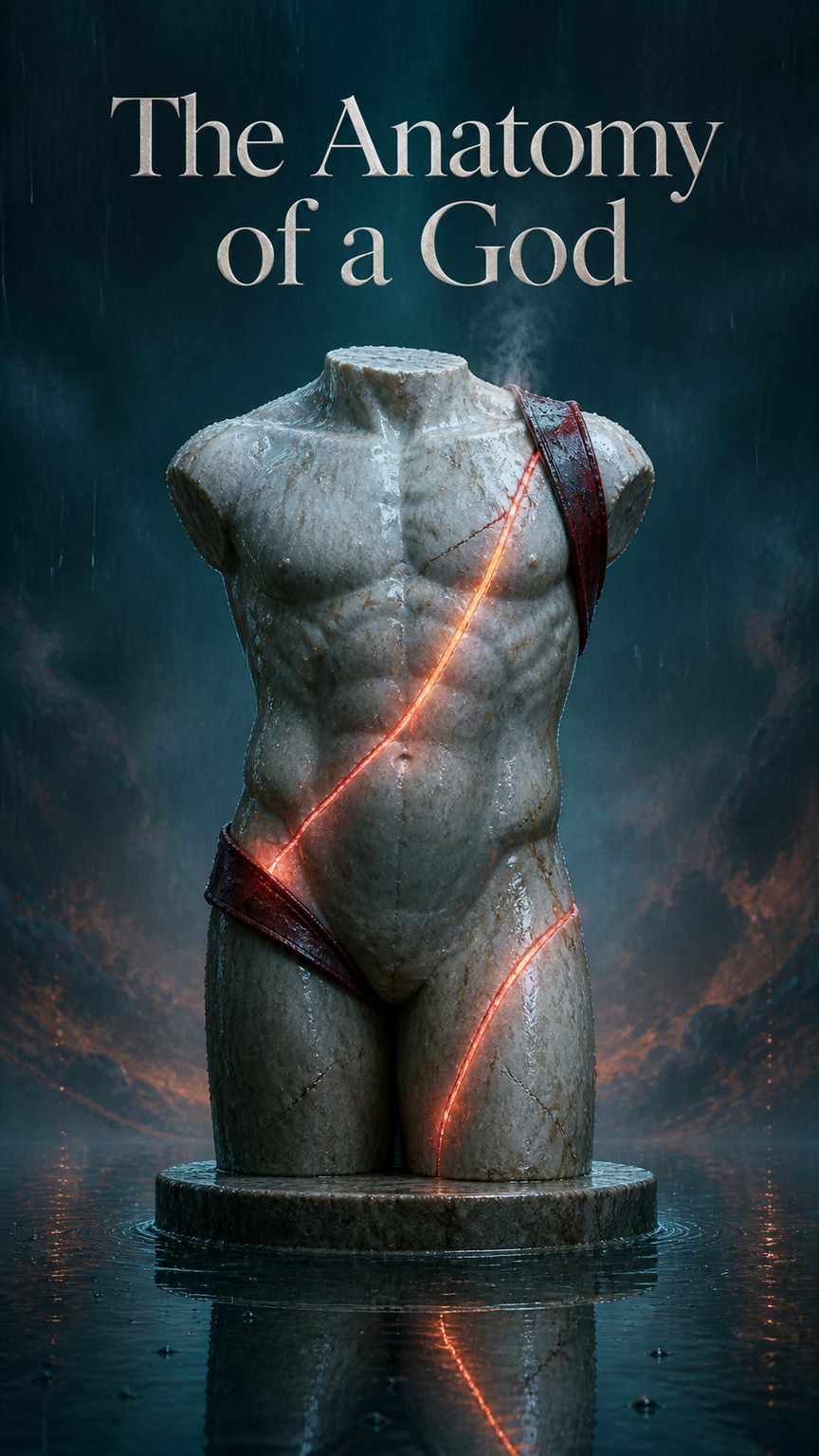
The man I had stabbed stopped being dead before I reached my satchel.
I do not use dead loosely. I had spent twelve years with my hands on people at their worst—under fallen masonry, in fever cots, on kitchen floors after a regeneration went wrong. I knew the little concessions a body made before it quit. His had made all of them. No breath. No pulse against my knuckles. Eyes fixed on the painted beams of the sanctuary while rain worried at the roof.
Then the wound under his torn coat drew itself shut. It did not glow. There was no choir, no clean flash of divine correction. The flesh tightened in small, ugly increments, as if invisible fingers were pulling a purse string. His ribs lifted. One heel scraped the audience floor. Heat rolled off him strongly enough to stir the dust between us.
My satchel lay where he had thrown it, six paces away beside the outward doors. The doors were still barred. The broken ceremonial knife was in my hand, its edge dark to the hilt. I backed toward the satchel.
The man sat up.
Rainwater tapped through the high windows and collected in copper bowls along the walls. He looked first at the knife, then at me. His face had returned to its grave, handsome arrangement, but the eyes did not track together at once. The left caught me. The right wandered to the empty dais and came back.
“You were told to kneel,” he said.
“You put your hand on my neck.”
“I showed you the posture.”
He rose before his balance had returned. His right knee locked. His weight went too far toward that side, and one bare foot slapped down to save him. He disguised the correction by spreading his arms, turning a stumble into benediction.
I had seen my stepsister do the same thing with a tray of soup. She had come home from a roof collapse with every bone apparently mended and no idea where the floor intended to be. She took three majestic steps into the kitchen, raised the tray as though presenting it to a court, and fell shoulder-first into the flour bin.
Don’t laugh, she had said from inside the white cloud.
I’m getting a cloth.
You’re laughing while you get it.
The man before me had no flour on his face and would not have improved with it. Still, the resemblance gave me a place to start. Not certainty. I had made that mistake before.
I nudged one of the copper bowls with my heel. It skated over the tiles, ringing, and spilled rainwater across his path.
His gaze followed it a fraction late. I ran for the satchel.
He moved fast once he chose a direction. His hand closed on the shoulder of my coat just as I caught the satchel strap. I dropped my weight, turned beneath his arm, and dragged the broken knife across the back of his forearm. His grip opened. The cut began closing even as his blood struck the floor.
“Again?” he asked, his eyebrows lifting.
“I only need the door.”
“There is no door for you until you acknowledge whose house received you.”
“This house tried to drown me through the ceiling.”
I pulled the satchel toward me. He stamped on the trailing strap.
The sanctuary had been empty when I climbed to it from the ravine road: no attendants, no pilgrims, no smoke from the kitchens. Only this man seated above a hall of mildewed cushions, waiting in a dry circle while the storm came over the mountain. I had asked for shelter. He had asked for my knees. We had both repeated ourselves until he decided to demonstrate.
Now a tendon stood out in his neck. His renewed skin shone with sweat. He noticed me looking and lifted his chin.
“You witnessed death obey me.”
“I witnessed you get very hot.”
I jerked the strap sideways. His foot shifted, and the satchel came free. Two buckles burst. Rolls of bandage, three stoppered vials, my shears, and a coil of recovery web scattered over the floor.
He looked down. I looked at the doors behind him.
“No,” he said.
That was his first useful answer. I snatched up the coil and ran the other way, toward the faded curtain beside the dais. Behind it, a narrow service stair dropped into the mountain. The smell rising from below was wet stone, old leather, and minerals sharp enough to taste.
The road would be under water soon. My satchel was open on the audience floor. The sensible path was behind a man who had already survived being killed once.
I took the stairs.
He followed without hurry at first. His bare feet made soft, deliberate sounds above me.
“You came into my refuge,” he called. “You drew blood beneath my image.”
There had been paintings on the hall walls. Damp had peeled most faces away, leaving crowns afloat over pale smears.
“Is that who they were meant to be?” I asked.
The steps turned sharply. I slipped around the central support and waited. When his shoulder appeared, I cast the recovery web over his arm, braced one heel against the stair, and pulled his wrist toward the opposite hip.
It was the first hold we used when my stepsister’s repairs ran too fast. Her body mended along two broad chains that crossed through her trunk. When both tried to bear weight at once, they dragged her into a spasm strong enough to break whatever she was lying on. We never stopped the repair. We gave one chain work and asked the other to rest.
The web drew taut. The man’s shoulder turned; his left leg faltered.
For half a breath, I thought I had him. Then his hip moved the wrong way.
Not wrong for him. Wrong for my hands. Instead of unwinding across the body, the tension climbed his right side and vanished beneath his ribs. He seized the web and hauled. I hit the underside of the stair hard enough to burst sparks across my sight.
He twisted his captured arm. The wrist folded where the web held it. I released by instinct, but he had already used the injury to slip the loop. By the time his hand closed around the central support, the joint had rebuilt.
He pulled the web from me and snapped its wooden tension bar against the wall.
“A net,” he said. His breath was quicker now. “Was that the breadth of your revelation?”
I pushed myself upright. “No.”
“What, then?”
I said nothing. He wanted an answer more than he wanted me caught. That bought me two steps.
The stair ended at a landing lined with body braces.
They stood in pairs, tall frames of blackened wood with padded slings for shoulders and hips. Some were child-sized. Others could have held the man above me with room to spare. Their leather was cracked, their buckles green, but grooves had been worn into the handrails by years of use. A shelf held empty salt jars and cups with mineral crust around their rims.
So the great audience hall had a hidden underside, and somebody had once spent a great deal of time helping bodies through difficult hours.
The man stopped on the last stair. He saw where I was looking.
“Those are refuse.”
“Good. I need parts.”
I tore a sound length of strap from the nearest frame. He came down fast.
I ducked behind the brace. His fist split the upper rail where my head had been. The old wood gave way with a dry report. I caught the lower rail and drove the broken frame across his shins. He kicked through it; one upright glanced off his left hip. His right shoulder tightened after the hip had already taken the force, while his right knee corrected into the pull beneath his ribs. The delayed eye, the locked knee, the staggered response—none of it made my stepsister’s clean crossing. His repair carried load in offset pairs, overlapping instead of mirroring.
Or I was frightened and inventing patterns because patterns were easier than death.
He caught my coat again and lifted me against the wall.
“Look at me,” he said.
Up close, his skin smelled of hot metal and rain. The corner of his mouth ticked. He had spent water sealing what I had opened, then spent more escaping the web.
“I am looking.”
“What do you see?”
His grip tightened. He expected an office, a domain, a glorious name. I saw one pupil wider than the other and salt dried white below his ear.
I drove my thumb into the knot already trembling under his renewed arm. The arm folded before the rest of him caught up. I dropped, left my coat in his hand, and ran through the low doorway at the end of the landing.
The chamber beyond was round and warm. A mineral basin occupied its center, fed by a pipe that dripped cloudy water from the rock. Four iron supports leaned over it. Straps hung from them, better preserved by the damp than the frames outside. Against the far wall, a maintenance gate stood above a drainage channel. Rain showed silver through its slats—an exit, if the wheel would turn.
I reached it and put both hands on the wheel. Rust flaked beneath my palms. It shifted one finger’s width, then stopped.
Behind me, water splashed.
The man had stepped into the basin. He crouched and drank from his hands, without ceremony now. The tremor in his face eased. His shoulders settled at different times, right before left. The bruise at his left hip faded upward toward his right shoulder while the scrape at his right knee contracted toward his ribs. Not a crossing. Two crooked lines sharing the middle.
My stepsister had once woken me after midnight by tapping a spoon against my doorframe.
Cup’s too heavy, she said.
It was not. The cup was tin. But her repairs had spent everything after a fever, and both hands shook when she tried to lift it.
Water or broth?
Water. No, broth. Is there any salt left?
I had held the cup while she drank. In the morning, when she could close her fingers again, she made me practice the release buckle on the recovery web until I could open it with either hand. The first time I fumbled, she took the web away. If I could not open it frightened and half-awake, she said, I had no business closing it around her.
The man rose from the basin.
“Last opportunity,” he said.
His words came more slowly, perhaps because he had decided slow speech sounded merciful. His attention had sharpened. He was done displaying himself.
I let go of the gate wheel. “All right.”
He waited.
I lowered myself to one knee.
Satisfaction altered his face before he could prevent it. He stepped out of the basin and came to stand over me. Water streamed from his clothes. His right foot landed close to my hand, his weight already committed forward.
I pulled the release pin from the nearest support.
The iron arm dropped across his right shoulder. I rose under it, using my legs and his forward motion to drive him past me. He struck the basin rail. Before he could turn, I looped a broad strap behind that shoulder and clipped it to the rear support.
He tore the clip free.
I had expected him to. The break dragged his shoulder backward while his left hip drove forward to recover his balance. I kicked the second support loose. Its padded sling caught the hip and held that rotation for one crucial moment.
His renewal answered the strain. Heat struck my face.
The line from his left hip to his right shoulder tightened first, trying to set both into one bearing posture. The fading injury at his right knee called the line beneath his ribs a beat later and turned his trunk against it. I pulled the remaining strap low across the basin, not around a joint but across the two slings, and fed it through the old floor ring.
He reached for me. His fingers brushed my hair.
I threw my whole weight backward.
The slings turned in opposite directions.
He could have broken either one with ordinary strength. He tried. The right shoulder surged forward; the left hip followed; the half-mended knee asked him to shift back. His body corrected the correction. One foot stamped down and did not rise. His reaching hand stopped short of my throat.
The chamber filled with the smell of hot stone.
“What did you do?” The ceremonial fullness had gone out of his voice.
I kept both hands on the strap. It thrummed hard enough to numb my fingers. “Held the repairs apart.”
He heaved again. The iron supports groaned. A buckle tore halfway through its leather tab, then stopped when his strength vanished into another shudder.
“My renewal.” He pulled once, weaker. “You stopped it.”
“Not for long.”
He stared at the motionless hand in front of him. His mouth opened, but no sound came until he tried the hand again. “How?”
I watched his breathing. Fast, but open. The strap had not crossed his throat or chest. Good.
“Where I come from, regenerators aren’t rare.”
His mouth tightened around the word as though I had called him livestock.
“My stepsister is one,” I added. “I guessed you’d be similar. You weren’t. Not quite.”
He tested the bind with a small turn of the shoulder. The strap hummed.
“I am a god.”
“You keep saying that.” My grip slipped. I wrapped the loose end once around my forearm and leaned back. “Stop pulling.”
“Release me.”
“When I’m outside.”
He fought the bind again. The right support lifted from the floor and slammed down. Heat poured from him, but there was nowhere for the effort to go except through the mismatched renewal. His legs buckled without letting him fall. The slings held him in a strained half-kneel at the basin’s edge.
“You mistake the body for the being,” he said through his teeth.
“I’m working on the part that grabbed me.”
His eyes found mine. For the first time since he rose upstairs, he was not performing for an invisible hall. He was measuring distance, buckles, my tired hands. Thinking. The change made him more dangerous and easier to predict.
“How long?” he asked.
“If you keep doing that? I don’t know.”
“And if I stop?”
“Lie still. Let the heat come down. The straps loosen when your body quits choosing between the two positions.”
“You expect obedience.”
“No. I’m telling you what happens next.”
The damaged buckle gave a small, fibrous creak.
He could keep fighting until the old leather failed. He might catch me before his next collapse. Or he could preserve his body by accepting stillness from a stranger who had already proved willing to stab him. Neither choice resembled worship.
His hand closed by a fraction. Opened. At last he let his shoulder sink into the sling.
The strap went on vibrating for several breaths, then softened.
I waited until his weight settled without another surge. Releasing my end too quickly could tighten the hip sling; leaving it wound around my arm meant he could drag me close if he changed his mind. I unwound one turn at a time.
“Your people built this room for the aftereffects,” I said. It was not a question.
He looked toward the salt jars on the landing. “They feared imperfection.”
Maybe they had. Maybe they had simply grown tired of catching him when the floor moved. I did not need his version before the road vanished.
I secured the strap with the release buckle facing his free hand. He could reach it once the tremor passed. Then I took a cup from the shelf, filled it at the basin pipe, and set it on the rim near him.
He watched the cup instead of me.
“That is not reverence,” he said.
“It’s water.”
I went upstairs for my things.
He did not call after me. In the audience hall, the rain had found new holes. It drummed on the scattered contents of my satchel, soaked the bandages, and washed his blood into the cracks between the tiles. I recovered the vials, the shears, and what dry wrapping remained. The broken knife I left beneath his painted faces.
The outward doors still would not open. I returned to the recovery chamber and forced the maintenance wheel with the shears wedged through its spokes. Rust cracked. The gate lifted six inches, then nine, spilling cold rain over my boots.
Behind me, the man remained still. Steam had stopped rising from his coat.
“There are many of me?” he asked.
The question was quieter than his other questions and less complete.
I crouched by the opening and pushed my satchel through. “Many who mend. I don’t know if any of them are you.”
His lips parted, then closed.
I slid under the gate and dropped onto the lower slope.
The ravine road had already flooded. Brown water covered the marker stones and shouldered branches against the bend. Going down would put me in the river before dark; going back through the sanctuary would put me in front of its owner before his hands steadied.
Above the road, a goat track cut across the shale toward the ridge, narrow, exposed, and still passable. I shortened the satchel strap. Before the rain loosened it, I put my full weight onto the first slab and started up.