The Apes Above
Humans abandoned Earth many years ago for space stations; below the Dino Council is meeting to discuss what to do about those pesky apes in orbit throwing rocks at them.
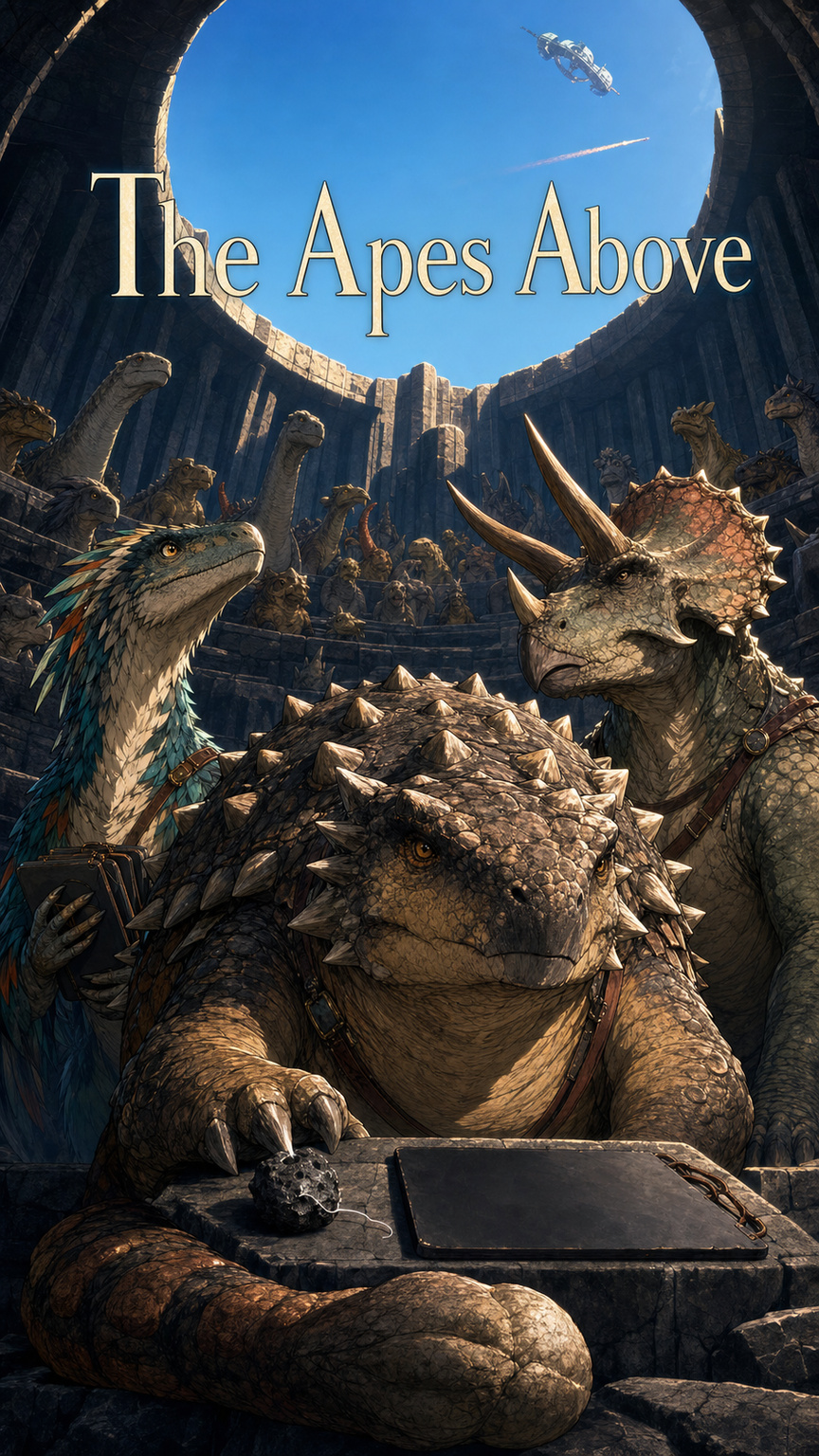
The fragment would not lie flat in the council well.
Qemri set one foot against its blackened curve while two porters worked the sling loose. The thing was no larger than a sleeping egg, but its weight bowed the map tiles beneath it. White packing fibers clung to one scorched edge. On the other, a row of metal sockets had melted into small silver mouths.
Grit kept falling from the folds of her hide. She had left the south hatchery while the roof was still ticking itself apart, and every time she moved, another pinch of that place landed on the council floor.
“Put the basin under it,” Sulekk said.
The map keeper dragged the floor image eastward until the old blue contour of the basin shone around Qemri’s claws. The fragment covered six nesting blocks.
“That is not its full body,” Qemri said. “That is what came through the heat gallery.”
Across the well, a road councillor leaned over the rail. His tail displaced a stool, which struck the water steward’s ankle. Neither looked down.
“The gallery stood after the strike,” he said.
“For eleven breaths.”
The chamber doors scraped open. A hatchery messenger squeezed through sideways, one forelimb strapped to his chest. Plaster whitened his snout.
Qemri stepped off the fragment. “How many?”
“No crushed eggs. Two carriers burned. The west loop cracked where it joins the warm-water trunk.” He looked at the water steward, not Qemri. “We need the reserve carts now.”
“They’re loading.”
“We need them moving.”
The steward slapped the call plate with her palm. Somewhere beyond the chamber, a bell answered. That was the only agreement the room had managed since Qemri arrived.
Above the map well, the descent clock changed from ninety-one minutes to ninety.
Qemri looked at Sulekk. “Release the coil.”
The chair’s crest was scarred at the tip from years of ducking beneath doors designed by smaller ancestors. She did not sit. No one could have fitted properly around the well with the fragment in it anyway.
“Brinnt first,” she said.
The defense engineer had already unrolled a copper mesh across the floor. They pinned two corners with tool cases and held the third beneath a rear foot. Points of red light multiplied over the basin, hopped the ridge, and spilled across the three nesting terraces to the north.
Qemri’s bad shoulder tightened. “That spread is wrong.”
“It was wrong last meeting.” Brinnt touched the fragment with a probe. The red points shifted again. “Now I have the shell laminate.”
“The coil breaks it in the upper air.”
“The center, yes. The jacket strips. These fibers make wide pieces, and the guidance block makes fast ones.” Brinnt pointed at three dense red clusters. “North terrace. Water stairs. Your east shelter mouth.”
The water steward stopped calling for carts. “How fast?”
“Fast enough that you don’t send carts through there.”
“They have to cross the stairs.”
“Then they cross before we fire.”
Voices rose around the well, not in one wave but in collisions. The road councillor wanted the north ramp reserved for egg sledges. The granary member needed that same ramp for draft teams. Someone at the rear asked whether the old tunnel still had lamps. It did not. The messenger said the south hatchery had lamps and no brackets to hang them from.
Qemri planted both forefeet on the well rim. “Quiet.”
Several councillors kept talking. She struck the melted metal with one claw. The note rang low enough to be felt through the floor.
“North terrace clears first,” she said. “No carts on the water stairs after sixty minutes. Open the old tunnel and carry lamps. Messenger, tell my crews the east shelter is closed.”
“They’re using it for the injured.”
“Move them.”
“Where?”
Qemri saw the heat gallery again: the roof seam unzipping through steam, carriers bent over their sling while she counted the distance to a doorway that had ceased to be there.
The messenger waited.
“Kiln cellar,” she said. “Take blankets. It’s dry and cold.”
He pushed back through the doors.
Sulekk watched the red fan crawl over the map. “If the terraces clear?”
“Full discharge fragments the object,” Brinnt said. “Probably.”
Oxaul, who had been coiled awkwardly beside the instrument arch, lifted his narrow head. “That probability assumes the same shell.”
Brinnt did not turn. “It assumes an object in the mass band you gave me. If you changed that, say the number.”
“I refined it.”
“Say it.”
“Twelve percent heavier.”
Brinnt swept the red model away with a hard motion and began resetting it.
Qemri crossed the well before Oxaul could retreat into qualifications. “You had twelve percent when?”
“Seven minutes ago. The latest range burst resolved the tumble.”
“And you brought it here in your mouth?”
Oxaul’s throat feathers flattened. “The trace station is still recording.”
“Then we go to it,” Sulekk said. She glanced at the clock. “Eighty-four minutes. Water and roads stay here. The rest of you, carry the mesh and cases.”
The trace instruments occupied an alcove built when the council had believed one polished lens and a patient observer could answer every orbital question. New frames had been bolted around the old stone. Cables crossed the floor under rubber humps. Qemri stepped over them; Brinnt did not, but pulled up each hump to inspect the cable beneath before placing a plated foot.
Oxaul climbed onto the operator’s ledge. He used both hands and his chin to align three transparent sheets over the main screen.
“These are the last nine descents,” he said.
Nine pale arcs bent from the belt of moving lights overhead toward the same mark on the ground. The first six ended in a blue basin. The seventh ended at its southern lip. The eighth was the black thing in the council well.
The ninth kept drawing itself, bright grain by bright grain.
Qemri pointed to tight combs of light along each arc. “Those.”
“Range bursts. The object calls; the stations measure the return.” Oxaul slid the upper sheet. “Here are steering commands. Not many. Small corrections after release.”
“Human commands?” a councillor asked behind them.
“Human transmissions from the stations. The transponder and cold-gas valves on the object obey them. Nothing in the object decides.”
Qemri had seen one of those valves in the hatchery mud, still frosting the grass after everything around it had burned. Metal, fuel, wire. Dead things could travel very far when a living hand let go.
Oxaul brought up a second pattern: launches, evenly spaced, each paired with a dim movement in the orbital band. “They strip shielding from the stations, compact it, and throw it backward. The throw changes station speed. The ballast goes down.”
“At us,” Qemri said.
“At this coordinate.” His claw circled the basin. “It was empty when their surface maps were made. I’m moderately confident the targeting record is old.”
“How old?”
“I can’t date a record I cannot read.”
“Then what changed on the seventh?”
“A steering pulse, late. It moved the fall by four hundred body lengths.”
“Away from the old center,” Sulekk said.
Oxaul shifted the sheets. “Toward it at first. Then the tumble complicates—”
“Which way did it move?” Qemri asked.
He looked again. “Away.”
“The eighth?”
“No late pulse.”
Dust rasped between Qemri’s teeth. “So one ape looked down once.”
“No.” Oxaul’s answer came cleanly, surprising them both. “A command changed one course. I don’t know what was seen. I don’t know who sent it. I don’t know why.”
The newest arc brightened across the screen. Its predicted end lay through the south hatchery.
“But that is where this one is going,” Qemri said.
“At present confidence, yes.”
Brinnt shoved a tool case under a rocking instrument foot. “Give her the spread, not your confidence.”
Oxaul touched the control. A brown oval opened across the map, its narrow end covering the hatchery and its wide end reaching the warm-water ponds.
Qemri measured it by crews. Roof team in the south gallery. Six sledges on the west loop. Two injured in motion toward a cellar she had not inspected in three seasons. The oval held all of them.
“Can they hear us?” Sulekk asked.
The room changed around the question. Necks came up. Even Brinnt stopped bracing the instrument.
Oxaul rubbed one wrist against his chest. “Hear is not the word I would choose.”
“Choose a shorter one.”
“Their receiver measures returns. We can make returns.”
He called up the recovered guidance fin on a side display. Its wires had been separated and labeled. Beside it sat the plain timing pattern of the human range bursts.
“Three portable beacons can echo this pattern,” Oxaul said. “Two from opposite edges of the occupied basin, one from the empty quarry. The delays mark two locations. Repeated, organized receivers. It would not identify us. It would not say stop.”
“Would it say the quarry is safe?” the road councillor asked.
“No.”
“Then why put one there?”
“Because two points are a line. Three points show a choice of ground.”
Brinnt interrupted. “If the pulse reaches orbit.”
Oxaul glanced at them. “The beacons need amplification.”
Everyone looked toward the defense controls beyond the next arch.
The coil’s storage bank showed one full white bar.
Brinnt closed the tool case. “Full fragmentation or a full-strength echo. The same charge feeds both.”
“You said three beacons,” Qemri said to Oxaul. “Not the coil.”
“The beacons shape and time the return. They cannot drive it through the upper air.”
“You left that part out.”
“I was establishing what the signal could demonstrate.”
“You were waiting until I had carried it this far.”
Oxaul looked down at the moving arc. “Yes.”
Qemri had expected another qualification. Before she found a new attack, Sulekk stepped between them, forcing her horns back from the instrument frame. “Seventy-two minutes. Brinnt: after amplification, what remains?”
“A third charge if I narrow the pulse.”
Oxaul said, “Narrowing may corrupt—”
“It will not corrupt your timing. It may fail to reach. A third charge cannot fragment the rock. It can score one face, maybe vent a guidance bottle, maybe do nothing. If it breaks the wrong way, we get the same fan with less height.”
“Final firing line?” Qemri asked.
Brinnt put a yellow curve across the display. It passed just above the horizon on the ninth arc. “After this, any break falls inside the terraces. Before it, a weak strike still has lateral distance. Not good distance. Some.”
The road councillor had followed them in. “And while you tap at the sky, my ramp is blocked by egg sledges.”
“It would be blocked under full defense,” Sulekk said.
“For one descent. You’re asking us to leave it blocked for an experiment.”
“I have asked nothing yet.”
“My district hears the difference poorly.”
From the well chamber came the clang of the water steward’s call plate and her voice demanding a cart count.
Sulekk looked toward it. “Go give them one.”
The councillor stared at her, then went.
Qemri watched the clock subtract another minute. The old scar along her shoulder had begun to pulse. She had earned it years before the apes started throwing ballast, in a quarry slide caused by a bad distance marked on a good map. Since then she trusted lines when she could stand on one. Evacuation line. Fragment line. Firing line. Oxaul offered her a return that might vanish into the upper dark and three lights that meant only what a careful observer wished they meant.
Behind the wall, the storage bank hummed with enough charge to turn one large danger into hundreds of smaller ones.
“Bring the beacon cases,” she said.
Oxaul blinked. “All three?”
“You asked for three.”
“I did.” He reached for the field cabinet, missed its latch, and caught it on the second try.
Brinnt pushed his hand aside. “Not that side. The hinge pin is loose.”
They carried the cases back to the well. No one announced a new position. Sulekk assigned two runners, and the map keeper cleared a route from the chamber to the outer ramp. One beacon went south to the cracked heat gallery, one north beside the warm-water trunk, one east to the empty quarry. The quarry runner asked for brush crews.
“Why?” Sulekk said.
“Dry grass. If something falls there.”
“Take four beaters and a water skin.”
“Four won’t hold a quarry fire.”
“They’re not to hold it. They’re to come back and tell us where it starts.”
At fifty-eight minutes, the north-road member reported that two draft teams had balked at the tunnel mouth. At fifty-three, the water steward lost a cart wheel. At forty-nine, a beacon runner called from the south hatchery and all the chamber heard the roof settle behind her in a long mineral sigh.
Qemri took the handset. “Position?”
“Inside the old basin mark. There’s no upright stone.”
“Use the warm-water tower.”
“Its ladder is cracked.”
“Then lash the beacon below the third rung. Don’t climb past it.”
“The signal clears the ridge from there?”
Qemri looked at Oxaul.
He bent over the terrain plot, changing height values. “Not fully. Move nine lengths west.”
“West is the gallery wall,” the runner said.
“Of course it is.” His hands passed over the controls and returned. “Five lengths south. Raise it one length.”
“With what?”
The water steward, still listening, said, “A cart axle. There’s a broken one at the west loop.”
“Get it,” Qemri told the runner. “Report when tied.”
At thirty-six minutes all three beacon marks steadied on the map: two pale green points bracketing the occupied basin, the third alone in the quarry. Between them, the black fragment still covered six nesting blocks.
Sulekk called the council to the defense rail. Bodies crowded around a control designed for one engineer and one warden. Brinnt made them back away until their tails cleared the manual release and Oxaul could reach the signal key without leaning across Qemri’s firing plate.
“Terms,” Sulekk said. Her formal cadence was gone. “We clear the modeled fan. We send one return. Qemri holds the remainder. If the predicted center crosses the yellow line before a new course is measured, she fires without another vote.”
“Against Brinnt’s own warning?” asked the granary member.
“Against the rock.”
“And if it shifts?”
“She decides.”
Qemri glanced at her. “You are handing me both mistakes.”
“I am naming whose they are.” Sulekk put her palm against the authorization plate. “Do you accept?”
The hatchery messenger had returned. He stood near the door, holding his strapped arm, waiting to carry whatever the room chose back to people beneath a cracked roof.
Qemri pressed her palm beside Sulekk’s. “Yes.”
Several councillors objected at once. Sulekk did not call for order. She pointed the water steward toward the outer chamber, sent the granary member to count cleared shelters, and told the road councillor to keep one ramp open until the last possible minute. Their objections went with them, still audible through the door.
At twenty-one minutes, the incoming object began its final range sequence.
The speakers gave three dry clicks. A pause. Three more.
“South ready,” said the operator at the relay desk.
“North ready.”
The quarry mark flickered.
Brinnt had both forefeet inside an open floor panel, tightening a contact. “Wait.”
The next range burst passed unanswered.
Oxaul’s fingers hovered over the key. “We are losing the sequence.”
“You’ll lose the whole pulse if this arcs.” Brinnt pulled the contact free, scraped carbon from it with the edge of a tool, and drove it home. The quarry mark went solid. “Now.”
Oxaul keyed the beacons.
The storage bar dropped in a white rush. Deep inside the ridge, the coil struck no projectile and made no thunder. It pushed the three small echoes upward until the chamber’s loose cups rattled. On the trace screen, three fine strokes climbed into the noise: south, north, east. Two locations made with three points. An occupied basin and a quarry. Nothing in the strokes for eggs, burns, apes, dinosaurs, permission, or regret.
The station band answered.
Not with a voice. A fresh ranging burst touched the south point, then the north, then the quarry. The order repeated. Oxaul made a sound Qemri had never heard from him, half laugh and half breath lost on a climb.
“They have all three,” he said. “They changed the ranging order. Confidence—high. Very high.”
The incoming arc did not move.
Eighteen minutes.
“Course?” Qemri asked.
“Holding.”
“Again.”
Oxaul checked another display. “Holding.”
At sixteen minutes, the predicted center touched the first hatchery roof.
Oxaul’s hands became busy without effect. He shifted filters, cleared them, rebuilt the old arc. “There may be command delay. Depending on station position, operator routing, whether the return was recorded locally or relayed—”
“Course.”
He swallowed. “Holding.”
Brinnt closed the floor panel and moved to Qemri’s side. The remaining third of the charge glowed amber under her palm. “Weak shot is aligned. Upper-left face. If the bottle is where the eighth one carried it, we may vent. If not, surface spall.”
“Spread?”
“Bad.”
“Distance.”
“Yellow line in ninety breaths.”
Sulekk stood behind them. “The authority is yours.”
Qemri hated her for saying only that. She preferred Oxaul’s fraying possibilities; there was something to push against in them.
The hatchery relay began reporting doors shut. South gallery. Warm-water store. Kiln cellar. Then a roof team failed to answer.
“Again,” Qemri ordered.
The relay operator called. Static. Called again.
The arc crept toward the yellow line.
Qemri set her claw into the firing guard. “Brinnt. On my mark.”
Oxaul stared at his unchanged trace. All his careful degrees had gone out of his face.
“Roof team answering,” the relay operator said. “They’re clear. They left the handset.”
“Line in twenty breaths,” Brinnt said.
High over Earth, a new signal cut across the station band.
Oxaul did not speak. He seized Qemri’s wrist with both hands. The predicted arc kinked, barely at first. Tiny gas jets on the falling ballast fired in a staggered row. The object rolled, exposing another face. Its center mark slid along the yellow line instead of across it.
“Where?” Qemri said.
Oxaul tried once and failed to answer. He magnified the trace until the quarry beacon flashed beneath the new curve.
Brinnt saw it. “Hold. Hold.”
Qemri’s claw remained under the guard. The curve wavered. If the jets stopped now, the object would take the ridge above the hatchery and bring the ridge down with it.
“Seven breaths to line,” Brinnt said.
“It’s still changing,” Oxaul managed.
“Five.”
The arc cleared the ridge by a mark so narrow Qemri could cover it with one claw. She had crews farther from the quarry than from any fragment fan she could create now. Not safe. A distance.
“Two.”
Qemri pulled her hand from the guard.
The ballast passed below the chamber’s horizon. For one quiet instant the instruments showed only its radio trace moving east.
Then the quarry struck.
The floor rose beneath Qemri’s feet. The scorched fragment jumped in the map well and came down on a different district. Cups shattered in the trace alcove. One of the old polished lenses tore from its mount and swung on a cable until Brinnt caught it against their shoulder.
The sound arrived after the movement, a long concussion through stone. Dust erased the ceiling. Somewhere outside, brushfire bells began hammering.
Qemri counted through the fading vibration. The quarry distance, the depth of the cut, the reduced mass after guidance burn. Windows would crack. Loose walls would go. The hatchery roof had remained above her feet.
“Relays,” she said, coughing. “All districts. Injuries and fire. Get the quarry team back.”
The chamber broke into work.
The south beacon had gone dark when its lashings failed. The north one still transmitted. The quarry beacon transmitted for six more breaths, then vanished beneath the returning stone. Oxaul saved the traces twice. When he tried to say what they proved, his first sentence would not start.
Sulekk waited beside him, dust striping her crest.
“A new command,” he said at last. “A controlled burn toward the quarry. After the returns.”
“Chosen because of them?” she asked.
He looked at the blank quarry mark. “I can’t give you that.”
“Good. Keep the part you can.”
Reports came in. Three cracked windows. One broken water stair. Fire on the quarry’s western lip, moving slowly against the beaters. No dead. The two burned carriers were stable in the kiln cellar, furious about the cold.
The descent clock reached zero and began counting upward.
They reconvened around the map well because the control rail was needed for recharging. No one put the stools back. Brinnt’s model now showed the next three orbital passes and the hours required to refill the coil bank. On the floor, the old blue basin remained partly hidden by the fragment.
The road councillor wanted full discharge on the next descent. The water steward wanted the apes’ ranging bursts answered only after the warm-water trunk was repaired. Neither had softened. Both were gray with quarry dust.
Sulekk listened until they repeated themselves.
“Three passes,” she said. “Paired basin beacons and one quarry beacon each pass. Evacuation begins before the range window, not after a launch. The coil recharges under guard.”
“And when the next rock ignores us?” the road councillor asked.
Qemri answered. “If it descends without a ranging burst, we fire full. If it ranges and holds the basin, we clear to the line and fire. If it shifts, I measure where.”
Oxaul lifted his head. “Three passes cannot establish a stable practice.”
“They establish three passes,” Sulekk said.
Brinnt tapped the recharge curve. “Only if nobody draws from the bank for the east tram.”
The granary member, halfway to the door, stopped. “The tram is carrying roof stone.”
“Then find draft teams.”
“They’re still in the old tunnel.”
“Get them out.”
Sulekk raised one dusty palm before the next argument could grow. “Three passes. Any unannounced descent ends the trial. Any descent we cannot clear ends it. Qemri keeps firing authority. Oxaul records changes, not intentions. Brinnt owns the bank. We meet after the third or sooner if one condition fails.”
“I object,” said the water steward.
“Recorded. Send two carts to the quarry.”
“They’re already moving.”
Sulekk nodded once and went to help the map keeper lift the fragment.
Qemri left before the council found another word for what had happened.
Outside, dawn had begun behind the orbital lights. The apes’ stations crossed the paling sky in orderly points, too high for faces, too near for neglect. Smoke from the quarry flattened along the eastern ridge. Below it, the hatchery district leaked steam from the cracked water loop.
Qemri reached the heat gallery as a brace crew was trying to feed a roof beam through the wrong doorway. The beam jammed between the frame and a carrier’s shoulder plate. Everyone shouted a different correction.
“Back it out,” she said.
They stopped shouting.
“Low end first. Two more on the cracked side. You, bring the jack.”
The hatchery messenger, his arm still strapped, had tied himself into the beam sling. “I can pull.”
“You can count.” Qemri cut him free and handed him the crew board. “South braces. Warm-water leak. Egg sledges returned. Keep those columns separate.”
He looked at the board. “When do I mark the next clearing?”
She checked the orbital pass time Oxaul had scratched beneath her firing authorization. Then she measured the beam against the roof scar and moved the first crew’s release forward by eight minutes.
“Here,” she said. “Now count us in.”