Not Friday
“Bro just trust me! She likes you!” “you said that about the last 4 girls an-” “shut up! I wasn't wrong about the last four. They didn't leave cause you misinterpreted signals. They left cause you waited 6+ months to be a man. Now ask her out before she gets tired of you!” “……ok i am going for it!”
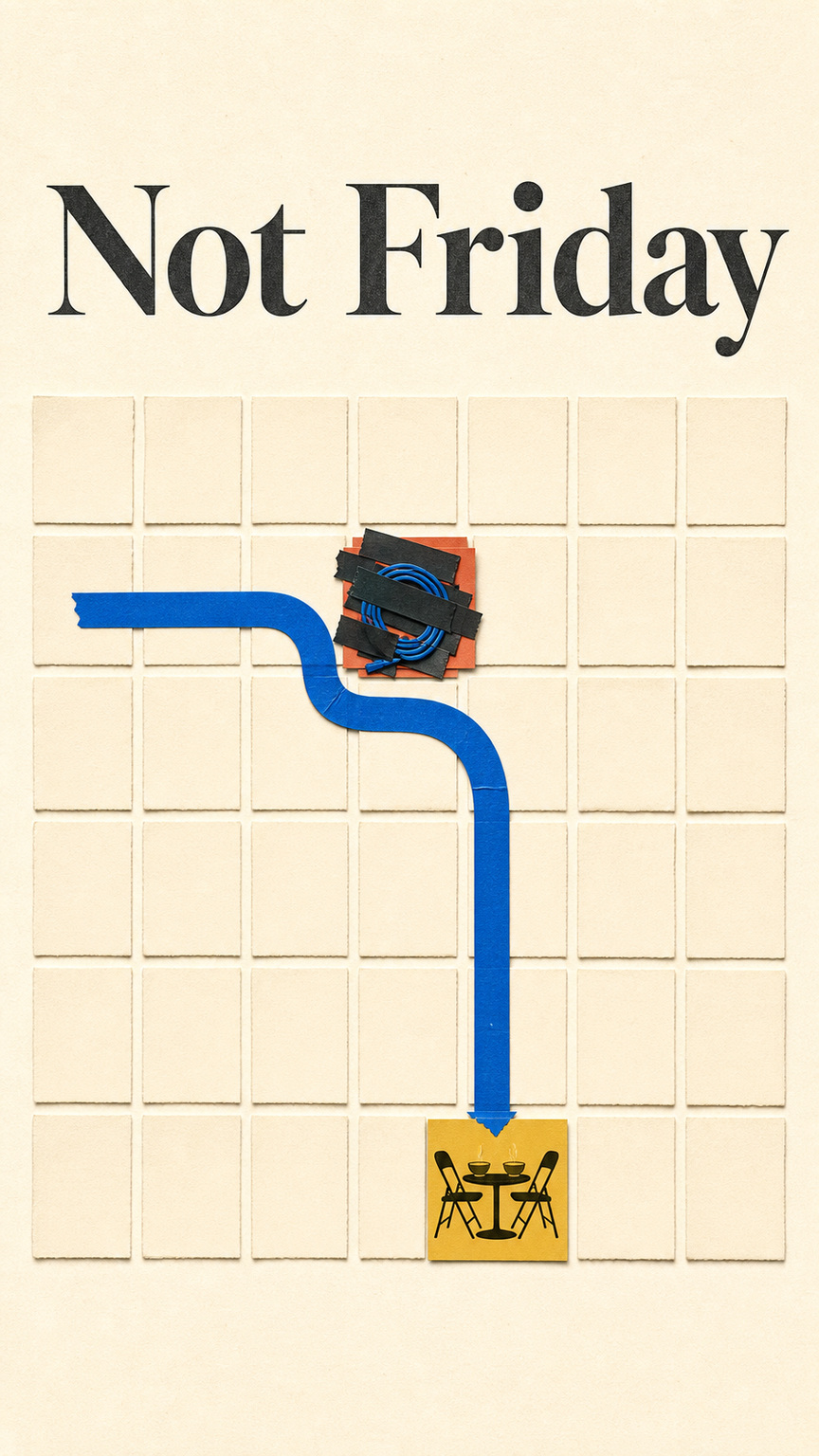
Wesley had carried eight folding chairs at once exactly one time. He had the scars on two knuckles and the dent in the arts center’s baseboard to prove it. On Wednesday afternoon he carried four, which left Jamar Ellis two free hands for opinions.
“Bro, just trust me. She likes you.”
Jamar walked backward between the chair stacks, steering by confidence. Behind him, forty-eight black seats waited to become eight straight rows in the rehearsal hall. Wesley set down his load before Jamar could hit one.
“You said that about the last four women, and—”
“Shut up. I wasn’t wrong about the last four.” Jamar planted both palms on the chair backs as if calling a witness. “They didn’t leave because you misread some mysterious signal. They left because you waited six-plus months to find out anything. Now ask Beatriz before she gets tired of waiting for you to ask.”
“Or she isn’t waiting.”
“Six-plus months,” Jamar repeated, having selected the useful portion of Wesley’s sentence. “Each time. Pattern established.”
“Not each time.”
“Objection.”
“Nobody invited you to court.”
“The court convened when you made the same mistake four times.”
They had known each other long enough that Wesley could hear the concern inside the performance. Jamar hated watching him retreat into maybe. He hated it with the personal offense of a friend who had listened to every careful postmortem and believed most postmortems could have been replaced by one timely question.
That did not make him an authority on Beatriz Soto.
Wesley took a tape measure from his pocket. “Thirty-two inches between rows.”
“Flight from evidence.”
“Fire code.”
They pulled the first row into place. The chair feet rasped against the old wood in brief, ugly bursts. Outside the hall, somebody tested the lobby lights, turning the open doorway amber and then white and then amber again.
“All right,” Jamar said. “Exhibit one. Ceramics class. She asked if coffee would be a date. You said you needed to check your schedule.”
“I did need to check it.”
“For seven months?”
Wesley nudged a chair leg onto the tape mark. She had asked clearly. He had liked her, and the clarity had somehow given him more to lose. By the time he returned with an answer, she no longer wanted one.
Jamar raised a finger. “Exhibit two. You two kept talking about dinner, you kept improving the plan, she moved away.”
“That was four months. And she moved for a job.”
“Sustained as to four months.”
The third woman had answered his eventual question with friendship, plainly and without cruelty. They had suffered one awkward volunteer shift and then been fine. This fact ought to have encouraged him. Instead, Wesley’s mind had filed the awkward shift under preventable hazards and misplaced the rest.
The fourth had started seeing somebody else while Wesley waited for a level of certainty no other person could possibly supply. Jamar presented that history with two fingers raised, then four, then a broad gesture that nearly took out a chair.
“Those are four different situations,” Wesley said.
“Four situations. One delay.”
“The move wasn’t caused by me. The friendship wasn’t a failure. And the fourth met somebody. She didn’t do that to make a point at me.”
“Great. Excellent distinctions.” Jamar shoved the next chair into line. “Ask on behalf of all your distinctions.”
Wesley measured the aisle. He could name what Jamar was getting wrong. Beatriz’s habit of saving him a dumpling during late setups did not reserve anything beyond a dumpling. The time she had texted him a picture of a display label with its apostrophe corrected proved she knew what irritated him, not what she wanted from him. She laughed at Jamar, too. She had given both of them rides when the buses stopped running. Friendly was not a coded contract.
Still, the four histories had one narrow piece of evidence in common. Waiting protected Wesley from answers while he called the protection consideration.
He folded the tape measure closed. “Okay. I’m going for it.”
Jamar slapped the back of a chair instead of Wesley, which was why they remained friends. “Motion carries.”
“You are not coming within twenty feet of the conversation.”
“Unreasonable restriction.”
“Thirty feet.”
“I’ll be in another room.”
“Thank you.”
“With excellent hearing.”
The side door opened before Wesley could revise the terms. Beatriz came through hip-first, a cardboard file box balanced against one hip and a coil of blue cable hooked over her other arm. Her dark hair was pinned up with a pencil. Three revised run sheets stuck out of the box like surrender flags.
“One of you has hands,” she said. “Possibly both.”
Wesley took the box. Jamar accepted the cable and made a dignified show of not looking at him.
Beatriz put the run sheets on the front row. “The Friday check-in volunteer canceled. The replacement says maybe, which is no. I moved the student quintet ahead of the auction, the food delivery window is now five-fifteen to five-forty, and the upstairs storage lock is sticking again.”
“How was the contract orientation?” Wesley asked.
“Three hours about ladders. My first paid call is Saturday morning, assuming Friday doesn’t bury me under a silent auction basket.”
“We can take check-in,” Jamar said.
“I can,” Wesley said at the same time.
Beatriz looked between them. “Wesley on the desk. He knows the ticket sheet. Jamar, float between lobby and house. No improvising new donation tiers.”
“That happened once.”
“It happened on three signs.”
Jamar carried the cable toward the stage, shaking his head at this hostile account of his service. As he passed Wesley, he lifted his eyebrows twice. Wesley concentrated on the file box until the eyebrows had safely left his peripheral vision.
For the next hour, Beatriz had half a conversation with everyone. She marked chair positions in blue tape, found the missing key in the wrong envelope, took a call from the food vendor, and corrected the same start time on twelve programs. Wesley watched any plan involving a dramatic Friday confession become obviously absurd. Friday belonged to the showcase. It also stood between Beatriz and a new job she had spent months trying to get. Adding his uncertainty to her load would not make the question more romantic.
It did leave him Wednesday.
At six-twenty, Beatriz checked the bus app and began packing her papers. Wesley had rehearsed seven openings. Two required a transition no real conversation would ever provide. One sounded like a calendar invitation composed during a fire. In another, he explained so carefully that she was free to decline that the invitation almost disappeared.
He carried the file box with her through the lobby. The front doors stood open to the mild evening, and buses sighed at the curb beyond the plaza. People crossed between them with grocery bags and backpacks. If Beatriz wanted to leave, leaving was already happening all around her.
“I can take that from here,” she said, reaching for the box.
Wesley gave it to her. His best opening vanished. Then the second-best.
“Could I—” He stopped. The rest of that opening had already become an explanation.
“Would you like to have dinner with me after the showcase on Friday?” he said. “Just the two of us. If you don’t, that’s okay. I won’t make Friday weird.”
Beatriz settled the box against her hip. For two seconds she looked only tired, and Wesley’s mind tried to build exits for both of them.
“I am interested,” she said. “But don’t backfill every friendly thing I did into a promise. I hadn’t made one.”
“I know. Or I was trying to know that.”
“Those are different.”
“Yes.”
The bus rounded the corner, its route number bright in the dusk. Beatriz shifted the box again.
“And not Friday,” she said. “Friday is the showcase. Saturday is my first contract call, and I will still be thinking in cables until at least Monday. Tuesday at seven. The noodle place beside the library.”
The bus hissed to a stop.
“Tuesday works,” Wesley said.
“Good. Send me your order if the food vendor texts you back.”
She climbed aboard with the file box. Wesley stood on the plaza until he remembered that staying there would not make the answer more answered. Then he went inside and sent her the vendor’s revised count.
Friday began by subtracting people.
At four-fifty-two, the replacement check-in volunteer sent a message containing the words so sorry and a photograph of a flat tire. At five-ten, the student quintet arrived with five students and one additional cello. At five-twenty, one of the two card readers refused to recognize the building’s network.
Wesley sat behind the lobby table with a cash box, a printed guest list, and Jamar leaning over his shoulder.
“She assigned you to the money,” Jamar said quietly. “Trust. Significant.”
“She assigned me because you invented platinum-level raffle tickets last time.”
“Community enthusiasm punished again.”
“Put the programs on the left.”
Jamar put the programs on the left. For nearly six minutes, he spoke only about programs.
By six-thirty the lobby had filled with damp coats and the smell of baked cheese from the warming trays. Beatriz moved through it with a headset over one ear, counting lanyards and answering questions in pieces.
“Two vegetarian trays downstairs,” a volunteer told her.
“Bring one up now. Leave one sealed.”
“The quintet wants six chairs.”
“Five players, six chairs. Fine. No seventh.”
She reached Wesley’s table and set down a roll of drink tickets. “How many checked in?”
“Eighty-three. Eleven prepaid haven’t arrived. The card reader on the right is dead, but the left one is keeping up.”
“Cash?”
“Balanced at two hundred forty.”
“Good. East doors open at six-forty-five.”
Jamar watched her go. “She said good to you differently.”
Wesley handed him half the programs. “East doors.”
The doors opened. The audience moved inside. At six-fifty-eight, two minutes before the welcome, every speaker in the black-box theater made a low electrical thump and fell silent.
For a moment the room absorbed the failure without understanding it. A hundred conversations continued under the work lights. Then the sound technician appeared at the lobby door, one hand pressed to his headphones, and beckoned so sharply that Beatriz was already moving before Wesley saw him.
She came back thirty seconds later.
“Main cable failed. Wesley, studio B upstairs. Orange road case. Bring two twenty-five-foot XLRs to the booth, then come back to the east doors. Don’t wait backstage. Jamar, keep this aisle clear.”
Wesley’s mind supplied questions. Was the road case labeled on two sides or one? If the storage lock stuck, should he find the facilities volunteer or come back? Did two cables mean two loose or a joined pair? The questions queued neatly, each offering a small delay.
“Orange case. Two XLRs. Booth, then east doors,” he repeated.
“Yes. Go.”
He went.
The upstairs hall was dark except for the red glow of an exit sign. The storage lock resisted once, then opened when Wesley lifted the door by its handle. The orange case sat behind two rolling costume racks. He moved them, found the cables, and ran them down the back stairs without stopping to imagine what Beatriz might infer from his speed.
At the booth she took one cable from him without looking away from the technician. “Other one under the stage lip. Then doors.”
Wesley passed it down, returned to the lobby, and stayed there. He explained the delay to late arrivals, found a chair for an older guest, and redirected three people who mistook the silent auction room for the theater. Through the wall came a burst of static, a voice saying check, and then applause when the voice came through clean.
The welcome began nineteen minutes late.
Jamar drifted back at seven-thirty with empty program boxes nested under his arm. “You notice she called you specifically.”
“I notice you have nothing to do.”
“I have pattern recognition.”
“Take the empty trays downstairs.”
“That’s not my assigned—”
“Please.”
Jamar studied him, perhaps hearing the edge that Wesley had not meant to add. Then he took the trays. “All right. Basement kitchen?”
“Service stairs are faster.”
“See? A useful conversation.”
At eight-forty, Beatriz appeared with her headset hanging around her neck. The welcome delay had spread. One performer had used the full original time, the auction had started late, and the closing quintet still needed a twelve-minute changeover. Wesley knew it was Beatriz’s favorite act because she had attended two of their rehearsals and once made Jamar stand perfectly still in the lobby to hear the cello through the wall.
She placed both hands on the check-in table. “Numbers. How many people still here?”
Wesley checked the clicker and the departure marks. “One hundred twelve inside. Eight have left. Forty-two said they’re taking the nine-forty bus, but some came in groups.”
“Any bidders in the gallery now?”
He looked through the open doors. “Six. Two are filling out sheets.”
“Facilities confirm ten o’clock hard close?”
“I asked when the sound went down. Alarm arms at ten-ten. They need the room empty at ten.”
Beatriz tapped the table once. The quintet could have its full set or the event could have its promised ending time. Wesley wanted to tell her that cutting her favorite was unfair, that everybody would understand, that he could help somehow. None of those sentences changed the clock.
“Do you need another count?” he asked.
“No. Close the gallery at nine-fifteen. Last bids at nine-ten. Tell the quintet eight minutes, no encore. I’ll apologize to them.”
“Okay.”
“And put the bus people on the aisle when they come out of the auction.”
Wesley wrote the new times on the lobby board. He found the quintet’s volunteer liaison and gave her the eight-minute limit. When the silent auction closed, he collected the pencils, directed the bus riders, and did not go backstage to see whether Beatriz was angry or disappointed or impressed. None of it would help her empty the room by ten.
The quintet played for eight minutes. Their final note was still moving through the room when Beatriz stepped out to thank the donors. The audience reached the lobby at nine-twenty-eight. The bus group left together. At nine-fifty-six, Wesley folded the last chair while Jamar rolled tape into a gray, useless ball.
Beatriz crossed the empty hall carrying a crate of bidder sheets.
“Table goes in the office,” she told Wesley. “Chairs in stacks of six, not eight.”
“A lesson I remember.”
“Good. Tuesday, seven.”
“Tuesday, seven.”
She kept walking toward the office. Jamar opened his mouth.
Wesley pointed at the gray ball in his hand. “Trash.”
Jamar considered an appeal, then dropped it into the bin.
On Tuesday evening, Wesley reached the noodle place at six-fifty-two without sending anyone a screenshot of the menu. He had looked at it twice, which was restraint by his standards.
Beatriz was already at a small table near the window. The pencil was gone from her hair. A strip of black stage tape clung to the cuff of her jacket, and there were shadows under her eyes that the restaurant’s yellow lights did nothing to hide.
“You look tired,” Wesley said, then wished he had chosen one of the other six openings available to him.
“I am tired. First contract weekend.” She peeled the tape from her cuff and wound it around one finger. “I carried a fake brick wall up two flights because someone measured the freight elevator emotionally.”
Wesley sat across from her. “Did the wall fit on the stairs?”
“After we removed a door. The door was real and heavier than the wall.”
A server set down two menus and asked whether they wanted tea.
“Hot,” Beatriz said. “Big pot.”
Wesley nodded. “Please.”
When the server left, Beatriz opened the menu and looked at him over its top edge. “Do you share appetizers, or do you become territorial?”
“Depends on the appetizer.”
“Cucumber salad.”
“Shareable.”
“Scallion pancake?”
He pretended to require calculation. “Border dispute likely.”
“We’ll get two.”
She marked the paper order slip. Wesley watched her choose the noodle thickness without consulting him, then slide the pencil across the table so he could choose his own. Outside, a bus pulled away from the curb. Beatriz asked what he did when the arts center did not need its chairs counted, and waited through his first, overly detailed answer until he found the part she had actually asked about.
The tea arrived. Then the cucumber salad, cold and sharp with vinegar, and two separate plates of scallion pancake.