The Blade Calls Your Name
The blade calls your name
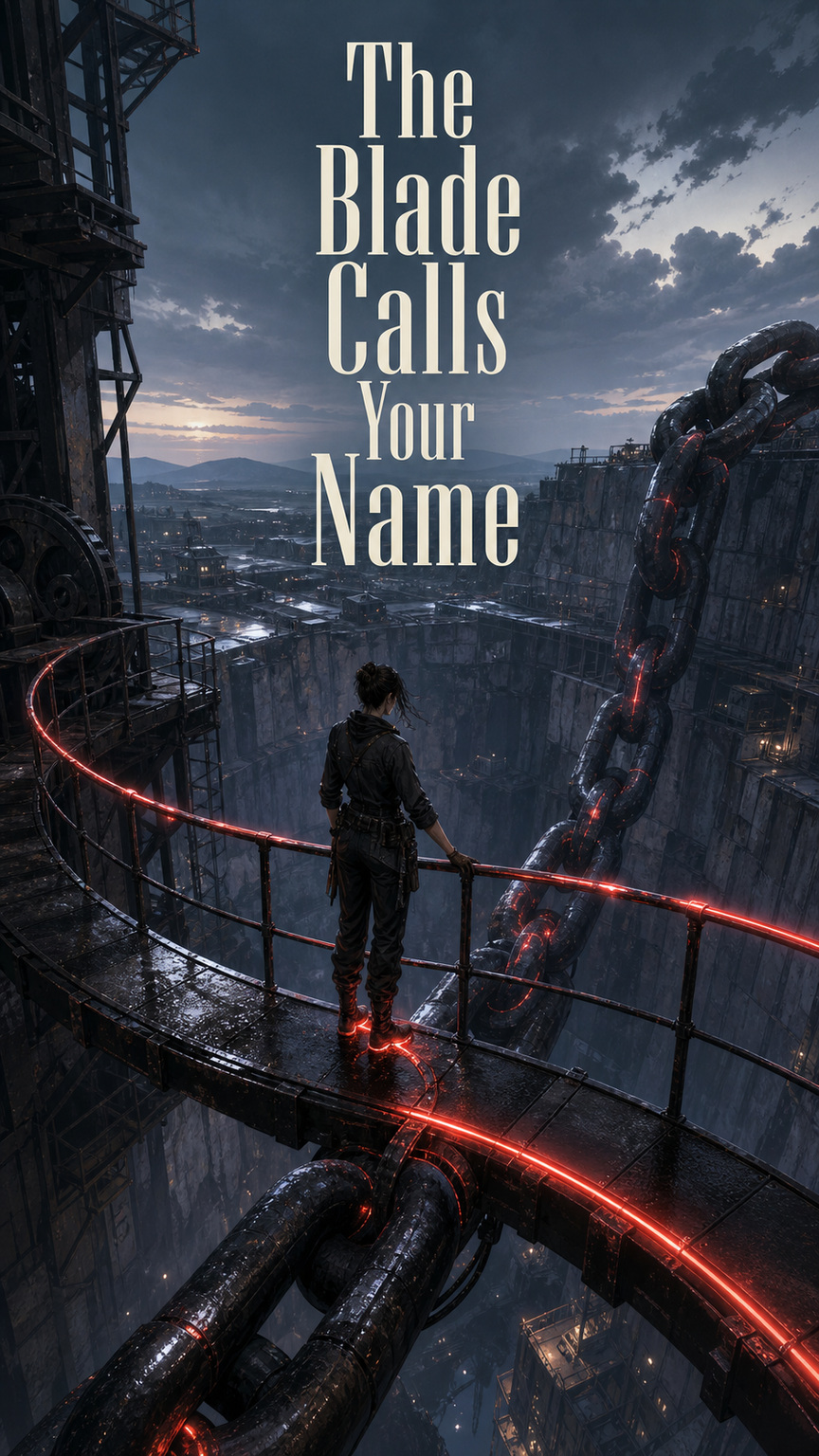
The blade called Odmara’s name through the soles of her boots.
She felt the first syllable in the guild hall’s iron gallery: a low double knock under the chatter of chainwrights putting away tools. The second climbed the railing into her palm. Across the room, above the long rack of service keys, red light moved inside a blade that had been dark for six years.
Mica seams divided its black length into narrow scales. They lit one after another, making the old work-script.
ODMARA.
The blade could not know she was there. It had no eyes, no will, and no notion that the name belonged to a woman standing under it. Still, the gallery gave a third knock, and twenty people turned toward her.
Registrar Yevet reached the rack first. “Clear the rail. Everyone.”
“It has dust in the back plate,” Felrin said. He was already rolling up his right sleeve. “A contact has crossed.”
Odmara kept her hand on the railing. The pulse came again, two beats at the O, a scrape through the M, then three close taps where the final A should have ended cleanly. She knew that damaged rhythm. She had put it into an anchor by lanternlight while rainwater ran down both wrists.
“Don’t touch the hilt,” she said.
Felrin stopped with his fingers a thumb’s breadth away. Six years had silvered the hair at his temples and done nothing to improve the way he looked at a fault: chin forward, as if every material might yield to seniority.
Yevet slid a lamp shutter closed. The hall dimmed. The red strokes remained.
“The registered worker is Felrin,” she said. “The maintenance ledger says west-nine was his repair.”
“Then the blade is wrong,” Felrin said.
The railing knocked Od-ma-ra against Odmara’s bones.
“The ledger is wrong,” she said.
No one in the gallery spoke. Hammers settled on benches. A coil of fine chain gave one last whisper as an apprentice let it down.
Yevet looked from the blade to Odmara. “Is that a claim of workmanship?”
“It’s a maintenance alarm.”
“That wasn’t my question.”
“Then ask it after we know what needs maintaining.”
Felrin reached again. Odmara caught his wrist. The old habit of obeying him arrived half a breath late and found her hand already closed.
“If you answer with the wrong pattern,” she said, “the key will show only the witness layer. It won’t show the cut.”
“You haven’t worked this hall since you left.”
“And you haven’t answered it yet.”
The outside door struck its stop. Kosca came in wearing the quarry lift’s blue shoulder sash, one end dark with brake water. She did not waste time on the gathered chainwrights.
“West rail is singing,” she said. “The full counterweight comes down at deep bell.”
Yevet opened the shutter enough to read the water clock. “Thirty-eight minutes.”
“Thirty-four before I need the lower route empty.” Kosca looked at Odmara, then at the name on the blade. “There you are.”
Odmara heard the six-year-old rain in those three words.
Felrin heard something else. “You knew?”
“I knew whose hammer I was holding a lantern for.” Kosca hooked two fingers toward the service stairs. “Argue while walking.”
Yevet took the rack key from her belt. “The blade remains guild evidence.”
“It remains useful,” Odmara said. “Unlock it.”
The registrar considered the red script, then set both hands to the rack. “Felrin, right guard. Odmara, do not take the hilt.”
Felrin’s mouth tightened, but he obeyed. With two people holding the guard, Yevet turned the key. The clamps opened. The blade stayed where it was until Kosca slipped a carrying bar through the guard and took one end.
It did not leap for Odmara. It did not point. Freed from the rack, it merely carried her name in red mica and gave the iron bar a tired, repeating hum.
Together they carried it down.
The lower works of Hearthchain hung under the guild hall like the ribs beneath a ship. Stairs switchbacked along the cliff, past chain combs thick as doorways and water pipes sweating into the evening air. Below, roofs crowded the suspended terrace. Supper smoke lay flat over them. Farther out, the quarry lift’s cage waited above the dark cut in the mountain, and its counterweight showed as a block of stone and iron high in the opposite shaft.
At the first control landing, Kosca braced her end of the bar against the wall.
“No load first,” Odmara said.
“I can float the guide for eight counts,” Kosca said. “After that the west brake takes water.”
“Six is enough.”
Yevet held up her slate. “What will that establish?”
“Whether the rack is lying,” Felrin said.
Odmara crouched beside the landing rail. “Whether the signal comes from the lift load or the terrace hang. Different question.”
Kosca was already at the brake wheel. “Lower stairs clear?”
Yevet leaned over the inner rail. “Clear below!”
An answering call climbed from landing to landing. Kosca waited for the last one, then cracked the bypass. Water hammered through a side pipe. For six counts, the guide chain slackened.
The red name vanished from the blade.
Felrin exhaled as if acquitted.
Then the carrying bar trembled in Kosca’s grip. One thin vibration continued through the landing rail, too high to hear and impossible for Odmara to mistake through her fingertips.
“West-nine,” she said.
“There are twelve west anchors,” Yevet said.
“Only nine shares that overtone with the lift guide.”
Felrin put two fingers to the rail. “Or eight, after the second expansion.”
“Eight rings flat when the guide is floating.”
Kosca shut the bypass. The pipe thumped silent; the guide took weight. Red strokes crawled back into the mica.
“Thirty-one minutes,” Kosca said. “Pick a stair.”
Odmara took the west one.
They descended past the upper anchor chambers while the blade changed in their hands. At one landing it flashed her whole name. At the next it showed only ODM, the rest lost in a red blur. The connected railings carried a coarser version of the call into the homes below. People had begun coming out onto their walks.
Kosca stopped long enough to point two lift hands toward the evacuation routes. “Lower three rows first. No bundles larger than a child. East stair, not the quarry bridge.”
One of them glanced at the glowing blade. “Captain, is it naming who broke it?”
“It’s naming work. Move people.”
He moved.
Yevet wrote on her slate as they continued. “Six years ago. West-nine. Emergency entry?”
“There wasn’t one,” Odmara said.
“There is an entry. Felrin, full replacement of the ninth flexible link, inspected and closed.”
Felrin’s hand shifted on the carrying bar. “The storm had opened three hangers. We could not leave the terrace on eight.”
“That explains urgency,” Yevet said. “It doesn’t explain a false completion.”
“It was intended to be completed.”
Odmara almost kept walking. The old choice had lived so long without words that speaking it felt like picking a rusted pin from a wound.
“I made a flexible splice,” she said. “Spring strips around the broken eye, staggered so the link could settle while the comb was wet. Temporary. I told him it would take the night load, maybe a season if we watched it.”
Yevet’s chalk paused. “Under which work-name?”
“This one.” Odmara tapped the rail when it pulsed again. “I’d claimed it nine days before.”
At the time, the guild had still carried her childhood name in its apprentice book. Felrin had said a new engraving required a master’s petition. Odmara had engraved her own name on the blade’s mica strip with the tip of a broken awl.
“Two witnesses held the guard?” Yevet asked.
“I did,” Kosca said. “Felrin did. She hammered.”
Yevet turned to Felrin. “And you marked the repair as yours.”
“An apprentice’s unregistered name would have voided the work.”
“Her work held the terrace,” Kosca said.
“Which is why I put my mark over it.” Felrin’s answer came quickly, almost in his old teaching cadence. “An emergency authorization. The only one the lower wardens would accept. I ordered new stock the next morning.”
“You promised to replace it,” Odmara said.
“I know what I promised.”
“Do you know where the stock went?”
He did not answer before Kosca cut in. “Twenty-six minutes. Lamp.”
Yevet passed it forward. Odmara took it, though she had asked no one for light. She had been listening for Felrin to deny the promise and had nearly walked past the west-nine door.
The anchor chamber was a slot in the cliff, hot with trapped metal smell. A chain as broad as Odmara’s chest entered through the floor and divided over an iron comb set into the mountain. Twelve teeth held twelve hanger lines. The ninth line quivered hard enough to rattle scale from the wall.
The splice lay behind the comb where she remembered it, dull spring bands wrapped around the old eye. Six years of grease had blackened everything evenly. Nothing in the room announced guilt. Loads did not care what the ledger said.
They set the service blade on trestles. Its point was squared, its back toothed for shaving anchor shoulders. It had once been part of a sky-iron quarry saw; the old alloy ran pale through newer spring steel, and red mica filled the forge seams. Three materials and a century of repairs lay under Odmara’s hand.
Felrin examined the splice with a probe. “No separation.”
“Not at rest,” Odmara said.
“I can read a joint.”
“Then read it under load.”
Kosca set her shoulder to the speaking tube. “Control, give me one-eighth on west guide. Hold lower cage.”
The answer came faintly. A wheel turned somewhere beyond the stone. The ninth link drew taut. Odmara watched the spring bands settle, each taking the pull in sequence exactly as she had meant them to.
Felrin’s probe stayed still. The splice held.
Beside it, the tenth tooth moved.
Only a hair’s breadth. Enough. Its base leaned toward nine, and a bright crescent of rubbed metal showed where no metal should touch.
“There,” Odmara said.
Felrin moved the probe. “The tooth has walked.”
Yevet bent close. “Cause?”
“My splice flexes more than the solid eye,” Odmara said. “It was supposed to until replacement. Six years of it let nine pull sideways against ten.”
Yevet wrote, then stopped. “So the defect comes from your method.”
“From leaving the method in service,” Felrin said.
The precision of that surprised Odmara more than denial would have.
Kosca knocked the speaking tube twice. “Take the load off. Twenty-one minutes.”
Yevet studied the bright crescent. “Workmanship sound. Authorization false. Replacement omitted. Consequence transferred to an adjacent part.” She rubbed out three words on her slate and wrote again. “I will need separate lines.”
Felrin looked at Odmara. “Let me seat the blade.”
“Why?”
“My mark authorized the repair. If the witness layer accepts it, we may get the cut path without making this a claim on you.”
She wanted that to be possible. Wanting it made her suspicious.
“One test,” Yevet said. “No force.”
They lifted the blade from the trestles and slid its squared tip into the diagnostic slot beneath the comb. Felrin took the hilt. Yevet and Kosca held the two sides of the guard, completing the old witness circuit.
Felrin spoke his registered work-name and tapped the hilt with the test hammer: the standard six blows every master learned.
The mica lit amber at both edges. Witness colors. A shallow red groove appeared down the blade’s center, then broke into scattered flecks before it reached the tip.
“No cutting path,” Odmara said.
“The lower section is faint.” Felrin leaned his weight into the hilt.
The blade gave a dry snap. A black chip jumped from the mouth of the slot.
Kosca released the guard and shoved him back. “No force meant no force.”
Felrin stared at the chip. His face had gone grey under the chamber lamp.
Yevet picked it up and placed it on her slate. “Attempt by authorizer. Incomplete response. Damage to seat.”
“We don’t have time for your categories,” Felrin said.
“We have damage because you ignored one.”
“Both of you, space.” Odmara knelt at the slot. “Lamp lower.”
Kosca lowered it. The chip had come from a sacrificial lip, not the comb itself. Repairable, if nobody forced the blade again.
Felrin crouched beside her. For once he did not fill the silence. His hands waited on his knees.
“I need the fine hammer,” she said.
He passed it handle-first.
Odmara took the hilt. Her engraving lay beneath her palm, the letters shallow and uneven. She had made them in anger six years ago, after Felrin told her to wait for permission to be called what she was already called everywhere else. She had forgotten how cramped the final A was.
“Guard,” she said.
Kosca set her left hand to it. Yevet set her right.
Odmara did not speak her name. The blade already held the label. She answered with the repair: two light taps for the first spring strip, a pause while the load had settled, three along the second, then the dragging fourth blow she had made while the rain shifted the broken eye under her hammer.
Red light ran from her palm to the point. Her name appeared once across the mica. Below it, two cutting grooves shone side by side.
Felrin bent closer. “The inner groove follows the old eye.”
“It did six years ago.”
“Then the outer is ten.”
Yevet said, “Which one is valid?”
Odmara looked at the two lines. Changed cable tension had folded the old reading over the new fault. The blade repeated stored strain. It did not choose between them.
“I don’t know yet.”
Kosca’s mouth was at the tube again. “Seventeen minutes. Lower rows are clear. I can bleed the west brake and buy five more, but then I can’t stop the terrace lift during evacuation.”
“Don’t spend it,” Odmara said. “Give me the lamp shutter.”
They tested the grooves by changing one condition at a time. Kosca floated the guide for four counts while Odmara watched the red lines. Yevet shut the lamp, then opened it through a finger-width slit so reflections could not masquerade as mica. Felrin touched separate rail leads to the ninth and tenth teeth.
At no load, the inner groove dimmed. At one-eighth, both returned. When Felrin isolated the ninth lead, the inner line rang through the hilt. When he moved to the tenth, the outer line gave a slower beat that matched the railing under Odmara’s knee.
“Outer,” she said. “We shave ten. The splice stays.”
Felrin’s head came up. “If we cut the shoulder without unloading nine, the tooth may kick.”
“We unload it too far and ten snaps back against the comb.”
“A wedge before the cut.”
“A wedge won’t seat while they’re touching.”
Kosca broke in. “I can pulse the load. Quarter, eighth, quarter. Tell me where you want the gap.”
Yevet looked from the blade to her slate. “Who is performing?”
Odmara understood the trap before Yevet did. If she held the blade alone, the tool would store her pattern again. The emergency would be hers in metal even if the ledger managed honesty this time. Felrin watched her understand.
“I can take the cut,” he said.
“You can’t read the path.”
“Your hands over mine.”
That would look like instruction. Master and apprentice, restored by posture before anyone wrote a word.
“No.” Odmara stood. “Felrin, you take the wedge and the seat. On the joint, not behind me. Kosca owns the load and the right guard. Yevet, left guard and record. I’ll take the blade.”
Yevet hesitated. “The key records one work-name.”
“Your slate has room for four kinds of work. If you’re going to write this as mine alone, take your hand off now.”
The chamber gave a low shiver. Dust came down from the lintel.
Kosca said into the tube, “West control, stand by quarter-load pulse. On my count, not the bell.” Then to the room: “Wedge?”
Felrin chose one from the wall case and offered it to Odmara.
She shook her head. “Fit it.”
He tested it against the gap, filed one corner, tested again. His explanations had left him. He spoke in material and measure now. “Too proud by two hairs.”
“One,” Odmara said.
He filed once more. “Ready.”
Yevet put down the chalk and gripped the left guard. Kosca closed her free hand around the right, pinning the speaking tube against her shoulder. “I am witnessing a joint operation,” Yevet said. “Authorization, load, cut, and seating recorded separately.”
“Good,” Odmara said. “Hold.”
Kosca drew breath. Through the speaking tube: “Quarter.”
The chamber tightened around them. Nine drew outward. The bent tenth tooth pressed hard enough to squeal.
“Eighth.”
For an instant the bright crescent opened into a gap.
Felrin drove the wedge halfway. The gap caught it.
“Quarter,” Odmara said.
Kosca relayed the order. The load came on in a rising growl. Felrin’s forearm shook, but he kept the wedge square.
Odmara seated the blade against the outer red groove. She did not swing it. She drew its toothed back across the jammed shoulder in one short stroke. Sky-iron sang against iron. Red mica flared with the pattern in her palm.
“Eighth.”
The gap opened. Felrin struck once. The wedge moved to its mark.
“Hold,” he said, barely louder than the metal.
Kosca held the load. Odmara shaved again. A curl of hot iron fell across her glove. The tooth eased away from nine, not much, then enough for both lines to stand true.
The deep bell began above them.
Its first stroke rolled through the mountain. Kosca had the tube before the echo died. “Counterweight in four stages. First now.”
The guide chains took the descending weight. Every hanger in the chamber pulled. Felrin kept one hand on the wedge and reached the other toward the seat, feeling for movement. Yevet’s fingers whitened on the guard; her free hand marked each stage on the slate.
“Second,” Kosca said.
The splice lengthened by the width of a nail paring. The new wedge took the sideways pull. Ten stayed straight.
“Third.”
Odmara felt the blade’s red pattern sharpen. Her name burned clean across it, then broke into the diagnostic strokes of the repaired joint.
Felrin said, “Seat is holding.”
No precedent. No explanation. Just his hand and what it touched.
“Fourth,” Kosca called.
The full counterweight descended. The terrace groaned beneath the cliff, a great working sound that passed through rails, floors, pipes, and the bodies of everyone who had not yet evacuated. Then the loads settled. The ninth splice held. The tenth tooth stood clear. The sacrificial lip kept its small new chip and no more.
Kosca waited three breaths. “Stable.”
Only then did Yevet and Kosca release the guard.
The blade continued to show ODMARA. The alarm had cleared from the railings, but the stored work label remained bright in the mica. A repair was not closed until someone demonstrated the new pattern and the prior worker released the old one.
“I can do the sequence,” Felrin said.
Odmara looked at him.
He swallowed the rest. “Kosca controls this load.”
Kosca handed the speaking tube to Yevet and wiped brake water from her palm. “Fine hammer.”
Odmara gave it to her. Kosca seated the blade again, called for eighth-load, then no-load, then quarter. She tapped once at each change, not Odmara’s old repair rhythm but the new path through nine and ten. The mica answered with straight red strokes. At the last tap, Kosca scratched her work-name into a fresh strip at the hilt.
Yevet watched the rail leads. “Demonstration complete.”
Felrin took the slate. His hand hovered over the authorization line.
“Don’t put your mark over hers,” Kosca said.
“I heard you.” His voice was tired, not sharp. He wrote his name in the authorizer’s field, then passed the slate back. “Joint repair authorized under active load. Odmara, cut and diagnosis. Felrin, seating. Kosca, load and receiving maintenance. Yevet, witness and record.”
Yevet read it before adding her mark. “Prior omission remains referred for judgment.”
“Yes,” Felrin said.
Odmara set her thumb over the cramped A engraved six years before. Felrin and Yevet took the guard. Kosca held the hilt without pulling.
“Release the Odmara pattern,” Yevet said.
The mechanism required the prior worker’s voluntary hand on the name strip. That was all. It could not know whether she forgave, whether she belonged, or whether the name still fit. It knew pressure, contact, and the sequence the builders had given it.
Odmara pressed the release stud beneath the mica.
“Released.”
Red light withdrew from her letters. For a moment KOSCA shone at the hilt while the repaired diagnostic strokes crossed the blade. Then the counterweight finished its descent, the strain matched no alarm pattern, and the blade went dark.
Kosca let out a breath. “People can go home in twelve minutes if the second reading holds.”
“It will need a watch through morning,” Odmara said.
“I said go home. I didn’t say sleep.”
Yevet tore a temporary tag from her book. “Performer field.”
“Fields,” Odmara said.
Yevet glanced at the slate and ruled three extra lines. “Cut and diagnosis. Seat. Load.”
“And authorization,” Felrin said.
“That already has its own line.” She tied the tag to the tenth tooth, well clear of the chain. “Guild membership?”
Odmara pulled off her scorched glove. “No.”
Felrin kept his eyes on the wedge. “Independent chainwright.”
Yevet wrote it exactly.
Above them, the blade waited in Kosca’s hands, its mica seams dark. Through the railing came the ordinary diminishing rumble of the quarry counterweight, with no name inside it.