The Fourth Blood
You're a sorcerer in the mountains, trying to unlock the secret of immortality thru blood magic. Instead, you're starting to figure out that humans have blood types.
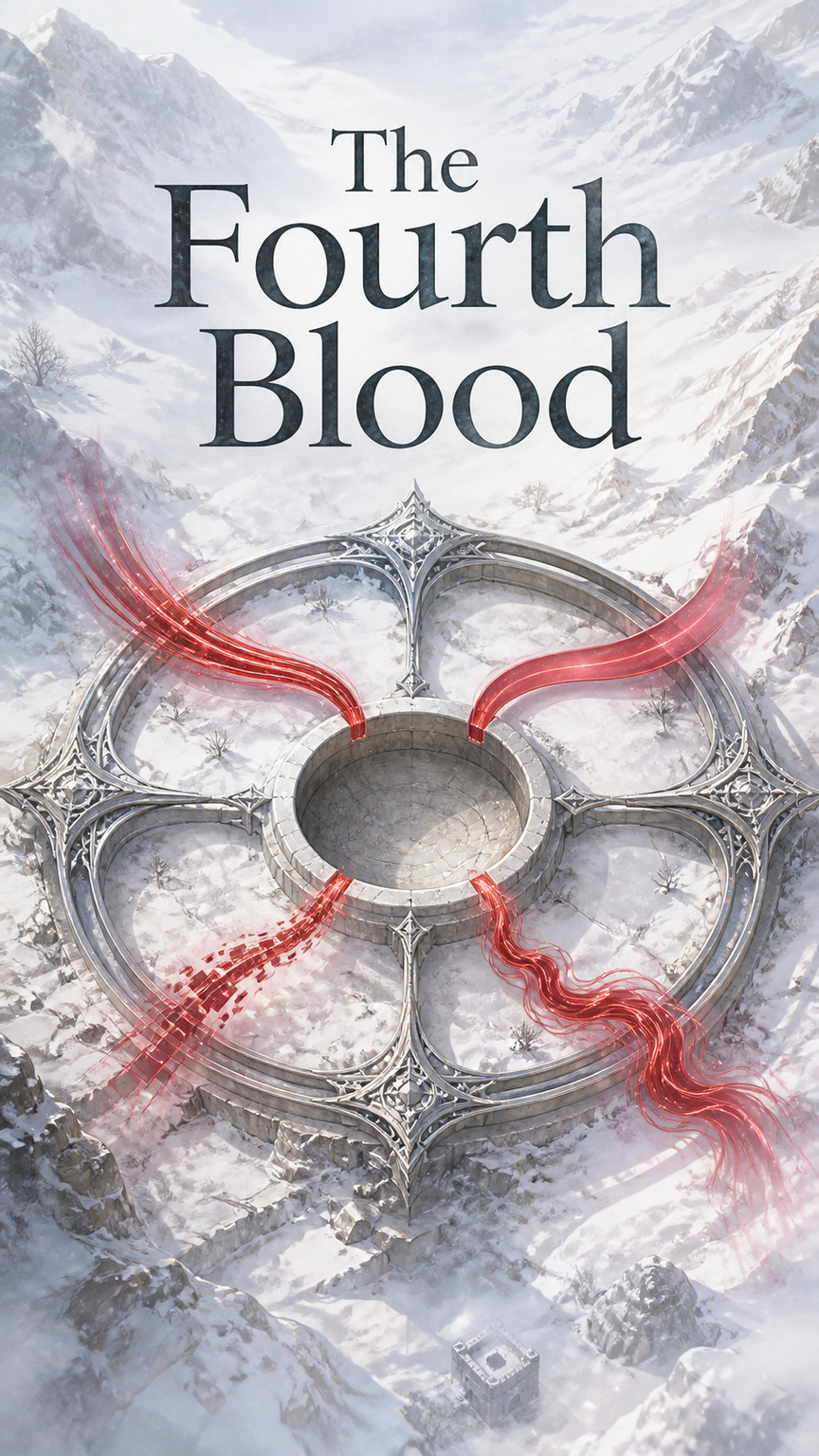
The healer brought the last case up the mountain six days before the first snow, though I had assured her the snow was three weeks away.
She set it on my bench and kept both hands on the lid. Meltwater darkened the shoulders of her wool coat. Behind her, through the tower’s western slit, clouds had swallowed the high pass where my weather rods stood pointing at a sky they could measure but not persuade.
“Twenty-eight,” she said. “Sealed separately. The marks match the ledger.”
I reached for the case. She did not release it.
“And?”
“And you read the permissions back to me.”
The convergence frame occupied most of the room: four rings of silver wire around an empty stone basin, with a place for each vessel along the outer rim. It looked magnificent. It did nothing. The wire could hold a shape I gave it; the stone could keep a working from spilling; the samples in their glass were only samples. Without my hand on the pulse plate, every costly piece was as magical as a spoon.
I tapped the ledger. “They permit comparison, joining in the final pattern, and retention until the thaw.”
“Some permit all three. Five permit comparison only. Two want what remains returned before the pass closes.”
“Then those two will not be retained.”
“Say the rest.”
The clouds lowered behind her. I had spent nine years approaching this morning: nine years proving that age was an error of repetition, that a living pattern frayed because it renewed itself alone. Braid enough human continuance together, I believed, and no single failure could end the whole. A rope survived the breaking of a fiber. A river did not die when one spring went dry. My own blood-linked trials had held for minutes, then hours, then one full turning of the moon.
The ledger was not the work. The ledger was what people placed between the work and its completion.
“Nothing enters a body,” I said. “Nothing treats an illness. No sample outside its permission. I supply and end the working.”
Only then did she let go.
“Soup’s in the lower pot,” she said. “You look thin.”
“Immortality will correct that.”
“Eat before you test it.”
She hung her coat beside the stove, inspected the salt crock, and told me the mule would make only one more trip if the eastern shelf iced over. I was already fitting the separately sealed vessels into their numbered rests. She had made the marks deliberately dull: squares, bars, dots, no sign of who had been strong, sick, young, old, related, or well fed. The human particulars I considered noise had been removed for me.
Nothing in the first comparison behaved as blood ought to have behaved.
I set my palm to the pulse plate. The frame waited through one beat of my heart and took the second. Pale light moved outward from my hand, not from the glass, and touched two vessels at once. I meant the light to rise into a single steady loop, the smallest proof that separate lives could support one pattern without losing their difference.
The loop held.
I chose a third vessel. The light went out.
Not dimmed. Not weakened. Extinguished back to my palm so quickly that my wrist struck the edge of the bench.
The healer looked up from the ledger. “Stop.”
“A flaw in the channel.”
“Your hand is shaking.”
“Because the return surprised me.” I moved the vessel to another rest and began again. My pulse entered the silver. Two samples held the loop; the third erased it. When I exchanged the third for a fourth, the light returned, steadier than before.
The healer came beside me. “Which permission?”
I read the mark twice before I found it on the page. “Comparison and final joining.”
“Not whatever you decide this has become.”
“It has become a correction.”
“Then correct inside the boundary.”
She had a talent for making a boundary sound less like a wall than a sequence of doors, each requiring its own answer. I resented it because doors delayed me. I obeyed because the case would never have come up the mountain otherwise.
By dark I had repeated the comparison with different rests, different lengths of silver, and a fresh circle drawn on the pulse plate. The frame remained blameless. So did the glass. Every shape began in the beat under my palm and ended when I lifted it. Yet the same pair held, the same third extinguished, and two others I tried divided themselves around that difference.
“Cold,” I said.
The healer was cutting yesterday’s loaf into the soup. “It’s cold in here, yes.”
“The samples. Some crossed the upper bridge after noon.”
“The marks don’t tell you which.”
“You do.”
“Not until you write down what happened before I tell you anything.”
“I know what happened.”
“Write that, then.”
The next morning I learned the extinguishing sample had arrived warm with the others. The morning after that, authorized comparisons divided recent samples and older ones into the same alliances. Hunger did not explain it. Neither did fever, recovery, the high farms, or the damp houses by the river. Each possibility had the decency to fail. The original pattern did not.
By the fourth day I had drawn three columns in my book.
I called them measures of vigor. The healer crossed out the heading.
“You cannot alter my record.”
“Then stop leaving it open while you come down for onions.”
Her rooms below the ridge smelled of steam, ash, and wet wool. Six people waited there for ordinary care. Nobody cared that I had divided human vitality into three elegant orders. They wanted dry boots, a cough quiet enough for sleep, and news of whether flour had come before the bridge washed out.
The healer carried the onions to the pantry. “There are frail people in each of your columns.”
“Frail now.”
“And strong people in each.”
“Strength is not always visible.”
She put one finger on the heading in my book. “Then this word is a guess. Cross it out.”
I followed her between shelves. “If the strongest pattern accepts the others—”
“You haven’t found strongest.”
“The first column sustains the cleanest loop.”
“With itself.”
“Purity often looks like that at first.”
A cup struck a table behind me, hard enough to spill.
The resident from the mill had been sitting near the stove with both boots wrapped in blankets. I had not seen him since the earlier charm. He was thinner. The gray under his eyes made me think of insufficient recovery, an error I nearly offered aloud.
“Don’t call it that,” he said.
“Call what?”
“Mine impure.”
“I don’t know which is yours.”
“You told her I was, after the charm.” He nodded toward the healer. “You said something in me muddied the line.”
I remembered the trial as a page of failed ratios. Three volunteers’ sealed samples had rested in separate arms of a holding frame while I supplied the charm from my own pulse. No blood had passed between anyone. The spell was meant to let one person’s strong rhythm steady another’s fatigue across a few paces. It had instead put the miller on the floor.
“That was an uncontrolled interference,” I said. “This may explain it.”
“Explain this.” He pressed two fingers beneath his ribs. “Everything pulled tight here. Then my mouth tasted like old coins, and the room kept tipping after you stopped. Is that one of your columns?”
“The charm never entered you.”
“I know where it didn’t enter.”
The healer came back carrying a heel of cheese. She did not rescue me. She set it beside his cup and waited.
I heard myself begin again, faster. “A connection need not transfer matter to impose pattern. If the joining tried to reconcile two unlike structures, the rebound would have traveled through the living source—through me—but the linked participant might experience a sympathetic—”
He pulled the blankets off his boots. “No.”
“I am answering you.”
“You’re making a longer question.” He stood, caught the table when the room moved under him, and looked at the healer. “Do I have to leave my sample up there?”
“No,” she said. “You allowed comparisons until the snow. You can withdraw that now.”
He glanced at me once. “Then I withdraw it.”
The loss was immediate and ridiculous. One vessel out of twenty-eight, yet I saw a hole in the design larger than the basin. “If it is the sample that produced the unusual result, removing it destroys the chance to understand what happened to you.”
His hand stayed on the table. “You didn’t understand it when you had it.”
“I understand more now.”
“Then tell me when it’s enough to be useful.”
He left with the cheese in his pocket. The healer watched until the outer door shut.
“Return his vessel,” she said.
“Today?”
“You have a mule going up.”
“It will disrupt the series.”
“Yes.”
There was no pleasure in her answer. That made it harder to fight.
I ate the soup cold that night. Before removing the resident’s vessel from the frame, I copied only the comparisons already permitted and performed. Then I wrapped it, sealed my copy of his withdrawal beside it, and sent it down unopened.
The fourth blood appeared two days later.
The healer had relabeled an authorized subset while I stood outside my own workroom in sleet. She changed every position and kept the key. I protested that concealment punished expertise. She said, “Good. Predict without it.”
I predicted.
The first group held only with itself. The second held in combinations that extinguished the first. The third seemed broad until one pairing exposed a clean refusal. Then there was the fourth: three vessels I had scattered among the other columns because their donors’ ages, diets, and winter health tempted different explanations. Blind, they found one another. Under my pulse, the light took a tight, low arc unlike the other loops. When I lifted my hand, it vanished. The three vessels sat in ordinary glass, dark and silent.
“Again,” I said.
The healer checked the permissions before she moved anything. “One comparison. Then you rest.”
“I’m not tired.”
“Your thumb won’t stop twitching.”
“That is not fatigue.”
“What is it?”
I put my thumb against my palm. “Revision.”
She gave me one comparison. The low arc returned.
The categories in my book stopped being a ladder. I drew them as separate circles, then struck out the circles because they suggested clean borders the evidence had not earned. One vessel still changed its apparent allegiance when compared across days. I could not decide whether it marked a fifth pattern, an error in my own control, or a distinction too fine for the spell. I wrote a question beside it and disliked the look of my handwriting.
Outside, snow covered the weather rods to their elbows.
The convergence remained scheduled for the longest night of the fortnight. I told myself the new groups did not invalidate it. A rope could carry fibers of different strength. A river accepted unlike waters. A chord required different notes. Each analogy arrived polished, obedient, and false in a slightly new way.
The frame had already shown me what difference did under pressure: the pattern did not broaden. It went dark.
Still I set every permitted vessel around the basin on the final evening. Five comparison-only samples stayed locked in the case. The withdrawn sample was gone. The remaining glass stood in its marked rests, each separate, while silver channels led toward the empty center. Activating the frame would not mix a drop, but it would pool every linked pattern inside the working and drive the whole convergence through the only living source in the room.
Me.
That had once seemed like a virtue. I would become the knot that could not be cut because every human line reinforced it. Now the frame offered another possibility: incompatible lines forced together, returning through my pulse and outward along every connection before I could release them.
Snow struck the slit in handfuls. The pass had vanished. Down in the valley, people slept under roofs already carrying winter’s weight. Some had allowed me to compare a sample. Some had allowed a final joining because I had told them it was the last step in a theory I understood.
I placed my hand above the pulse plate.
My heart beat against the silence. It was not the serene clock I had described in nine years of papers. It hurried. It skipped when I held my breath. A small animal in a locked room, throwing itself at the door.
I wanted more time. Not a noble quantity of time, not centuries dedicated to wisdom. I wanted the next morning because the next morning existed and I might not. I wanted enough years to prove I had not wasted the ones behind me. The desire was ugly only in its appetite. It was also mine.
My palm hovered until the skin cooled.
Then I lifted each vessel from the frame and put it back in the case.
The basin remained empty. The silver remained wire. Nothing woke.
Near midnight the healer came through the storm with a lantern and a sack of barley. She found me at the smaller comparison board, not the convergence frame.
“The shelf iced over,” she said. “The mule’s staying below.”
“You walked.”
“Yes.” She stamped snow from one boot, then the other. “Is it done?”
I pointed at the unopened case.
She did not praise me. “What are you doing now?”
“One comparison. The permissions allow it. The labels are still blind to me.”
“Why this one?”
The answer unfurled at once: predictive distinction, independent confirmation, the philosophy of categories as instruments rather than essences. Her face made me stop halfway through the first breath.
“Because I wrote down which pair would fail before you arrived,” I said. “If it fails, the groups explain the old result better than cold or weakness did. If it doesn’t, I write that.”
She took the ledger from her coat. “Whose permission?”
I showed her the two marks.
She checked them slowly. “Do it.”
My pulse entered the board. For a moment the light held between the vessels, and hope rose with it—mean, immediate hope that every distinction would dissolve and return my beautiful design. Then the line folded inward and went dark.
I released the board.
“It failed,” the healer said.
“It predicted.” I had to say the word twice before it came out quietly. “The kinds are stable enough to predict.”
“Kinds of what?”
I looked at the two sealed vessels. Not kinds of courage. Not measures of vigor. Not purity, longevity, or human worth. The spell had never seen a soul. It had only met a recurring difference I had been too ambitious to notice.
“Blood,” I said. “Human blood has types. At least these patterns, among these people. Perhaps more. One result still won’t hold still.”
“And the convergence?”
“Canceled.”
The word hurt more than the failed loop.
In the morning, when the resident returned to help clear the lower path, I gave him an account at the healer’s table. I began with the pattern because beginnings were where I hid.
He listened until I said interference.
“What happened to me?” he asked.
The healer had a list of stores open beside her. Lamp oil, two jars. Barley, enough for eight days. She left the pen lying across the page.
I tried once more. “The charm forced unlike blood patterns into one magical rhythm—”
“Mine didn’t go anywhere.”
“No. It stayed sealed. I made the link. My spell forced the rhythm. You felt the harm, and I called your blood impure because that protected my theory.”
He studied the tabletop. “Can you tell me it won’t happen again?”
“That charm won’t happen again.”
“Not what I asked.”
My explanations crowded up, each eager to be chosen. I let them go unanswered.
“No,” I said.
He rubbed the place beneath his ribs, then took his hand away. “Keep the note about what happened. Not my sample. Not my mark beside your four kinds.”
“It was returned.”
“Good.” He looked to the healer. “Is there stew?”
“At noon.”
“Then I’ll clear to the bend and come back.”
That was all he offered. It was enough to change the record.
The healer and I spent the rest of the morning separating permission from possession. Some volunteers had asked for their vessels back; those went into the traveling case. Some allowed their samples to remain through the thaw; those stayed sealed. Each person would be told privately what I had observed and what I had not. My book retained comparisons without turning the marks into names. The plan after winter was small: ask whether the patterns persisted among newly willing volunteers, seek the reason for the wandering result, and count no number of types as final. No treatment. No bodily trial. No claim that one group was safer, stronger, or more human than another.
The healer read the page twice.
“You left out immortality,” she said.
“It is no longer part of this investigation.”
“No. I mean you left out what you’re going to do about it.”
Snowlight filled the room, clean enough to make every stain on the table visible. “I don’t know.”
She closed the ledger. “All right. Bring the lamp oil.”
We went downhill together, carrying the records and the vessels due for return. Above us, the convergence frame waited in a cold room with an empty basin. It would never hold the pooled working I had built it for. I had not unlocked eternity. I had found four recurring patterns and one result that would not settle, and I had learned how quickly a grand design could make people disappear into marks.
The path was narrow under new snow. The healer went first, testing each buried edge with her staff, and told me where to place my feet. I followed with the case held level against my chest. Inside, glass clicked softly with each careful step. Beneath it, my heart kept its frightened, finite pace.