Held Together
a Married hero couple going through a rough patch get captured by a married villain couple and are surprised at how healthy their relationship is.
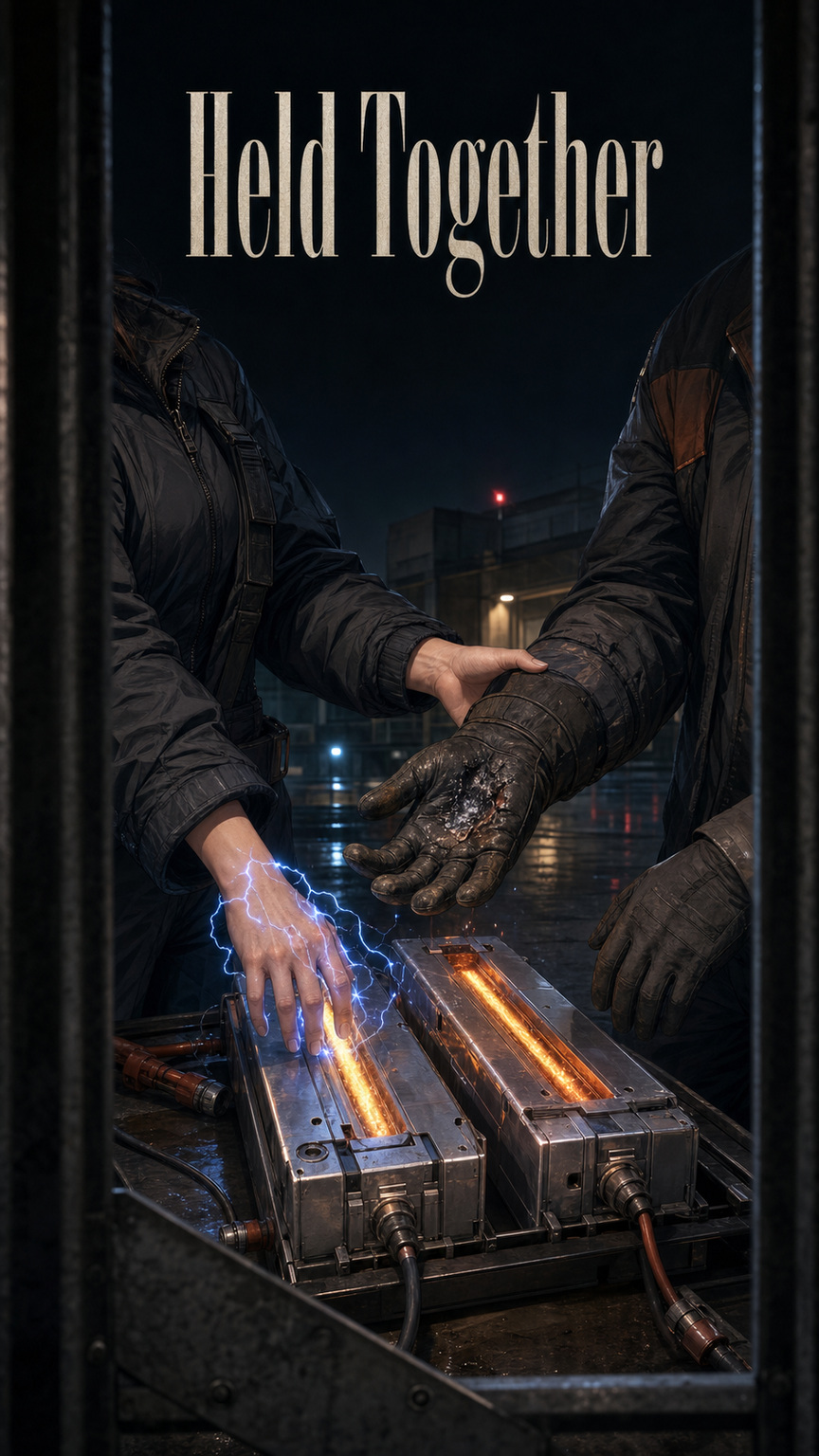
At 2:13 in the morning, the transfer station’s ventilation stopped, and Renata heard Jonas’s patrol app reroute them.
“West stairs,” its flat voice said. “Nearside remains with Fixedpoint.”
Beyond the service doors, reserve batteries held enough charge to keep three neighborhood clinics and an assisted-living tower cool through the hottest night of the year. On Renata’s phone, the station diagram showed a breaker fault in red and an access alarm in amber. The west stairs curled around two locked landings. The cable trench ahead was open, straight, and four metres across.
“The trench is faster,” she said.
Jonas stood behind her on the concrete steps, broad shoulders blocking the emergency light. “The app says west.”
“You wrote the app.”
“I changed one permission.”
“Mine.”
Somewhere below, metal struck metal. The temperature display beside the door read forty-one degrees. A second access sensor turned amber.
“We can have this fight upstairs,” Jonas said. “West stairs. Now.”
Renata looked through the open gate at the landing beyond the trench. Four metres, clear line, no one visible. She went Nearside.
Space caught her behind the eyes. The landing replaced the step beneath her boots, and the world tipped left before righting itself. She kept one hand on the rail until the depth returned. First transit.
“Renata.”
Ahead, through another open grille, the main-floor catwalk ran beside the reserve bus. Less than five metres. The shortest route had always been a chain of small, certain things.
She made the second transit before Jonas reached the trench.
This landing arrived doubled. Two yellow rails slid together, then apart. She blinked until they agreed on one position, but by then a woman in insulated work clothes had stepped within arm’s reach of the lighting conduit.
The lights died from her outward.
Not a station-wide collapse. A moving absence, three metres across, following the woman as active circuits emptied into the two silver cells mounted on a low sled behind her. Brownout. Livia Kade turned her bare hand over, measuring the last blue thread of current across her palm.
“She’s early,” Livia said.
“Still on sequence,” Xavier Kade answered from above.
Two amber tags flashed on the catwalk. The shutter behind Renata dropped so hard its bottom edge starred the concrete. A weighted baffle swung across the catwalk, its offset steel slats showing only other steel. Xavier, Downforce in the case files, stepped out on the overhead gantry with a battery harness tight against his ribs.
Renata turned toward the last place she had seen Jonas. No clear line remained.
A pale plane grew under the descending shutter, rigid and translucent. A second formed at the far edge of his six-metre sight, reaching toward the baffle. Jonas had committed both at once. For perhaps a second, Renata saw him between them: jaw set, hands spread, trying to make two paths exist where she had left him none.
Livia crossed close to the wall conduit. His comm light went black.
Xavier touched two fingers to his harness. The tagged shutter multiplied its downward load. Jonas’s first plane bowed, not bending but sinking into cracked concrete as the floor failed beneath it. The second vanished when he pulled one numbed hand toward the manual latch. Too late. Another shutter sealed him into the relay bay.
The baffle struck Renata across the shoulder and drove her into a floor cage. A U-shaped anchor yoke closed over her ankles. Xavier planted a tag on it, and the steel became too heavy even to rock.
“That’s three,” Livia said.
“West shutter, relay shutter, anchor,” Xavier said. “Sixty seconds.”
The last slat locked into place. Every opening in Renata’s cage faced a backing plate. She could see strips of floor, pieces of equipment, one of Jonas’s boots six metres away. Nowhere she could go.
Above the bus, the red reserve clock changed from 45:00 to 44:59.
Livia pulled the first cell’s leads toward the live cabinet. “Begin.”
The Kades did not celebrate.
Livia positioned herself beside the active reserve circuit and let current vanish into the cell within her living field. Xavier checked the cage, the relay shutter, then the route to the loading ramp. He marked each task on a grease board clipped to the sled.
“Return before auxiliary,” he said.
“After auxiliary.” Livia watched a meter tremble. “If you close return first, the clinic feed sees the dip.”
Xavier studied the switch labels, erased one arrow with his thumb, and drew it again beneath AUX. “After auxiliary.”
“Yes.”
No score kept. No little victory placed aside for later. Renata hated them more for how ordinary it looked.
She pulled against the anchor yoke. Its added load drove the cuff edges through her suit and into bone. Xavier glanced over.
“Don’t,” he said. “It won’t get lighter because you’re angry.”
“The cooling wards lost twelve minutes last month,” Renata said. “People in that tower can’t sweat properly.”
Livia’s meter climbed. “They have room batteries.”
“For forty minutes.”
“Then your utility will have five minutes to transfer the reserve after we’re gone.”
“If your staged fault didn’t damage the switchgear.”
Livia looked at the scorched cabinet, then at the charging cell. “Xavier, temperature.”
“Fifty-three.”
She had heard Renata. She simply returned to the theft.
From the relay bay, Jonas said, “How many transits do you have?”
Renata found his face through two misaligned slots. “Work your latch.”
“I need your remaining count.”
“You don’t need to authorize it.”
“Not what I said.”
“It was the shape of it.”
He wrapped both hands around the manual lever. They did not close properly. Concurrent planes always numbed his fingers, beginning at the tips and moving inward. Renata had watched him fumble keys after patrol and teased him for refusing mittens in winter. Tonight the lever slipped from his palms.
“No more transits,” he said. “Not until I can get you a line and support the landing.”
There it was again. The shape and the substance.
Renata leaned back from the slots.
The first minute ended. Amber light faded from the anchor tag, and some of its crushing weight released. Xavier’s harness fans spun up to cool the spent cycle. He tested the yoke with his boot before Renata could lift it, then renewed the downward load as soon as the tag answered.
Jonas had seen it too. “Sixty seconds,” he said.
She gave him nothing.
At 31:18, Livia moved the intake leads from the first cell to the second. The first was the size of a carry-on case, finite and nearly full, its charge bars wavering orange. Xavier peeled the cooling west-shutter tag from its mount and braced it against the cell housing to reseat a clamp.
“Hold the tag against the housing,” Livia said. “I’ll pull the spike.”
“No.”
She looked up.
Xavier opened his hand. The center of his glove had blistered glossy over a burn. “The housing is over limit. Ceramic handle or it waits.”
Livia checked the thermal strip. “Ceramic.”
She fetched the handled clamp herself and set it within his reach. He seated it. She pulled the spike down into her field, and the cell steadied.
Xavier returned the tag to the west-shutter mount without engaging it.
“Abort at seventy-eight,” Xavier said.
“Seventy-eight,” she agreed.
The reserve clock continued to fall. Behind the far maintenance door, somebody struck twice, paused, then struck twice again. Utility workers. Alive, at least. The station display showed clinic demand rising with the outside temperature.
Renata waited for the anchor to cool, jammed her fingers beneath it, and heaved. One edge rose a centimetre. She twisted her right ankle. The doubled cuff became one too late; pain ran up her shin, and the yoke slammed down when Xavier renewed the tag.
“Stop testing it alone,” Jonas said.
“Stop giving me orders through a wall.”
“Then answer one question. How many?”
“Enough.”
“That isn’t a number.”
She knew. That was why she had chosen it.
Livia crouched by the second cell. Its charge indicator jumped, fell, then blinked amber.
“You seated it wrong,” she said.
Xavier did not turn from the loading ramp. “Seated at sixteen. Checked at twenty.”
“It’s moving now.”
“Then something changed.”
Livia put her hand beside the intake without touching it. Current made a fine blue web across her knuckles, and the station lights nearest her dimmed. She checked the reserve meter, then the cell.
“Bus sag,” she said. A beat passed. “I read it as the clamp. That was mine.”
Xavier came back. “Can you hold fifty percent?”
“Forty-six.”
“Do that.”
She caught his burned wrist before he reached for the clamp. “Open.”
He opened his hand. Two fingers curled; the others shook.
“You don’t renew the west shutter until your hand cools,” she said.
“That leaves the ramp route open.”
“I know what it leaves.”
“All right.”
She released him. He switched hands, and they returned to the cell without filling the silence.
Renata pressed her forehead to the cage steel. She had expected vanity, cruelty, one of them performing dominance for the other. What she saw was worse and smaller: correction accepted, limits believed, harm divided efficiently. They could do all of that and still watch the clinic demand climb.
At 12:06 remaining, Jonas said, “I can make one reliable plane. Two, and I won’t have hands for the release.”
Not a command. An inventory.
Renata looked through the lowest slot. Xavier’s anchor tag would gray at the end of its minute. Each time it did, his harness fan ran while he checked the sled wheels. To move the charged cells up the ramp, he would need the sled loaded downward for traction against the vibrating floor. Three tags, no fourth. He had rehearsed the transfer twice with his eyes.
“One,” she said.
Jonas went still.
“I used two after 1:31. One left in the six-hour window.” She swallowed. The cage seemed to lean toward her. “After the concussion, the second makes edges split. The third takes depth. Last time, seventeen minutes. I couldn’t tell the floor from a step.”
“Last time?”
“Three weeks ago.”
His breath left him through his nose. She waited for the contingency tree: dates, reporting failures, the predictable list of all the ways she had made them unsafe.
“What can you see now?” he asked.
“The near slat. Your boot when you move it. Not their faces unless they cross the middle gap.”
“All right.”
The words sounded unfinished in his mouth.
Renata gripped the yoke. “Tell me what you’ve seen.”
“Baffle pivots toward me when the anchor tag cools. Hinge opening is five point six metres from my left slot. His transfer takes four seconds. The sled crosses your middle gap after the tag seats.”
“Can your plane hold the baffle?”
“Thirty seconds.”
He waited.
Renata measured the strip of concrete beyond the middle gap. Four metres, perhaps four and a half. It doubled if she stared too hard, but both versions were inside her limit.
“On the next transfer,” she said. “Wedge the baffle. I lift the yoke when the load drops. I go to the clear patch by the sled.”
“You’ll land blind.”
“Nearly. You’ll route me to your release.”
His boot shifted into view, then stopped. “Yes.”
At 8:41, the anchor tag went gray.
Renata lifted. The yoke came off the floor, ordinary steel again, heavy but possible. Jonas’s pale plane grew through the left slot, a single rigid sheet expanding into the baffle hinge. Metal screamed. The offset slats opened three centimetres, then ten.
Xavier looked over. His burned hand hovered near the tag.
“Sled first,” Livia said. “We’re below exit traction.”
He tore the amber marker from Renata’s yoke and slapped it onto the sled frame. The cells sank against their suspension. Their weight bit the wheels into the ramp.
The middle gap cleared.
Renata chose the patch of floor she could see and went.
The cage vanished. Concrete struck both boots at once. Then the room lost its distances.
Rails floated near and far. Livia became two dark figures beside a blue flare. Renata dropped to one knee before the false floor could move under her. Her stomach surged. Third transit. None left until after 7:31.
“Forward two paces,” Jonas called. His command voice caught on the first word, then changed. “Your pace. Handrail at your right knee.”
Renata found the rail by sweeping her hand. Behind her, Xavier hauled at the loaded sled. Livia left the bus to intercept, and the charge stream broke as soon as the active circuit passed beyond her three-metre field.
“One pace,” Jonas said. “Relay release is shoulder height. Orange handle. Twenty centimetres left.”
There were three orange blurs. Renata closed one eye. Two remained.
“Which one?”
Silence, just long enough for him to look instead of assume. “Farther left. Your hand is below it. Up.”
Her fingers struck the handle. She pulled.
The relay shutter lifted. Jonas ducked under it as Xavier renewed the tag, and the metal crashed onto the plane Jonas formed beneath it. One plane. His right hand hung half closed.
“Main isolation?” Renata asked.
“Six paces behind you. Yellow wheel.”
Livia moved back toward the bus, choosing the cells over Renata. Current flared again. Xavier abandoned the sled and came toward Jonas, one tag control in his good hand.
They countered on different instincts and blocked each other’s route.
“Xavier,” Livia said. “West rail is seventy-two.”
“Sled or shutter?”
“Sled. Give me the route.”
He stepped back at once and dragged the sled sideways, clearing her path to the live cabinet. “Two metres. Clamp high. Then ramp.”
Jonas could have put a second plane across them. Renata saw his shoulders set for it, saw his numb fingers twitch.
“One wall,” she said.
He kept the shutter off them.
“Wheel is five paces now,” he said. “Drift right.”
Renata moved through the swimming geometry. At the yellow blur, she used both hands until she found the rim. It resisted, then turned. The reserve bus separated with a blow she felt in her teeth. Clinic demand disappeared from Livia’s intake meter, isolated behind the mechanical switch.
The cells remained charged. Their rig whined against the cut circuit, hunting for a path.
“Ground bar,” Jonas said. “Low left.”
“I can’t find low.”
“Stop.”
She stopped.
“Your left boot is touching the housing. Bar is on the housing. Slide your heel back.”
Metal knocked her boot. Renata crouched without trusting the floor and closed both hands around the insulated grip.
Livia saw what she held. “Don’t.”
The plea was for the cells, not the reserve or the workers behind the door.
Renata pulled the station’s emergency ground into place.
The siphon load went down the copper braid. Both cells flashed white. Livia broke her field and stumbled away from the cabinet. Xavier caught the back of her harness, keeping her clear of the arcing leads without touching them.
“Seventy-six,” she said.
“Ramp is open.”
“Seventy-seven.”
Xavier reached for the sled, burned hand failing around its handle. The cell casing ticked as it expanded.
“Seventy-eight,” Livia said.
He let go.
Together they backed toward the service ramp, Xavier counting the steps twice when smoke hid the edge. Livia cut power from one active door circuit as she passed within range; the lock released dead rather than opening for them. Xavier shouldered it wide. He tapped the still-mounted west-shutter tag, increased the shutter’s downward load, and followed her through before the cooling harness could answer again.
Jonas’s plane expired. The shutter hit concrete between the heroes and the ramp.
He did not make another.
“Pursuit?” he asked.
Renata listened to the pounding behind the maintenance door. One worker’s strikes had become uneven.
“No. Staff first.”
“Yes.”
They grounded the cells, released the damaged switchgear from the reserve, and opened the maintenance room by hand. One technician had a bleeding scalp. The other lay beside a fallen tool cabinet with an ankle swelling inside her boot. Jonas formed a single plane as a rigid litter while Renata, moving by touch and his plain directions, kept the technician level. They carried her to the cooler stairwell and waited for responders instead of the Kades.
At 3:28, exactly seventy-five minutes after the ventilation had stopped, a hospital physician shone a narrow light across Renata’s eyes.
“Tell me every transit in the last six hours,” she said.
Renata sat on an intake bed with a basin between her shoes. Jonas stood by the curtain, his hands wrapped in warming pads. A patrol supervisor waited on speakerphone beside the blood-pressure cuff.
“Three,” Renata said. “Two before capture, one to escape. The window started at 1:31. I had a concussion last month. Since then the second transit doubles edges, and the third removes usable depth. I hid the change from medical and from my partner.”
The physician recorded it without looking at Jonas. “Observation until the depth loss clears. You agree?”
“Yes.”
On the phone, the supervisor asked, “Why did your route split?”
Jonas shifted a warming pad from one palm to the other. “I added a field veto to our patrol app. I did it unilaterally, and I didn’t disclose it to command. Renata rejected the route. We stopped sharing information before entry.”
He did not add a reason after the fact.
Renata looked toward him and found two Jonases at the curtain.
“Remove the veto,” she said.
“Now?”
“Now. Leave the route log intact for review.”
“Okay.” His fingers would not work the phone. “Will you unlock it for me?”
She did. He talked her through the settings but did not touch her hand. The permission changed from PARTNER OVERRIDE to SHARED CONFIRMATION.
The physician rolled a visual-field target to the end of the bed. “Do you want him in the room for the assessment?”
Renata considered the two blurred figures, the marriage she still inhabited and the field partnership she could not decide from a hospital bed.
“For the assessment, yes.”
Jonas looked at the empty spaces on either side of her. “Left or right?”
“Left.”
He moved there and waited while the physician raised the first light.