Hello, Lover
A demon appears before your party, exclaiming “Hello lover!” Everyone looks at the bard, but then the cleric speaks up. “Actually, my ex is referring to me.”
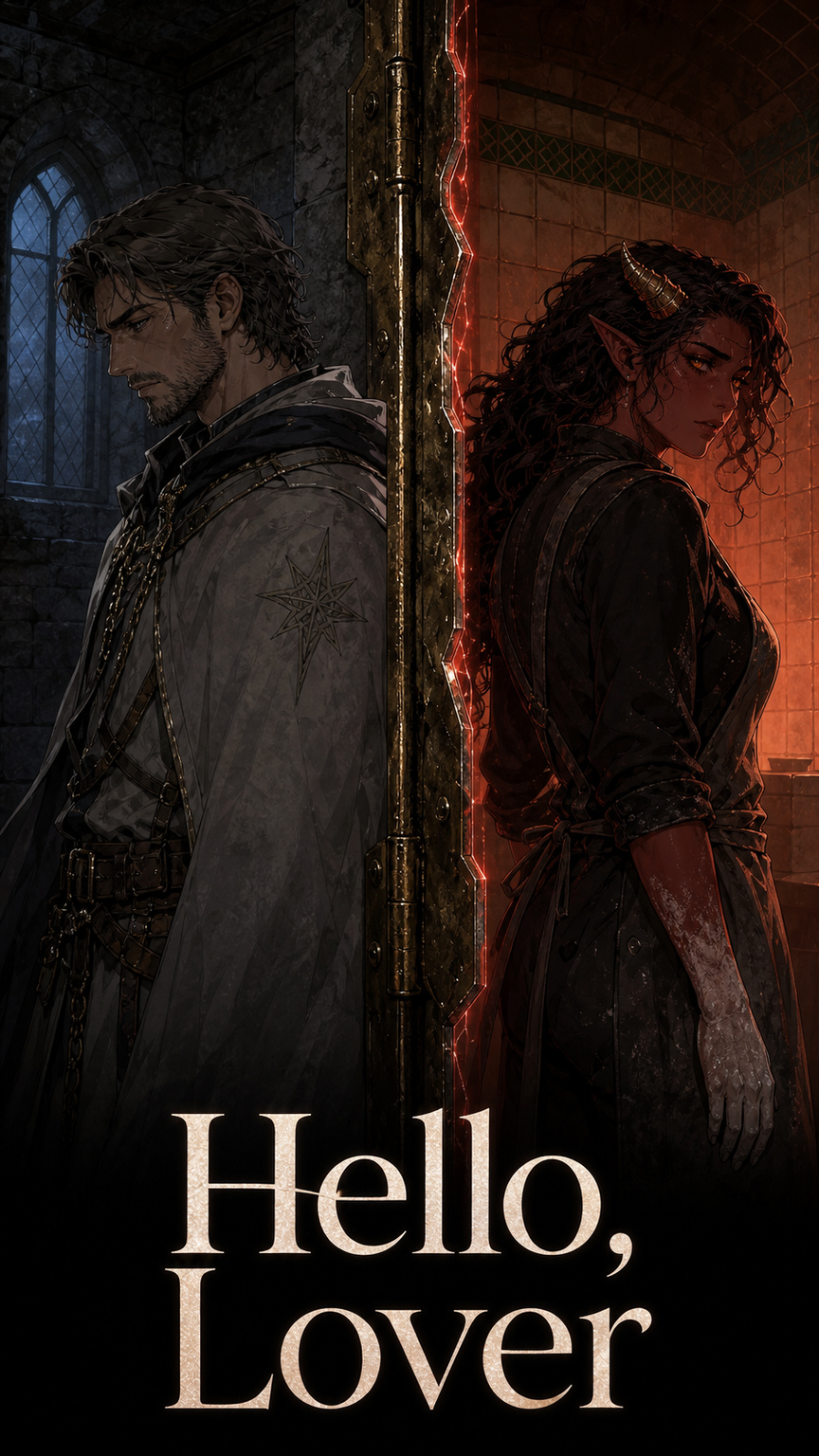
The sanctuary door had swollen in the first cold rain of autumn. Emet Sarn put his shoulder to it while Udren lifted the latch, and together they admitted the last two carters from the road. Wet cloaks already covered every peg in the House of Common Shelter. Bedrolls crowded the common room between the plain altar and Bosk’s stool by the stove.
“One more hard shove in the morning,” Udren said, “and we will have a door-shaped hole.”
“Then it will never stick again.” Bosk turned his hand drum toward the stove. Its damp hide gave a dismal little plunk. “I believe this is called preventive maintenance.”
Emet had just found space for the carters beside a family with three snoring dogs when a red seam opened across the north wall.
It was too straight for lightning and too bright for fire. Mortar flashed to steam. The seam widened from floor to lintel, showing a tiled room on the other side and a demon striding through it with heat rolling off her work leathers. Brass capped the points of her swept black horns. Her dark red hands were powdered to the wrists with white kiln clay.
She planted one boot on the sanctuary floor and called, “Hello lover!”
Every head in the room turned toward Bosk.
Bosk looked behind his stool, as if another bard might be hiding there.
Emet raised one hand. “Actually, my ex is referring to me.”
The silence held just long enough for one of the dogs to sneeze.
Lacrixa looked Emet up and down. Nine years had added a silver ring through the ridge of her left horn and taken nothing from the level way she could make him feel improperly assembled.
“Good,” she said. “I would hate to have crossed this far and found the wrong bad decision.”
Then the red seam tore sideways.
Udren’s shield struck the floor between the crossing and the bedrolls. A gust of kiln heat bent the room’s rushlights flat and rolled two sleepers into the shield’s broad back. Beyond Lacrixa, figures shouted in the tiled room. Something heavy shattered. Bosk caught his stool with one foot and his drum with both hands.
Emet saw the hinge leaf bolted into the new frame.
It was a hand-long strip of yellow bronze with a split-tailed end, its face darkened by years in a wrapping no one else had known existed. His thumb knew the shallow notch near the lower screw. His knife had made it on a rainy evening in Lacrixa’s room, when the two of them had fitted a courtesy hinge because crossing the kiln court after midnight meant waking six households and a flock of vicious white geese.
He had told her he destroyed it.
He had kept it in the stitched lining of his field breviary. Three days ago, at a crowded ford, someone had slit that lining and taken nothing Emet was willing to report missing.
Now his leaf was mounted in a stranger’s ironwork.
Lacrixa followed his stare. “That does not look like ash.”
“I didn’t mount it.”
“You kept it long enough for someone else to do so.”
Udren leaned her weight into the shield as another hot gust struck. “How many people on your side?”
Lacrixa turned at once. The tiled room behind her had once held a bed, two chests and a table Emet could never make sit level. It now held racks of glazed bowls. Past its open arch lay the kiln court: brick galleries, firing pits, wash troughs, and more than two dozen people trying to move hot ware out of the wind.
“Thirty-one in the court,” Lacrixa said. “Six in this room. All adults, two with bad legs. How many here?”
“Seventeen guests,” Udren said. “And us.” She pointed to the sanctuary’s ordinary front door, eight paces behind her. “Bosk, count them out. Emet, tell me what this is.” She angled her shield and started the first group moving.
The crossing stood as a doorway-wide rectangle between the two rooms. The sanctuary lay on Emet’s side; Lacrixa’s old room and the kiln court lay on hers. Three black iron loops telescoped through its throat: one against the sanctuary jamb, one midway in the red-lit depth, and one flush with the plane where the worlds met.
A courtesy hinge had two keyed leaves. One leaf mounted alone was inert. Bring both living bearers near their leaves, and they supplied the hinge with enough power for a step between familiar doors. The rig around these leaves had no power and no judgment of its own. It could only redirect what Emet and Lacrixa were giving it. Someone had added three borrower loops and stretched a private step into a road.
Breaking either leaf would stop the supply. With people crowding both approaches and the loops forcing the route open in the wrong shape, the plane could slam shut through anyone caught in the throat.
“The loops come off from this jamb inward,” Emet said. “Then we break the leaves when both approaches are clear.”
“We?” Lacrixa asked.
The leaf under its iron clamps warmed at Emet’s nearness. Across the plane, the matching leaf shone on the old room’s tiled jamb, exactly where they had mounted it. Lacrixa had left hers in plain view. It could have reached nothing by itself.
“Both bearers,” Emet said. “It needs our hands.”
“Of course it does.”
Udren continued moving guests behind her shield toward the front door. Lacrixa snapped instructions over her shoulder, and the kiln court answered with motion: workers banked firing pits, overturned sand bins onto sparks, and carried a limping glaze grinder away from the arch. Bosk settled his drum strap across his chest and gave the rim three clear taps.
“Three loops,” he said. “Seventeen guests. It is comforting when disasters can be counted.”
“You are on twelve,” Udren told him.
“Less comforting. Twelve.” The drum spoke once as a carter ducked through the ordinary door. “Thirteen.”
Emet approached the first loop. Heat pressed against his eyes. On the far side Lacrixa matched him, bracing one clay-white hand against the iron. They had moved kiln shelves together, long ago, and carried sacks of House grain up narrow stairs. His body remembered where she put her weight. That was not the same as knowing her. His body did not care.
“On Bosk’s fourth beat,” Emet said. “Lift, quarter-turn toward the court, then down.”
“It will bind on your lower corner.”
“The corner is clear.”
Lacrixa rapped the iron with one knuckle. The note came back flat. “That is the sound of a corner preparing to embarrass a cleric.”
Bosk began the measure. On four, Emet and Lacrixa lifted. The loop moved a finger’s breadth and seized exactly where she had said it would. Heat bit through Emet’s glove.
Lacrixa swore, shifted her hip, and said, “Blue-bowl turn.”
Emet dropped his right shoulder before the memory arrived. The phrase had been born when they tried to carry a broad blue mixing bowl around the crooked stair in her court: yield the high corner, take the weight low, and do not pause to argue. They had broken the bowl anyway and laughed until the neighbors came to complain.
Their hands made the old adjustment. The loop rolled free.
For half a breath they stood with its weight balanced between them. Lacrixa’s grip tightened.
“I did not mean to say that,” she said.
“I know.”
“Then stop looking as if I gave you something.”
Emet looked down at the hot iron.
The crossing bucked. They dropped the loop clear as Udren drove the rim of her shield into the floor. Bosk’s drum marked the last sanctuary guest through the front door.
“Seventeen. Udren, they’re out.”
The first loop hit the stones and split along a seam. A smell like hot pennies filled the room. With one borrowed route gone, the crossing contracted. The old room sprang into painful focus.
The bed was gone. The uneven table was gone. New racks covered one wall, but a border of green-and-cream tile still ran behind them, including the piece Emet had set upside down and Lacrixa had refused to fix because it annoyed him more each year. Her leaf remained openly screwed above that border. On Emet’s side, the first loop’s fall had peeled back an iron clamp and exposed a scrap of gray cloth trapped beneath it: the prayer-stitched wrapping from inside his breviary.
Lacrixa saw the cloth.
Light flared orange through the seams of her clenched fingers. She put a hand against the tiled jamb. The glaze beneath her palm crackled into a white web, and three chips spat onto the floor. Bosk struck the opening beat for the middle loop. Lacrixa did not move.
“Hold,” Emet said.
Bosk flattened his hand against the drumhead.
Lacrixa took her palm from the wall. Little glazed scales clung to it. “I left my leaf where everyone in my court could see it. It was dead. I wasn’t tearing out good tile because you left.” The air shook above her shoulders. “Pride. Mine. But you told me its twin was ash.”
“I know.”
“Were you about to tell me I kept mine too?”
Emet rubbed his thumb across the iron.
“Of course.” She scraped the glaze from her palm. “Before I put my hand into the middle of this thing, I want the rest. Did the House ever forbid us?”
There was no safe category of answer. He had spent nine years inventing them anyway.
“No,” Emet said. His burned hand slipped on the iron. “The House of Common Shelter never forbade our relationship.”
Lacrixa went still. Behind her, court workers dragged a wheeled rack away from the arch. One wheel screamed on its axle.
“The circuit takes twenty years,” Emet said. “No posting beyond one season. Every first frost, I packed while the people around me banked the hearth. If we had stayed together, you would have had to leave your court again and again, or I would have had to give up the circuit.”
“So you chose.”
“I chose the road.” His breath would not finish. “I said they chose for me.”
The crossing gave a deep metallic groan. Emet’s right boot skidded toward it.
Udren came in behind him but did not seize him. She planted her shield edge on the stone at his back.
“Left sole,” she said.
“Stone.”
“Right.”
“Stone.”
“My shield is here if you want it.”
He leaned. Its oak face held firm between his shoulder blades.
Udren’s voice stayed low. “Next lift yours?”
“Mine.”
“Then ask for it.”
Emet looked across the red plane. “Lacrixa, will you help me take off the middle loop?”
She wiped her hand once on her apron. “I will help the people in these rooms.”
Bosk lifted his palm from the drum.
The second loop had twisted as the crossing narrowed. Emet could reach its lower arc, but Lacrixa had to step onto the ledge of the old jamb and hook an arm over the upper. They did not use the old shorthand. Bosk gave them a slow six count instead.
On five, the red depth pulled like a river. Bosk’s stool went first. His drum followed. The strap snapped across his shoulder, and the drum sailed between Emet’s hands, struck the far jamb, and burst its hide with a sound like a door slammed in an empty house.
Bosk stared after it for one beat.
Then his heel hit the sanctuary floor. “Six. Again. One, two—”
His count was smaller without the drum, and more stubborn. Emet and Lacrixa worked the warped loop up by increments. Lacrixa’s breath rasped. Emet’s burned glove stuck to the iron. Udren held the shield behind him without pushing.
At six, the middle loop cleared its catches. Lacrixa kicked her side away. Emet dragged his down. It struck the first loop, and both went dull.
The crossing shrank to the inner loop. The rectangle was still doorway-wide, but now the whole pull of the leaves ran through a single iron ring flush with the plane between worlds. Emet stood on the sanctuary side with Udren’s shield at his back. Lacrixa stood opposite him, her back toward the old room and the court arch. Bosk took Emet’s left, stamping the measure into the stones.
“Old room clear!” Lacrixa called.
A stack of bowls toppled from the nearest rack. The crossing caught them in midair and flung glazed shards through the plane. Udren raised her shield over Bosk. Emet ducked, but one shard sliced his bare wrist above the glove.
From the kiln court came a shout. The limping glaze grinder had returned for a leather tool roll lying beside the arch. The floor tiles lifted under him like cards in a gust. He fell, slid through Lacrixa’s reach, and struck the inner loop hip-first. One leg crossed into the sanctuary. The other remained in the old room.
The ring screamed.
Lacrixa caught the grinder under both arms. Emet locked his hands around the near arc to keep it from folding across the man’s body. Udren set her shield against his back and braced one boot against the altar step.
“Pull him courtward,” Emet said.
“I know where my court is.” Lacrixa hauled. The grinder cried out. His trapped boot had caught beneath the far catch.
Bosk stamped. “One. Two. Three.”
The iron tried to close. Emet’s burned palm opened against it.
He held.
Udren grunted behind him. Lacrixa let go with one hand, struck the catch with her fist, and sent a short tongue of flame across its pin. The pin softened. She tore the grinder’s boot free, seized him again, and pulled.
Bosk kept the count with his heel. “Four. Five. Six.”
The grinder’s knee passed the plane. His ankle followed. Lacrixa dragged him across the old-room tiles until two court workers caught his coat.
She looked down and said, “Both feet clear.”
He held.
The inner loop remained open between them. Lacrixa straightened slowly. Behind her, the grinder was carried out beneath the court arch. The old room stood empty except for broken bowls, her mounted leaf, and the wreck of Bosk’s drum.
“Emet,” Udren said. She did not increase the pressure of the shield. “The approach is clear.”
“Wait.” His arms shook. “If I let the ring go, the crossing closes.”
“Yes,” Lacrixa said.
“We can take the leaves out of this rig and mount them properly. Only as a rescue route. Or we could—”
“There is no reunion,” Lacrixa said. “Not now. Not after. Do you understand me?”
He did. His hands did not open.
“The court could catch again,” he said. “You could need shelter. I kept the leaf because I thought—”
“You do not keep me safe by keeping access.”
Emet looked at the gray cloth pinched beneath his leaf. With his free hand, he bent its split tail out over the iron ring while the screws still held the other end to the clamp. Across the plane, Lacrixa wedged the claws of a kiln hammer beneath her own leaf. Bosk’s heel struck once, twice.
“Goodbye, Lacrixa,” Emet said.
Her jaw worked once. “Goodbye, Emet.”
On Bosk’s third beat, Lacrixa levered her leaf in two against the tiled jamb. Emet drove his palm down on his. The keyed bronze split beneath his blood. Red light ran through both broken leaves and collapsed toward his fingers.
Emet withdrew.
The inner loop fell flat on the sanctuary floor. The rectangle filled with a brief view of the old room: Lacrixa standing amid broken glaze, one hand on the shoulder of the injured grinder. Then there was only the north wall, wet stone, and a cooling iron ring.
For the next hour Emet worked on the sanctuary’s injured. Two guests had blistered forearms from the first kiln gust. A carter had struck her head against Udren’s shield, and Bosk’s snapped strap had left a purple weal across his collarbone. Emet washed grit from eyes, spread burn salve, checked the carter’s pupils twice, and wrapped his own palm last.
When everyone could sit without falling over, he gave Udren and Bosk the full account. He told them when he had taken the leaf, what he had told Lacrixa, where he had hidden it, and why he had said nothing after the lining was cut at the ford. Bosk sat on the altar step with the broken end of his drum strap in his lap. Udren wrote each fact in the field ledger.
When Emet finished, she turned the ledger around. She had struck his name from solo threshold watch and from route decisions.
“Until field trust is rebuilt,” she said. “No threshold watch alone. No choosing our routes. Do you accept that?”
“Yes.”
Udren nodded. She unwound the bandage he had tied one-handed, smoothed the twisted pad, and wrapped his palm again without pulling the knot too tight.
Bosk disappeared into the pantry. He returned with a cup of water and sat beside Emet, their shoulders not quite touching.
“I had a song for this,” Bosk said.
“Had?”
“It was in the drum.” He handed Emet the water.
By dawn the rain had passed. Udren propped the ordinary sanctuary door with a chipped hearth brick, and cool morning moved over the sill.