
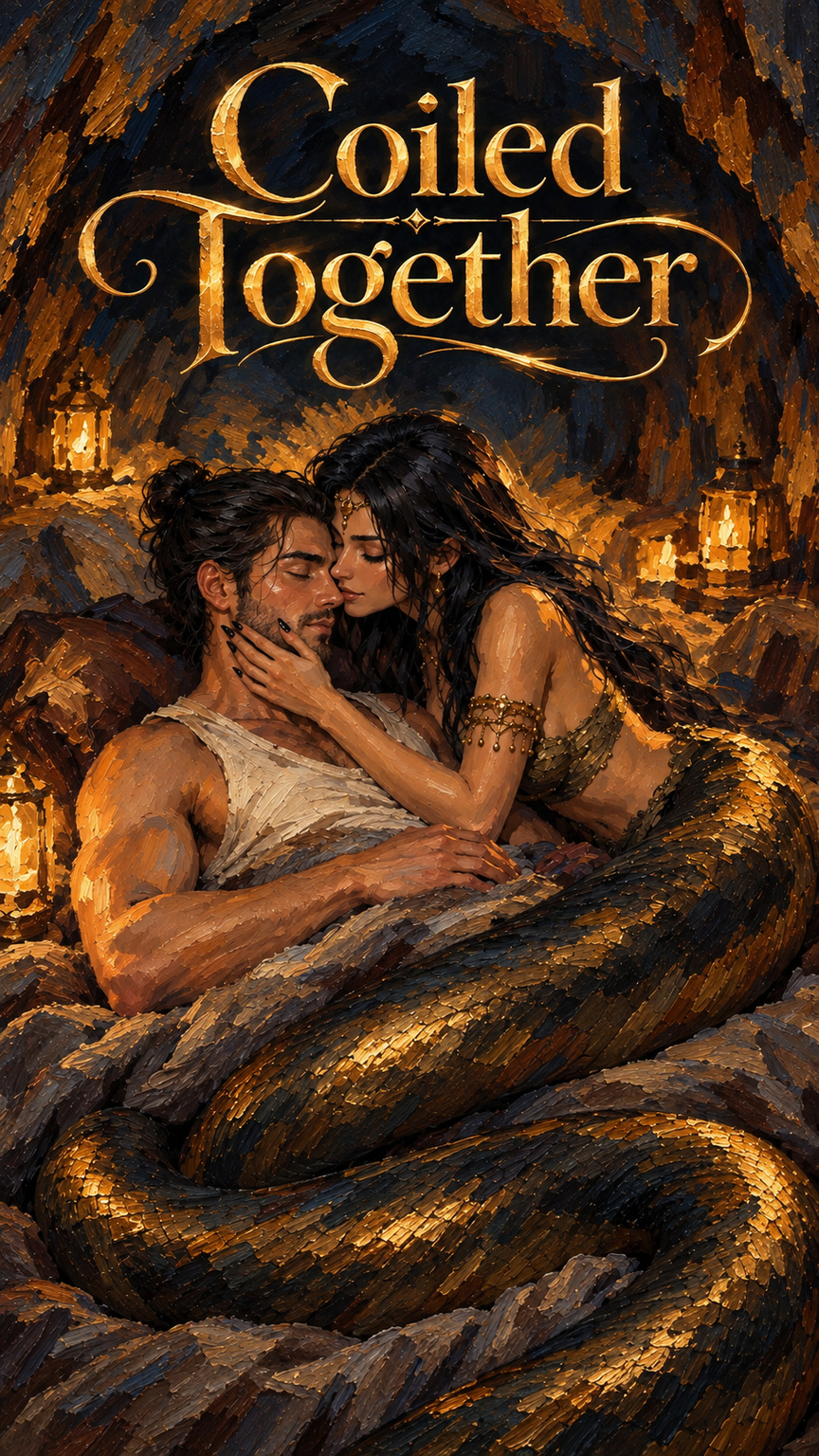
I woke because I could not finish a breath.
Something warm and hard crossed my chest. Another band pinned my thighs. A third lay behind my shoulders, holding me against a body that shifted under me with slow muscular corrections. The cave was dark except for a clay lamp on a shelf. Its flame showed overlapping black-green scales, each as broad as two fingers, curving around me and continuing beyond the light.
Everyone on the north road knew what serpentfolk did with travelers underground. The stories disagreed about whether they swallowed boots.
I tried to reach my knife. My arm did not move.
The coil across my ribs tightened when I struggled. Not much. Enough.
“Loosen.” My first attempt scraped out too softly. I swallowed and tried again. “Loosen me.”
The pressure eased at once. The band across my chest lifted until I could drag in a full breath. Cool cave air burned my throat.
“More?” a woman asked beside my ear.
Her common speech was plain, the voice low from effort rather than softness.
“Release me.”
The coils began to move. I felt myself tip toward open air and clutched at the first solid thing under my hand.
“There is a drop to your left,” she said. “I am putting you on the hide.”
One of her arms came beneath my shoulders. The other steadied my knees while her body unwound in stages: chest, hips, ankles last. She set me on a folded hide three paces from the ledge and took both hands away.
I rolled onto my elbows. The cave swayed. My knife and belt lay beside a wet pack and my rolled saddle blanket, close enough to reach. I dragged the knife free before I looked at her.
She had drawn herself into a wide curve along the edge of the shelf. Seven metres, perhaps, from the human-shaped rise of her ribs to the blunt end of her tail. A storm-grey wrap crossed one shoulder and fell to where her waist gave way to scale. Below it, a dark stain spread along her right flank. One of the serpentfolk’s feared queens, if the notched copper bands on both forearms meant what the caravan guards said they meant.
Behind her, a smaller serpentfolk knelt over an open medicine case. The attendant held a strip of cloth in both hands and watched the queen’s wound, not my knife.
The queen said, “You asked me not to let go.”
My grip tightened. “I asked you to wrap me like that?”
“You said, ‘Don’t drop me.’ Several times. I was carrying you out of the flooded lower basin.”
“I don’t remember a basin.”
“I know.”
“Then how convenient for you.”
The attendant pressed the cloth to the queen’s flank. The queen’s fingers closed once on the stone, then opened.
“You were cold through and a pace from that drop, and you fought me every time I eased,” she said. “Should I have set you down on the edge? You asked for release. I released you.”
Rain boomed somewhere inside the mountain. The lamp flame bent, recovered, and drew light across a crown-shaped rim of dry rock. Beyond it, black water churned far below. I remembered riding ahead of the caravan at dusk. I remembered the storm pipe at the cave mouth, three falling notes that meant shelter or danger depending on which roadwarden had carved it. I had taken them for shelter. After that came a coldness at my boots, though I could not place where.
I asked, “How long was I senseless?”
“Less than an hour.”
“Where is my cousin?”
“Above us, I think. Someone is working a rope through the signal fissure.”
“Which way out?”
She pointed with an open hand. “The upper path. It is flooded at the first bend. It should clear when the rain weakens.”
“Why can’t I remember?”
The queen glanced at the lamp. “The low air.”
I waited.
The attendant tied off the bandage and began counting without looking up. “Two dry blankets. Half a water jar. Salts. One sound lamp. Your left hand is cut.”
Only then did I see the blood dried between my fingers.
The queen said, “Cold, carbon-heavy air settles in the basin. We taste it before you do. It still slows us. Humans lose their feet, then their order of thought. Some wake without the last part.”
“You knew it was there.”
“I knew when I tasted it. By then you were already deep in it.” She touched the bandage at her flank. “I went down when I heard your whistle.”
“The pipe at the mouth?” Everyone on the road knew how serpentfolk brought travelers in. “Was that you, calling me in?”
“That pipe belongs to the roadwardens, and it was cut to say danger. What I heard came from the basin. Brass, blown over and over until there was no breath behind it.”
My brass whistle hung from my belt by a half-snapped loop. I picked the belt up. A black-green scale was caught in the torn leather, where something had gripped hard enough to split it. I did not remember blowing the whistle. I buckled the belt on.
Somewhere above, stone rang twice. The attendant answered by striking the floor twice with the wooden handle of a spoon.
I raised my knife.
“That is the falling-stone warning,” the queen said. “We drill three signals here: stop, move, and stone. Nothing else.”
The tapping came again, followed by a voice made thin by water and distance.
My cousin.
The attendant lowered the spoon. “Human knocking. Not stone.”
I lurched to my feet. The queen did not move to block me, but the ledge tilted under my boots. I planted one hand on the wall.
“The low air is still in you,” she said.
“Or your medicine.”
“You have taken none.”
The attendant held up a stoppered jar from the case. The wax on its mouth was unbroken.
I found the signal fissure behind a curtain of runoff. It was a split in the wall scarcely wider than my shoulders. A rope rasped within it. The queen could not have forced her upper body through, much less the rest of her.
“I’ll go alone,” I said.
“Yes.”
I had expected an argument and mistrusted the absence of one. “That’s all? You’re letting me crawl off?”
“I want to keep you,” she said.
The words stopped me with one knee in the fissure.
“Keep me how?”
The attendant shut the medicine case. The queen did not look away from me. “For six days, and paid. Our stakes at the basin edge should have turned you back. You went past them the way travelers do, as if they were an invitation. You know how people on the road read a warning. I want someone who can tell me why they misread ours.”
“And if I don’t?”
“Then you leave when the upper path opens. Nobody here will stop you.”
She settled lower while the attendant tucked the medicine case under a rock lip.
I crawled into the fissure.
The stone squeezed my shoulders and smelled of iron-rich mud. Three body lengths in, the passage bent. The queen called something after me—two ordinary words, perhaps left wall—but runoff struck the crack between us. Her consonants tore away. Only the drawn hiss of breath reached me.
Ahead, my cousin shouted my childhood kin-title.
“I’m here.”
The rope jerked against my wrist. I caught it.
“Tie in,” my cousin said. “We’ll pull you clear.”
A second voice cut across theirs. “Not over that lip. Knees down. No load yet.”
The rope carrier. I had seen them rig wagon teams on slopes where everyone else preferred prayer.
I crawled until I could see two blurred faces above a slant of water. The fissure opened beneath their shelf, its lower lip a chalky blade of stone.
“Did you see me fall?” I asked.
“I saw that thing take you.” My cousin reached down. “Give me your arm.”
“Before that. Did you see me in the basin?”
“You rode past the warning stakes.”
“Did you see me fall?”
“The bend hid you for half a minute. Then she had you wrapped from neck to boot. I know what I saw.”
“From up here?”
“Close enough. Come on.”
Behind me, the queen shouted. The fissure pared the words into a long sibilance. My cousin flinched and seized the rope.
The carrier said, “Wait. That edge is shedding.”
“They’re within reach.”
“No load.”
“Pull,” my cousin ordered me. “Now.”
I had one knee on the chalk lip when my cousin hauled. The rope snapped tight under my arm. White stone broke with the sound of a plate struck against a table.
The fissure floor dropped.
I fell backward into the chamber in a burst of water and grit. The rope burned through my palm. I let it run, hit the crown ledge on one hip, and slid toward the black basin until the queen’s hand caught the back of my coat.
The crack widened above us. Runoff that had been threading down one wall poured through the new opening and cut a foaming channel across the ledge, between our shelf and the high side. Beside the wall, the attendant lost hold of the medicine case. The queen released my coat immediately, threw both arms around the attendant, and took the impact of falling stones along her wounded flank. Her body recoiled from the edge, carrying the attendant into a shallow alcove.
My cousin shouted, “She’s got you again!”
“She let go.” I spat grit. “Stop pulling.”
The rope carrier’s voice came sharper. “I had no load. You loaded it.”
“Help me get my kin out.”
“Then stop sawing the line over broken rock.”
The rope lay across the new channel, slapping in muddy water. Its free length still reached me. I dragged it off the crumbling lip and fed it around a basalt knob on my side.
“Pay me slack,” I called.
“Come up the line,” my cousin said.
“Slack. This ledge is going.”
The queen had braced her tail against the alcove wall. Blood ran fresh beneath her bandage. The attendant, one arm hanging close to their side, peered past her at the water.
“Shoulder,” the attendant said. “Mine. Not broken. Queen’s cloth is through. Two people above. One below standing badly.”
“I’m standing,” I said.
The attendant looked at my feet. I looked too. One boot was planted half in the channel, though I remembered setting it on dry stone.
The air had changed. The lamp flame near the floor was a small blue bead now. Cold climbed inside my trousers. Thoughts arrived like badly packed cargo: rope, cousin, queen, exit, and no certainty about which had to move first.
The queen tasted the air with a quick opening of her mouth. “The water is rising under the low air and pushing it up to us.”
“Bad air rising?”
“Yes.”
“How long?”
“Not long.”
“How long?”
“I cannot measure it.” She was already reaching for the attendant. “We climb now.”
The obvious way was the fissure. Its lip had just proved what it thought of us. I looked past the queen instead, following the route as I would judge a washed trail: where silt gathered, where water ran clear, where a crack stayed dry because air moved through it. High above the attendant’s alcove, a seam of grey showed between leaning slabs.
“That chimney,” I said. “Does it go out?”
“Out. A hand’s width at the top,” the attendant said. “Enough air.”
“Behind the slab it opens wider,” the queen said. “Wide enough for my body.”
My cousin called, “No. Take the rope here.”
“That lip won’t hold three loads.”
“You’re confused.”
“Yes,” I said. “And I’m still the outrider.”
The carrier leaned into view. “Chimney line looks cleaner. I need a second anchor.”
I pointed to a dark horn of stone above the fissure. “Back it with that.”
“Too sharp.”
“My saddle blanket’s by the hide. Folded double.”
My cousin began, “We are not rigging a rescue for—”
“Blanket,” the carrier said. “Now.”
The queen crossed the foaming cut first, not by clearing it but by filling its safe edge with her body. She locked the thick end of her tail around a rib of stone beside the alcove and reached across to the chimney slab. Her right hand found a seam. Her left arm curved behind the attendant’s back.
“Move,” she said.
The attendant answered with one tap of the spoon against stone: the drilled signal for movement. Then they slid along the inside of the queen’s braced body, one useful arm working, feet testing each hold. The queen took their weight when the ledge crumbled under a heel. Her wounded flank trembled.
I knotted my saddle blanket around the rope, fed it across behind the attendant, and passed the bundle up. The carrier caught it, padded the sharp horn, and called the load at every change of hands. My cousin obeyed for three breaths, then reached down for me.
“Come while she’s holding it.”
I put my foot into the cut and forgot where my other foot belonged.
The water seemed to split into two channels, then four. My cousin’s arm doubled above me. I blinked hard, but the chamber did not settle.
The queen said, “I can brace the break or carry you. Not both.”
“Keep your coils off my kin,” my cousin said. “We have the line.”
“The line isn’t on me,” I said.
“I can put a loop down.”
The carrier said, “Not a blind waist loop on a confused climber.”
The attendant reached the first shelf in the chimney and wedged the medicine case behind their knees. “One injured above the cut,” they reported. “One dizzy below. Queen failing.”
The queen’s fingers slipped a joint along the seam.
I knew the reach across was less than two paces. I also knew I could no longer trust my knees to understand that.
“Coil me,” I said.
The queen looked down.
Fear went through me so cleanly that for a moment I could think again. I pointed, because the words mattered and I did not want more of them than necessary. “Once at my hips. Once below my shoulders. Leave this much at my ribs.” I held my hand sideways against my chest. “Across to the chimney. Put me down on the shelf.”
“Agreed.”
“And release when I say.”
“Yes.”
“You can’t stop bracing yet,” the carrier called. “Give me ten breaths.”
The carrier threw a loop to my cousin, who caught it and cursed at the force. The carrier talked them through a body belay: feet against the rear wall, rope across the padded horn, no wrapping a wrist. My cousin tried to hurry; the carrier made them reset one sliding boot. I called the chimney holds. The queen shifted her brace when I called. Above, the carrier set the anchor and my cousin took the hauling side.
I clipped my belt ring to the line and crawled close to the queen. Her body moved around me, one measured band at my hips, another under my arms. The pressure stayed clear of the hand-width I had shown her.
When she shifted me against her side, something struck loose inside my head: floodwater white at the edge of lamplight, my fingers jammed through a copper arm band, my boots knocking empty rock. My own voice, hoarse and near her shoulder.
Don’t drop me. Don’t—
The rest vanished. I had that fragment and nothing around it. The voice was mine.
“I remember asking,” I said.
“Good,” my cousin answered too quickly. “Now come up.”
The queen did not answer at all. Her attention was on the carrier.
“Set,” the carrier called.
My cousin took the strain. The rope tightened from my belt to the horn, replacing some of the pull the queen’s tail had held. The attendant struck one tap. Move.
The queen unhooked her tail from the rib of stone.
For one breath we hung over the cut, the rope carrying part of me, her left hand on the chimney slab, her right arm clamped to a seam. Then her body drove forward. Water hit my boots. The fresh bandage at her flank split, and her next breath came as a dry click, but she crossed. She placed me on the shelf beside the medicine case.
“Release,” I said.
The coils opened before the last sound left my mouth. She kept one palm under my elbow until my weight was on stone, then removed it.
The carrier hauled. My cousin pulled in time with the carrier rather than ahead. I crawled upward, pushing the medicine case while the attendant climbed one-handed before me. Below, the queen withdrew the final length of her tail just as the crown ledge broke and went into the basin.
She came last, using both arms and the pressure of her long body against opposite walls. Halfway up she stopped.
Two taps sounded beneath us.
Stone.
Nobody translated it into more. The attendant flattened. I jammed the medicine case under the shelf. My cousin held. The carrier locked the rope. A slab struck where the queen’s head had been; she folded sideways, waited for the smaller fragments to pass, and climbed again.
The air changed first. It lost the cold mineral weight. Then the chimney widened, and rain-grey light showed an upper mouth beyond a row of teethlike rocks. We crawled into fresh wind one by one.
Outside, the upper path had become a brown torrent, too deep to cross before morning. For the moment, the mouth was as far as rescue went.
The attendant made us sit by the outer wall and distributed the remaining water without discussion. The queen lay along the inner rock while the attendant cut away her ruined bandage. My cousin hovered over me, touching my shoulder every few breaths as though I might disappear between one glance and the next.
“We take you down as soon as that drops,” my cousin said.
“If it drops enough.”
“It will.”
The carrier inspected the rope’s abraded span. “Not by dawn, unless the rain stops now. And not on this strand.”
“She offered me work,” I said. “Six days, and she’d pay. She wants to know why people ride past her warning stakes.”
“Those were her words?”
“She said she wants to keep me.” I had not meant to repeat that part.
My cousin rounded on the queen. “You stay away from my kin.”
The queen’s face had gone still with pain. “They are free to sit where they choose.”
“You call wrapping them free?”
“I saw one carry,” the carrier said. They ran a thumb over a damaged strand. “Your kin asked for it. I had them on the line, but she carried most of the weight across. She put them down on the shelf and let go when they said. Before that she had the attendant when the ledge went.”
“You heard my kin just now. She wants to keep them. Her word.”
“When she was talking through that crack, all that came up was hissing.” The carrier went back to the strand.
My cousin looked at me. “You’re not taking this offer.”
Their hand was still on my shoulder.
I asked the queen, “The six days. What pay?”
“Two silver weights for each day, and your meals. I would not send you out to the stakes until the path is safe to walk.”
“Where would I sleep?”
“In the niche beside this mouth.”
I looked. It was dry, human-sized, and completely open on one side.
“No door,” I said.
“The air moves better through it without one.”
“And when the upper path opens, I can leave. Even if the six days aren’t done.”
“Yes. You will be paid for the days you worked.”
I looked at my left hand, cut before the rope ever burned it. The edge of a copper arm band would open a palm like that, if someone held on to it hard enough.
“In the basin,” I said. “How many times did I ask you?”
“I stopped counting on the climb,” she said. “By then you had no breath for it. You held on to my arm band until the ledge.”
My cousin’s hand tightened on my shoulder. I kept my eyes on the queen.
“I’ll take the trial. One recovery night first.”
The attendant looked me over. “Ribs bruised. Palm open. One night.”
The queen said, “Sleep, then.”
My cousin swore under their breath. “She is dangerous.”
“Yes,” I said. Seven metres of injured muscle had just held up a broken route. I looked at the torrent outside. “So is that path.”
“That isn’t the same.”
“No.”
By the time the rain weakened, we had agreed only that nobody would attempt the upper path in darkness.
The attendant cleaned my palm, bound it, and sent me to the niche. I laid out my own bedroll there, with my pack and knife beside it. Across the mouth, my cousin argued quietly with the rope carrier about the morning anchors. Deeper in, the queen asked for the narrow bandage instead of the broad one, and the attendant told her there was no broad one left.
I set my boots where I could find them in the dark and slept until the attendant woke me to check my ribs.