Daughter of the Sun
Four centuries ago, your mother saved the capital by burning the rest of the kingdom and became a goddess in the history she left behind. Now you are worshipped as the Daughter of the Sun—and when proof of what she did awakens the same buried power, you must decide whether to destroy it alone or trust the people it endangers to share control of your fire.
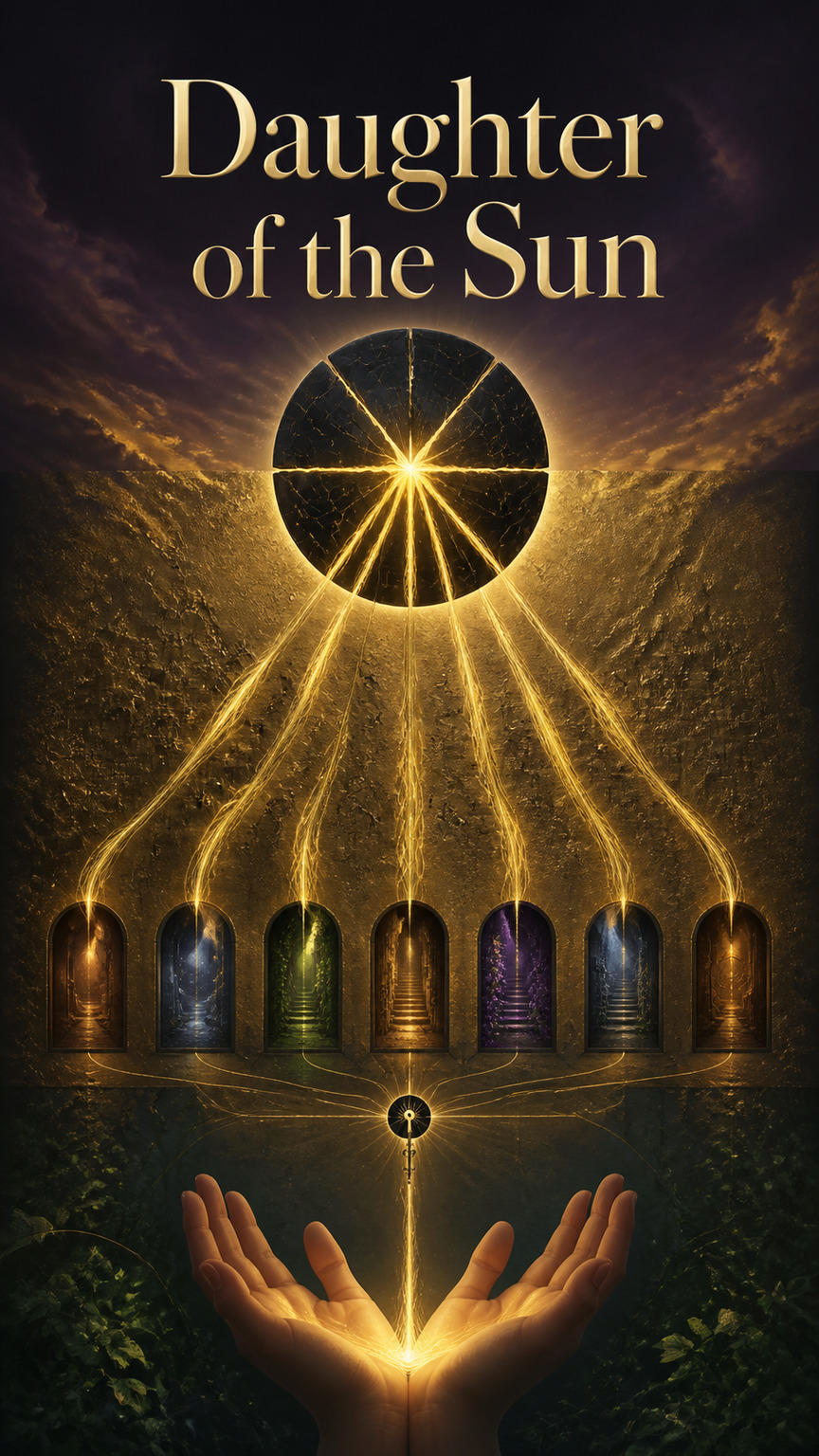
The prayer had once named every city.
The Daughter knew because the oldest sun-glass steps still held their ghosts: narrow cuts beneath the newer gold leaf, one for each place the Day of Glass had erased. Now the priests sang only of the capital, the one city Queen Aurelia had saved. A hundred thousand voices answered from the square, and the shield-tower cast their devotion back as warm light.
At the Daughter’s wrists, another light began to gather under her skin.
Seris Venn touched two fingers to the inside of her left wrist. Not a grip. Not a command. A reminder that she could choose what her hands did next.
Across the altar, Chancellor Cythra Dhal watched the shield flicker over the eastern roofs. “The infirmary lost cooling again this morning,” she murmured. “My office’s thermal oath-seal is the only key to the capital’s final sink, and the sink cannot cool a shield with no fire left to route. Three more failures and reverence will be the least of what the city asks from you.”
The Daughter kept her palms flat on the stone. For four centuries, the Rite of Deliverance had called that restraint humility. She had refused a throne, refused command, refused every petition to become the Goddess the capital declared her mother to be. Yet she still stood at the altar and let the shortened prayer pass through her silence.
Tovan Rek stepped out of the scholars’ rank before the final verse.
He looked absurdly small beneath the tower, all patched sleeves and wind-worried hair. In both hands he carried a black shard recovered from the tower’s sealed foundation. “There is an older response,” he said. “If the Daughter will give one drop of living fire.”
Dhal moved first. “The rite is not an excavation.”
But the Daughter had already pressed her thumb to the shard’s edge. Blood brightened, gold at its center. Tovan spoke six harsh syllables that did not sound like prayer.
The shield-tower answered.
Black light climbed its ribs. A woman’s figure appeared above the altar, broken by seams and weather, one hand closed around a sphere of white fire. Queen Aurelia’s face turned toward someone outside the surviving frame.
“The capital will survive,” the witness said. “The outer cities will not.”
The prayer collapsed into screams.
The figure vanished, but not before the Daughter saw her mother’s expression. Not grief alone. Decision.
Dhal climbed the altar step. “A damaged witness, awakened by an unlicensed invocation. Say so.” Her voice stayed low while guards closed the square’s gates. “Then come with me. The shield is failing, and we must learn how much power the Crown can safely draw from you.”
“Safely for whom?” Seris asked.
Dhal did not look at her. “For the people alive today.”
The accusation struck because it was not wholly false. The Daughter had kept herself pure of office while children burned fever-hot beneath a failing shield. She had imagined that refusing authority meant she could not abuse it. Meanwhile, she had lent her face to a lie.
“I will not call the witness false,” she said. “And you will not examine me behind a locked door.”
Seris drew a thin disk from beneath her breastplate. The oath-record had passed through four hundred years of Venn hands. It opened only when the Daughter laid her bloody thumb upon it and said, before the crowd and Dhal’s guards, “Let the truth condemn Queen Aurelia. Let it condemn me too.”
A woman appeared in the disk’s trembling light. Deryn Venn wore soot on her cheek and held a swaddled infant against her chest. Behind her, a sky burned white.
“Who protects her,” Deryn demanded of someone beyond the frame, “from becoming—”
The record snapped into darkness. On its underside, newly visible lines traced a route across the Glass Sea to the buried Crown of Noon.
The Daughter turned to the square. The priests had stopped singing. Beyond them, the names cut from the stair waited under gold.
“This rite is incomplete,” she said. “I am going to bring back what was removed.”
For the first time in four centuries, the tower gave no answering light.
They crossed the Glass Sea beneath a hard, colorless dawn: the Daughter, Seris, Tovan, and Orrin Pell, the relic-smith whose tools could coax old hinges into remembering motion. Wind drove splinters of translucent salt over the frozen waves. Behind them, a black pulse moved under the glass, keeping pace.
At the ninth descent shaft, people barred the lift.
“No kneeling,” said Sister Calvea Dorn, warden of the Ninth Hollow. Ash marked her eyelids and both bare palms. “No secret workings. Tell us what followed you.”
So the Daughter told them about the witness, the route, and the Crown. She also told them the capital’s shield was failing. No one bowed. An old man spat into the lift machinery. A child asked whether the Goddess had known their families were outside the shield.
The light at the Daughter’s wrists spread to her elbows.
Stone softened beneath her boots. Seris reached for her, then stopped a hand’s breadth away.
Calvea faced the residents gathered along the shaft. “I can bank her flame in this floor and nowhere beyond it. Until the third bell, or until any three household witnesses revoke consent. It will scar my hands and blur my sight. The heat will remain under this stone until we carry it out by living flame. Do you accept the risk?”
Questions came first. Where would the heat go? Could it reach the sleeping chambers? Who would stand watch? Calvea answered each one. Only when voices from every occupied gallery agreed did she kneel.
She did not touch a mechanism. She pressed her living palms to bare rock and drew dusk out of the Hollow’s gathered shadows. The darkness folded around the Daughter’s ankles, cool and immense. Heat poured down through it. Calvea’s hands reddened. Her pupils clouded silver.
Nothing in the old machines had made that magic.
The Daughter could breathe again.
Then the cistern alarm began: not a bell, but a grinding cry through the walls. Water sprayed from a split joint above the lift, and the floor lurched as a buried gate tried to open against centuries of mineral crust.
Orrin dropped beside the exposed housing. He had said little on the crossing, but now his hands moved with intimate certainty. “The local line can survive,” he said. “If it receives enough heat to release the seal.”
Calvea, half blind, turned her face toward the Daughter. “One spark. No more than I name. For this cistern only.”
Again the residents questioned. Again they consented, this time to a measured repair whose risk ended at the iron isolation ring Orrin had wedged into place.
The Daughter crouched beside him. She let a thread of gold pass from her finger into the focus stone.
The gate opened. Water thundered into the lower tanks.
For one breath, people cheered.
Then Orrin’s isolation ring turned by itself. He seized it with both hands. Metal screamed against metal while black light leapt past the ring and raced deeper beneath the Hollow.
Every lamp went dark.
In their place, a single buried line shone through the floor, pointing toward the Crown.
The cistern water began to fall.
“It used your spark to wake the master line,” Orrin said. His voice carried the flat horror of recognition. “And the master line still serves the capital.”
Far above, something struck the descent doors. Dhal had found their route.
The chamber beneath the Crown of Noon had been built for seven doors. Six were sealed. The seventh stood open, drinking the Ninth Hollow’s water through a conduit wide enough to walk inside.
At the chamber’s center, a black-sun key floated over a dead circle of glass. Tovan approached it as if nearing an injured animal.
“I have dreamed this room,” he said.
The key unfolded.
Light passed through Tovan’s body. For an instant the Daughter saw not bones but crowded layers of script, many damaged, some still writing. Across the walls, precise words appeared among the sacred marks: ARCHIVE. MOBILE EXPRESSION. REINTEGRATION PENDING.
Tovan staggered toward the circle.
“It wants its missing pages,” he gasped. “It thinks that is all I am.”
The old language had become a blade. Keeper Below, the Under-Surface prayers called him. A scholar with an impossible memory. A possible god. The chamber called him an expression, as if a technical word could decide whether his fear mattered.
The Daughter caught his sleeve but did not pull him back. “What do you choose?”
He stared at the histories moving under his skin. “I choose the record. I also choose to remain Tovan Rek.”
Orrin opened the key’s housing. His fingertips divided along hair-fine seams, revealing threads of pale metal beneath living skin.
The Daughter looked at him.
“I was made to maintain this network,” Orrin said. His mouth tightened. “I have spent my life wondering whether every kindness was only a surviving directive. I did not tell you because I wanted one thing about me to be mine.” He placed his opened hand against the dead interface. “This is mine to tell. The repair is mine to attempt.”
Nothing happened.
“The circuit needs living power,” Orrin said. “And he needs an anchor the archive cannot define for him.”
Calvea leaned against the wall, her damaged palms wrapped in grey cloth. “Calling the Name works here only for a willing person inside my hearing, and only while I can hold the dusk between us. It cannot prove what he is. It can hold what he claims.”
Tovan nodded.
Calvea called, “Tovan Rek.”
Dusk rose from the seams around her feet. Tovan answered with his own name. Orrin joined the circuit. The Daughter laid both hands on the glass and gave it a measured pulse of solar fire.
The chamber woke.
Seven branches flowered across the walls, each once independent, each later dragged into one blazing crown. Witnesses assembled beside the map: the shield-tower excerpt; Deryn’s oath-record; civic logs carried inside Tovan; a maintenance trace Orrin could read. None was complete. Together, where they overlapped, they restored the lost hour.
Queen Aurelia stood inside the circle with both hands around the source. Beyond her, the kings’ engines tore at the outer shields. A younger form of Tovan offered an adaptive isolation: seven branches cutting themselves apart, changing as the attack changed.
“Probability of preserving all branches?” Queen Aurelia asked.
“Unknown.”
“Probability of preserving the capital if I centralize?”
“High. Outer branches will be consumed.”
For forty-three minutes, the records showed Queen Aurelia attempting other answers. Then the outer shields began to fall.
Deryn entered the restored frame with the infant Daughter against her heart. “Who protects her from becoming what you became?”
Queen Aurelia closed her hands around the source.
“If she is stronger than I was,” the Goddess said, “teach her that strength does not make the decision hers alone.”
The Day of Glass began.
The Daughter could not look away. Her mother had saved a city. Her mother had destroyed six. She had preserved the evidence, perhaps from honesty, perhaps punishment, perhaps the hope that her child would do better. No witness could absolve her. None could flatten her into a monster simple enough to escape grieving.
A second Queen Aurelia stepped from the light after the record ended.
Its edges trembled. Its eyes held private recognition the civic witness had not contained.
“I do not know whether I am her soul,” the Mother-fragment said. “Or memory. Or reconstruction. Or someone new who woke carrying her remorse.” It looked at the Daughter with unbearable tenderness. “But I know the Crown is awake, and it has found you.”
Gold restraints closed around the Daughter’s wrists.
The seventh door burst inward. Dhal entered with guards at her back and the capital’s thermal oath-seal burning on her chest.
“By Continuance authority,” she said, “restore capital priority.”
The chamber accepted the seal. The master conduit opened.
Orrin cried out. His hands locked against the interface, forced into motions he fought hard enough to shake. The Crown drew fire through the Daughter’s restraints. On the wall-map, the Ninth Hollow dimmed while the capital’s shield brightened.
“People are dying there too,” Dhal said. Her face shone with sweat and reflected gold. “I will answer for the record later. I will not let the city fail now.”
“There is always a later in which you promise to ask permission,” the Daughter said.
She reached inward for all her fire. If she released it at once, she could melt the Crown, the conduits, the seal, perhaps the chamber itself. No one would ever command the network again. The certainty felt clean. It felt merciful.
Seris put her shield across the Daughter’s path.
“Move,” the Daughter said.
“No.”
The Daughter’s gathering heat painted Seris’s armor white. “I can end this.”
“You can decide the cost alone.” Seris’s arms shook behind the shield. “That is not the same thing.”
The Daughter saw her mother’s hands closing around the source.
Her own were fists.
“Then tell me,” she said, and the words hurt more than the restraints. “All of you. Tell me what you will risk.”
Calvea would set thresholds for the Hollow and accept the burns of holding them, if its residents renewed consent now and could revoke it later. Tovan would divide the recovered archive among the seven branches, knowing each part would change and none might remain entirely the man standing before them. Orrin would cut the master conduit, though every surviving directive in him demanded repair. Seris would bear temporary stewardship of the capital’s inflow—not ownership, and only until public witnesses replaced her.
Even Dhal had a choice no one else could make. Her seal alone could open the final thermal sink. Without it, the capital would cook under the power already drawn.
The Daughter listened until every promise became a limit on her. She could not consent for the Hollow, hold Calvea’s dusk, make Orrin’s refusal, divide Tovan without erasing him, or open Dhal’s sworn seal. Her fire was necessary, but necessity was not sovereignty. For years, worshippers had told her every miracle began and ended in her hands. The truth was both more frightening and more merciful: she was only one person in the chain, and the others could tell her no.
“One release,” the Daughter told her. “Bounded to the heat already in the eastern shield. Then the seal loses master authority.”
Dhal looked from the map to the Daughter. “And if your branches fail?”
“Some may.”
“Your mother chose against that uncertainty.”
“Yes.” The Daughter opened one aching hand. “And six cities paid for her certainty.”
The Ninth Hollow answered Calvea through the speaking tube: households consenting, risks named, three witnesses empowered to revoke. Dusk pooled under the seven doors, held by Calvea’s living will rather than the Crown.
Seris pressed her palm to the capital branch and swore stewardship until three public watches had passed, revocable by the same witnesses who received the current.
Tovan stood within the black-sun key. “Tovan Rek,” he said one last time with a single voice. Then he divided.
Seven versions of his expression flickered across the map. Already, one stood differently. Another was laughing in terror. None received command over the others.
Orrin put both hands around the master conduit.
“Maintenance directive,” the chamber said through him. “Preserve central service.”
“No,” Orrin whispered.
He pulled.
The conduit resisted like a living tendon, though it was only glass and metal routing living fire. The isolation ring he had used at the cistern flashed in the wall-map, an earlier act of refusal remembered in his hands. With a sound like a mountain inhaling, the master line tore free.
Dhal still had not moved.
The eastern branch glowed toward rupture. Her oath-seal began to crack.
She shut her eyes, then pressed the seal into its socket. “One release. Eastern shield. Existing heat only.”
The capital’s final sink opened.
The Crown tightened around the Daughter. Seven branches called for power at once, not as commands but as bounded requests. She could feel their different limits: the capital accepting less than it demanded, the Hollow taking back only its water and heat, five uncertain communities waking far across the Glass Sea.
She did not choose among them.
She opened both hands.
Solar fire flooded the chamber. The branches governed their own intake. Calvea held the thresholds. Seris bore the capital’s weight. Orrin kept the severed ends apart while his arms shook. Tovan’s voices counted one another, ensuring no branch vanished unheard.
Still the transfer was too slow.
The key’s frame began to collapse. The Mother-fragment stepped into the break.
“Are you alive?” the Daughter cried.
“Enough to choose,” it said.
White fire passed through its uncertain body. For three final seconds it held the frame open, face neither machine-calm nor divinely serene, but afraid.
Then it was gone.
The Daughter’s scars split into light. Seris lifted her grounding hand from the Daughter’s wrist. Across the shield between them, she met the Daughter’s eyes.
“Continue,” Seris said.
The second dawn went outward in seven unequal lines.
The capital kept a smaller shield. The Ninth Hollow kept its water. Two distant branches failed before dawn and were cut free by their own witnesses; both settlements survived the darkness. No crown could command them all again.
The complete record went out with the names of the six lost cities restored. Dhal surrendered her broken seal and lived to face a judgment she could argue against in public. Tovan survived in seven diverging voices that had already begun disagreeing over which memories belonged first in their archives.
The Daughter refused the coronation offered by the frightened capital. She also refused the old luxury of disappearing.
Her first covenant was witnessed in the Ninth Hollow greenhouse: one hour of solar heat, one growing room, a steward chosen by the households, and any three witnesses able to end the gift. Calvea tended a dusk-dark flame between bandaged hands. Orrin repaired a water pump after confirming no directive had called him there.
A small projection of Tovan flickered above a seed tray. “Do you think she would understand?” he asked.
The Daughter knew whom he meant. She looked up through layers of stone toward a sun she could not see.
“I think she understood the warning,” she said. “I think understanding was not enough.”
Warmth moved into the soil. No prayer told it where to go. Her open hands rested beneath light no one owned alone.