When Death Knelt
the god of death has arrived at your doorstep, but instead of taking you to the afterlife, he begs you to chooses him to be your earthly avatar and champion.
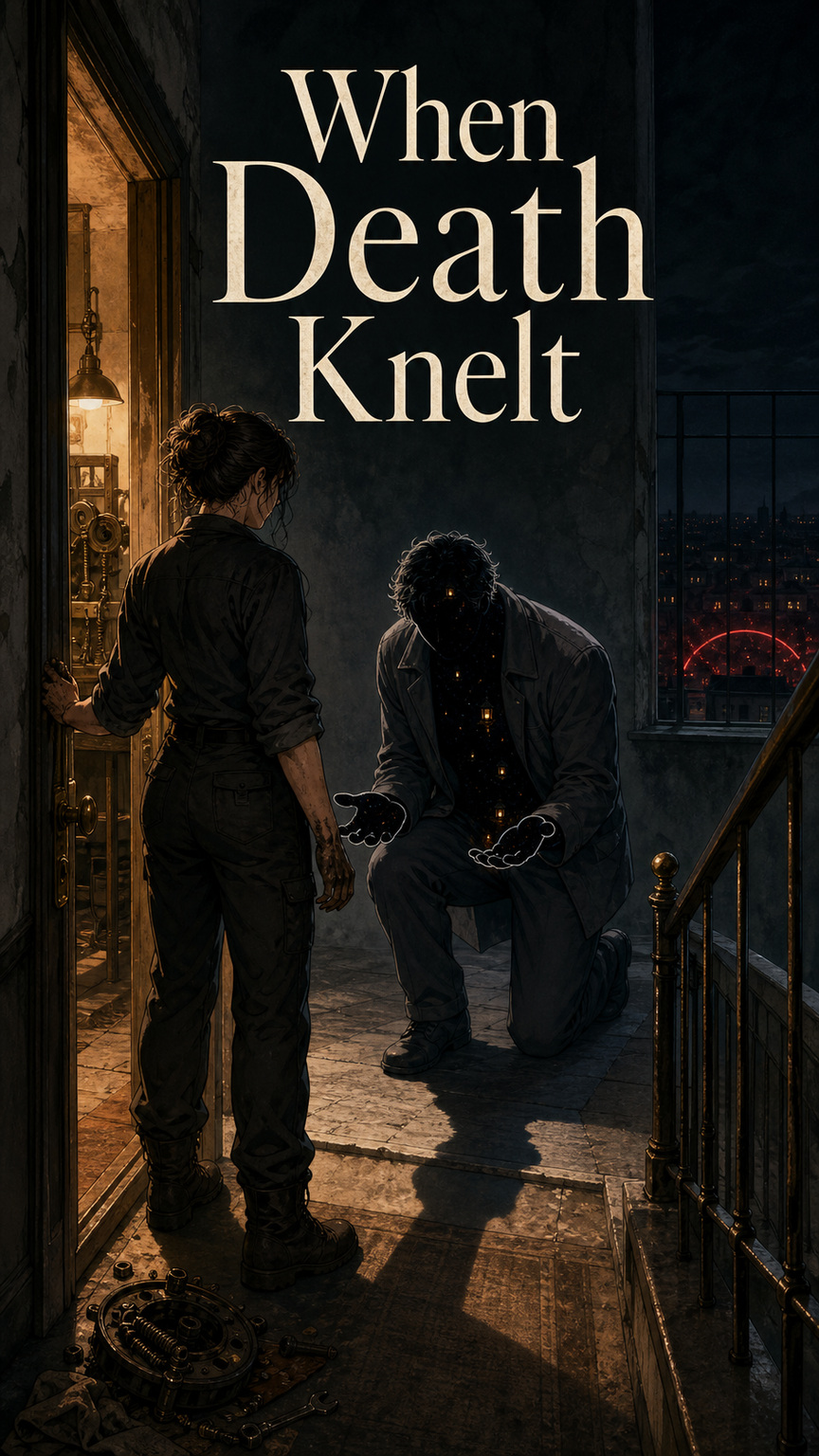
Derva had the stair-hoist brake in pieces when someone knocked.
Not a tenant’s knock. The people in her building struck the door with whatever part of themselves was free: a shoulder under a basket, a boot when both hands held a child, three fingernails when they wanted the key to the roof. This sound landed exactly where bare knuckles would, one measured blow, a pause, then another.
The little brass washers on Derva’s floor jumped before the third.
Far below, something hit the lower district hard enough to make the apartment lean. Lime dust breathed from the crack above her sink. The hoist cable inside the open brake housing twanged against her thumb.
Six minutes and some change since the last impact. The backward thunder would come at seven.
Derva set the brake shoe down and opened her door.
The god of death knelt on the landing.
She knew him without robes, scythe, or skull. He wore the shape of a tall man in travel-gray, but the unlit space inside his outline had the depth of a night sky. Worship moved through that depth like faraway lanterns. His lowered knee had not dented the stair runner. Dust lay undisturbed beneath his other boot.
“Derva,” he said. The landing gave his voice a small, awkward echo. “Please choose me.”
She kept one hand on the door. “You have the wrong flat.”
“Any willing adult inside the ward would suffice. Yours was the last open door between here and the charge.”
“That isn’t better. Choose you for what?”
His head came up. There was a face in the darkness now, spare and solemn, trying to hold a ceremonial expression together under plain fear.
“As your earthly avatar,” he said, “and your champion.”
The district bell began hammering below: five strokes, the signal for the eastern evacuation lane. People shouted in the stairwell.
Derva looked past him. Through the landing window she could see the demonstration engine at the foot of the slope, or what remained of it: a plated prow buried in the old test barricade, six wheels crooked along the paving, the brass memory drum in its belly pulsing red. It had been built to remember one charge supplied by forty living spellwrights. It had no driver, no will, no appetite. A broken stop-pin was enough to make catastrophe look purposeful.
As she watched, red light ran backward over the wreck. Torn plates shuddered. Beams ripped from a cooper’s roof and flew toward the engine. Iron guttering peeled from three facades, twisting into wheel rims. The prow drew itself out of the barricade and vanished uphill in a clap that hurt her teeth.
The next circuit had begun.
“You want me to serve you,” Derva said.
“No.” The god’s ceremony broke cleanly on the word. “I cannot take material form inside this ward ring without a living patron. The customary rite makes you my champion. Reverse it. Give me a cause, and I serve yours.”
“Why can’t your worshippers do it?”
“They gave me worship. Elsewhere, I have power and authority. Here, the ring admits neither through prayer alone.” His gaze dropped to the tools at her feet, then returned to her. “I am asking for the one thing they cannot grant from a distance.”
Up the street, metal began to turn.
Derva knew that sound. The engine was back in the arsenal yard, its remembered wheels gathering speed. On its first circuit it had shattered the test barricade. The roadway had settled under that weight; when the engine came again, the old grooves would tip it east toward the tailrace bridge. The reservoir sluicehouse stood beyond the next bend. If the prow entered the gate gallery, it would break the manual gearing or the wall around it. Either failure would put half the reservoir through the lower district.
“What can you do?” she asked.
“I can end what has finished ending. A spent spell. A completed fracture. A dead construction. Not an intact machine, not a healthy life, and not a choice about which part of your city should be lost.”
“The engine resets every seven minutes. End that.”
“Its charge has not ended. The broken pin removed the end it was given.”
That answer was useless, but not vague. Derva preferred a useless measurement to a hopeful lie.
She stepped onto the landing. “I choose the god of death as my earthly avatar and champion for one cause: end this repeating charge without surrendering the lower district to it.”
“Freely?”
“Don’t make me repeat myself.”
For the first time, his boot pressed dust into the runner.
His shadow leaped beneath hers. Cold folded around Derva’s ankle, not painful but exact, as though someone had fitted a shackle made from the instant before a pendulum dropped. The god stood. The landing groaned under his weight.
“Stay where I can see you,” he said. “If you stop moving, or lose sight of me, my reach here collapses. And when I act—”
The charge struck the top of the street before he finished.
The engine came around the bend in a storm of sparks, taller than a house and patched with what it had stolen: blue shutters armoring its left wheel, roof beams bristling from the chassis, a marble lintel driven through the plated prow. Its wheels followed the old demonstration grooves, but the broken paving canted it farther east on every pass.
People jammed the stairs below. A woman dragged a handcart through the entry arch while a boy pushed from behind. Above them, the cracked stone cornice tore loose. Red threads from the engine’s drum caught the falling pieces and pulled them sideways, toward the moving chassis.
“Stop those stones,” Derva said.
The god raised one hand. “The wall has already lost them. They’re still falling.”
The cornice blocks swung above the cart like hammerheads. Derva started down the stairs, keeping the god in view through the railings.
“Then end their return to the engine.”
Darkness closed over the red threads. The blocks dropped straight down, smashing the empty doorstep behind the cart.
Derva tried to run after the evacuees and found that the world had thickened around her legs. Her first step took as long as three. The god matched her without changing stride, but each pace he took drew speed out of hers.
“You could have mentioned that first,” she said.
“I attempted to.”
It was not a joke. His eyes were on the charging engine.
Derva forced her knees to unlock. The engine passed the building close enough to scour plaster from the arch. Its right rear wheel dropped into a new hollow, throwing the prow toward the lower lane. Then it thundered on, over the bridge, toward the sluicehouse.
They followed as fast as Derva’s borrowed body allowed.
The street had become six kinds of obstruction. Bedding filled a doorway. A brewer rolled two barrels uphill against the evacuation flow. Someone’s geese had settled in the middle of the paving and would not be driven uphill.
“East stair’s jammed,” a porter told Derva, breathless. “Chest won’t turn.”
She looked once. “Stand it on end. Take the feet off.”
“They’re carved on.”
“Then it stays. Move the people.”
At the next corner a girl held out a coil of thin rope. “Winchwright, is this yours?”
“Mine now.” Derva took it without slowing. The coil felt heavy as anchor chain in her unresponsive hand.
The god reached to carry it.
“I need you visible,” she said.
He withdrew his hand. A cart piled with chair frames rolled between them. His body went translucent at once; his planted foot passed halfway through a paving stone.
Derva caught the cart shaft and heaved it aside. Painfully slow. The moment she saw him whole again, weight returned to his coat and boots.
“Mutual sight,” he said.
“That was the word you left out.”
“Yes.”
Behind them came the hollow boom of the engine striking the sluicehouse’s outer brace. A lesser impact than before. It had glanced off and reset before its full recorded distance, but the next circuit would begin from a roadway in worse condition.
The lieutenant in charge of the evacuation had occupied the diversion winch halfway down the slope. Four crews strained at its capstan, shifting a buried length of demonstration rail toward the eastern residential lane. Chalked numbers covered the lieutenant’s leather sleeve.
“Winchwright.” He spoke before Derva reached him. “We can turn it six degrees. Lane is empty. Ninety-one dwellings lost, reservoir and bridge held.”
“The lane isn’t empty.”
“Last count says it is.”
“The drain runs under it. You put that much weight through those cellars, the culvert folds. Then the next reset eats the bridge footing for replacement stone.”
The lieutenant glanced at the god. His mouth tightened, but he did not waste time asking who the impossible man was. “Six degrees. Ninety-one dwellings. We have four minutes.”
“The drain won’t hold it. Lock the rail where it is.”
“Give me another line.”
Derva watched the red glare kindle uphill. The engine’s left axle would pass within arm’s reach of the winch platform. If the god could end it here, there would be no need to touch the gate works.
“That axle,” she told him. “Take it when it reaches us.”
The god studied the approaching machine. “It is worn. Not ended.”
“It will be under full load.”
“Derva—”
“Do it on my mark. Lieutenant, get your crews off the capstan.”
The lieutenant did not move. “Six degrees saves the water.”
“Off.”
Perhaps it was the god beside her. Perhaps it was the engine filling the street. The lieutenant chopped one hand downward, and the crews scattered.
The engine struck the loosened rail. Its prow yawed; the left wheels climbed the paving. Derva saw the axle flex under the chassis, saw daylight open between its collar and bearing, and gave the order.
The god closed his hand.
All motion went out of Derva.
Her lifted heel hung above the stones. Breath stopped halfway into her lungs. Around the god’s fingers, darkness gathered and slipped from the axle without purchase. The metal flexed, screamed, and held. Then the wheel slammed down. The engine tore the diversion winch from its bed and dragged the capstan away in a shower of bolts.
Derva fell when her body returned to her. The god caught her under the arms, but his grip faded as her eyes squeezed shut. She forced them open. His face resolved inches from hers, ceremony gone, fear plain.
“It had not broken,” he said. “I couldn’t begin the break.”
The lieutenant limped from behind the platform, one trouser leg torn. “Three minutes to impact. Ninety-one dwellings still standing. No diversion. What now?”
He was not gloating. He wanted a line he could use.
Derva rolled onto one knee. The engine’s rear assembly passed them. A snapped crescent of bronze rattled inside an open gear case, separated from the shaft but held in its old position by red light. Each turn widened a black seam through the collar around it.
The god pointed. “That break is complete. The charge treats the pieces as joined.”
Derva almost told him what to do again. Her mouth formed the first word.
She swallowed it. “Which pieces?”
“The bronze collar and the drive shaft.”
“If you end the joining, what still turns?”
“The shaft, badly. Until the load finds the seam.”
There was the measurement she needed.
“End the joining,” she said. “Nothing else.”
The god touched two fingers to her shadow. The red light in the gear case went out. The broken collar dropped onto the paving and bounced away. Derva’s muscles dragged again, but she had kept walking this time—one heel down, one toe forward—and the god stayed solid.
The exposed shaft began to wobble.
“Sluice gallery,” Derva said. She turned to the lieutenant. “I need the west gate counterweight unpinned, two hauling crews on its service line, and everyone else off the bridge.”
“That opens the west gate.”
“Not if I dog the manual wheel.”
“You’ll be in the gallery.”
“Yes.”
He looked from her to the engine, counting without moving his lips. “Two minutes.”
“Then stop spending them here.”
This time he ran before she did.
The sluice gallery was a stone throat built along the reservoir wall. On one side, iron gate wheels rose taller than Derva; on the other, arched service openings looked down onto the tailrace bridge and the charge route. The west counterweight hung in its shaft above them, six hundred pounds of river-smoothed iron meant to balance the gate. Its service line ran through a ceiling block to the manual wheel.
Derva entered with the god at her shoulder and the thin rope across her chest. Her body still answered late. She made every movement continuous: walking while she pulled the coil free, circling the wheel while she knotted the rope, leaning rather than stopping when her fingers failed to close.
Outside, the engine vanished in backward thunder.
Fourth circuit.
The lieutenant arrived with two crews. “Bridge clear. One minute forty.”
“Take the counterweight’s safety pin out.”
“It drops, west gate rises.”
“Only a handspan if they hold the service line.”
“A handspan puts water on the gallery floor.”
“Then we’ll have wet boots. Pin.”
He repeated, “One minute forty,” but he set both hands to the pin with Derva. It came free grain by grain. The crews took the strain; rope fibers snapped in tiny reports.
Derva led the thin line through the nearest service arch and around a maintenance snatch block. The block’s hook had been driven into the wall to lift gate teeth, not swing weights across a roadway. She tested the anchor with her shoulder.
The god watched the strain travel through rope, block, hook, and stone. “The hook may end first.”
“May?”
“Its inner curve is hidden from me.”
“Then stand where you can see it when it loads. Tell me which failure finishes. Don’t choose for me.”
He bowed his head once. Not submission. Attention.
The charge entered the lower street. Its rumble filled the gallery floor. Derva tied the thin rope to the counterweight’s lifting eye and passed its free end to the lieutenant.
“When the prow clears the bridge, pull. Not before. If the weight hits the prow, it rolls into the wall. We need the drive shaft behind the second wheel.”
The lieutenant wrapped the line around his forearm. “Prow clear. Second wheel.”
“Those are different moments.”
“I heard you.”
The manual gate wheel shivered under Derva’s palm. She needed to dog it the instant the counterweight swung free, or the reservoir would lift the gate. The pawl hung half engaged above the ratchet. Ordinarily she could seat it in one hard movement.
Nothing she did was ordinary while the god spent her motion.
The engine burst onto the bridge.
Stone cracked beneath the first wheel. Its prow carried half the district in its armor now: carved fireplace surrounds, drain grates, roof nails gathered into a bristling black hide. No life animated it. The fixed drum beat red, giving the same command to a road that changed beneath it.
“Hold,” Derva said.
The crews leaned against the service line. Water hissed around the west gate.
The prow crossed the far edge of the bridge.
“Now.”
The lieutenant hauled. The crews paid out one arm’s length of service line. The counterweight dropped, the thin rope caught it sideways, and it swung out through the service arch.
It struck the wobbling shaft behind the second wheel.
The sound was smaller than Derva expected: a hard iron cough. Then the shaft folded at the unjoined collar. The rear wheels drove over the broken metal, twisting the chassis sideways. The engine’s prow cleared the bridge and buried itself in the empty inspection yard. Its memory drum kept turning, but no force reached the wheels.
The snatch-block hook split.
“Hook ended,” the god said.
“Leave it. The engine?”
He stared into the red drum. Begging had made him look almost human on her landing. Here, with a true ending before him, he became difficult to see at all. The gallery lamps bent inward. Every shadow in the stone throat pointed toward his hand.
“The drive is ended,” he said. “The pattern can be severed now.”
Derva’s legs were already failing. Behind her, the manual wheel began to turn as the unbalanced gate lifted.
“Do it.”
The god reached.
The drum’s red pulse stopped between beats.
Derva lost everything except the small forward drag of her left foot. She kept that toe scraping stone while the god drew the last stored repetition out of the wreck. Red lines rose from the engine, thinned to threads, and disappeared into the dark of his palm. Timber and masonry trembled in the chassis but did not fly backward. The engine remained where it had broken.
The manual wheel spun faster.
Derva could not raise her arms. She let her weight fall against a spoke. The wheel drove her around with it, once, half again. Her right hand passed the hanging pawl. Too late. On the next turn she hooked it with two fingers. The ratchet hammered against its tip and kicked it loose.
Water spread over her boots.
“Derva,” the god said.
“Keep—” Her jaw worked after the word. “Working.”
He could not hold the wheel without abandoning the engine. He did not explain that. He looked once at the lieutenant.
The lieutenant shoved his shoulder beside Derva’s. “On three,” he called to the crews. “One. Two.”
They checked the service line on two. The gate wheel slowed just enough. Derva caught the pawl again and dropped her whole forearm over it. Iron met iron. The ratchet struck, bounced, then seated.
The west gate stopped a handspan open. A shallow sheet of reservoir water washed through the gallery drains and into the tailrace, nothing more.
For several breaths, nobody spoke. Rope creaked. The broken engine ticked in the inspection yard.
Then the god lowered his hand.
Motion returned to Derva in painful increments: lungs first, then shoulders, then the cramped fingers locked around the pawl. Her legs remained distant things. She sat down because choosing to sit was easier than pretending she had not fallen.
The lieutenant went to the arch and looked out. “No reset.”
“Clear the hauling crews,” Derva said. Her words came slowly, but they came. “Then braces on the west gate.”
“And the wall?”
“After the gate.”
He nodded and began assigning hands. The first brace crew was moving before anyone found breath for cheering.
Derva watched the memory drum until its metal cooled from red to ordinary black. “Cause ended?”
The god stood beside her shadow. He was still fully present, but the gallery lamps no longer leaned toward him.
“The repetition is gone,” he said. “The machine cannot charge.”
“Then the bond is done. I dismiss you.”
His outline thinned. For an instant she saw the impossible distance behind his face, all those far lamps of worship and the authority they carried. He opened his mouth, perhaps to recover the words proper to a god’s departure.
A crewman shouted from the gate shaft, “Which brace first?”
Derva looked away from the god. “East bearing. Nobody touches the wheel until it’s shored.”
When she looked back, the gallery held only her own shadow.
Feeling returned to her feet as pins and heat. Derva pulled the thin rope toward her, found the broken snatch block at its end, and began checking which pieces could still be used.