The Warning Comes Second
"If you've ever had déja vu, then it's too late."
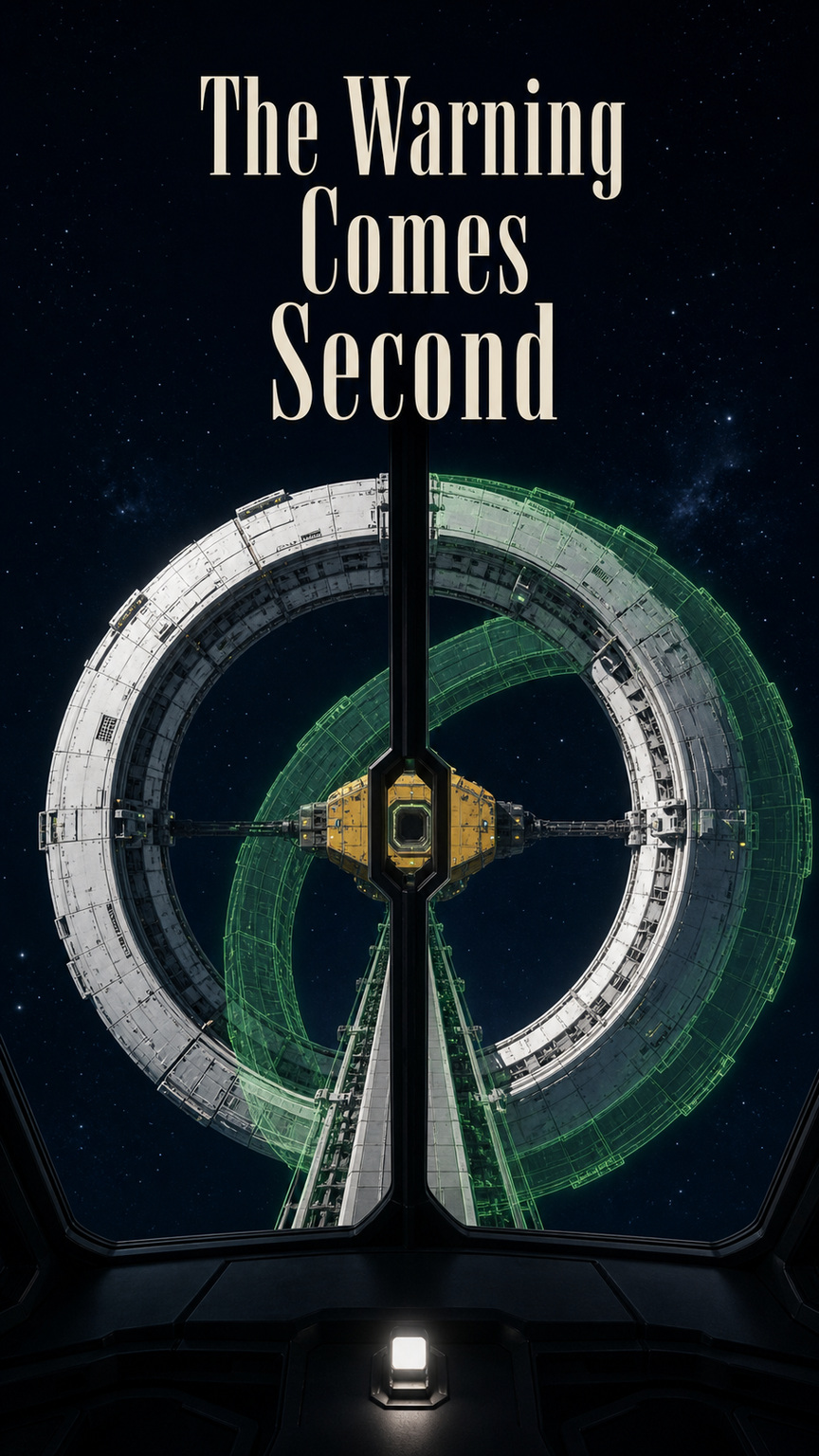
Kessa’s thumb was already under the cargo-release guard when the green arrows came around again.
Three on the docking screen: left, left, hold. The receiver painted them over the ring ahead, a clean corridor through a view that was anything but clean. White plating rolled across the forward window. The service ring’s occupied spoke slid after it. Somewhere under Kessa’s boots, metal ticked in a quick descending run.
Her hand knew what came next. Lift the guard. Brace the wrist. Press with the thumb, because the old switch kicked.
She snatched her hand back.
The tug kept turning. A red numeral on the dead-center display changed from 00:06 to 00:07 AFTER REPRISE. Kessa stared at it until a recorded voice opened in the headrest behind her.
“If you’ve ever had déjà vu, then it’s too late.”
Dalsen’s voice, brisk and level. Then the harness gave its machine inventory: baseline sealed, outboard loss latch confirmed, cognitive lock recorded, working and episodic restore complete, charge exhausted. The small bridge lamp beside Kessa’s shoulder had fused white. A spent cartridge smelled of hot almonds through the cockpit filters. The consented harness had stored one neural baseline before approach; the white lamp meant it had spent that single state.
She remembered fastening the harness before final approach. She remembered Orivan going outside to watch the reluctant cargo latches. She remembered the ring no larger than a coin beyond the glass.
Now the ring filled half the window, her lower lip was bleeding, and the port thruster cluster showed no pressure at all.
“Orivan?” She hit the suit channel. “Exterior, answer.”
Static snapped. A voice tried to form inside it, close enough to raise the hair on her arms and too broken to understand.
“Service tug, cut your approach.” The ring controller arrived hard over the same channel. “Cut approach and declare control.”
“Control is partial. Pilot Kessa. I have a reprise event and structural loss.”
“Kessa, this is Pavax on ring duty. Your transponder dropped for one minute thirty-six. Radar puts you inside the occupied arc. Range one hundred eighty-four, closure point two five. That solution is one point eight seconds old.”
“Copy old range.” Her mouth knew the radio shape, at least. “My docking display says aligned green.”
“It is not aligned.”
The green arrows returned: left, left, hold.
Kessa looked past them. A black mechanical sight bar lay along the tug’s nose, built for the day every clever instrument failed. Its notch should have enclosed the ring’s yellow alignment block. The yellow block was drifting toward the notch’s right edge.
Her hands expected left thrust. The dead cluster sat on the left.
“Do not fire lateral,” she said, partly to the radio and mostly to herself.
Two people answered at once. Pavax said, “Confirmed, no lateral,” while another voice began, “If the bridge lamp is fused—” and vanished under him.
“One at a time. Dalsen, again.”
The harness designer came back with a breath of room noise around him. “If the bridge lamp is fused and the outboard loss recorder agrees, the restore completed. Read me the latch state.”
Kessa found it low on the structural panel. “Loss latch: irreversible. Source: exterior. Bridge: fused. Charge: zero.”
“Then ninety-six seconds elapsed, whether you remember them or not. The tug, your body, and every transmission kept going. Only your working and episodic memory returned to baseline.”
“I know what the device is supposed to do.”
“Good. Your recorder?”
“Exterior buffer damaged.” She opened it anyway. Blocks of gray filled the final minute. One frame showed Orivan’s gloved arm at the cargo rail. Another showed empty stars scored by a band of static. The last intact telemetry line reported a rising twist in the port truss, then nothing. “Incomplete.”
“Mine too,” Dalsen said. “I received the loss event and harness firing time. I did not receive your controls.”
The broken suit channel crackled again. Kessa pushed its gain up until static hissed across the cockpit. Beneath it came three knocks through the hull.
Not radio. Contact.
“Orivan, knock once if you hear me.”
One hard blow rang below her left boot.
“Your suit audio is gone?”
One.
“Are you losing air?”
Silence. Then two.
No.
“Injured?”
One.
The next knock scraped instead of striking. A contact microphone in the exterior work collar caught a torn piece of his voice.
“—right leg. Collar’s bent. Don’t—”
Static swallowed the rest.
“Don’t what?” Kessa asked.
“—four side down—”
“Four side?”
A fist hammered the hull twice, impatient even through metal. The collar mic cleared for half a second. “Port side down. We rolled after the hit.”
“Port side down,” Kessa repeated. “I have you.”
He remembered. The thought landed differently from the fused lamp or the clock. Orivan had lived the ninety-six seconds her mind could not reach, and he had carried them into this one with his leg trapped outside.
The ring’s white plating rolled past again. Kessa’s stomach clenched before the view arrived, a sour warning with no attached scene. Her shoulders tightened against a shove that had already happened. When the green arrows flashed left, her wrist turned toward the cargo guard once more.
Motor prediction, Dalsen had called it during training: the body’s fast guess about the next required movement. The harness did not store that system. It did not rinse stress chemicals from the blood or pry learned associations out of the senses. She had considered that an untidy footnote when she signed consent.
Now it was the only account she had written herself.
“Pavax, new range.”
“One hundred fifty-six, closure point two five. Updated one point eight seconds before receipt. Your receiver continues to answer with a valid green checksum.”
“Valid for when?”
A pause traveled out to the ring and back. “The same alignment packet has repeated four times. Receiver timestamp is frozen before your transponder gap.”
Old green. Not a lie, not guidance. A loop that could still prove itself correct.
Kessa killed the overlay. The arrows disappeared, leaving the mechanical bar, the ring, and the thin blue brackets of tug radar. The brackets leaned right of the bar. The ring controller’s range put them closer still. Orivan had felt the port side drop.
Three poor measurements, none agreeing perfectly, all disagreeing with green.
“We struck something during the gap,” Kessa said. The sentence stalled after that. She could name the evidence. When she tried to name what she had done, the thought opened on blank air. “I don’t—my control choices aren’t there.”
“They won’t be in the fused bridge,” Dalsen said. “It verifies that the harness fired and fixes when, not what you chose before it did.”
“Exterior recorder shows the port truss twist,” Pavax said. “Radar shows a fragment leaving your old approach line. Current roll is consistent with a port-side loss.”
“Consistent,” Dalsen said, “not complete.”
“The cluster is sheared,” Kessa said. She put two fingers against her cut lip. They came away red. “Orivan’s trapped. Those aren’t missing.”
The collar mic rasped. “Glad we settled that.”
Pain shortened him to the useful edge of a sentence.
Kessa checked the other thrusters. Fore and aft answered, but their common feed pulsed below minimum. One clean burn, perhaps, if the damaged manifold did not tear. It could slow the tug or change the roll, not both.
Pavax came back. “Authorized safe action follows. Separate the flight cell on my mark. The ring will fire the outer catch field across the tug’s path. Pilot cell clears outward. The main hull is diverted below the occupied spoke.”
Kessa looked at the exterior diagram. The flight cell’s explosive bolts would throw her clear. The tug, its cargo, and the bent collar would enter the catch field together. The field was built to drag metal, not protect a person pinned to it.
“Orivan is on the tug.”
“I have his suit beacon.” Pavax’s voice stayed in numbers because the numbers were his work. “His air is stable. The predicted collar load in a catch is beyond suit tolerance. I cannot authorize the tug through the occupied arc.”
“So your safe action is safe for the ring.”
“It is the option inside my control.”
No defense. No apology. The ring turned behind his words, full of people who did not know a green corridor was pointing eighteen loaded tonnes at their wall.
Kessa’s thumb found the cargo guard again.
This time she let it rest there.
“Cargo rail state,” she said.
“Last frame shows latches three and four released,” Dalsen answered. “One and two unknown. Release command began before my exterior feed failed.”
An unfinished action. Her body’s next movement had not come from nowhere.
The tug carried six refinery membrane drums in a cradle along its belly. The spring rail existed to shove them clear if a dock jammed with the drives cold. Ejected forward and outward, the drums would take momentum with them. The rail sat below the tug’s centerline; its kick would also turn the hull.
Kessa pulled up the mass sheet. The cargo represented the delivery, their lease reserve, and most of what she and Orivan had not yet paid for. The stabilizing pulse after recoil would consume the damaged feed’s return margin. She placed the eighteen tonnes into the manual impulse model.
“Pavax, if I eject the cradle on this roll, where does it go?”
His answer came after the radio delay. “Do not release debris toward the ring.”
“Run it. Forward spring rail, current port-down rotation. Cargo takes forward-inward. Tug recoils aft-outward. Offset rail gives me starboard roll.”
“Your attitude solution is degraded.”
“So is yours. Run it.”
Dalsen spoke into the silence. “If the two unseen latches remained closed, the rail won’t fire. If they opened before the recorder failed, the impulse will be within nine percent of rated. I can’t narrow it.”
“Kessa,” Orivan said through the collar, his voice shredded by vibration, “hatch is… thirty degrees above me. Turn starboard, I can reach it. Port more and the collar folds.”
Pavax returned. “Model complete. Cargo clears the occupied spoke by eleven meters at median spring force. Tug clears by six. Error bounds overlap the spoke.”
“Range?”
“One hundred twelve at receipt. Closure point two five.”
Seven and a half minutes by old radar, but the narrowing release angle would close much sooner.
Kessa opened the manual release circuit. Latches one and two showed amber: neither open nor closed. The guard kicked against her thumb exactly as her hand had promised.
For one sick instant the cockpit became familiar down to the hiss behind her right ear. Her thumb pressed. The hull struck. Orivan called something she couldn’t keep. Then the sensation dissolved without giving her an image.
She lifted her thumb.
“Not yet,” she said.
“Confirm hold,” Pavax answered.
“Orivan, I need present roll. Forget the display. Count the truss vibration as the bent collar comes under load.”
“Can do. It pulls my leg on the low side.”
“Give me high, level, low.”
The contact mic dropped out. His first word arrived through the hull instead: one knock, then a pause.
“High,” Kessa translated.
She watched the mechanical notch. The yellow block drifted toward its edge. Radar lagged behind the visible line; Pavax’s numbers lagged farther. Only the groan under the floor belonged to this fraction of a second.
“Range ninety-six,” Pavax said. “Recommend immediate cell separation.”
“Denied.”
“I need receipt of hazard boundary. Cargo must not release before—”
Orivan’s voice broke through his. “Level.”
“Before what?” Kessa asked.
Static. Pavax did not answer.
“Pavax, say boundary again.”
Dalsen cut in, “I have a latch transition—possibly one, possibly noise—”
“Both of you clear.” Kessa kept her thumb off the switch. “Pavax, repeat.”
The yellow block crossed the notch and kept moving. The alignment she had expected passed without a receipt. Every part of her wanted to complete the old motion. She held.
Pavax’s voice returned. “Do not release before next starboard-level crossing. Cargo would clip the spoke on the present half-roll. You were not heard acknowledging.”
“No acknowledgment because I didn’t receive it. Holding for next crossing.”
“Confirmed.”
One option gone. The hull rolled on.
Kessa’s hands became fluent while the rest of her did not. She armed the rescue hatch, dumped cabin clutter into restraints, and set the remaining aft thruster to a pulse after recoil. When Dalsen asked whether she remembered beginning the cargo release, no answer came. The memory question opened the same blank reach.
“I know where my hand goes now,” she said. “That’s enough.”
“Range seventy-two,” Pavax said. “Your release window is four seconds wide on my delayed solution. I will call one second early.”
“Don’t call fire. Call range.”
“Copy. Range only.”
The collar groaned. Orivan breathed once into its microphone, too close and rough.
“Pain?” Kessa asked.
“Seven if still. Nine when low.”
“Air?”
“Forty-three minutes.”
“Tool pouch?”
“Right hip. Can’t reach.”
“Rescue latch?”
“Looks whole.”
The exchange was so ordinary that Kessa trusted it more than the green had ever deserved.
“Range fifty-eight,” Pavax said.
The yellow block approached the notch again. Kessa felt the roll through the chair rails. A shallow tremor, then a deep one that climbed through her teeth.
Orivan knocked once. High.
“Range forty-nine.”
The tremor flattened.
“Level,” Orivan said.
The mechanical notch closed around yellow. Kessa lifted the guard, braced her wrist, and pressed.
The switch kicked.
For a heartbeat nothing moved. Then the rail discharged along the tug’s belly. Six drums tore away in their cradle, silver bands flashing across the lower window. The cockpit slammed backward and outward. Kessa’s harness caught her cut lip against her teeth. The ring slid sideways. The tug rolled starboard, rescue hatch dropping toward the bent collar.
She fired the aft pulse for eight-tenths of a second. Feed pressure collapsed as she released it.
“Cargo vector clear,” Pavax said. “Tug vector—stand by. Stand by.”
Kessa watched white plating travel across the window. The occupied spoke reached the mechanical bar, touched it, and began to slip away.
Metal boomed once beneath her. Orivan, or the truss, or both.
“Tug clears,” Pavax said. His voice lost one of its hard edges. “Minimum predicted separation four point six meters. Do not thrust.”
“No thrust available worth naming.” Kessa unbuckled. The after-reprise clock read 09:41. “Orivan, hatch is coming to you.”
His answer emerged through the collar mic with a thin burst of breath. “I see it.”
Kessa sealed her helmet and vented the short rescue lock. Through its round window she found Orivan pinned below the bent service collar, tether taut, right leg twisted under a folded brace. Beyond him the ring moved upward now instead of across. The new direction unsettled her stomach, but no ghost of movement came with it. This part had not happened before.
She opened the outer hatch and clipped her line before reaching for him.
“Don’t pull me straight,” he said. Face-to-face, his suit carried no sound at all. The collar microphone caught him only when his helmet touched the hull; she read the rest from his mouth and his pointing glove. “Lower pin first.”
Kessa found the pin under the folded brace. “Red tab?”
He shook his head, then tapped twice beside it. Secondary catch.
“Black catch, then red.”
He gave her one raised thumb.
The black catch resisted. Kessa took the short lever from his right-hip pouch and fitted it under the collar lip.
“How much turn?” she asked, pressing her helmet to the hull so the contact circuit would carry her voice back.
“Quarter. Stop if my boot moves inward.”
“Your boot’s already inward.”
“More inward.”
She turned the lever. The collar flexed. Orivan’s eyes shut, and his gloved hand closed around her forearm—not a signal, just pain. Kessa stopped.
“Air still good?”
Thumb up.
“Leg sensation?”
He spread his fingers, uncertain, then held up two. Two toes, perhaps. Enough to wait three breaths before trying again.
On the second turn the black catch lifted. Kessa pulled the red tab. The lower pin sprang free, and the brace opened a hand’s width without dragging his boot. Orivan pushed with his left leg while she guided his shoulders into the rescue hatch.
The after-reprise clock passed 11:32 as the inner door sealed.
Cabin air rushed around them. Kessa cut the suit fabric at his right knee, braced the leg where it lay, and pressed a cold pack around the swelling. Orivan watched her hands.
“Pain now?”
“Six. Unless you ask me to stand.”
“I’m not asking.”
“Then still six.”
Pavax called with final separation and a recovery vector. Dalsen asked for the spent harness serial, then accepted that Kessa would read it when both her hands were free.
At 12:04, Kessa opened the damage ledger. Orivan lay strapped beside the cockpit with his leg splinted and the analgesic working. She entered the sheared port thruster cluster, the bent service collar, the fused reprise bridge, and the loss of all six cargo drums.
“All six?” Orivan asked.
“All six.”
“Put the rail cartridge on there too.”
Kessa added it. The ledger calculated a number large enough to change the year ahead. Outside, the cargo beacon receded down a debris-safe track beyond the ring’s recovery cone, while the tug and the occupied ring continued apart.