The City Keeps Score
In a dystopian future, police drones are known to routinely harass, surveil, and incapacitate civilians on the street. It has become a hobby for the city's disaffected teens to compete in finding new and increasingly daring ways of bringing the drones down.
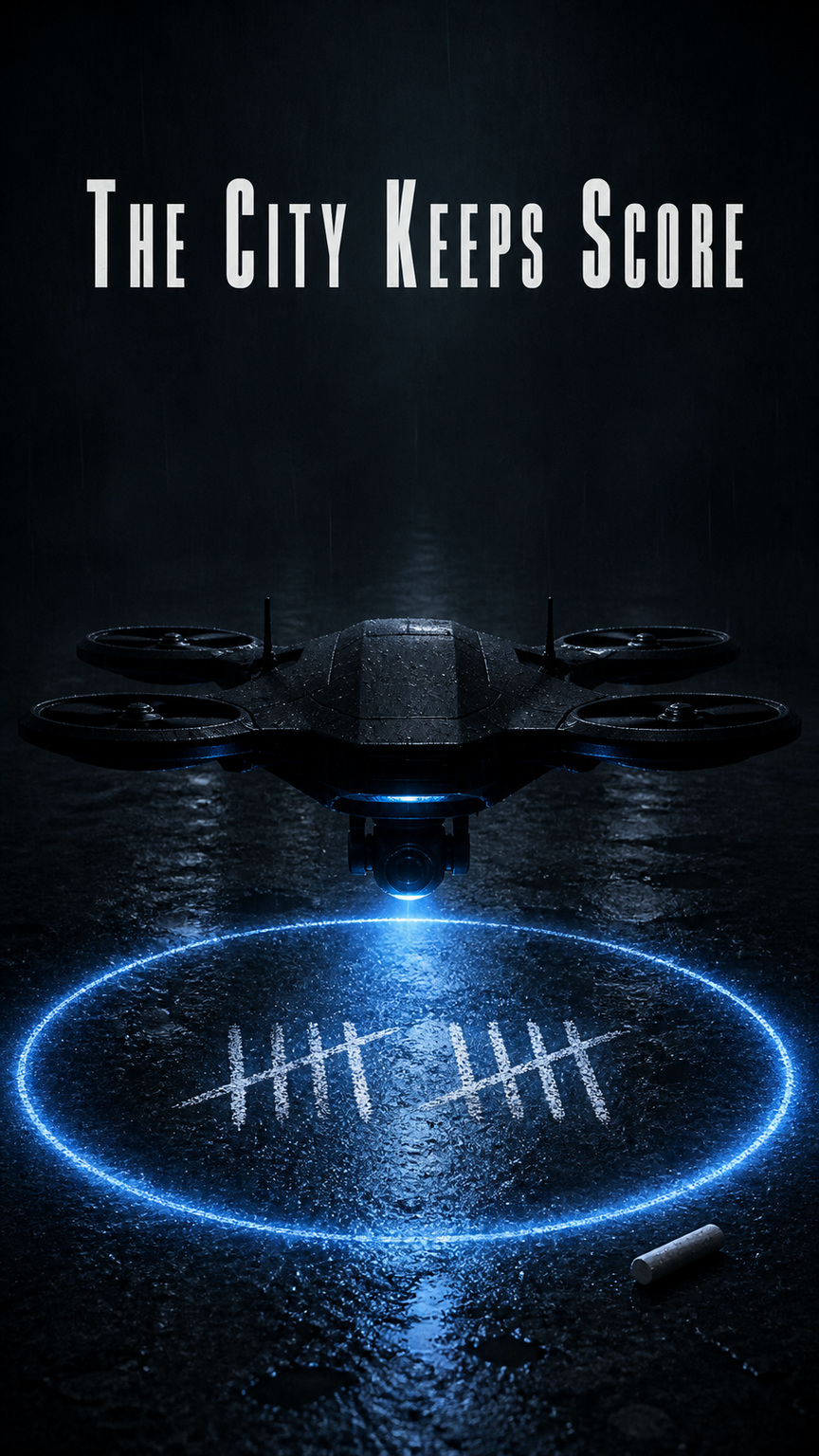
The drone had kept the bread queue standing in the rain for eleven minutes when the old man’s knee gave out.
Nobody caught him. Catching somebody meant moving, and the drone had said REMAIN STILL often enough that the words seemed to hang in the wet air after its speaker clicked off. People watched him settle against the curb with both hands out, slow as a dropped coat. Above him, the drone tipped its black camera pod and made the soft three-note sound that came before a command became a charge.
Raska counted the notes. One, two, three.
The ring beneath the drone changed from white to blue.
Across the street, Kero was leaning against a shutter as if the rain had put him there. He glanced at the awning above the queue, then at Raska. Too obvious, his face said.
He had started looking at her like that since she got stunned: first at the danger, then at her, as though estimating which would arrive fastest.
Raska stepped out of line.
“Pedestrian, return to your assigned position,” the drone said.
She kept moving. The street was all movable parts if you stopped believing the city owned them: delivery rails sunk in the curb, folding stall roofs, laundry rigs stretched between buildings, shutters with three good teeth left in their gears. She kicked the wheel of an abandoned fruit cart, caught a length of rain-heavy canvas, and turned three pieces of street junk into one brief, flapping animal.
The drone rose to clear it. That was what the older units did when surprised. Up first, then back, never sideways.
Raska slapped the delivery post as she passed. Something clanged beneath the curb. The cart slewed. The canvas climbed in a wet yellow billow, and the drone, still watching Raska, flew backward into a rack of empty clothes hangers.
The sound was magnificent. Metal hail. A hundred cheap hooks skittering over pavement. The drone struck the shutter, tried to correct, and rolled into a crate of split melons with its rotors sewing pink pulp across the curb.
The queue vanished. People grabbed bread or children or nothing and left the old man sitting where he was. Raska pulled him behind the fruit cart while the drone repeated OBSTRUCTION RECORDED into a mouthful of melon.
Kero arrived without hurrying. “That was an awning drop.”
“There wasn’t an awning.”
“Canvas at height.”
“That is not the rule.”
“It is exactly the rule.”
Sevi unfolded from behind a dead information box, where they had witnessed the whole thing. At fourteen they were small enough to disappear behind city furniture and old enough to make that insulting on purpose. Chalk dust made pale moons around their fingernails.
“Half,” they said.
Raska stared. “It hit the street.”
“Melons.”
“The melons were on the street.”
“Assisted landing. And derivative.”
“You don’t even remember the original.”
Sevi crouched at the edge of the wreck, careful of the blue threads snapping between the frame and the wet curb. The drone’s reserve camera swiveled toward them. They leaned, read the unit mark painted beneath one buckled arm, and skipped back.
“Witnessed,” Sevi said. “Mark seven-four-gray. Half.”
The old man had found his bread. He tucked the loaf inside his coat without thanking any of them. Sensible. Retrieval sirens had begun their low two-pulse call somewhere beyond the apartment blocks.
Kero offered Raska his hand over the fruit cart. She went around it instead.
They kept the board under a broken stair that had once led down to trains. The station doors were welded shut, but rain still breathed up through the cracks, carrying a warm mineral smell from whatever machinery the city had buried without turning off. Sevi slid aside a sheet of advertisement plastic. Chalk numbers crowded the tile behind it.
KERO: 12 1/2.
RASKA: 11.
Sevi added a short horizontal stroke to Raska’s column.
“I brought one down and I’m still a whole point behind,” Raska said.
“You were one and a half behind,” Kero said.
“I should get style.”
“You don’t get style as a number.”
“Then why do we have you?”
Sevi snorted, which spoiled the stern expression they had been practicing. Below the two scores, in smaller chalk, they had begun a third column.
SEVI: 0.
Raska rubbed it out with her sleeve.
“Hey.”
“Witnesses don’t compete.”
“I can bring one down.”
“You can barely read the underside without putting your hair in the charge.”
Sevi shoved their hands into their pockets. “My hair is not conductive.”
“All hair is conductive if the city wants it to be,” Kero said.
He meant it as a joke. Raska heard the warning underneath and hated him for putting it there.
Three weeks ago, a drone had told her to uncover her face. She had laughed, because it was summer and because Kero was watching. Then the blue ring, the three notes, pavement against her cheek. She remembered the beginning and the end. The middle remained a white room in her head, furnished only with the smell of scorched dust.
Since then Kero had questioned good routes, rejected clean chances, and stood too close whenever a patrol shadow crossed them. He was winning because Raska had spent three weeks being managed.
She tapped the half mark Sevi had just made. “Active blue ring next. Clean ground. Full point.”
Kero’s smile went away. “No.”
“You don’t set challenges.”
“You just did.”
“I set mine.”
“Then find another witness,” Sevi said.
Raska looked at the damp smudge where their zero had been. “Fine.”
It was not fine. That was why, four nights later, all three of them were under the market flyover when an incapacitation unit came nosing between the pillars.
It had been bothering a boy on a bicycle, demanding a registration his rusted frame had never possessed. Raska approached from the service lane. Kero came over a locked kiosk roof. Neither acknowledged the other. Sevi, crouched on a concrete divider, looked delighted by the breach in procedure.
The drone’s blue ring painted the pillars in revolving slices. Raska saw a bowed delivery gate, a heap of insulating foam, and an old sign that still tried to rotate when the wind pressed it. She began fitting the pieces together.
Across the lane, Kero loosened a sagging length of advertisement mesh.
Sevi pointed at Raska, pointed at Kero, then put both fists together: competing attempt, same unit. It was a ruling they had invented that moment. Their grin admitted it.
Raska moved first.
The bicycle boy fled. The drone turned after him, then caught Raska stepping into the service lane.
“Pedestrian, stop.”
Two paces. The sign rotated. The gate shuddered along its buried track.
“Pedestrian, kneel.”
One pace. Kero’s mesh slid down the kiosk front too early, a gray wave that missed the drone and blocked Raska’s view.
Three notes sounded from the other side.
One.
Her mouth filled with the taste of a coin.
Two.
The lane narrowed to rain stippling the mesh. Her count did not reach three. It went somewhere her body would not follow.
Kero hit her around the waist. The pavement moved sideways. They went behind the delivery gate just as a white crack snapped through the place where Raska’s shoulder had been.
The gate, jarred by their weight, finished its crooked journey. The old sign turned. Mesh tightened between them, and the drone dropped hard inside the heap of foam with one rotor still whining.
For several seconds Raska could hear nothing except Kero breathing against the back of her neck.
“Off,” she said.
He rolled away.
Sevi came running. “Shared fall.”
“His,” Raska said.
Kero sat up. “Don’t.”
“You touched it last.”
“I touched you last.”
“Then score whatever you dragged down.”
Sevi’s grin had disappeared. They looked from one to the other. “The gate was hers. The mesh was his. Shared.”
“Full to Kero.” Raska got to her feet. Her knees felt assembled from loose cups. “I stopped.”
Kero wiped rain off his mouth. “Yes.”
It was the truth, and the bluntness of it hurt worse than pity.
At the board Sevi wrote the point in Kero’s column. Kero did not watch. Raska did, making herself stay until the chalk stopped moving.
After that, she changed routes whenever she saw either of them.
For six days the city seemed to reward the separation. Patrols passed Raska without dropping low. Commands followed other people. The three-note warning sounded twice beyond walls and once from the far side of a tram viaduct, and each time she counted to two, failed, and kept walking before anybody could see.
She noticed Sevi only in pieces. Their red hood vanishing through a laundry court. Their narrow shoulders held very straight beneath a drone that followed them across an intersection. Three observation units outside the steamed-glass shop where they bought fried dough, though that street usually had one.
When Raska asked, Sevi said, “They like the sauce.”
“Drones.”
“Very advanced sauce.”
Then they asked if Kero had spoken to her, too quickly and with their mouth full.
On the tenth evening, a new mark appeared on the hidden board: a crude triangle intersected by a hook, followed by ACTIVE and three chalk slashes. Raska recognized Kero’s old challenge sign, though he had drawn the hook badly. Beneath it: SOUTH RAIL. LAST LIGHT.
His score had not changed. Neither had hers.
She arrived at the shuttered south market ready to take back the point she had handed him and found Kero coming from the opposite arcade with the same expression.
“You chalk like a child,” Raska said.
“That was your hook.”
“My hook closes.”
“Your hook looks like an injured spoon.”
Something hammered metal behind the shutter stalls. Both of them stopped.
The incapacitation unit hung knee-high in the crossing, fighting a web of parcel straps. One strap had wound around its shell; another disappeared into the mouth of an automatic delivery rack that kept trying to retract, shivering the drone sideways. Its rotors chewed sparks from a steel stall front. It was not down. It was furious.
Sevi stood on top of the rack with a hand locked around a red service handle. Their other hand held the chalk.
“It was lower before,” they said.
The drone’s ring flashed blue.
“Let go and get off,” Kero said.
“If I let go, it rises.”
“Then get off and let go.”
“You always make things sound like one action when they are two.”
Raska saw what Sevi had built, if built was the word for upsetting half a block until the parts objected to one another. The parcel straps pulled east. The rack wanted them west. A shop shutter bowed over the drone like a dented ceiling. It might hold. It might spring loose and turn the crossing into a box full of cutting metal.
The drone stopped struggling.
“See?” Sevi whispered. “It does that. It pretends.”
Kero’s head snapped toward them. “How long have you been here?”
“Not long.”
“How long?”
Sevi looked at Raska, as if she might grade the answer instead. “Since there was light.”
There was no light left except the blue ring.
The drone’s front display cleared. Three face frames appeared. Raska’s was an old street image, chin raised at a command. Kero’s caught him laughing at something outside the frame. Sevi’s picture had been assembled badly from several angles, but the red hood made them unmistakable.
Numbers ran beside each face.
RASKA: ASSOCIATIONS 12.
KERO: ASSOCIATIONS 11.
SEVI: ASSOCIATIONS 18.
The number beside Sevi changed to 19.
“What did you do?” Raska asked.
“Witnessed.”
The service handle slipped in Sevi’s damp hand. The drone surged upward, stopped by the straps, and let out the first warning note.
Kero dropped every trace of humor. “Sevi. Off. Now.”
“I can’t.”
Second note.
Raska grabbed a loose parcel bin and rammed it under the rack. Sevi jumped. The bin rolled on impact; they landed on one knee, swore, and crawled behind a shutter post as the third note sounded. A charge tore across the rack, bright enough to print every strap inside Raska’s eyes.
The drone faced the post where Sevi hid.
PRIORITY SUBJECT, PRESENT HANDS.
“Nineteen,” Kero said. He looked sick. “You knew they were tracking you.”
“I knew they were around.”
“Three outside the dough shop,” Raska said.
“The sauce is popular.”
“Sevi.”
“I thought if I got one, you’d stop treating me like the furniture.”
Kero made a sound too sharp to be a laugh. “So you found an active unit alone.”
“You both said no.”
Raska opened her mouth to say because you are fourteen. The words reached her teeth and stopped. Kero was looking at Sevi the way he had looked at her for three weeks: danger, then person, the calculation already made on their behalf.
The drone rotated. Parcel straps screamed against its casing.
“Later,” Raska said.
“There is no later if that strap goes,” Kero said.
“I mean argue later.” She pointed to the bowed shutter, then to the old rail trolley above them. “It will climb left when it gets free.”
“It climbed right before,” Sevi said.
Raska looked at them.
“Twice,” they added. “Mostly right.”
“That would have been useful.”
“You were busy asking what I did.”
Kero was already hauling at the shutter’s bottom edge. “Right means my mesh can turn it.”
“Your mesh missed a stationary wall.”
“The wall moved.”
“Walls love you.”
The drone’s camera found Raska. Its display boxed her face. Association 12 became 13.
She moved into the crossing.
Kero saw the decision arrive. “No.”
“It needs a nearer subject.”
“We have one.” He jerked his chin toward Sevi.
“Not anymore.”
The drone pulled hard against the straps, angling toward Raska. She raised both hands and backed beneath the rail trolley. Its shadow cut across her shoulders.
PEDESTRIAN, KNEEL.
Kero caught her sleeve.
For one hot second she wanted him to pull. Then she wanted to hit him for knowing that.
He did neither. He let the cloth slide through his fingers and moved to the shutter.
Raska showed him two fingers low by her hip: wait.
Behind the post, Sevi nodded and raised two fingers back.
Kero read it as two sides. He crossed early.
The drone snapped right, exactly as Sevi had warned, and Kero’s shoulder struck the rail support instead of the release. The trolley groaned but stayed overhead.
“Brilliant,” Raska said.
It was the wrong thing. The drone’s microphones caught her voice. Its ring brightened, and the three notes began.
One.
The market lost its depth. The shutters flattened into silver walls. Kero was down on one hand. Sevi’s red hood floated without a body inside it.
Two.
Raska had a count for every kind of fall except her own. Her tongue would not move.
Kero did not come for her. Fear stripped his face bare, but he stayed at the rail support, waiting for the signal she had given him.
Sevi shouted, “Not two sides! Two beats, you idiot!”
The drone turned toward their voice.
The change was small. Enough.
Raska let her raised hand fall.
Sevi yanked the red service handle. Kero threw his weight against the support. The shutter sprang half a meter and stopped; the rail trolley lurched out of its rust with a sack of rainwater and torn advertisements hanging from it. Raska drove the parcel bin forward with her hip because both hands had gone numb.
None of it happened in the right order.
The trolley struck the straps. The straps lifted the bin. The drone climbed right, met the bowed shutter, and pitched under its own correction. One rotor burst into white fragments. Kero ducked too late and lost a strip of hair. Sevi fell backward into a stack of plastic baskets. Raska ended on both knees with the bin rolling away from her.
The drone hit the paving stones belly-first.
Its charge fired into the metal shutter. Blue light raced upward, found nothing living, and went out.
For a breath, nobody spoke.
Then Sevi, buried to the waist in baskets, said, “Full point.”
Kero touched the bare stripe above his ear. “To my hair.”
Raska laughed once. It came out ragged and surprised.
The drone’s rotors had stopped, but the reserve camera continued to turn. Its display was cracked through Kero’s face. Beneath the fractures, text appeared.
UPLOAD QUEUED.
RETRIEVAL: 01:56.
The unit mark was on the underside, pressed against the street.
Sevi climbed out of the baskets. “We need the mark.”
Along the drone’s exposed frame, contact lights woke one by one.
“No,” Kero said.
“No mark, no fall.”
“We saw it fall,” Raska said.
“Witness and mark. That is your rule.”
It was. Raska had defended it through six arguments, two stolen pieces of chalk, and one week when Kero tried to count a unit that fell into a canal before anyone could read it. Without the mark, a story grew a cleaner landing every time it was told.
The retrieval timer reached 01:41.
Raska stepped toward the drone. The reserve camera found her immediately. A square tightened around her face.
Kero said her name.
He did not grab her.
Beyond the cracked display, Sevi’s associations changed to 20. Raska’s changed to 14. Kero’s stayed at 11 until he moved beside her; then it became 12.
Raska stopped outside the reach of the blue contact threads.
“Can you read it?” Sevi asked.
“No.”
“If we roll it—”
“No.”
This time Sevi heard the difference. They looked at the drone, then at the mouth of the arcade where retrieval lights had begun to pulse against the shutters.
“Then it doesn’t count,” they said.
Kero opened his mouth.
Raska beat him to it. “Correct.”
Sevi shoved the chalk into their pocket. They seemed furious, frightened, and taller than they had been ten minutes ago. “The challenge was mine, by the way.”
“That hook looked like his,” Raska said.
“It looked like hers,” Kero said.
“You’re both illiterate.”
The drone told them to remain at the scene. They left before it could finish.
At the first intersection, Sevi turned away from their usual route. Raska followed. Kero came after her, one hand still pressed to the ridiculous bare stripe on his head.
“My first drop was not derivative,” Raska said.
“Half drop,” Sevi said.
“The drone was fully down.”
“Melon assisted.”
Kero began to laugh. Sevi complained about that, too, and kept complaining for the next six blocks.