Every Flower She Knew
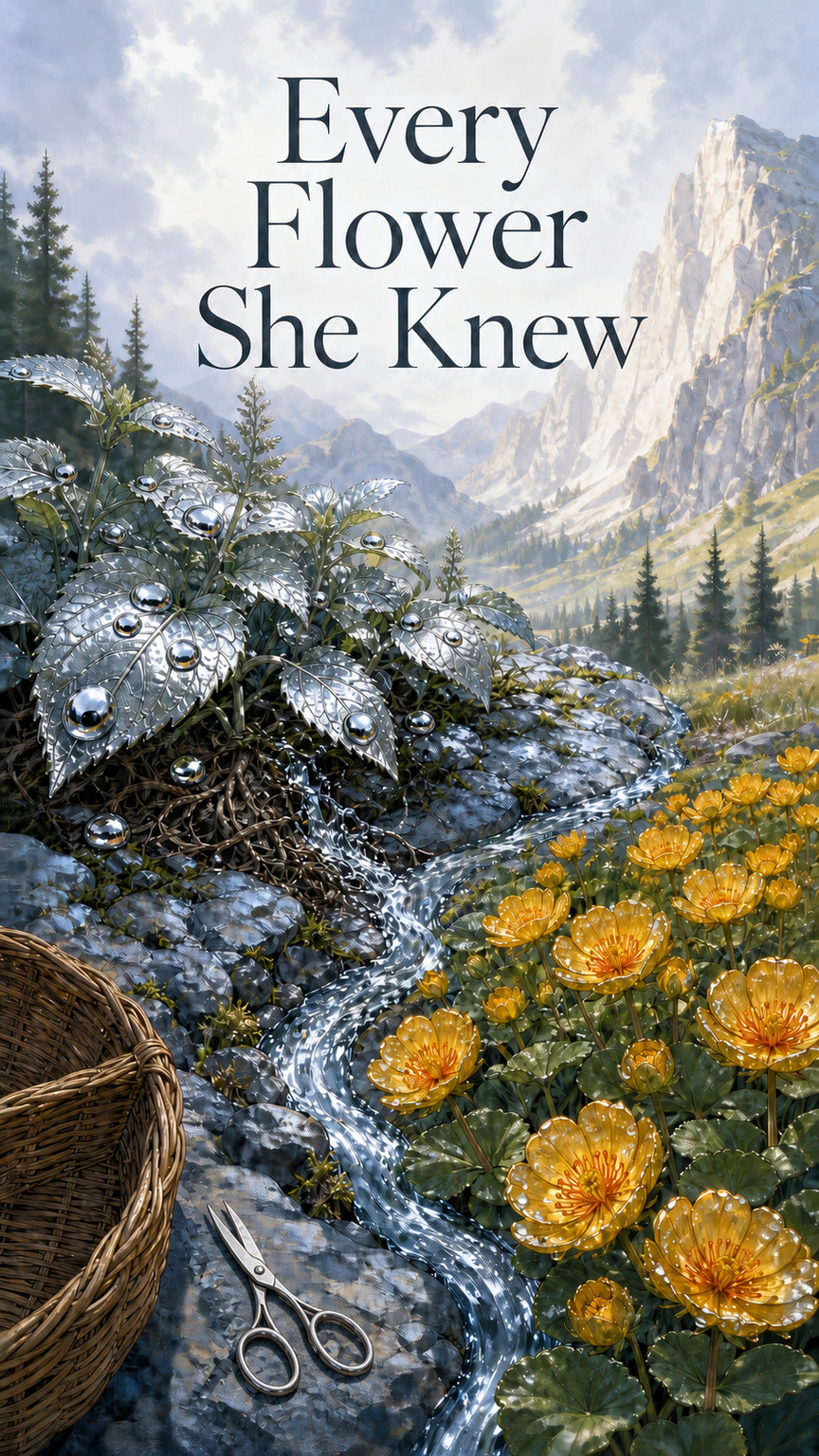
She ventures alone into a wild valley where beautiful flowers can heal the sick, restore strength, sharpen memory, or bring peaceful sleep—and others can kill with a touch. She knows every dangerous bloom and carefully avoids them, returning to her village with baskets of wondrous flowers that have helped her people for years.
Safra pressed the last waxed divider into the first basket while the village was still dark. It seated with a soft complaint against the willow ribs. She ran one finger along the joint, found no gap, and set a blank tag in each compartment.
Across the herb room, the healer lifted the cloth over the fever cot. The patient beneath it was an old man whose breathing came fast but even. A basin stood ready by his bed; the water in it had gone untouched.
“No ambercup since yesterday,” the healer said. She spoke toward the cot, as though the words belonged first to the body they described. “Hot skin, dry mouth. He knows me. His chest is clear.”
“One petal for tonight.” Safra wrote fever cot—one on a tag and pressed the point into the wax tablet beside it. “One. If anything changes, you wait.”
The healer nodded, then held still a moment, listening to the old man breathe. “The millwright can’t place the wheel teeth in order. She remembers doing the repair. Not the sequence. The watcher slept perhaps an hour yesterday and less the night before.”
Two more marks in the wax. Clearblue before midnight. Duskbell, dried.
The channel forewoman came in trailing the smell of wet clay. She put both palms on the worktable and left ten brown crescents there. “North cut is holding. For now. Eight on the crew. Two still lifting well. Six spent. Water at the third peg when I left. It’ll take four bodies two hours to clear the choke, maybe five bodies if the bank slips. No—four. The passage is too narrow for five.”
“How long to the village marker?” Safra asked.
“If the ridge rain reaches us? By afternoon. If the high rain does too—” The forewoman glanced at the shutter, where no light yet showed. Her quick figuring broke into pieces. “Three hours to the bend. One more to the gate. Two hours’ work. Four people.”
Safra wrote four halves on the redspur tag.
“And enough for tomorrow?” the forewoman asked.
“If weight allows. Dry, they keep three days.” Safra tapped the divided outer pocket. “Redspur stays here. Nothing warm beside the duskbell. Nothing wet touches the weave.”
The healer’s gaze settled on the two baskets, each broad enough to cover Safra from hip to knee. “You can carry both back by the ford?”
“If the ford stays at two stones.”
“And if it doesn’t?”
Safra tied the wax tablet inside her coat. “The ridge.”
No one told her to be careful. For eleven flowering seasons she had gone into the valley alone. The healer helped her settle the shoulder straps. The forewoman lifted each basket once, testing the empty balance with hands that judged loads more readily than faces. They checked covers, knots, and wax seams, and Safra went out before the sun.
The path entered the valley between two dark shoulders of stone. Dawn showed first on the western wall, a pale band above spruce and scree, while the floor below remained blue with night. Safra stopped where the path narrowed.
She knew every bloom along the route, including the ones she never touched. Nothing dangerous here was unnamed to her.
On the downslope side, the leaves of the glass-nettle showed their mirrored undersides to the breeze. Their surfaces gave back scraps of sky with a hard, silver light. Dew sat perfectly still on them although every grass blade nearby trembled. When Safra drew breath through her nose, the air tasted metal-sour.
The shortcut lay three steps beyond the verge. It would have saved half an hour.
She backed away without letting her coat brush even the grass leaning toward the nettles. A living leaf killed by touch. A broken one left death in the wet around it, and a basket need only drink that wet through one strand of its weave to ruin everything inside. She climbed by the dry ledge above it.
She climbed until gravel slid under her heels and the first light reached the clearblue shelf.
The flowers grew close to the rock, each one a shallow blue star with a white filament at its center. Their opening lasted only from first sun until the stone warmed. Safra crouched on a folded square of hide. Frost had silvered the shelf two nights earlier. She could see its work in the outer petals: the blue had faded toward gray, which meant the filament inside would lose its edge before forty minutes.
She passed those by.
Farther along, where the cliff had held the night’s warmth, six flowers were fully blue. She checked each filament for the fine hooked tip that marked maturity, cut one with her narrow scissors, and laid it between sheets of black paper. The millwright needed one. The other five would dull at midnight whether cut or rooted, but Safra did not strip a shelf for an unnamed possibility.
She sealed the packet, wrote the hour on its tag, and placed it flat in the upper compartment. The filaments would dull when midnight came whether anyone had used them or not. Their value was not something she could carry into tomorrow.
Below the shelf the valley widened, taking the sun. Ambercup scattered gold over the lower meadow. Redspur stood among it in thin crimson fans. Farther downslope, a stream flashed between alders, still low enough that Safra could see the black back of the ford stone.
She left the path at a patch she had harvested for years. The ambercups there were wide enough to show their clear rims, and the veins inside each petal burned bright orange when she shaded them with her hand. Active. She counted three suitable petals on three separate crowns: one for the fever cot, two against another need before the next harvest if weight allowed. Ambercup bruised quickly after cutting, so she would take them when the warm redspur was secured.
Redspur required less blade and more patience. Its stamens heated as soon as they were cut. Safra used bone tweezers, cut two stamens, and set them on a fired-clay strip in the basket’s outer pocket. Each could be divided once at the herb table: four half-stamens, four workers, two hours of borrowed strength. The strength would not mend a strained back or spare anyone the weariness afterward. That was the forewoman’s judgment to make among bodies Safra had not seen.
She took a third stamen for the next three days, then considered a fourth. The baskets pulled lightly on her shoulders now, an invitation that would become a fact on the climb home. Duskbell petals were not heavy, but their drying frames were. Ambercup could not be squeezed. Clearblue could not bend. And anything stored beside redspur’s heat spoiled into brown uselessness.
The fourth stamen stayed flowering.
The rain began with three cool spots on the back of her hand.
Safra looked north. A gray seam had opened above the ridge hours earlier than the forewoman’s estimate, too thin to darken the sky but thick enough to spill. She closed both basket lids, fixed the oiled covers over them, and moved uphill from the stream. Rain clicked on ambercup petals. The redspurs shivered, making the meadow seem briefly full of small red wings.
The shower ended before she reached the upper path. Water continued to gather. It ran from leaf to leaf, found old channels in the soil, and braided through the meadow toward the stream.
At the upper edge of the ambercup bed she was about to harvest, a thread of runoff crossed the path. It looked clear. She smelled it before she knelt: the metal-sour edge beneath wet earth.
Ten paces uphill, glass-nettle leaned over a seep. Rain had passed across its mirrored leaves. The drops on them remained strangely motionless, held like beads of quicksilver, but water below the roots had already carried sap into the ambercups.
The bed was beautiful. Clear rims, bright veins, dozens of petals at perfect strength. The runoff had touched the lowest flowers and wicked sideways through their crowded stems. Safra could not see how far. She did not need to pretend she could.
She stepped back onto dry stone. She had not cut the three marked petals. Had the scissors rested on wet grass? No. Had a basket foot stood below the seep? No. Had her boot crossed the runoff and then touched a strap? No.
The baskets were clean. The bed was not.
At the dry edge, she set the three-stone warning for glass-nettle runoff. The glass-nettle was where it had always been; the rain had moved its sap. On the bed’s tag she marked three dry days before anyone could harvest there again.
The fever compartment remained empty.
The next clean ambercups grew on a shelf above the duskbell hollow. Reaching them meant a steep ascent now and a worse descent under full baskets. Safra retied the covers, checked the black-paper packet with two fingers, and started up.
The valley changed with height. Gold meadow gave way to scrub birch, then flat shelves where the wind pressed every plant close to stone. Water ticked in cracks. A hawk called once from somewhere beyond the wall; the echo returned thin from the stone.
Safra knew each shelf before she saw it. The first held ambercups thick as coins, all closed tight in the cold. She shaded one and found no glow in its veins. Pretty, inactive, nothing for a fever. The second shelf caught more sun but had taken the frost directly. Its petals opened ragged and opaque.
On the third, a lip of stone had turned the cold. Seven ambercups grew behind it. Four showed the bright inner veins and clear rim she needed.
She harvested two petals from two separate crowns. The fever cot required one; one clean reserve was as much as the shelf and the basket could afford. She folded them into a fresh paper, sealed it, tagged source and hour, then ran the sequence again. Dry tweezers. Dry paper. Dry hands. Clean shelf.
The repetition steadied her, though the climb had put a pulse behind her eyes.
From the shelf she could see the stream swelling over the black ford stone. Rain had struck the high country after all. The afternoon light lay yellow on the far wall, but the water below was already brown.
Safra weighed the baskets by their handles. The left carried clearblue and ambercup in the protected upper cells. The right carried redspur outside the waxed wall. There was room for more redspur on the way down, and the channel might want it. She pictured the duskbell frames, the long ridge, and the drag of a basket that pulled harder on one shoulder than the other.
She left the optional redspur rooted.
Duskbell grew in a hollow that held evening before the rest of the valley. Safra reached it as the petals began to curl inward. Open, they were pale and almost transparent. Closing, they took on the color of smoke. Before the edges touched, the petals held too much valley damp; afterward they folded too tightly to spread on a frame. The useful interval was marked by a dry whisper.
Safra heard it as she came down the last slope.
She set the baskets on two stones above the wet ground. From the bottom compartment she took a folding frame strung with horsehair. She clipped six closing petals, spread them so none overlapped, and held the frame in the hollow’s steady draft until their skins paled and stiffened. Damp duskbell molded. Warm duskbell spoiled. Her harvest notes carried both timings from season to season.
While the petals dried, she shifted the clay strip of redspur to the basket’s far outer side and inserted a second waxed panel. She tested the wax seam, waited, then put the frame into the opposite basket. Cool air could move around it. No redspur heat reached it.
By then the ford stone had vanished.
The direct path home crossed where the stream divided around it. Safra stood on the bank and watched a branch spin once, strike the hidden stone, and disappear into brown water. The ford might still be passable with empty hands. Not with two baskets, not with wax dividers that must stay upright, not with glass-nettle runoff somewhere in the flood.
She turned away.
The ridge path added three hours and climbed before it descended. Darkness would catch her there. The clearblue clock would keep running. The channel water would keep rising. None of that made the ford lower.
Safra tightened the straps until the baskets rode high and began the long way home.
On the ridge, daylight withdrew in strips. First the valley floor went dim; then the shelves; at last the western wall lost its fire. The baskets gained weight without gaining a single flower. Each step shook that weight into her hips. She stopped twice to check the covers and once when the smell of metal rose sharply from a wet patch of fern. No mirrored leaves showed there, only red stone under water. She knew the difference. The ferns were slick enough to overturn a basket, so she stepped around them.
Near the ridge’s end, fatigue shortened her checks. Left: paper flat, ambercup dry. Right: clay strip firm, redspur apart. Frame: cool, duskbell dry. Covers tied. Weave dry.
At the last halt she began again because she had said dry without touching the underside of the frame.
Left. Right. Frame. Covers. Weave.
The village lamps appeared below after full dark. Safra took the descending turns slowly, leaning away from the baskets when loose stones rolled. At the first wall, somebody saw her and rang the small handbell kept for late returns. Doors opened. No one came running up the path; they knew better than to jostle a harvest whose dangers were invisible once mixed.
The healer and the channel forewoman met her in the herb room. Safra set both baskets on the clean table. Her shoulders, freed of them, seemed to float.
The healer did not reach for a lid. She looked at the rain shining on Safra’s coat, then at the dry basket feet. “Start at the water.”
“Early shower. North runoff crossed the lower ambercup bed.” Safra untied the left cover. Her fingers missed the knot once. “Rejected every crown below the seep. Took two clean petals at the high shelf. Dry tools, dry paper. No wet on the weave.”
The healer waited.
Safra heard what she had omitted. “No wet on the weave. Not at the ford, not on the ridge. Ford was over the stone. I came by the ridge.”
Only then did the healer open the basket. She read each tag before moving its packet. “The fever is higher. Still knows me. Chest still clear. He’s had no ambercup today.” She laid one petal on a white saucer and left the second sealed. “One now. We keep one.”
“One now,” Safra repeated. “No second today. A second brings shaking. It won’t mend an injury or touch poison.”
“I heard.” The healer’s voice had become slower as Safra’s had become clipped. She touched the old man’s wrist, counted, then crushed the single petal into his water.
At the other end of the table, the forewoman read the redspur tag. “Four halves. Good. Crew is down to seven. Two can lift without it. One has the bad shoulder and gets none. That leaves—” Her hand made a quick division over the clay strip, then stopped. “Four. Four at the cut. Two changing loads. One watching the bank.”
“Two hours,” Safra said. “Then the strength goes. No repair. They’ll be tired after.”
“Four bodies. Two hours. We clear the choke, then they come off.” The forewoman broke the two stamens into four exact halves with the marked bone knife, folded each into its own square, and went out calling only for the crew, not for an audience.
The millwright arrived in her work apron with grease dried black at the hem. Safra checked the wall clock: two hours and forty-eight minutes before midnight. She gave the woman one clearblue filament and turned the sandglass.
“It won’t find a fact you never had,” Safra said. “And it won’t tell you which memory is true.”
“I had it,” the millwright said. She was already reaching for paper. “Winter repair. I stood inside the wheel. I need the order.”
For the next forty minutes she wrote without looking up: tooth counts, the side from which she had driven each pin, the order in which the old axle rings had come free. Twice she crossed out a line and placed it lower. Once she wrote uncertain beside a number rather than polish it into confidence. When the sand ran out, her pencil slowed. The memory did not vanish; access to it narrowed to its ordinary width. She had a sequence for the morning repair and three marked places to verify against the wheel itself.
The duskbell went to the night watcher only after the petals had been checked dry. The healer laid one on the watcher’s tongue and wrote the hour on the bedside slate. Two neighbors took the next watch in three-hour turns. The woman had been asleep less than ten minutes when the healer’s cup clicked against the basin. Her eyes opened at once.
“Only me,” the healer said.
The watcher looked toward the fever cot, saw someone seated there, and let her eyes close again. The petal would give her about six peaceful hours if nothing woke her, and release her readily if something did. It would not settle the reason she had kept watch so long. For this night, other people covered it.
Before midnight, boots and shovels sounded on the lane. The channel crew returned bent with the fatigue redspur had postponed. Mud streaked their sleeves to the elbow, but the forewoman raised one hand through the herb-room door: the choke was clear. The workers who had taken the half-stamens went to food, dry clothes, and bed. None mistook borrowed strength for an unwounded body.
On the fever cot, the old man’s breathing had eased. Sweat darkened his hair. The healer changed the cloth under his neck and left the clean reserve petal sealed for another day if another day required it.
Safra sat at the worktable with the wax tablet under her hand. Her letters started square and grew cramped as she recorded the failed bed: lower ambercup patch, glass-nettle runoff after early rain, every bloom below the seep rejected. She checked the calendar, counted forward, and wrote the earliest safe return after three full dry days. Beside it she noted the high shelf’s remaining crowns, the clearblue filament taken and used before midnight, four redspur halves spent, one dry stamen viable for three days, five duskbell petals left.
The healer read the first line and pushed the candle closer. Safra warmed the stylus, deepened the date, and drew a box around it. Then she added the watcher’s coverage: first neighbor until the middle bell, second until dawn.
Outside, rain began again on the roof. Inside, the separated packets stayed dry, the compromised bed had a date, and every occupied cot had someone awake beside it.