All the Ways They Knew Her
Every summer, the city closes the old park road for a sprawling street festival, and every summer she spends the day weaving through the crowds on rollerblades. This year, halfway down the avenue, she realizes something strange: everyone she passes seems to recognize her.
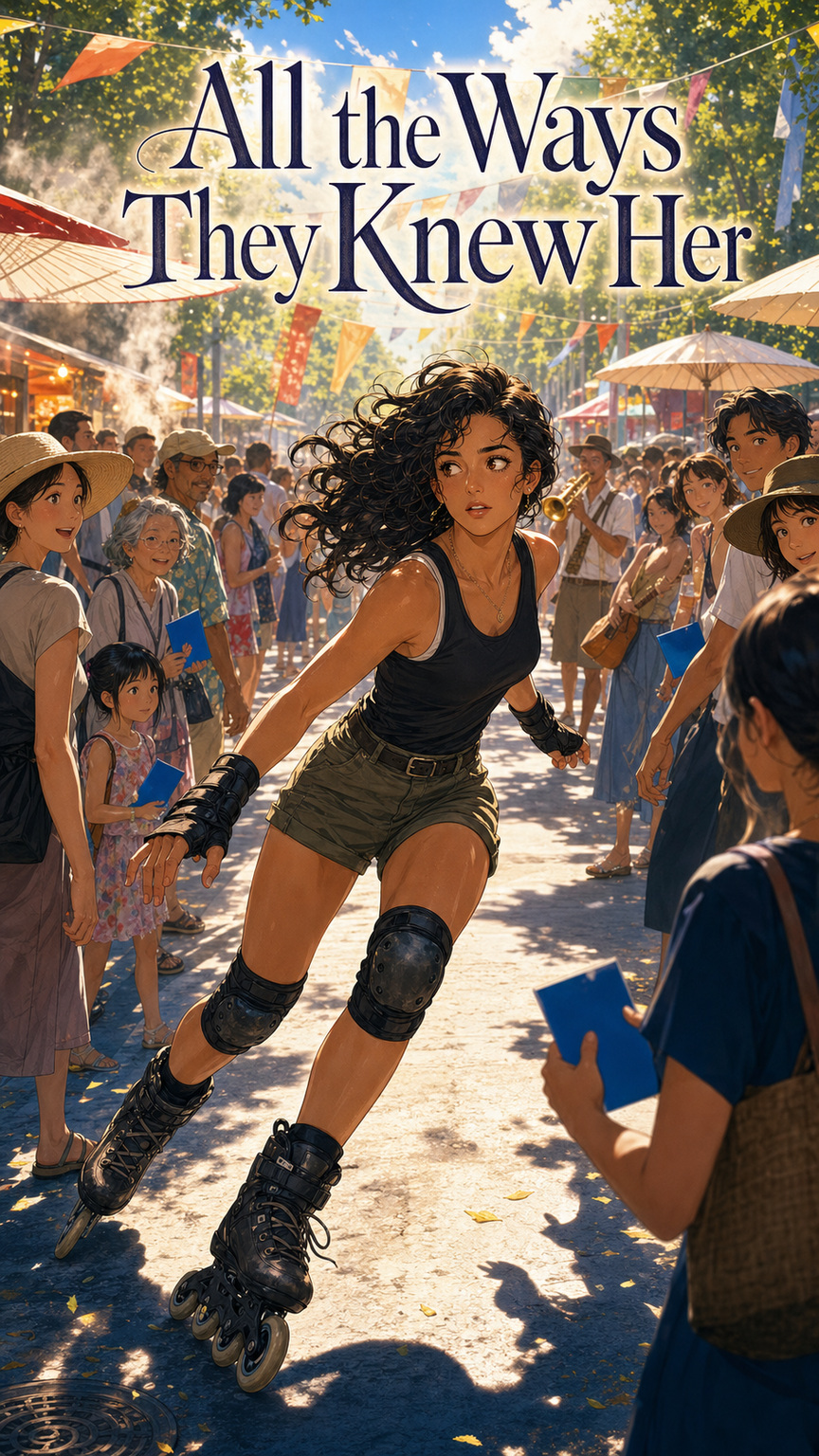
The west gate was already narrowing when she rolled through it.
One volunteer had a hand on a waist-high barrier and the other cupped over an earpiece. Beyond him, the old park road dropped in a long mild slope under strings of paper pennants. Food smoke blurred the first block. Tables pressed in from both curbs, and the crowd moved in all its usual directions at once: toward samples, away from strollers, sideways after children. The strip of pavement down the middle looked barely wide enough for a bicycle, which meant it was wide enough for her.
“Wheels coming in,” the volunteer said, not quite to her.
She lifted two fingers without slowing. “Last one.”
“Yes. Exactly.” He turned his shoulder to the barrier. Into his radio he said, “One still inside, heading east. Blue jacket, black shorts, red bag. Adult on skates.”
The description followed her down the hill, flattened by static.
She was late. Not disastrously late yet, but late enough that the repaired clasp in the zipped pocket of her bag had begun to feel heavier than a piece of metal that fit under two fingers. Her niece needed it at the children’s drum lineup at the east end. After that, she had promised to relieve her sibling at the family stall. She had twenty minutes if the road behaved as it had every summer since she had been old enough to decide that the closed avenue was an invitation.
It never quite behaved. That was the pleasure of it.
The old road had been patched in strips. Her left skate hummed over smooth tar while the right ticked across a comb of cracks. She let her knees take the difference. A man backed away from a spice table without looking; she changed edges and passed behind him. A child dropped a paper fan; she stepped over it without breaking stride. Two women stopped shoulder to shoulder, leaving a dark seam between their elbows and a planter. She aimed for the seam, watched one elbow lift, and slipped through as the gap widened around her.
Every summer, once the city closed the old road to cars and filled it with the festival, she crossed the whole length this way. On foot, the road was a chain of interruptions. On skates, it became a question that kept answering itself one opening at a time.
Ahead, a worker started to pull a loaded handcart across the center lane. Glass bottles trembled in its stacked trays.
Another worker called, “Hold that. Blue jacket.”
The first man stopped with the cart angled over half the pavement. His head came up. He looked directly at her, then hauled the handle backward.
“Through on your left,” he said.
“Thanks.” She took the outside of the cart, close enough to smell citrus syrup and the hot rubber of its wheels.
“Clear,” someone said behind her.
She heard the cart clatter across the road as soon as she passed.
The lane opened more generously after that. A vendor drew a display of painted jars away from a table edge before she reached it. A parent gathered two children by their shoulders. A woman carrying a tray waited in a doorway between stalls, although she could have crossed well ahead of her. Each movement made sense by itself. Skates asked strangers to calculate speed, and strangers usually calculated it badly. Perhaps the volunteer’s radio call had made them unusually careful.
Then the jar vendor leaned over the table and said, “I thought that was you.”
She coasted past on a shallow curve. “Me?”
But the vendor was already gripping the loose corner of a tablecloth. A gust from her passage lifted it. “Knew I should weight this side.”
The answer, if it was one, vanished beneath a burst of drums from farther east.
At the next crossing, a steward in a bright vest held back a family. The youngest child bounced on both feet, trying to see around an adult’s hip.
“There she is,” the child said.
“Stay in,” the steward said.
The adult caught the child’s wrist. “Let the skater go by.”
She knew none of them. She was certain of that while they were ahead of her. After she passed, certainty loosened. The child might have been at the festival last summer, or the summer before. Children remembered recurring things adults discarded: the puppet with the missing eye, which stall gave double napkins, the woman who rolled down the road once a year.
At the edge of her sight, the bright-vested steward pivoted a route post across the gap she had used. The family flowed into the space behind it.
Her phone vibrated against her back. She could not reach it without taking the bag off, and there was nowhere to stop without becoming an obstacle. She bent lower and let the slope return a little of the time she had spent late.
“Blue jacket coming,” a radio voice crackled from somewhere inside a fabric stall.
“Seen,” another voice answered.
A volunteer pushed an empty rack flush to the curb. The vendor beside him did not look up until he did, then followed his gaze and pulled a box of ceramic cups under the table.
“Not those,” the volunteer said. “Just keep the crossing open.”
“You want a wheel through here, I want the cups under.” The vendor shoved the box in with a foot. “Last year I lost six.”
“Wasn’t her.”
“Was still six.”
She passed between the rack and the stall. The vendor watched her bag miss the cups by more than a meter and gave a satisfied nod that could have been meant for his own precautions.
The looks had become impossible not to count. A worker on a ladder paused with a pennant string in both hands. A teenager at a drink tub pointed before remembering to lower the pointing hand. Two older vendors turned together, one because the other did. A parent said, “Back a bit,” and three children shuffled backward while staring at her skates.
None of the faces held the uncertain inspection of someone noticing a stranger at speed. They brightened, tightened, or simply arranged themselves for her arrival. People she had never met behaved as if she occupied a known place in the next few seconds of their day.
She checked what they could see. Blue jacket despite the heat, because its inner pocket zipped. Black shorts. Red canvas bag. Hair tied up badly. A smear of pale grease might still mark one thumb from the clasp repair. Nothing remarkable. Nothing that explained the boy beside a stack of folded chairs calling, “She’s nearly here,” to someone she could not see.
Nearly where?
The road flattened before the halfway crossing. Her wheels lost their borrowed speed, and she worked for it with two hard strokes. A cluster of performers waited behind the north barrier, their costumes wrapped in clear rain covers against cooking smoke and spilled drinks. They should not have been this far into position yet. One carried a tall fabric standard tilted above the crowd. Another rested both hands on the shoulders of a child in a painted cardboard helmet.
The child saw her and tried to roll one sneaker along the pavement as though it had a wheel.
“Not now,” the performer said, drawing the child back.
Across the road, someone called, “That’s the last—”
A whistle cut the sentence in half.
The steward at the route post held one palm toward her and pointed down with the other: slow, then stop. Behind him, a family had begun to cross on a signal meant for them. One adult saw her, jerked the smallest child backward, and set off a chain of shoulders bumping shoulders.
She turned both toes inward. The brake blocks caught. Heat dragged through her ankles, and her wheels shivered over a patched seam before she stopped with one hand around the route post.
The family hurried through. The last adult looked at her face as if confirming something, then looked away.
Halfway down the avenue, stopped for the first time, she saw what motion had hidden.
Behind her, the center lane no longer existed. The bright-vested workers had swung barriers across it in staggered sections. Carts stood crosswise where she had rolled. Families filled the open pavement between stalls. Farther uphill, she could just see the top of a rack being wheeled from one curb to the other. The road was closing in her wake, section by section, each closure following at roughly the pace she had set.
Ahead, the performers were entering. The fabric standard dipped through a gap. A line of children pressed toward the curb to watch it pass. Her next opening was narrower than the last, and beyond it the road bent out of sight.
The steward’s radio said, “Confirm adult skater at half. Blue jacket, red shoulder bag.”
She looked from the radio to him. “Why are they describing me?”
He kept his palm raised toward the crossing while two more people hustled through. “Give me a second.”
“They’ve had several sections.”
“And I’ve got this one.” He dropped his hand when the gap cleared, turned the route post across it, and spoke into the radio. “Held at half. Don’t release the next foot group.”
The answer broke under drums and static. He leaned closer to hear.
She said, “I need the east lineup.”
“Then you entered at the worst possible minute.”
“The gate was open.”
“It was closing. The noon reset went early.” He pointed uphill with two fingers, not taking his eyes off the performers gathering ahead. “West saw you inside after the call. You’re the last wheels. Each section holds until you clear, then they turn the road over behind you.”
Last wheels. Not a name. A dependency.
Her phone vibrated again. “So everyone was told to look for me.”
“The crews were told blue jacket, black shorts, red bag, eastbound. Vendors hear the radios. Other people see us make room.” A woman with a folded stroller approached the post; he moved her back with his forearm. “Please wait there.”
The woman retreated, tugging the stroller sideways. Her companion asked, “Is that her?”
“Must be,” she said.
The steward touched his radio. “That part.”
Downhill, a child called, “It’s the summer skater!”
Another child asked, “Who?”
The first pointed. “Her.”
The steward glanced toward them. “Some remember you.”
The road offered no single way of knowing. The jar vendor had recognized her passage from other summers, perhaps only by the draft under the tablecloth. The worker with the cart had matched four plain details to a radio call. The adult beside the stroller had read the workers. The children had read one another. By the time she reached a section, their different guesses produced the same result: heads turned, hands came out, a line appeared.
She tightened her grip on the route post. The metal inside the red bag pressed against her ribs.
“How do I get through?” she asked.
“I can escort you on the road.” The steward looked east. “Slow pace behind the standard until the children’s units peel off. No passing, and you stop when I stop.”
“How long?”
He listened to his radio. “Depends whether the next section has moved its equipment cart.”
“I need a number.”
“I don’t have one.” His attention shifted past her. “Hold that barrier. Not yet.”
She turned. A worker uphill had begun to swing a panel shut behind her. At the steward’s signal, he froze with it diagonal across the pavement. People crowded toward the unclosed half.
Her fastest route had always been forward. The east end lay beyond the bend, down a road that still showed strips of open asphalt between bodies. With an escort and a few firm strokes she could take back the minutes. She knew how to move without touching anyone. She knew exactly how little room wheels needed.
The children at the curb did not.
One mimed her stance, knees bent and arms loose. The child in the cardboard helmet copied him. A third put both feet on a wheeled board that an adult was trying to drag out of the road.
“Off it,” the adult said. “They said no wheels.”
“She has wheels.”
“She’s with staff.”
The explanation made the child lean farther into the lane to see.
Ahead, the standard bearer started through the bend. The escort would not hide her. It would put a bright vest beside her and clear a path through children already prepared to believe that where she went, wheels could go. Every section would have to hold not just for her but for the possibility of a smaller body following the gap she made. The clasp in her bag was urgent to her family. It did not grant the road a different sequence.
“No escort,” she said.
The steward had one finger against his earpiece. “What?”
“I’m getting off the road.” She pointed to the barrier beside the performers’ waiting area. Beyond it, a rough service verge ran behind the stalls. “Can you open a side gap?”
“If you’re carrying the skates.”
“That’s what getting off means.”
“I need you stopped until you’re through it.” He spoke into the radio. “Half exiting on foot. Keep uphill panel open.” Then to a worker beyond the barrier: “Side only. Watch the stand legs.”
No one applauded the decision. The vendor nearest the gap objected at once.
“Not through my stock.” She braced both hands on a tower of shallow produce crates. “There’s no clearance behind the scale.”
The worker lifted the end of the barrier. “In front of your counter, then behind the drink drums.”
“Her bag will catch the awning line.”
“I’ll carry it,” she said.
“Carry it low,” the vendor said. “And don’t lean on those crates.”
That route was a human-width kink between the barrier foot, the counter corner, and two plastic drums sweating meltwater. It was not skateable. She sat on the broad base of the route post and worked at her buckles.
The first boot released easily. The second strap had taken grit and would not lift. Around her, the held section strained against the delay: radios ticking, the standard moving away, a stroller wheel knocking the barrier twice. Her phone vibrated for the third time.
“Lift from the inside,” the steward said.
“I know my buckle.”
She lifted from the inside. It came free.
“Good,” he said, already looking elsewhere.
Her thin shoes were lashed beneath the red bag, carried for the stall shift. She pulled them on without socks, tied them once, and hooked two fingers through the frames of both skates. The sudden height loss made the crowd look different. Openings that had been lines became patches of ground occupied by ankles, dropped wrappers, cable covers, and the wide splayed feet of tables.
The worker raised the barrier just enough. She ducked under, held the bag below the awning cord, turned sideways past the vendor’s crates, and stepped onto gravel.
“Clear of the road?” the steward called.
She moved both skates behind the barrier. “Clear.”
He did not answer her. Into the radio he said, “Final wheeled traveler is off route at half. Close uphill through half. Foot units can release in sequence.”
The panel behind her completed its swing. The stroller crossed. The family waiting near the post never looked her way; they were watching the first costumed performers arrive.
She started east on foot.
The service verge had no useful rhythm. Gravel slid under her thin soles. Awning ropes divided the passage at shoulder height, delivery tubs narrowed it at knee height, and every stall had somebody coming out backward with an empty tray. Carrying the skates forced her left arm away from her body. The frames knocked together until she wedged the toe of one through the heel strap of the other.
At the next stall, a worker pushed a bin into the passage.
“Can I get by?” she asked.
“Not that side. Hot pan.” The worker drew the bin toward one ankle and gave her six inches beside a tent pole. “Bag first.”
She fed the bag through, then the skates, then herself. By the time she reached the bend, the drums on the road had begun a steady marching measure. She could hear the children’s section marshal counting groups into place somewhere ahead.
Her phone was finally reachable. Three messages glowed on the screen.
The first asked where she was. The second said the lineup had been moved forward. The third contained only: now.
She put the phone away and ran badly in shoes made to survive a shift behind a counter. The skates struck her thigh on every third step.
At the east lineup, children with drums stood in two bent rows behind a temporary rope. Their harnesses made black angles over bright shirts. Her niece was at the end of the nearer row, the drum tilted against one knee while an adult worked at a knot in the short webbing strap. The repaired clasp had been replaced by a length of cord tied twice and pulled hard. It held the drum too high.
Her niece saw the red bag first. “You have it?”
She was already unzipping the pocket. “Yes.”
“We move after this hold.”
“Then keep still.”
“I am still.” The drum rocked against the child’s knee. “They tied it wrong.”
The assisting adult raised both hands. “It was that or take her out.”
“Cord did its job.” She crouched. “I need it loose now.”
“It’s jammed.”
Her niece pulled the drum toward herself. “Can you cut it?”
“Not while you’re pulling.”
The child let go at once. That was how her niece handled pressure: not gracefully, not after discussion, but completely once the next task was clear.
The line marshal called, “Near row, ready. Far row, check straps.”
The assisting adult pinched the knot while she worried the cord backward with the flat end of the new clasp. One loop loosened. The second gave enough to slide free.
“Short webbing,” her niece said.
“I see it.”
“Not the long one.”
“Hold the drum level.”
She threaded the clasp through the short strap, turned it so the repaired spring faced away from the shirt, and pressed until the tongue seated with a small, hard click. She pulled once. The webbing took the weight. Her niece rolled one shoulder, testing the height.
“Again,” she said.
The child bounced carefully. The clasp held.
“Near row,” the marshal called. “Forward.”
Her niece moved with the others, stopped after two steps, and looked back. “Your shift.”
“I know.”
“You’re late.”
“Forward,” the marshal called again.
Her niece turned and went.
The family stall was another five minutes along the service side. By the time she arrived, her sibling had sold down most of the cold drinks and was packing fresh ice around the remaining bottles. A customer waited with coins spread across one palm.
Her sibling looked at the skates in her hand. “What happened?”
“Clasp is on. Go, or you’ll miss them.” She slid behind the counter.
“You’re half an hour—”
“I have the counter.”
Her sibling hesitated only long enough to point under the counter. “Small change left tin. Ice under the towels. Don’t open the last bottle crate until the front row is gone.”
“Go.”
The customer pushed the coins toward her. “Two lemonades.”
She set her skates beneath the counter, toes pointed east, and reached into the ice.