The Tide Will Have Her Answer
A disgraced shipwright is crowned the town’s god for a joke—but when the sea obeys her, she has fifty-seven minutes to decide whether she will allow the ritual to make her mortal again.
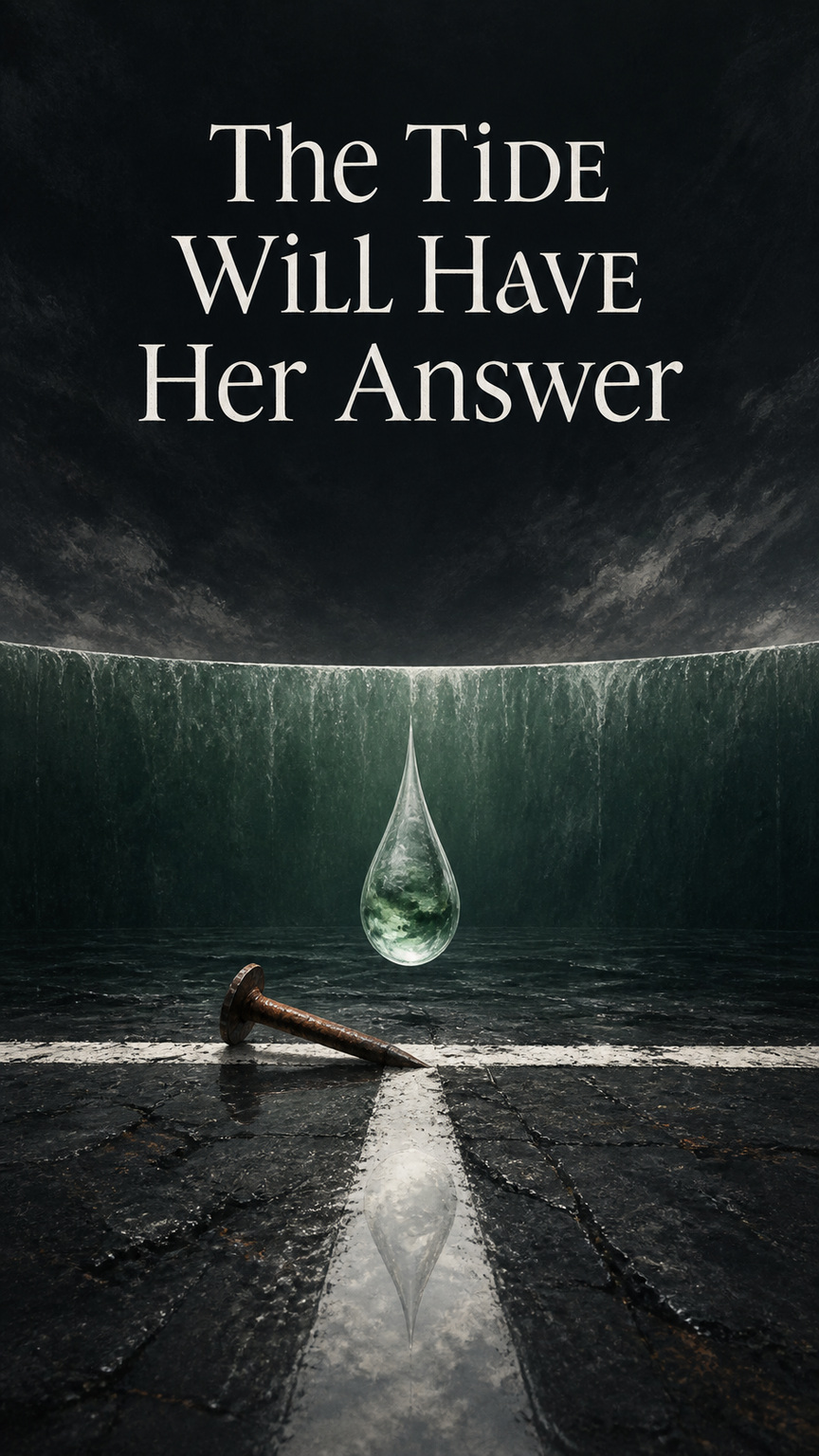
The crown was old caulking rope, tar-black and stiff enough to scrape Orselle Vuret’s brow when they pushed it down over her gray hair.
Someone had tied seven limp ribbons to it and stuck a bent copper nail through the front. Mallowbreak laughed because launch-day misrule required laughter, and because their god of sound workmanship could enter the shipyard by no other title.
“Mind the sacred tar,” called a cooper from the launch apron. “It might improve her judgment.”
That laugh came harder.
Orselle stood outside the white boundary scored across the yard gate. Four years ago, the harbor court had struck her master’s seal from the register and barred her from every working cradle in town. She had deserved both punishments. Repetition had not improved the joke.
Rulik Saal watched from beside the new herring boat’s bow, wearing the yard foreman’s blue sash. When the rope crown went around for each volunteer to touch, he folded his arms.
Sileth Nemm, keeper of the rite, rapped a driftwood staff against the stones. “If you’re going to do it, do it in order. Mockery doesn’t excuse bad observance.”
“That’s why we chose Vuret,” somebody said.
“Quiet while I read.”
At Sileth’s feet stood the brine clock: seven green-glass vessels on a cedar rack, each sealed until she turned it. Together they measured fifty-seven minutes. Orselle had repaired the rack when she was still welcome here. The third vessel always dripped down its left side in wet weather.
Sileth set her hand on the first glass. “Those present and willing, attend. Within the harbor stones, we lend the crowned one our notice. We lend the crowned one our obedience in the work of launching. We lend the crowned one the harbor’s right to order what bears upon the water.”
It was children’s solemnity in old clauses. Yet the laughter thinned. Caps came off. Even the cooper lowered his mug.
Sileth looked straight at Orselle. “Do you bear it until the last brine drains?”
Orselle’s tongue tasted suddenly of deep water.
That taste had lived under everything for eighty-six years: breakfast, fever, blood, the lie beneath her seal. Usually it was salt at the back of her mouth and weight moving beyond walls. Now it filled her lungs.
“It’s a rope,” she said.
Sileth waited.
The crowd did too. They were choosing to attend. Not forgiving her, but seeing together the thing they had named.
“I bear it.”
Sileth turned the first glass.
Across the apron, a ballast lighter rolled against its fenders. Its port side was low; three men shifted iron pigs on deck while a squall pressed past the sea wall. A fender spat free. The lighter leaned toward the new boat.
“Hold her,” Orselle snapped.
The harbor rose beneath the lighter like a hand.
Not a wave. Waves moved. This water shouldered upward under the listing hull and held it level while the men stumbled.
The first glass ticked brine into its cup.
“Nobody speak to the water,” Ossa Keld said.
The harbormaster did not shout. She had a way of placing a sentence where panic would trip over it. “North-quay lead, clear the apron. Two routes: kiln stairs and net lane. Tell me when each is empty. Rulik, get those men off the lighter. Vuret, say exactly what you’re doing.”
Through her boots Orselle felt forty-three tons of hull and iron, supported at the wrong angle by attentive water.
“Keeping the lighter’s port bilge level with the black quay ring,” she said. “Nothing else.”
The water adjusted a finger’s width. A woman near the clock swore.
“Received,” Ossa said. “Keep that condition. Rulik?”
“Men coming off. Leave the iron. No, leave it. Your foot first.”
Sileth had gone pale. She crouched beside the cedar rack, thumbing through the stitched leaves of her rite book.
“Find the ending,” Orselle said.
“There are three endings. One is for rain.”
“Not that one.”
“I had gathered.”
The first vessel gave a hollow gulp. Sileth turned the second.
They tested the command with an empty punt. Orselle told the water under its bow to rise the breadth of Ossa’s thumb, then settle. It did both. She said, “Let go,” meaning the punt, and every north-quay mooring jumped slack while the water drew an inch from the wall.
“Not that phrase again,” Ossa said. “North quay, retie the fish boats. Confirm each one.”
“It obeys the noun it can supply,” Orselle said. Her own voice sounded thin beside the pressure in her chest. “And the widest measure allowed by my words.”
“Then use more words.”
Rain freckled the apron. Beyond the harbor mouth, the storm darkened the sea to hammered lead. The new herring boat waited on its greased ways while the tide pressed against the outer stones.
Rulik came off the lighter last. “Port bilge’s clear.”
Orselle released the support. The hull rolled once, less than it should have, and found its fenders.
“That was you?” he asked.
“Apparently.”
“Don’t do apparently with a harbor.”
She almost reminded him whose rule that had been at nineteen. The cruel words stayed behind her teeth.
At the drydock, crews were trying to close the inner sluice before the squall drove weed into its guides. Three orders crossed at once.
“Haul east!”
“Ease the gate!”
“Which line, damn you?”
Orselle saw the sluice rope snarl around a bollard and a boy step inside the bight. “Run it clear past the red stones!” she shouted, pointing beyond him.
The boy dropped flat.
The rope did not move.
The whole incoming tide did.
Water fled the drydock, quays, and fishing slips. It poured between the sea walls and climbed beyond the two red boundary stones in one gray slope. Boats struck mud. Moorings cracked taut. Where the storm surge met the banished tide, a ridge began to grow.
The second glass emptied while everyone stared at the harbor floor.
“I meant the rope,” Orselle said.
Ossa looked once at her pointing hand. “Meaning isn’t in the order. All crews, treat Vuret’s voice as live tackle. Repeat before acting. Vuret, no pronouns. No pointing.”
From the fish quay came a man’s call: “My boat’s on her side!”
“Leave it,” Ossa answered. “People before hulls. Kiln stairs?”
“Clear to the cooperage,” the lead called back. “The goose keeper won’t leave his birds.”
“Take him. Open the pen. The geese can dislike us from higher ground.”
Sileth turned the third glass with wet fingers. “The water hasn’t gone.”
Orselle did not need to look seaward. Displaced weight leaned against her ribs. The storm kept feeding it beyond the harbor mouth until it found another route.
An inhabited cove lay east. A smaller one lay west. Both sat lower than Mallowbreak’s upper street.
“How long can you hold it there?” Ossa asked.
“Until the order ends or something else takes the load. The head is already walking along the coast.”
“Toward people?”
“Both ways.”
Ossa turned to the north-quay lead. “Send runners. East cliff road to the first cove. West track to the other. Don’t promise them time. Say storm water displaced from Mallowbreak, moving toward both coves. Say it exactly.”
The runner swallowed. “They’re going to ask who did it.”
“Then keep enough breath to answer. Go.”
Sileth found a page repaired with sail thread. “There is a shore-return before the seventh vessel finishes. The crowned one gives back the harbor right. The water is admitted through the old tide stone.”
“And me?” Orselle asked.
“The line says, what came breathing salt shall leave breathing air.”
“That isn’t an answer.”
“It’s the line. The margin was cut away before my grandmother kept this book.”
Ossa glanced between them. “What came breathing salt?”
The third vessel leaked down its familiar left side. Orselle watched the runnel choose the old groove in the cedar.
“Me,” she said. “Long before any of you.”
She told them only what the harbor needed. At thirty-nine, before Mallowbreak, she had gone overboard at the northern teeth in winter. Something vast and living had been dying beneath the ice, its hide luminous as drowned moonlight. It pushed a final warm current through her lungs. Since then salt water had not drowned her, age had not advanced, and every tide announced its weight inside her bones. She had changed ports when questions gathered and never commanded so much as a cup.
“If the old headings fit,” Sileth said, half to the page, “power, but no observance and no harbor right. Not godhood then.”
“Don’t tidy it yet,” Ossa said. “Can shore-return kill her?”
“The record says mortal. Not dead.”
“Can you guarantee that?”
Sileth wiped rain from the page. “No.”
The third glass drained dry.
Mud shone between stranded boats. Piling feet long hidden from air were furred with worm holes. Beyond them, the relief gate was a stone throat meant to take storm tide through the abandoned lower yard and across the western waste. It had not opened in Orselle’s memory. Her old shop stood in its path.
Ossa turned the fourth glass. “We need that gate.”
“You need it braced before it opens,” Orselle said. “Otherwise the first head takes the wall with it.”
“Route?”
“Across the mud from berth six. Keep wide of the crane piles. Twelve people, two shores, the long auger, sledges, wedges, and every dry oak beam Rulik can spare.”
Ossa pointed to three crew leaders in turn. “People. Tools. Beams. Say back.”
They did, not in unison. One had only one sledge. Another asked if his mule could cross the mud. A fishwife demanded help with six baskets of smoked eel.
“Move the baskets yourself if you can carry them uphill,” Ossa said. “If you can’t, leave them.”
“Easy for you. They’re not your winter.”
“No. They’re your next four minutes. Choose.”
They went down by ladders. Mud sucked at Orselle’s boots; the storm ridge pulled at the salt in her lungs. She ordered a cart-road ribbon of water to remain beneath the lighter so its keel would not break, and another patch to bear the brace team until their planks found mud.
Then someone behind her yelled, “Lift us!”
Orselle saw the tool sledge mired to its runners. “Lift that crew a handspan.”
Water punched upward beneath three men, the sledge, and half the plank road. They rose in black mud. The sledge slewed sideways.
“Down,” Orselle said.
Every held patch dropped. The lighter struck its water hard enough to throw an iron pig through the rail.
“Vuret!” Ossa’s voice carried from the quay.
“No one asks me for movement,” Orselle shouted. “Name the problem. I will name the water.”
One of the men spat mud. “Problem is my teeth are full of the harbor.”
“Keep those. We haven’t time to find another set,” his mate said.
The fourth glass emptied as they reached the relief gate.
Its oak leaves had swollen into the stone rebates. Rust scaled the hinge straps. Rulik cut rot from the sill and pushed his knife into a seam to the haft.
“Lower hinge is gone,” he said. “If we drive the center, the leaf twists.”
“It takes the pier above with it,” Orselle said.
“I know what a twisted leaf does.”
“Then stop cutting there.”
“I was finding depth.”
Sileth arrived with the clock rack against her chest. The fifth vessel had begun to drain. People carried beams over the planks. Rulik chalked three cuts: one above the failed hinge, two through the cross brace.
Orselle wiped one away. “Not the upper. Load transfers into the left jamb.”
“The left jamb’s cracked.”
“Surface crack.”
“You said that about the ferry seam.”
The work around them did not stop, but it changed sound. Mallets landed softer. Someone missed a wedge.
Rulik stared at the gate, not at her. “I cut that scarph wrong. I left it proud, and I packed the hollow because I thought the bolts would carry. That’s mine.”
“Rulik—”
“You opened it after. You saw.”
She had. Reopening to the keel would have stopped winter service for six weeks and ended Rulik’s apprenticeship. Orselle had calculated plate, bolt, weather, and need, then written sound beneath a repair she had not proved.
“I judged the bolts sufficient,” she said.
“You judged the delay worse.”
“At the time—”
“No. You had the seam open. I had my knife marks in it. We were there.”
A beam carrier shoved between them. “Argue narrow. This end’s dropping.”
Rulik caught the beam, and the polished shape of Orselle’s defense broke apart under its weight. She got her shoulder beneath the other end.
“Left jamb first,” she said. “Double shore, low and high. Then your two brace cuts. Leave the upper strap to hold the twist.”
Rulik breathed through his nose. Once. Twice. “High shore wants a wedge behind the cap.”
“Two wedges. Opposed.”
“Bring two matched wedges!” he called. His voice worked again when the work did.
They braced the jamb and bored through salt-hardened oak. The auger screamed and stuck; four people reversed it while a chandlery boy complained that nobody had brought grease. Rulik refused offered lamp fat, then took it when the bit smoked.
The fifth glass ran low.
The storm head spread past the red stones, hunting shallow ground. If Orselle kept her first broad order, Mallowbreak would stay dry until low water. The eastern and western coves would take what she had moved.
If she ended the harbor right before the gate was ready, all the displaced water would return through the mouth. Boats, quay, people on the mud: one load, no sequence.
“East runner’s back!” someone called from the ladder.
Ossa received the report at the quay edge and sent it down in pieces. “East cove’s moving uphill. Two households refuse. Their south path is already under. West runner not back.”
“The head reaches the east cove first,” Orselle said. “Then west.”
“How long?”
Orselle closed her eyes. The sea pressed against its imposed boundary, every ton distinct and none patient. “Before this vessel finishes, the first roofs.”
Sileth looked at the brine. “This vessel?”
“The one draining now.”
“Confirm,” Ossa said.
“The east cove takes water before the sixth begins.”
Ossa sent every unused hand to the gate.
The auger broke through. They drove the two cuts and left the upper strap. When the last wedge seated, Rulik laid his palm on the braced jamb, feeling for movement.
“Ready to fail on purpose,” he said.
“Not yet,” Orselle said. “The lower yard isn’t clear.”
“Vuret’s shop is locked,” a crew leader reported. “Storehouse loft too.”
“No people?” Ossa called.
“Checked both floors. One goat.”
“Whose?”
“Goat won’t say.”
“Take it uphill. Leave the doors.”
The fifth vessel gave its final drop. Sileth turned the sixth.
The west runner appeared above the quay, one hand bloody from a fall. “They know. Cliff path’s broken behind me. They can’t get carts out.”
No one laughed now, nor did they become one body. The fishwife wanted the gate shut until her eel baskets were clear. A boat owner preferred mud under his hull to flood over it. Two lower-yard families shouted that Mallowbreak should not buy neighboring roofs with theirs. Another man shouted that children slept under those roofs.
Ossa sorted noise into facts. “Lower yard clear of people. Goat clear. North quay clear. Mud crews withdraw on the center planks after the cuts. Boats at berth six will be lost if the head returns. Vuret, received?”
“Received.”
“Rulik, gate readiness?”
He looked at Orselle’s bracing, then at his cuts. “Ready if the high shore holds.”
“If?”
“It’s timber, Harbormaster. It doesn’t sign guarantees.”
Sileth knelt with her book open beside the sixth glass. “There are two continuations. If the crowned bears through last brine, the harbor obeys until low water. It says nothing about water beyond the stones. If the crowned makes shore-return, the harbor right ends and the old tide way opens to receive what was withheld.”
“And the salt-breath?” Orselle asked.
Sileth turned the page back, though they all knew there was no more writing there. “It leaves.”
“Does eighty-six years arrive at once?”
“No clause says.”
Rulik’s face folded around a reply and failed to produce it. At last he said, “I don’t know what I want you to do.”
“Good,” Orselle said, too quickly.
“I know what I don’t want. Don’t spend this to make the ferry clean.”
The storm shoved at Orselle’s chest. Her heart had not worked this hard in decades. Perhaps that was fear. Perhaps the old salt-breath was already loosening.
“It won’t,” she said.
Rulik rubbed oak dust from his palm. “All right. High shore first when we open. I’ll take it.”
“Take the low cut. Your shoulder fits between the pairs.”
“I’m foreman.”
“Then assign by the opening, not your sash.”
He looked as if he might answer the history instead of the order. Ossa cut across him from above.
“Saal, assign the shores. Vuret, choose when. Nobody chooses for you, but we need the work sequence before the last glass.”
The sixth vessel emptied. Sileth’s hand hovered over the seventh.
Orselle could refuse. No curse would follow. Mallowbreak would remain dry; she would remain deathless, barred and watched, able to outlive everyone who remembered why.
Beyond the stones, the eastern cove took the first edge of the storm head. She felt it climb a road.
“Turn it,” she said.
Sileth turned the final glass.
Work narrowed. Ossa cleared the plank road by names and counted people onto the ladder. Rulik divided the crews, then made them repeat which wedge they would strike. Orselle walked the route: relief gate, lower yard, western waste. Doors stood open. The rescued goat bawled from the quay.
Rain erased the chalk except where Rulik had cut.
“Ossa, on my word: both marked cross-brace cuts inward. Upper strap untouched. Hold the left jamb between the paired shores until water reaches the third course of the storehouse wall. Then north steps.”
Ossa repeated it in shorter pieces. Each crew leader answered. Rulik corrected one man who had heard second course instead of third.
Sileth stood on the white boundary at the yard gate, crown-receiving cloth spread over her hands. “Shore-return requires you to cross from working water onto claimed land before the brine ends. The crown comes off after the crossing. I think.”
“You think?”
“The sentence lost a verb.”
“Use return.”
Orselle stepped onto the wet lower ramp. Rainwater threaded over the mud while the storm ridge pushed at her command. The final glass stood less than half full.
“Now,” Orselle said.
“Both marked cuts inward!” Ossa ordered.
Sledges fell out of rhythm. One cut opened first. The gate twisted against the upper strap, exactly as Rulik had predicted. The high shore bowed.
“High wedge!” he shouted.
The man there struck the low pair.
“Not those—the cap! Cap wedge!”
Orselle opened her mouth to lift the water away from them. If she said lift, it might lift every wet thing in the gate throat. If she named too little, the shore would snap before the pressure eased.
Rulik climbed the brace and drove the cap wedge himself. The high shore straightened. The second cut tore through.
“Gate crew out,” Ossa called. “Rulik last. North steps. Confirm.”
“Out!” Rulik answered.
The gate hung from its upper strap. Behind it waited an empty yard, open sheds, and Orselle’s shuttered shop.
Sileth shook the final glass. A shallow green line remained.
“Orselle. Now.”
She had been Vuret to Sileth all day.
Orselle reached the white boundary. Behind her, crews scrambled up the north steps. Rulik’s blue sash vanished over the top. Ossa counted and called the yard clear.
Orselle put one boot on claimed land.
The sea waited inside her command. She could still step back.
She brought the other boot across.
“I return the harbor right,” she said. “Take off the crown.”
As the final brine struck its cup, Sileth lifted the tarred rope.
For one suspended beat, nothing moved. Then the salt taste left Orselle’s tongue.
The sea struck the relief gate.
The upper strap tore free. Oak leaves vanished into white water. The paired shores buckled but held long enough to turn the first force into the lower yard. Water burst through stores, shouldered open Orselle’s shop, and carried her drafting table through the western wall. The lighter dropped onto mud. Along the quay, ropes and people took their assigned loads.
Orselle fell to one knee on the apron.
Air entered her lungs without salt. It was cold, narrow, ordinary air, and for a moment she could not understand why breathing required so much work.
“Stay down,” Ossa said. “Can you breathe?”
Orselle nodded.
“That’s not confirmation.”
“Breathing.”
“Pain?”
“Everywhere cheap workmanship usually puts it.”
Ossa gave her one irritated look, which was better than reverence, and turned back to the harbor.
By dusk, the storm had spent itself across the waste. Mallowbreak lost four sheds, eleven storerooms, two small boats, the lighter’s rail, and most of Orselle’s shop. The eastern cove reported water in one lane and no missing people. The western cove lost three carts. No roofs went.
Sileth wrapped the rope crown in oilcloth and wrote three pages of corrections to the rite book. She asked Orselle twice how mortality felt. Orselle told her the first question was reasonable and the second was not improved by repetition.
Rulik made his own correction in the harbor record. He wrote that he had cut and packed the ferry’s faulty scarph, that Orselle had reopened it, and that she had certified it without proof. He signed his name below hers rather than through it.
The hearing clerk arrived before dark to remind Orselle that saving two coves did not restore her master’s seal or settle the ferry’s injuries and ruined cargo.
“I know,” she said.
“You are still required on second bell tomorrow.”
“I heard you.”
Her face had not taken eighty-six years at once. Her hands shook from cold instead. Someone offered a blanket that smelled of goat, and she took it.
At the broken relief pier, Rulik and Ossa were arguing over whether the surviving high shore could be reused. Orselle listened until Rulik said the foot was sound.
“It shifted,” she called.
He looked across at her. “How much?”
Once, she would have felt the answer through water and timber together. Now she walked down with a rule, crouched beside the beam, and set its brass edge to the witness mark.
“Three eighths of an inch toward the gate,” she said.
Ossa bent to read it herself. Rulik wrote the measurement in the damage book.
The tide rose through the ruined yard by its own weight. Orselle held the rule steady until both of them had seen the line.