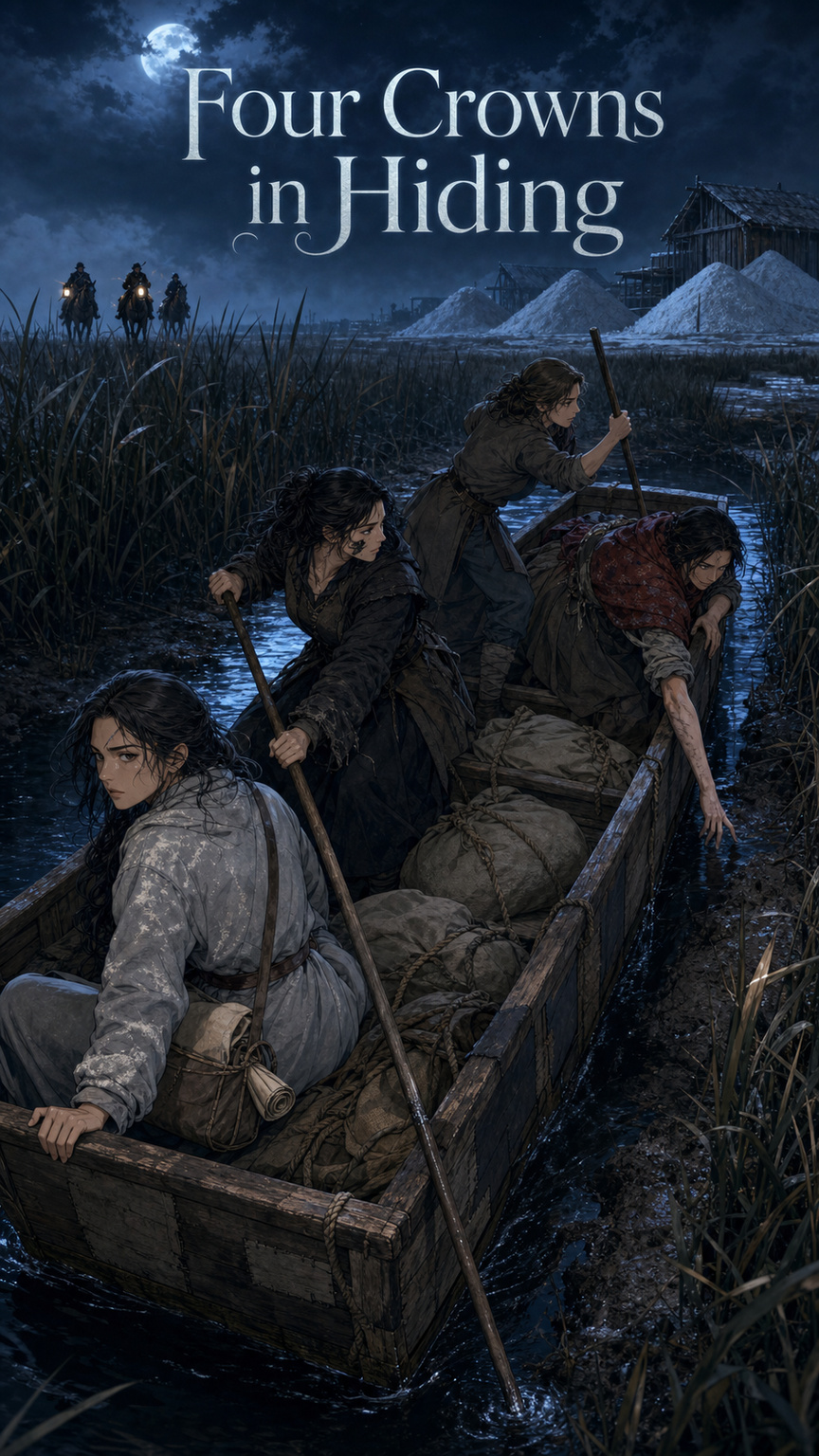
Four Crowns in Hiding
Four sisters, who are princesses, were brought to lowly kingdoms so they could hide from the person who wants them dead.
The west mirror flashed while Ilvara was scraping salt from its hinge.
Light, dark, dark. Light, light. A pause long enough for the tide to climb one painted finger on the wall, then another cluster. Ilvara set down the bone scraper. Across the inlet, three hundred hand-sized mirrors turned on poles above Nalevane’s mudbanks, passing the duskglass packet from one brine terrace to the next. The court that had hidden her here had called Nalevane low because its throne room had a reed roof. It had neglected to mention that the reed roof could be replaced after a storm, whereas the palace dome had cracked when the first cannon struck it.
Breqen looked up from the tide ledger. “Don’t touch the forwarding plate.”
“I am cleaning it.”
“You stopped cleaning.”
The flashes repeated. Ilvara knew the groups before Breqen finished marking them in charcoal.
FOUR CROWNS. FOLDGATE BEFORE FIRST LIGHT. ANSWER IN BIRTH ORDER. THE HOUSE IS CLEAR.
Then came the royal authentication: four bright strokes divided by darkness, a pattern that only a shard from the palace duskglass could impress on the relay.
For two months, since armed attendants had carried the sisters in four directions out of a kingdom collapsing around them, Ilvara had practiced receiving messages without expecting a familiar hand behind them. This one broke the practice in six words. Four crowns. The title their mother had used at the supper table when no minister could hear. Foldgate, the old transfer station midway among their refuges. A clear house. Reunion before dawn.
Her fingers settled on the plate.
Breqen closed the ledger over them.
“Remove your hand,” Ilvara said.
“No.”
Formality came over her when fear did, fitting bone by bone. “That seal is genuine. If one of my sisters has reached the palace stores—”
“The seal may be genuine. The tide is not.” Breqen tapped the charcoal record. “That pause claims the western water turned at dusk. It did not. I was standing in it.”
“The cipher does not include your tide.”
“Everything that crosses my mirrors includes my tide.”
Outside, workers hauled a mirror mast down against the rising wind. Nobody waited for the princess to tell them how. Ilvara looked again at the neat court groups, each one paced as Kalmid Osreth had taught her when she was nine: no wasted light, no ambiguous break. Kalmid had opened the sally gate during the coup. Later, word reached each refuge that he was hunting the four heirs left alive—not from appetite or fee, but because generals could build wars around surviving daughters.
He knew the supper name. He knew their birth order. He had once slapped Ilvara’s wrist for crowding two signal groups.
“One check,” she said. “Bounded. We ask the other routes whether their local marks agree. No position, no acknowledgement, no royal cipher.”
Breqen considered her, then took the forwarding key from his belt. “I will ask. You will read the answer beside me.”
“Agreed.”
He uncovered the lamp beneath the outbound duskglass. Ilvara held the ledger while he tilted the tide mirror into its first bright stroke.
In Rusk Hollow, the same packet arrived as iron sound.
Brikka watched the receiving glass brighten and dim. For every bright beat she struck the high bell with a padded hammer; for every dark beat, the low. The bells were no larger than bowls. Their voices traveled into the stone throat behind the relay room, struck the mountain’s hollow interior, and returned a breath later with the route folded into the echo.
Mirdakai wrote faster than the echoes came.
“Four crowns,” she translated. “Foldgate before first light. Answer in birth order. The house is clear.” The final strokes rang. She stopped with her pen above the page. “The seal is right.”
Brikka pressed two fingers to the high bell, stilling it. “Packet’s wrong.”
“The authentication interval is exactly one and three quarters—”
“Not that.”
“If the ridge temperature has shortened the rebound, then the expected decay is—wait. No. The low return is present, the high return is absent, unless your damping cloth took it, but you changed that at midday and the cloth would take both. Did the upper throat ice?”
“No.”
“A split in the stone?”
“Mirdakai.”
She made herself stop. The room still seemed crowded with numbers she had not spoken.
Brikka pointed the hammer toward the tunnel mouth. “A proper packet comes over the north shoulder. High bell answers twice. This came from the old south spur. Whoever sent it joined our line after the mountain.”
Mirdakai heard the invitation again inside her head. The house is clear. Mirdakai had never believed in clear houses. Houses had tolerances, loads, vents, doors left unlatched by people certain they had checked.
The outbound duskglass flickered with Breqen’s unsigned tide query. The marks were simple: LOCAL CADENCE TRUE?
“We can locate the sender,” Mirdakai said. The words hurried again. “Challenge the south spur with a rebound request, except a direct request reveals that we noticed it, so send a routine correction with a false high-bell delay and see which station repeats it. The stolen shard can answer the palace group but not a measurement made after arrival. Three beats late—no, two. Three would put the echo beyond Foldgate’s dead throat.”
Brikka set down the hammer. “Choose.”
Mirdakai stared at the columns. Everything in her wanted one more calculation, then another, until the longing inside the packet had become a harmless fraction.
“Two beats,” she said. “Mark it as bell maintenance. Ask for the return interval only.”
“Good.” Brikka turned the outbound shutter. “My bells, my challenge.”
“Yes.”
Brikka rang the maintenance group. Mirdakai listened as the mountain returned both notes, exactly where they belonged.
The packet tugged Oriel Strand’s message vanes in black and white.
Rhevos had woven the paired strips from stormgrass: pale face for light, dyed face for dark. The receiving duskglass worked a small tension bar, but no message reached the record until a weaver followed each turn and pinned a matching strip to the frame. Wind made errors. Knots slipped. Oriel Strand trusted hands because hands could admit they had slipped.
Meraine read the finished band twice.
FOUR CROWNS. FOLDGATE BEFORE FIRST LIGHT. ANSWER IN BIRTH ORDER. THE HOUSE IS CLEAR.
“There,” she said.
Rhevos glanced over. “There what?”
Meraine touched the words in birth order. “He wants us to answer as we were arranged at court.”
“You know it’s a man?”
“I know what he failed to imagine.”
That was not enough for Rhevos. She lifted the band from its lower hooks and held it sideways to the crosswind. One section fluttered while the rest pulled taut.
“Someone cut out a gap,” Rhevos said. “The east gust drops every ninth group. We leave the loose strand in the record. Whoever joined this packet trimmed it clean.”
Meraine watched the loose strand dance. Kalmid had been patient with omissions in lessons. An empty signal, he used to say, must be empty on purpose. Yet his invitation named the sisters, their order, their old house. It named none of the people who had concealed them, fed them, corrected their mistakes, or decided each morning to keep doing so.
The kingdoms were containers to him. Tip four princesses out, and the containers ceased to matter.
“Ilvara will ask whether the seal can be trusted,” Meraine said. “Mirdakai will ask where the packet entered. Nuvaya will want to move before the road closes.”
“And you?”
“I want to know what answer he has already prepared for.”
Rhevos waited.
Silence was often mistaken for uncertainty at court. Meraine had found it useful to let the mistake stand.
“No acknowledgement,” she said at last. “Not even refusal. Send the wind gap and the omission: the sender expects us without our hosts.”
“Weavers decide what leaves this frame.” Rhevos rehooked the band. “But I agree.”
The tide query arrived and, behind it, Rusk Hollow’s maintenance group. Rhevos wove Oriel Strand’s correction between them: CUT GAP. NO HOSTS NAMED. Meraine held the lower frame steady, feeling the wind try every knot.
Nuvaya was on the lamp roof when she saw the riders.
There were five, dark against the chalk road that wound from Ternhold toward Foldgate. They rode without lanterns. That meant they wanted anyone watching from the valley to think them shadows; it also meant every sentry above them could follow the pale dust kicked up by their horses.
Below Nuvaya, the receiving duskglass pulsed inside its copper hood. Ullet translated it by opening and closing four shutters around an oil lamp. Each stroke cast a shadow at a different angle across the marked wall: long for light, short for dark, east to start a group, west to end it. Ternhold’s relay clerks did not merely read whether a lamp shone. They read where the darkness fell.
“Four crowns,” Ullet called. “Foldgate before first light. Answer in birth order. The house is clear.”
Nuvaya was already climbing down. “Send warning. All routes. Riders on the dry road.”
Ullet caught the ladder before she could jump the last three rungs. “Which warning?”
“The one that says riders are on the dry road.”
“From which marker, moving how fast, able to see which towers?”
“We don’t have time for this.”
“Then don’t waste it being vague.”
Nuvaya bit back the next interruption. Ullet shoved a waxed route board at her and returned to the lamp. His equipment, his decision. She hated that this was reasonable.
On the board, the valley was cut into planes of sight. Nuvaya laid one finger on the riders, one on Foldgate’s broken bridge, and traced what they could see: the north lamp if it showed above half-shutter, the old transfer arch when the moon rose, none of the east face beneath the quarry shelf.
“They’re forty minutes from the fork,” she said. “If they take the bridge road.”
“It has no middle span.”
“They won’t know until the last bend. If they take the quarry track, an hour. The east face is blind from both until here.” She tapped the shelf. “We can reverse the shutters there. Make a west-cast packet look as if it came from the refuge road.”
Ullet looked at the board, not at her. “We can. We have not decided to.”
“Then decide quickly.”
The other kingdoms’ findings began to arrive. Tide false. South-spur entry. Cut wind gap. No hosts named.
Nuvaya read them as Ullet’s lamp threw their shadows. For the first time, the court-perfect message looked smaller than the valley around it.
“The riders aren’t coming to search Ternhold,” she said. “They’re going to watch Foldgate. He expects one of us to answer.”
“Which one?”
Nuvaya’s finger remained on the shortest road. Kalmid had always given her puzzles with too little time because she was the youngest and quickest to prove she could finish.
“Me.”
Their answer took three hours to build because none of the four relays could speak in another’s place. For most of that time, Nuvaya’s reports placed the five riders beside the same roadside trough, waiting below the fork.
Ilvara received the others’ findings in Nalevane as a field of mirrors: dark squares under cloud, sudden white glances when Breqen’s workers tipped them to the lamp. She put four stones on the ledger, one for each refuge, and refused to move any closer together.
“First condition,” she said. “No sister leaves sanctuary. Second, no route names a sanctuary. Third, if any local watch refuses the plan, the plan ends.”
Breqen adjusted the west mirror half a finger. “Those are acceptable. Stop calling them conditions as if you grant them.”
Ilvara’s mouth tightened. “Contingencies, then.”
He sent them under Nalevane’s tide mark.
At Rusk Hollow, Mirdakai received the tide flashes as alternating bell strokes. By then Brikka’s false maintenance request had traveled down the compromised south spur. Its return came exactly two beats late, without the mountain rebound.
“Foldgate,” Mirdakai said. Then, because Brikka raised an eyebrow, she forced herself to show the whole path on the slate. “The sender copied our delay at the first live station beyond the dead throat. Foldgate is the only station that fits. We can give him a reply whose timing appears to come from Ternhold, but only if Nalevane holds each group one tide count and Oriel Strand adds its regular ninth-group gap.”
“Our false beat?” Brikka asked.
“One and a half. He’ll expect me to correct too much. One and a half looks like haste.”
Brikka rubbed the bell rim with chalk, thinking. “The hollow can carry it.”
At Oriel Strand, the plan arrived in woven turns. Meraine read Ilvara’s three contingencies and Mirdakai’s timing. They had a route and a frame. What they lacked was a lie Kalmid wanted to believe.
Rhevos cut a frayed end from the black vane. “You’re making that face again.”
“Which face?”
“The one that means everyone else must wait while you notice something.”
Meraine let the strand slip over her thumb. An answer in birth order would reassure Kalmid that the sisters still obeyed the old arrangement. But four answers risked four locations, and Ilvara would never permit it. A refusal from Ilvara would sound like defense. A proof from Mirdakai would sound like a trap. Meraine’s own answer would make him hunt for the withheld part.
Nuvaya, though—Nuvaya would not wait for birth order if she believed the others were endangered.
“Make the acknowledgement incomplete,” Meraine said. “Start in the fourth position. Nothing before it.”
Rhevos’s knife stopped. “Words?”
“At Foldgate. Saw your shard. Coming by the refuge road. Hold the house.”
“That exposes Ternhold.”
“It appears to. The route must be Nuvaya’s choice, and Ullet must permit it.”
Rhevos wove the proposed bait, including the untouched empty spaces where three elder replies should have been. She sent it no farther than Ternhold.
Nuvaya received Meraine’s lie in the lamp shadows. It was nearly right.
“Not the refuge road,” she said.
Ullet folded his arms.
She tapped the route board. “Kalmid taught us never to name a road while moving on it. He’ll know that’s bait. Say east shelf. He thinks I can see Foldgate from there, and his riders can’t see the shelf from either approach. We reverse the cast so the packet appears to leave from the refuge side.”
“My watch can hold the quarry track,” Ullet said. “The bridge road stays open until his party commits to it. Then we close the gate behind them.”
“You can take five?”
“The road can. We built it.”
Nuvaya looked toward the waiting riders. Waiting had always felt to her like surrender performed in a chair. This waiting had edges. A gate shut here. A shutter reversed there. A broken bridge waited around a bend no invader had bothered to learn.
“Send it,” she said.
Ullet did not move. “Ternhold sends it. You set the route marks.”
She breathed once. “Ternhold sends it.”
Together, but at different tasks, they forged the acknowledgement. Nuvaya chose the apparent path. Ullet turned the shutters. Oriel Strand inserted its loose ninth gap. Rusk Hollow made the reply hurry by half a beat. Nalevane’s mirrors held each group against the true tide. Through the duskglass, one false answer acquired four honest imperfections.
FOURTH ANSWERS. EAST SHELF. SAW YOUR SHARD. COMING. HOLD THE HOUSE.
Then silence.
Near midnight, a return packet entered Ternhold from Foldgate. The palace authentication shone first. After it came only: COME ALONE.
“He’s there,” Nuvaya said.
Ullet hooded the lamp and signaled the watch with two ordinary shutters, nothing royal about them.
From the roof, Nuvaya saw the riders reach the fork. Four took the bridge road. One turned up the quarry track toward Foldgate’s east shelf. Kalmid separated himself from his escort because the youngest princess had offered him the ending he expected: haste, secrecy, a chance to prove herself before her sisters arrived.
Nuvaya hated how accurately he had once known that piece of her. She liked what she had done with it.
The quarry rider passed behind the shelf. Ullet opened the north lamp, and Nalevane’s delayed flashes appeared in the valley below as if far mirrors were moving toward Foldgate. A moment later Rusk Hollow’s false beat rang from an old resonance plate under the transfer arch. On the ridge, Oriel Strand’s held vanes released three pale turns into the moonlight. To anyone carrying a stolen duskglass shard, the three elder routes seemed to be converging.
The four escorts rounded the last bend of the bridge road and found empty air where the middle span had been lifted away for repairs. Ternhold’s gate dropped behind them. The road held them between stone walls while the watch called for their reins.
Kalmid emerged alone onto the east shelf. Even at that distance Nuvaya recognized the narrow set of his shoulders. He held a bright sliver above his head. The palace shard answered every relay around it with the proper four-part seal.
“Nuvaya,” he called into the dark. “Any general could make an army of one of you.”
No speech followed. Kalmid had never wasted words when he believed the result was obvious.
Ullet glanced at Nuvaya. The last reversal was hers to time.
She watched Kalmid’s position, the two shutter crews hidden above him, the net rope laid across the shelf, the blind turn behind. Route and risk. He could retreat for six strides before the quarry wall narrowed. He could jump nowhere. The shard occupied his right hand.
“Now,” she said.
Ullet reversed the east shutters.
Light struck the shelf from behind Kalmid. His shadow leaped forward, huge and false, pointing toward the refuge road. He turned toward it, expecting Nuvaya to step out where the signal claimed she stood. The watch pulled the rope. A weighted net dropped across his shoulders and pinned his sword arm before he cleared the blade. He hit one knee, still gripping the shard.
“You cannot keep them hidden forever,” he said.
Ullet’s answer carried from the rocks. “Put the glass down.”
Kalmid looked at the shadows around him, perhaps counting people he could not see. Then he set the shard on the stone.
The watch took him alive. They bound his hands, recovered the palace duskglass, and disarmed his trapped escort without bloodshed. The compact kept custody in Ternhold until witnesses from the other three sanctuary kingdoms arrived.
Nuvaya stayed on the lamp roof.
The capture receipt reached Nalevane before dawn. Breqen’s mirrors showed the recovered shard as four bright bars followed by the Ternhold watch mark.
Ilvara read it twice. “We should determine whether a more secure central refuge—”
Breqen shut the forwarding plate.
She looked at the workers resetting storm-tilted mirrors along the bank. “No. Strike that. I remain here tonight. Tomorrow I will ask again.” She picked up the bone scraper. “This hinge is still salted.”
In Rusk Hollow, Brikka found a hairline crack where the high bell’s mounting met the wall. Mirdakai held the lamp close and began listing repair times, then crossed out all but the first.
“After breakfast,” she said.
“Sensible.”
“I’ll still be here after breakfast. Do not become accustomed to the sensible part.”
On Oriel Strand, one vane had torn during the long transmission. Rhevos gave Meraine the black thread and kept the needle for herself.
“You staying?” Rhevos asked.
Meraine watched the empty gaps pass through the frame, each one left where the wind had made it. “If the offer remains.”
“It does. Hold that tighter.”
At Ternhold, Nuvaya refilled the lamp while the watch brought Kalmid down from the shelf. She could have watched him enter the gate. Instead she wiped spilled oil from the copper hood.
Ullet climbed the ladder and inspected her work. “Too much wick.”
Nuvaya trimmed it.
“The watch can take you north at sunup,” he said.
“No. The shelf lamps will need filling when they bring Kalmid down.”
The flame steadied. Through the duskglass came three separate receipts: a tide flash, a bell rebound, a pale vane turning in the wind. Nuvaya answered each with the same short shadow, cast from where she was.