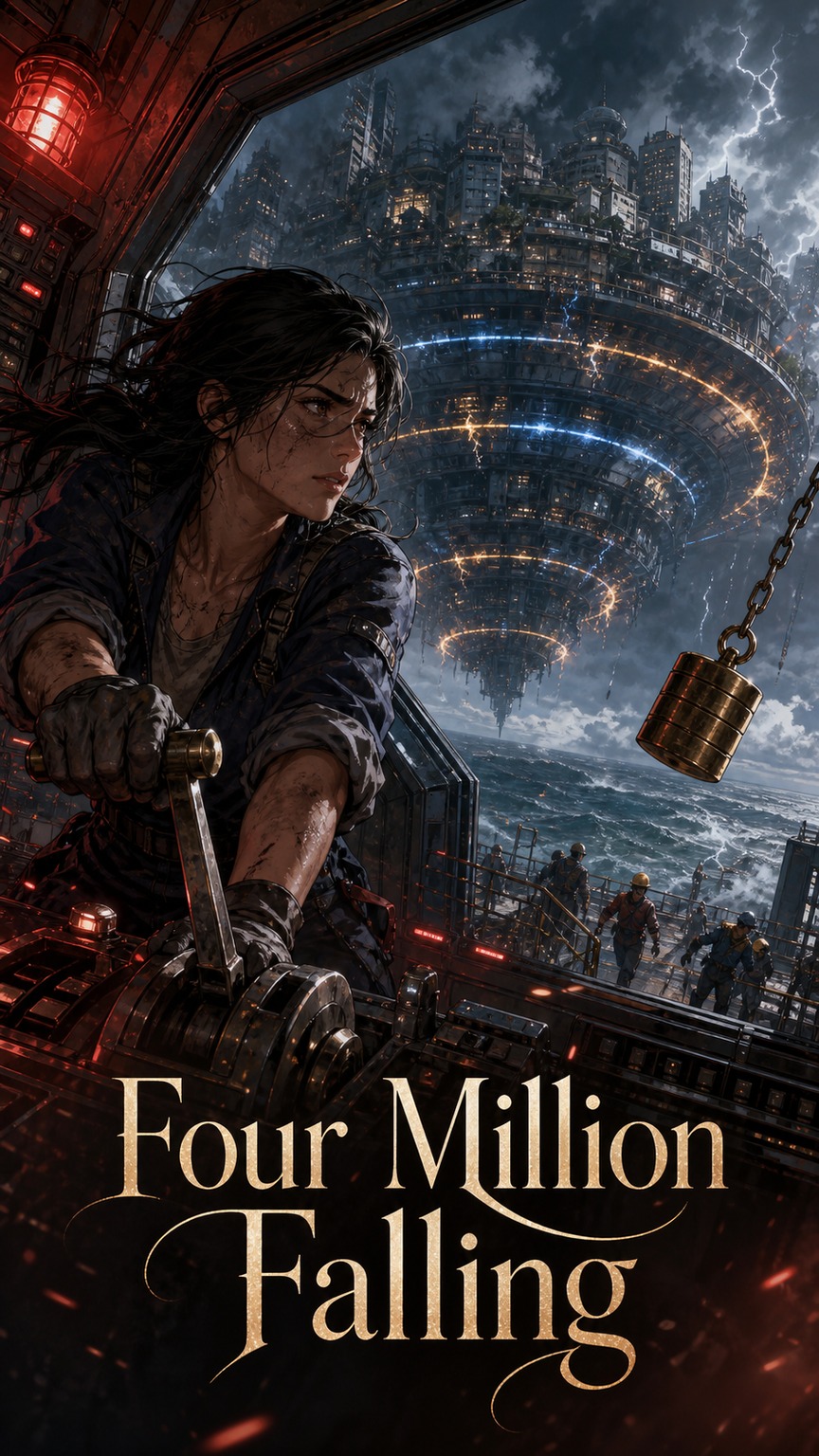
Four Million Falling
In a fantasy world much like our own, where magic has long since die out, the greatest wonder is a floating city that should not be possible. With over four million residents, it's ancient nuclear reactors are beginning to fail, and the results are catastrophic.
0:00
The cup moved three millimetres before the alarms began.
Inez Arco watched it creep across Chief Damas’s console, leaving a crescent of coffee on the old black surface. Above it, the calibration weight hung at half a degree from vertical. Half a degree was nothing in a city that crossed weather fronts. Half a degree during a routine load-transfer test meant the floor and the world had stopped agreeing.
Then Reactor Four’s board went red.
PRIMARY COOLANT PRESSURE LOW. SCRAM COMPLETE. TURBINE TRIP.
Inez was already out of her chair when the generator trace snapped flat. The isolation lamps changed from amber to green: commanded open. Current continued to pour across the common bus.
“Breaker Four is still closed,” she said.
Damas caught his cup before it reached the edge. “Confirm.”
“Four commanded open. No contact change. Bus current rising.”
The control room lights dimmed. Somewhere below the consoles, a relay began hammering fast enough to blur into a buzz. Reactor One vanished from the generation display, then Five. Three and Six followed so closely their alarms arrived on top of each other. Reactor Two held for two more seconds.
The floor dropped.
Not far. Perhaps the thickness of Inez’s hand before the lift rings caught the city’s weight again. Her knees knew, though. Four million sets of knees would know. Loose binders lifted and slapped down. Someone behind her shouted once.
“Authorize a bus retry,” Inez said. “If the breaker rail resets, I can bring a converter bank back before the rings coast.”
“No.” Damas’s voice stayed level because that was part of his job. “Arco, prove ring integrity. Reactor desk, confirm all scrams. Cooling desk, emergency trains by unit.”
“The bus is the source. Give me one reset.”
“Prove the rings.”
Procedure had become a wall, so she stopped pushing at it. Inez pulled the six generator phase traces across the lift board. Four’s trace had not simply died. It had broken into a violent comb, an arc reaching through damaged insulation onto the bus. Each remaining generator had fed the same fault until its protection tripped the turbine and shut its reactor down. The isolation commands had gone out. The old shared actuator rail, bridged last winter when replacement parts failed inspection, had opened none of the breakers.
The ring diagram steadied under her hands: six concentric bands, all intact, all losing stored field energy.
“Rings are continuous,” she said. “No converter input. We’re coasting.”
Damas looked at the vertical-rate estimate. It revised twice, settling as the stored fields weakened and Orison’s fall accelerated.
TIME TO LETHAL CONTACT: 00:51:08.
0:08
The bus-gallery camera showed a white scar where the copper spine had been. Smoke folded through the image until the lens disappeared.
“No restart to save,” Damas said. “Confirm.”
Inez hated confirmation loops when the answer was obvious. She hated more that they were useful. “Confirmed. Main bus physically destroyed.”
All six fission cores were shut down. Five had scrammed cleanly after the load rejection; Four had suffered a primary-coolant rupture, and emergency cooling on Two was cycling badly. None was exploding. None needed to. Their generators were gone, the lift converters were dark, and decay heat still had to be carried out of six ancient reactor blocks by pumps now competing for emergency power.
Orison’s phones woke together. Inez’s vibrated across the console with the civic alert.
LIFT INTERRUPTION. SHELTER IN PLACE ABOVE BLUE DECK. DO NOT USE TRANSIT. AWAIT DISTRICT ROUTES.
The population line beneath it read 4,083,612. A planning number, ordinarily. Water demand, school places, grain allotments. Now every digit had weight.
Reports crowded the side screens. Trains had braked in tunnels and platforms were filling faster than stairs could clear them. Three hospitals were on reserve power. The western shelter map showed twice its rated occupancy; eastern districts reported a southward slope, while the Low Keels reported north, because the city was flexing between rings. Fire crews needed priority lanes that no longer existed. Almost half a million people worked or lived below Blue Deck during the day. They had forty-three minutes to climb.
Inez opened the emergency generator diagram. “Cross-connect Unit Three’s black-start set to Converter Two. Six minutes at full output buys us nine minutes of field.”
“It buys the rings six at best,” Damas said. “And leaves Three without a cooling train.”
“Three scrammed clean.”
“Three is still hot. Four has one cooling loop. Two’s pump is hunting. The generators stay with cooling.”
She threw the calculation onto his board: megajoules, field decay, vertical velocity. “At least look at the gain.”
“I have. No lift recharge at the price of a damaged core.”
The refusal left no softer version of the same request. Inez closed her model. Five intact reactors had done what their protections demanded, and the city was still falling. She made herself look at what remained rather than what she wanted to restart.
“Then tell me what stored field we still own.”
Damas nodded once. The ring desk sent the numbers.
Inez ran them against current mass and contact speed. Then she ran them again with a lower final deceleration, enough to break windows and bones but not whole districts. The result did not improve.
“We can reach the sea alive,” she said, “if we lose twelve percent of mass.”
The Low Keels lit beneath the city diagram: freight vaults, reservoirs, sewage works, workshops, and stacked housing bolted below the oldest ring deck.
Paz’s clinic occupied Keel South Three.
0:17
There was no time to call her yet. That was the first lie Inez told herself.
She built the landing from forces she could still command. Clear the Keels upward. Fire their separation charges. Bleed the inner rings in sequence to keep the city level as mass fell away. Hold the outer two rings until the last minutes, then spend their fields in one deceleration pulse against the world’s magnetic field. The rings did not abolish gravity; they exchanged momentum while powered and held a finite charge when they were not. Once that charge was gone, there was no hidden reserve, ancient spell, or clever restart waiting beneath the numbers.
Damas studied her model. “Keep South Three. Drop the freight keels and the northern tanks.”
“Not enough.”
“Recalculate at fourteen metres per second contact.”
“I did. South Three drags the southern edge down first. Ring Four saturates correcting it, then we roll before contact.”
“Council authorization for inhabited separation requires projected loss comparison.”
“The Council has twenty-nine minutes to learn field balance.”
“Then give me something I can order without guessing.”
His calm finally cracked on the last word. Not much, but enough. Inez set the two descent curves beside each other. In the version he wanted, southern housing remained attached for eleven minutes longer. Then the outer rings exhausted above the sea, Orison struck nose-low, and the reactor quarter went under first. The other curve ended in a city-wide injury estimate and a permanent ruin, but it ended below the fatal line.
“All Keels,” she said. “Evacuation cutoff at thirty-four minutes. Separation immediately after.”
“Confidence?”
“Enough to act. Not enough to forgive us.”
Damas’s gaze moved to the green actuator commands that had never opened anything. “Not now, Arco.”
“My signature is on the bridge waiver. Individual breakers tested green. The common rail didn’t. I said thirty more days was an acceptable exposure. If you’re waiting for me to sound certain before you destroy those homes, this is why I sound certain.”
For one second, neither of them performed calm.
Then Damas keyed the command channel. “All desks, prepare full Low Keel evacuation and separation. This is not a drill. Route every available stair upward. Suspend equipment security and open maintenance passages. Confirm by sector.”
A voice from the emergency office asked whether the public notice should call the order a temporary clearance.
“No,” Damas said. Procedure had failed him; euphemism did not survive it. “Call it emergency jettison. Tell them the Keels will be lost.”
Inez’s model began counting down to the first ring bleed.
0:25
The passage to the manual sequencer sloped enough that Inez had to use the handrail. People were coming the other way: technicians carrying battery lanterns, two orderlies supporting a man with a bandaged scalp, a reactor worker stripped to an undershirt and shaking from exertion. Nobody asked her whether the city would remain in the sky. The public alert had answered that.
At the stair landing, an old mosaic showed robed magicians dissolving into gold dust while workers raised Orison above them. Every schoolchild knew the caption: When magic died, human hands built the greatest wonder. Inez had once corrected Paz for calling the lift rings enchanted. They were measurable, she had said. As if wonder and measurement were enemies.
She called.
Paz answered on the fourth attempt. Behind her came shoes on metal stairs, wheels knocking each riser, and someone counting to three over and over.
“You’re moving?” Inez asked.
“Forty-one patients, twelve staff, six neighbours who came in when the lifts stopped. Two beds won’t fit the south stair turn. What’s our cutoff?”
“Use maintenance stair K. It opens beside your pharmacy wall. Code six-zero-one.”
There was a pause, filled by the sound of a bedframe striking metal.
“Who else has that route?” Paz asked.
“You do now.”
“That’s not what I asked.”
“Paz, you’re losing time.”
“So are the dialysis ward and the nursery upstairs. Did you give them the code?”
Inez reached the sequencer door. Its battery lock was dead, and she had to shoulder it while entering the mechanical override. “The maintenance stair isn’t rated for a public load.”
“But it’s rated for your sister.”
The door gave. Inez stumbled into a low room where six manual ring controls curved around a window. The sea had risen visibly toward the city, blue and impossible beyond the glass.
“The Keels are being detached,” she said. Reassurance was another form of theft now. “South Three too. I can hold separation until minute thirty-four. I cannot hold it longer.”
Paz did not answer at once. The counting behind her stopped, then resumed farther away.
“How many stairs stay open if the deck tilts five degrees?”
“K and the central paired shafts. Avoid west crossways.”
“When do the lights fail?”
“They already might. Your phones should keep the route map.”
“Then broadcast K to the whole clinic block. Not just us.”
Inez opened the emergency route channel and stripped the maintenance restriction from stair K. Occupancy estimates jumped at once: hundreds diverting, then thousands. Too many for comfort, within the structural limit if they did not run.
“Done,” she said.
“Good. Hold us until the stairwell clears. Don’t promise anything else.”
“I will hold South Three until the stairwell clears.”
“Last bed is moving now.”
The connection broke before Inez could tell whether Paz had hung up or the network had.
0:35
The first Keel released cleanly. Its indicator vanished, and Orison rolled half a degree as thirty thousand tonnes fell away. Inez bled Ring Two east to correct.
The second release tore a freight bridge in half. Through the sequencer window, she saw a dark platform turn under the city, its cargo containers spilling in a slow glitter. It struck the Inner Sea seconds later. The impact rose as a white disk, then as sound through the city’s bones.
Keels North One and South Two followed. Warning boards reported fires where utility lines had failed to sever. A shelter stair collapsed in a district Inez could not see. The casualty field remained blank because nobody had time to count.
South Three stayed yellow.
LATCH BANK C: CLOSED.
The evacuation desk transmitted overlapping fragments: central shafts clear above Blue Deck; stair K traffic still moving; smoke in the west crossway; clinic group unconfirmed.
“Delay separation,” Inez said.
Damas answered through the command speaker. “Negative. Continue sequence.”
“South Three has a mechanical hold. I need evacuation confirmation.”
“Outer-ring reserve is falling faster than model. Release it.”
“Paz’s stair is in that sector.”
“I know.”
“Then give them another minute.”
“No minute available. You have nineteen seconds before Ring Four exceeds correction capacity. At zero, keeping that Keel risks the remaining city.”
She waited for the order. Damas did not give it.
“Your sequence,” he said. “Your call.”
The latch had no remote mechanical backup. The original builders might have known why; their diagrams ended at the housings, and every later generation had copied the gap. Inez could force current through the nearest inner-ring segment, far beyond its converter limit. The field pulse would wrench the attached structure downward and tear the latch out. It would also burn the segment open forever.
Twelve seconds.
She could hold the Keel and watch the southern mass overwhelm Ring Four. She could drop it with Paz somewhere inside. Another calculation would only spend seconds while pretending not to choose.
Inez armed the overload. “South Three destructive release. Ring Three segment south-six.”
“Confirmed,” Damas said.
She pressed both switches.
The current meter struck its stop. Heat pushed through the console into her palms. Outside, the skyline bent: towers, antennae, and the low roofs of a district that had always hung beneath her feet. A line of blue light flashed along the ring housing, electrical and brief. The stuck latch tore free.
South Three fell.
For an instant it remained level below Orison, streets and clinic windows small enough to cover with her hand. Then it tipped into the smoke from its severed utilities. Inez kept her hand on the dead switch until the indicator went black.
“Mass target achieved,” Damas said. No triumph entered the words. “Begin landing sequence.”
Inez spent the inner rings one at a time. Each bleed reduced their stored field and slowed the growth of vertical speed; each correction bought level at the cost of the final pulse. Orison groaned as loads found paths no designer had intended. The sea filled the window. Rescue vessels below scattered from the city’s shadow, leaving white wakes that looked motionless at this height.
Ring Two’s western switch froze halfway.
The city rolled. Cabinets burst open. A drawer crossed the floor and struck Inez’s ankle. Instrument tilt said four degrees, then six, but its sensor had lost power and continued reporting six while the horizon climbed.
She stopped trusting it. The visible sea was level. Orison was not.
“Burn east-five,” she said.
“That is our second permanent loss,” Damas replied.
“If we don’t, the outer rings spend themselves fighting roll.”
“Approved.”
She overloaded Ring Two’s opposite segment. A bang sounded somewhere deep in the structure. The horizon slowed, held, then settled almost straight across the window.
At minute forty-six, outer-ring telemetry corrected itself.
Not enough reserve.
The field estimate had been borrowing a failed temperature sensor, reading the outer conductors colder and more efficient than they were. Inez had three minutes of gentle braking on paper and less than one in metal.
“We can stretch the pulse,” Damas said. “Keep ten percent for contact and buoyancy support.”
He had shifted to bargaining because command could not change the charge meters.
“A stretched pulse leaves us at twenty-one metres per second,” Inez said. “The lower decks won’t survive.”
“No reserve means the city settles with full weight.”
“The sealed ring trunks may float long enough for boats. They won’t matter if impact splits them.”
“Contact speed?”
She shortened the pulse window until the line crossed survivable. “Eleven, if the field holds.”
The civic channel filled with shelter confirmations. Millions crouched in schools, offices, stations, and reinforced corridors. There was no room to move them now, only time to tell them what was coming.
Damas keyed the public line. “Brace. Final deceleration in thirty seconds. Impact will follow. Stay away from exterior walls.”
Inez set both outer rings to discharge together. No field remained in the inner pair she had burned, and none would remain in the outer pair after this. Orison would never hover on these rings again.
Ten seconds. The sea lost detail until it became a single hard surface.
Five. She locked her elbows around the console rail.
At zero, she spent the wonder.
The field took hold through the floor, a pressure in her teeth and spine. Vertical speed fell. Displays died one by one as the battery bus collapsed under the switching load. The horizon stayed nearly level.
Then Orison hit the Inner Sea.
Water erased the window. The first impact drove Inez to her knees; the second threw her sideways as the city settled unevenly. Metal screamed below. Glass burst somewhere behind her. Cold water punched through the door seam, climbed to her wrists, and stopped.
For the first time in its remembered history, Orison was no longer falling.
After
The control room canted seven degrees to the south. Inez knew because the battery inclinometer had revived, but she checked the horizon anyway.
The window was cracked and half above water. Smoke trailed from two lost districts. Steam rose from the reactor quarter where emergency cooling continued on local generators. Four’s damaged loop still demanded work; a contamination boundary would have to be drawn across part of the sea. Below Blue Deck, water moved through streets built for rain but never tides.
Damas sat against a console while a medic wrapped his forearm. “You’re finished here, Arco.”
“Ring trunks?”
“Three flooded. Two holding. One uncertain. Boats are approaching from windward.”
The first rescue craft could take hundreds. The next wave, thousands. Orison had held 4,083,612 residents that morning, plus visitors nobody had counted. Moving the survivors would take days if the weather stayed kind. Feeding them on a dead city would begin before that. None of them had a home that could rise again.
Inez tried to stand. Her left ankle refused her weight.
“Sit,” Damas said.
“I can bring up the shelter ledger.”
“No console. That’s an order.”
She almost argued that work was rest if the alternative was waiting. The lie had worn thin.
“Did the clinic stairwell clear?” she asked.
Damas looked toward the emergency desk. He did not soften his face before answering. “Partial receiving list came through Central School. Paz Arco arrived with thirty-seven patients and nine staff. Four patients and three staff from the clinic group are still unlocated. Other names are coming in.”
Relief hurt differently from impact. It did not restore South Three. It did not fill the blank casualty fields or lift the freight workers whose platform had struck the sea first. It only gave Paz back to a world that now required somewhere else for her to live.
Outside, responders had stretched a rope along the tilted avenue. People passed water, bandages, and children hand to hand toward the rescue boats. Above them, the old school mosaic had broken along its caption. The golden magicians ended at the waterline; the workers raising Orison were gone beneath it.
No magic arrived to dispute the lesson. No dormant power lifted the city. The rings were burned and empty, the reactors shut down, and the sea kept what had fallen into it.
Inez took a place in the line. Her ankle shook each time she accepted a water tin, so the woman beside her shortened the distance without comment. Farther down, someone called for room for a stretcher, and the line opened, then closed again.
The horizon lay level at last. Against it, Orison rested crooked, terribly still.