Friends of the Night
While your predecessors were busy hunting the beasts that hid in the shadows, you decided to befriend them. And when war came to your lands, your enemies found their armies shrinking in the night.
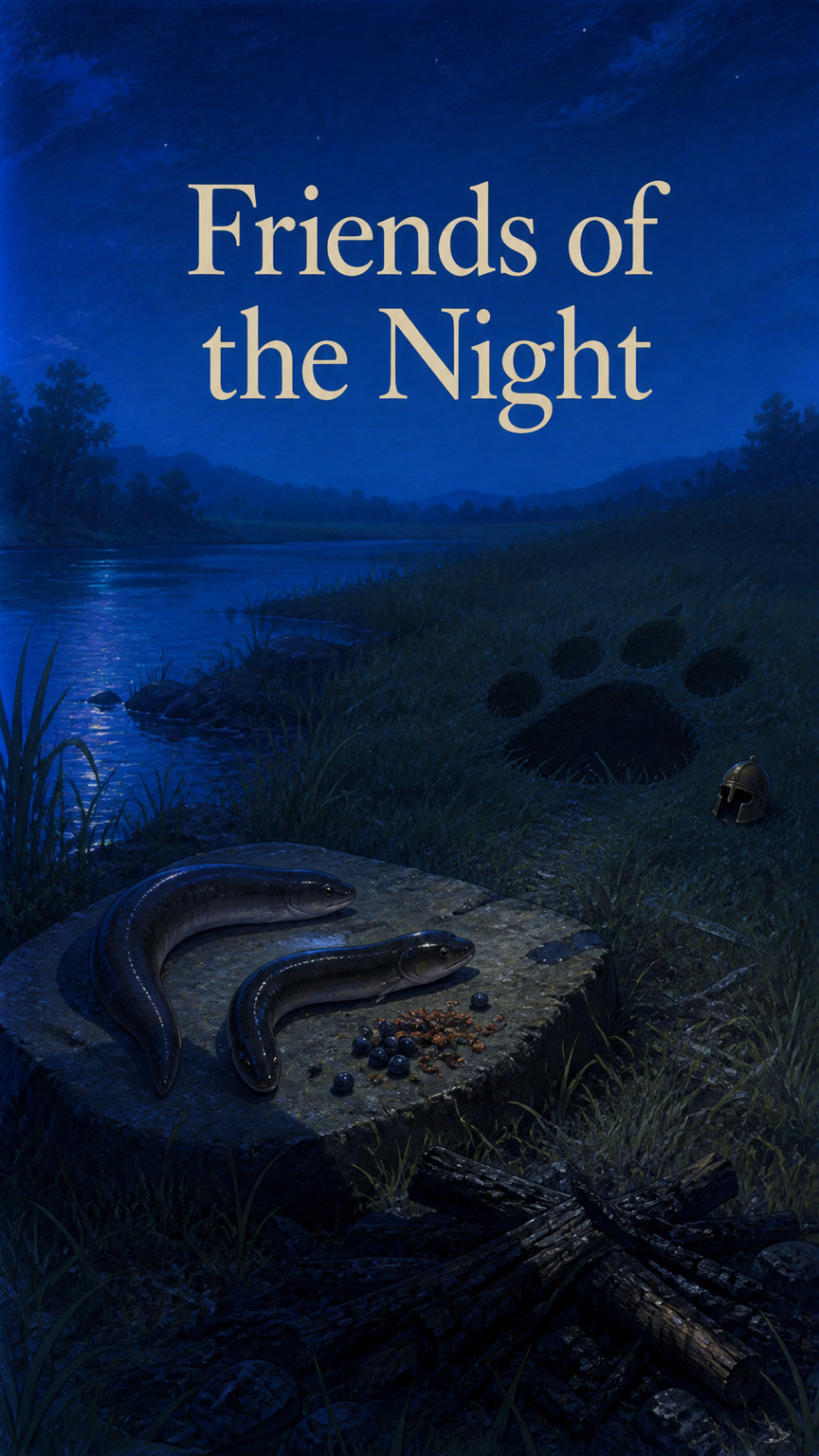
At sunset I set two river eels on the flat stone and backed away twelve paces.
Crooktail watched from under the hazels. I knew it by the right angle in its tail and the pale seam along one forepaw, though neither mark showed until it chose to move. Shadow beasts were not made of darkness. They had ribs, burrs in their fur, mud between their broad toes. Crooktail even sneezed when the hazels flowered. But its coat held so little light that my eye kept losing the edges of it, and when it lowered its head the ground seemed to open a mouth.
For six years, this had been our measure. I brought eels or a hare’s liver. I struck the stone once with a hazel switch. Sometimes Crooktail ate while I sat nearby. Sometimes it left me to the flies. Once it had followed me almost to the lower gate, pausing whenever I turned, and for a month afterward I had called that proof of friendship. Then I learned that a slaughterhouse cart had dripped blood along the same road.
That evening it did not look at the eels. Its ears had turned toward the western rim.
Drums came over the ridge, softened by distance but too regular for thunder. One by one, points of fire appeared above the barley fields. They multiplied down the road until the rim of Shalegate looked stitched with red thread.
Crooktail withdrew under the hazels. The brush gave one dry shiver, then nothing.
“Tavik!” Torma called from the fort wall. “Inside. Now.”
By the time I reached the gate, the western host had begun pouring into the valley: pikes first, then wagons and horse, all taking their places with the dull competence of people who expected to sleep on conquered ground. Torma stood above the arch in a boiled-leather coat, counting standards. Beside her, Denek was unhooding the east beacon.
“Leave that covered,” I said.
Denek did not turn. “A dark wall is an invitation.”
“A high flame will throw every sentry’s shadow across the beast runs.”
Torma leaned over the parapet. “How far?”
“On level ground? Thirty paces, perhaps more. It depends on the flame and where they’re moving.”
“Can you keep them off the wall?”
“No.”
She waited. Torma had a way of leaving silence open until a weak answer walked into it and died. I gave her no second answer.
“Light the beacons,” she said. “Double water beside each. Tavik, mark every run you know. Denek, keep the lower ward off them.”
The old keeper struck flint. “That was always the rule.”
Pitch caught with a greasy cough. Light vaulted over the inner roofs, and our shadows sprang westward along the wall.
The first man shrank before the enemy finished pitching its command tent.
He was an east-wall sentry carrying a bundle of quarrels. One moment his boots thudded above me; the next came a small metal clatter, no louder than a dropped cup. I found him hanging from the drain groove in the wall walk, his fingers hooked over its edge. He, his coat, his sword and the bundle on his back had all dwindled together. I could have covered his body with both hands.
“Don’t pull,” he gasped as I reached for him. “The buckle’s caught.”
That was our first good fact: the change had not hurt him, and fear had not taken his sense. I freed the buckle with my knife and lowered him into my cap.
Below the wall, Crooktail stood on the bare run with its jaw closed around the sentry’s long black shadow. There was no tearing, no blood. The shadow narrowed between its teeth like cloth drawn through a ring. Then Crooktail released it and vanished under the thorn fence.
A shout rose from the enemy’s near pickets. Another followed, farther south. Torches moved, stooped, scattered. By midnight our scouts had brought in five diminished soldiers they had found struggling through grass that reached their shoulders.
One of Torma’s spearmen looked down at the captives. “What do we do with these?”
“Get a bread tray,” I said.
“I meant after.” His boot shifted closer.
Torma caught the back of his belt and hauled him one step away. “After, you obey the law. Bread tray.”
The captives were cold, furious, and too frightened to sit still. We put the east-wall sentry with them because he refused to be carried alone. Under shielded lamps, which cast no useful reach for a beast’s jaws, I checked each of them. Armor rivets, scabbards, bootlaces: all reduced in proportion. A picket’s dropped torch had remained full-sized where it fell.
“How do you undo it?” Torma asked.
“The shepherd boy who shrank three winters ago recovered beyond the north ledge.”
“That boy was delirious.” Denek folded his arms. “He told us a moon spoke to him.”
“The moon did not return his height. Distance did.”
“You hope.”
“I observed.”
Torma pointed to the friendly sentry in my cap. “Take him to the ledge. If he grows, come back before dawn. If he doesn’t, keep going.”
The north path stayed behind the fort and climbed out of the beasts’ feeding range. Denek came with me, a spear in one hand and the tiny sentry’s bundle in the other. He repeated the old rules as we walked: flame high and close, stone underfoot, no reaching into brush. I knew them. I had learned them from him before I learned how many beasts his drives had killed.
At the third boundary cairn, the cap jerked in my hands. I set it down just in time. The sentry unfolded out of it, first the size of a child, then of a man crouching naked in the cold, except that his clothes and gear were growing with him. His sword knocked over two stones. Denek jumped back and leveled the spear.
The sentry lay panting on the path. “Can I stand now?”
“Try your left foot first,” Denek said.
He could stand. He was hungry and shaking, but whole.
On the way down, Denek carried the cap.
At noon, Torma met the invaders under a white shield hung from a pike. She took me because I knew the beasts, and Denek because he knew when I mistook a wish for a fact.
Marshal Drost arrived with six guards and a clerk. He wore bronze scales over blue wool. The guards wore no open flame, and all of them watched the grass. Behind them, soldiers were raising siege frames while carpenters measured our gate.
“Six pickets are missing,” Drost said. His voice still had ceremony in it. “You will return them and remove the affliction.”
“Five are inside,” Torma said. “The sixth ran west after he changed. We did not catch him.”
Drost looked at me. “You are the keeper.”
“I keep people from crossing the runs. I don’t keep the beasts.”
“Then you have failed at the smaller task.”
“You brought twelve hundred open flames into their range.”
His clerk glanced down at the tablet before him. Drost did not. “One thousand eight hundred and forty-two. Your wall has perhaps four hundred fit defenders.”
“Four hundred and six,” Torma said. “All behind stone.”
I crouched and drew the valley in the dust: fort, barley fields, western road, outer ridge. “Put out the fires. Withdraw on this road. Beyond the ridge, your people recover.”
“You have tested that?”
“One man, northward.”
“Your man.”
“The beasts caught him under our beacon. They don’t know your colors.”
For the first time, Drost looked toward the wall instead of through us. Then he wiped out my road with the toe of his boot.
“Nets at every fire,” he told the clerk. “Two handlers to each. Widen the fire lines by dusk.”
“Longer shadows give them more to reach,” I said.
“And more light gives my handlers something to see.”
Torma lifted the white shield from the pike. “Your five soldiers will be set outside the south gate at sundown. That is the last courtesy you get in my fields.”
We walked back without speaking until the gate shut behind us.
Denek stopped under the arch. “He is doing what we did.”
“You used hounds and hooked poles.”
“We used beacons first.” He rubbed his thumb along the old spear shaft. “Beacon nights pulled the beasts toward the outer houses. Shadows crossed beds, cradles, doorways. People ran small into winter rain. We killed the beasts because we could not move the wall.”
I had heard the death counts. I had dressed them in my own explanation: frightened keepers, ignorant hunters, an easy cruelty inherited as custom. “You told me they came into the houses.”
“They did. After our light laid a road to them.”
“And you kept lighting it.”
“There were raiders then too.” Denek looked up at the blazing east beacon. “Darkness never promised to spare us, Tavik.”
Neither had Crooktail. That was the part I had made soft in my mind.
When I took Denek’s post, I shuttered the house lamps, moved slaughter scraps away from the lanes, and cut new runs toward the stream. The drives ended. No resident had shrunk in six years. I had called that friendship because I needed a word better than truce and warmer than successful drainage.
The second night showed me the limit of all three words.
Drost’s bonfires made noon-colored islands across the valley. Each soldier standing near them cast a black road forty or fifty paces long. Nets lay open beside the flames. At first the handlers laughed when small shapes flickered at the edges. Then the shapes crossed between fires, and men began dropping below the line of shields.
A pike company collapsed unevenly as shadows passed over the south run. One soldier dropped to knee height; another dwindled until the grass hid him. Their clothes and weapons changed with them, but the ladders they held did not. Timber crashed. Horses reared above riders suddenly too small to manage reins. Orders broke apart into names and warnings.
From the wall I counted seven beasts. Then ten. Then I found the crook in one tail.
Crooktail had entered a net beside the largest fire. The handlers dragged the corners tight and pinned them with hooked stakes. Crooktail rolled, silent, while flame lit the pale seam of its paw. Every struggle wound the mesh closer around its throat.
“Open the lower gate,” I told Torma.
“No.” She was moving archers away from the long beacon shadows as she answered. “That camp is folding without us.”
“The beasts are trapped between their fires and ours. Douse the wall. Give them dark to leave through.”
“If I douse it, I lose the barley approach.”
Another ladder fell in the camp. Someone screamed for water; someone else screamed not to bring a torch.
Denek joined us at the parapet. “No dark gate during siege,” he said. “Keep the flame high. Keep stone under your feet.”
“Can you reach that net?” Torma asked him.
He watched the fire, the ditch and the folds of ground between. His lips moved once, repeating distances. “By the old drive path. Two men, no lamp.”
“Take Tavik.” She turned to the beacon crews. “Hood the east. Then the south. Lower gate opens one body wide, and it shuts behind them.”
The wall went dark in sections. Each vanished beacon erased a row of roofs, then joined the space between fort and field into one deep black. Wind carried sparks from Drost’s camp, but the beasts now had somewhere the long fire-shadows did not reach.
Denek and I slipped out.
He led without hesitation. “My shoulder,” he whispered. “Stay level with it.”
“I can see the ditch.”
“Good. Don’t step in it.”
The old drive path bent through thorn gaps I had never noticed because Denek’s hunters had cut them to funnel fleeing beasts. Twice he put a hand against my chest and stopped me before a shadow swept across us. Once a diminished soldier blundered into my shin and clung there.
“Road west,” I whispered, turning him by the shoulders. “No fire.”
He stumbled away without answering.
At the largest bonfire, the world became glare and hard edges. Crooktail’s net was fixed to four stakes. One handler had shrunk inside his own loop of rope; the other had fled. Denek crawled behind a supply chest, reached the first anchor and sawed through it with his belt knife.
I smothered a fallen torch under my coat. The shadow attached to Denek’s hand vanished an instant before a beast snapped at it.
“That’s one,” he said. His voice was steady, but he cut the next rope too fast and nicked his thumb.
The net loosened. Crooktail twisted, baring teeth no darker than ordinary teeth. Mesh still cinched its hindquarters to the last two anchors.
Boots approached from the fire side. At first I expected a child. Then I saw the bronze scales, each one reduced to the size of my thumbnail.
Drost stood no higher than my shoulder. Two guards flanked him, one scarcely reaching his waist. Rank had not left his face, but ceremony had.
“Three hundred eleven changed,” he said. “Forty-eight cannot clear the wagon ruts. Seventeen are missing. How long?”
“Until they cross the western ridge.”
“How long until more change?”
A shadow beast worried at a darkness stretched from the far fire. A soldier beside it dropped below the height of the supply chest.
“As long as you make those shadows,” I said.
Drost looked at the net. “This one leads them?”
“No.”
“You feed it.”
“It comes when it chooses.”
“Then why are you here?”
The final rope creaked as Crooktail strained. Denek shifted his knife into a stabbing grip, not toward the beast. Drost noticed.
“Because I know this one,” I said. “Cut that anchor, put out every fire, and I can mark your road. Torma can keep our bows on the wall. Those are the pieces I have.”
“No guarantee?”
“The boundary restored our sentry. I won’t promise what the beasts do between here and it.”
Drost’s smaller guard raised his spear. “Marshal, we can take them.”
“You can reach his knee,” Drost said. “Lower it.”
He drew a short bronze knife, stepped onto the loose edge of the net and cut the last anchor himself. Denek severed the remaining cord. Crooktail came free in a rush. It struck my shoulder, knocked me into the ash and crossed the firelight without looking back. The other beasts followed its movement only because open ground had appeared ahead of it, a scattering of black bodies choosing the same dark.
Drost watched them go. “Take me to your captain.”
Torma would not open the gate for him. She spoke through the waist-high wicket while Drost stood outside with Denek and me. A shielded lamp inside gave her enough light to see our faces and threw no shadow past the threshold.
“Engines stay,” she said. “Pikes stacked in the west field. Every open flame out. Your first file moves before the next dusk is gone.”
“I have three hundred eleven diminished and seventeen uncounted.”
“Find them by daylight.”
“I need two wagons for those who cannot keep pace.”
“Take wagons. Not towers, rams or throwers.”
“My host does not leave its sidearms.”
Torma considered that. “Sidearms stay sheathed until you’re past the ridge. One drawn blade, we close the road.”
Drost’s jaw tightened. “Your archers could cut us apart at the boundary.”
“They could cut you apart now.”
“Not before my full-sized ranks reach your gate.”
“Then we’re both still counting.” Torma bent to hear a report from someone behind her, answered it, then returned. “You get one daylight. No fire tonight, no fire tomorrow. Departure at dusk.”
Drost did his own counting in silence. Supply intervals, walking speed, the time needed to lower the siege lines without flame: I could see the numbers replacing anger because numbers were ground he trusted.
“At dusk,” he said.
The third day passed under a pale sky. Drost’s soldiers dismantled nothing they could not carry. They left the siege engines standing like stripped trees and stacked pikes in the barley. Torma’s archers watched from the dark wall. Some asked why we did not fire while the enemy was broken below us.
“Because I said hold,” she answered each time. No speech. No appeal to mercy. The order was enough, and she kept giving it.
Denek and I marked the western road with a waist-high rope. Where it forked near the burned hazels, we closed the wrong branch with carts. Drost sorted his diminished soldiers by pace. Those unable to cross wagon ruts rode in blanket-lined grain beds, guarded from wheels, boots and horses. No one laughed. At that scale, a dropped buckle was weight enough to break a foot.
Near sundown, Denek found a collapsed den beside the south fire line. He knelt, put his ear to the earth, and began clearing the entrance with his hands.
“We have to finish the rope,” I said.
“The rope is visible.”
“Not after dark.”
He pulled out another fistful of scorched soil. “Then stop talking.”
I dug beside him until we uncovered a narrow breathing space. Nothing came through it. We went back to the road.
The host began moving when the last rim of sun left the ridge. Their fires stayed cold. Shielded lamps hung inside three wagons, enough for officers to read tally boards but not enough to lay a shadow across the fields. Everyone else followed the rope by touch.
Darkness took away the shape of the army. I heard it instead: boots scuffing, harness rings, wheels easing into ruts, Drost’s officers calling intervals. The smallest files made almost no sound. Torma’s defenders heard them too. Bows creaked on the wall whenever a horse shied or a cart struck stone, and each time Torma said, “Hold.”
At the burned hazels, one soldier struck flint beside a tangled wheel trace. Three people shouted at once. Drost reached him first and knocked the tinder into mud.
“Use your hands,” he said. “Lift on three.”
There was no threat in it, only the next necessary thing. Six soldiers lifted; the wheel came free. The file moved.
I walked beside the rope until the land rose toward the western boundary. Denek stayed at the fork, repeating the same directions to anyone who lost the line: right hand on rope, carts to the left, ten paces before the cairns. He had spent half his life teaching frightened people how to move through beast country. The purpose had changed. The rules had not.
Restoration began beyond the first cairn. A larger diminished soldier carrying a child-sized comrade cried out as both bodies grew against each other; they had crossed too close together. After that, Drost widened the intervals. Men and women emerged from the dark at mismatched heights, staggered as boots and limbs returned to them, then moved on before the next file arrived. Armor expanded with low clicks of settling plates. Swords stayed sheathed.
Drost crossed near the end. At the boundary he grew from my shoulder height to his full stature in three unsteady steps. He braced one hand on the cairn until the dizziness passed.
“Seventeen?” I asked.
“Fifteen found. Two absent.” His eyes remained on the moving files. “One thousand eight hundred and forty alive at last count.”
“Keep them beyond bow range.”
He gave a tired, irritated motion that might have been agreement or dismissal. It was enough. He went after his army.
By dawn, the last wagon had crossed the ridge. Torma’s people collected the abandoned pikes and posted watches around the engines. Drost’s host continued west, and its rear guard did not turn before the road bent out of sight.
The valley smelled of wet ash. Three dens had burned. At the south run, Denek found tracks entering the breathing hole we had cleared, though none came out while we watched. One beast was still missing. Crooktail’s tracks crossed the fort road twice and ended at the stream.
Torma put the carpenters on the gate and went to argue about grain stores. Denek returned to the collapsed den with a shovel. I carried a new flat stone to the feeding hollow and settled it into the scorched earth.
Near midday, Crooktail appeared beyond the hazels. A band of fur had been rubbed raw around its hindquarters. It watched me tap the stone level with the butt of my knife.
Denek glanced over from the den. “Left edge is high.”
“I know.”
“Then fix it.”
I wedged a chip beneath the right edge. When I looked up, Crooktail had crossed our old twelve-pace measure. It stopped on the near side of the stone, close enough that I could see ash caught in its whiskers.
I set down the eels. Crooktail did not retreat, so neither did I.