
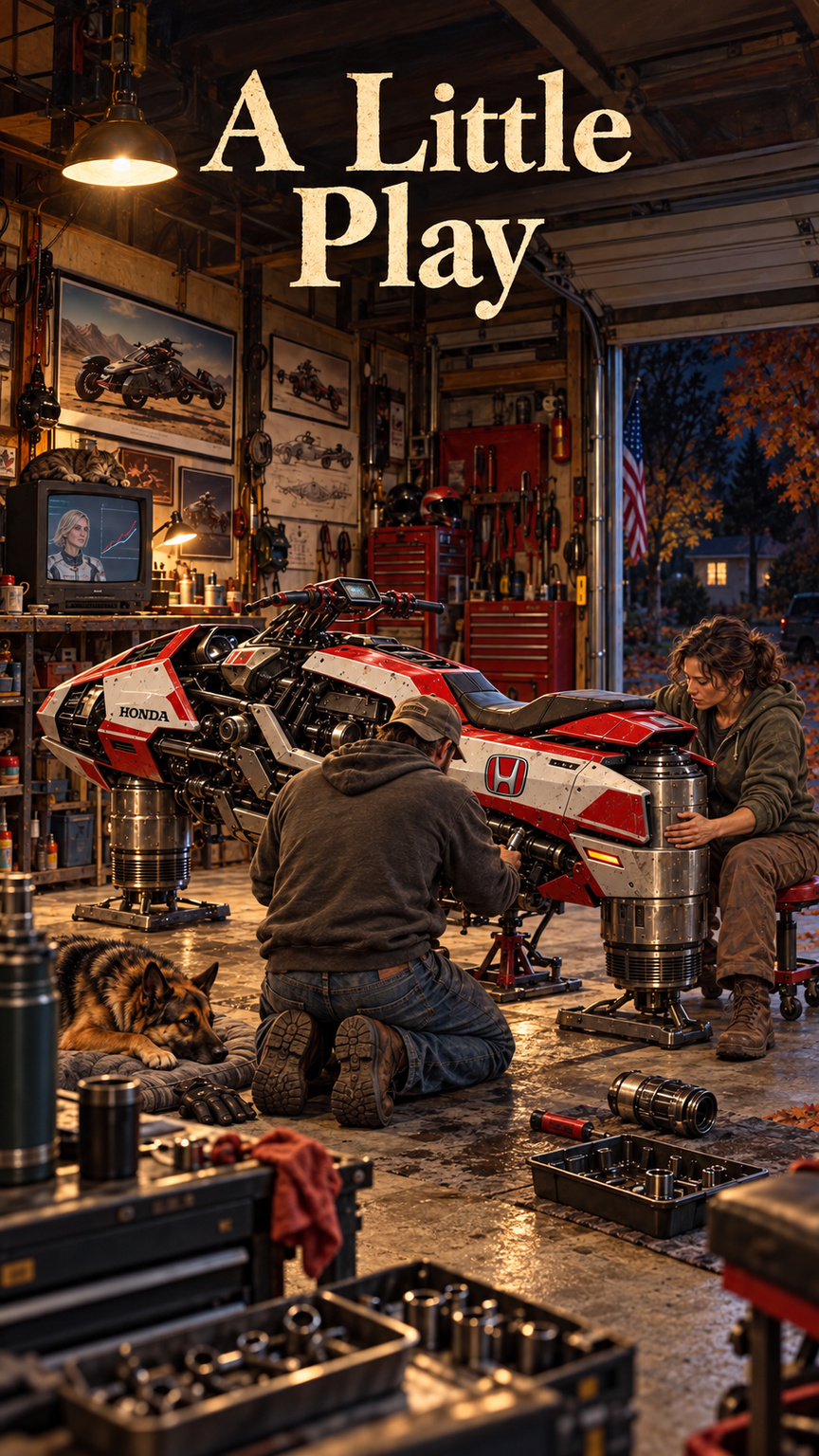
At eleven the night before the world final, the dog brought me my riding glove.
He set it beside my knee, put one large paw on it, and looked at the open garage door. For six months I had been leaving with the glove and coming back several days later. He had worked out which part needed hiding.
“You and me both,” Cora told him.
She was sitting backward on the mechanic's stool, holding the rear lift pod while I tightened its new damper. The pod was the size of a beer keg. Once it had kept the back end of a warehouse tug off the ground. Now, with the front unit, it supported a red-and-white racing bike that stretched from our workbench almost to the door.
The right fairing had come from a Honda touring motorcycle. I had cut around the badge. Under it were a delivery van's steering joints, a starter motor from the last shop I worked in, and things I had made three times before getting them right. The factory race teams built their machines around their engines. We had built ours around what would fit through the garage door.
Cora rocked the pod sideways. The damper resisted her.
“More?” she asked.
“Try it now.”
She pushed harder. The stool rolled away beneath her, and she nearly went onto the dog.
“That's less play, all right.”
“You could have stood up.”
“You could have invented something that takes one person to hold.”
She got her feet under her and pulled the tail across again. It came back toward the frame smoothly, without the last loose waggle. Beautiful. I watched it twice more.
On the television, muted above the workbench, someone was pointing to an animated version of our bike. Their artist had left out the crooked exhaust shield. A graph appeared beside it, followed by Saskia Renz in her silver Asterion leathers. Seven championships. Behind her, a whole wall of engineers watched other walls of screens.
Our tabby was asleep on the television's warm casing, with her tail across Saskia's face.
“Did you see her practice?” Cora asked.
I nodded.
“She's closing that inside line earlier.”
“I saw.”
“I know you saw. I'm asking what you're going to do about it.”
I reached for the damper adjuster.
She caught my hand.
“We test it first, Wes.”
“That's what I was going to say.”
She kept holding my hand until I looked at her.
“In the morning,” I said.
Outside, a leaf scraped down the driveway. The television showed the six finalists beneath the championship cup. I was the one whose entry photograph had been taken against the garage door. Cora had made me put on a clean shirt, then taken it from the collar up because there was oil on that one too.
Tomorrow, one of those six people would win the Crown. The season's points had got us into the final; they would buy us nothing once the lights went out.
I took the glove out from under the dog's paw. He sighed, leaned his weight against my leg, and forgave me before I deserved it.
*
Six months earlier, at the first technical inspection, a man in an Asterion jacket had asked where the rest of our team was.
Cora had looked up from the crate we used as a desk.
“Parking the trailer,” she'd said.
He waited for her to laugh. When she didn't, he looked at the bike again.
I understood. The front fairing was a different red from the rear. The lift ducts had been designed to carry sacks of grain, low and slowly, not a person who wanted to do three hundred through a hole in the air. On the handlebars, one switch still had a little picture of a van's heated rear window.
I had been flying it after work for two years on the abandoned quarry course. I had a competition license, a qualifying time, and the required safety gear. I also had twelve certified structural welds with a total invoice that made me feel sick. None of that was visible.
The man said, “Well, let's see if it flies.” Someone behind him laughed, then someone else did.
It flew. It finished nineteenth.
In the second race I led for fourteen seconds before cooking a front bearing. In the third I came seventh, and our prize money covered the bearing, the trailer tires, and a motel room without a coin meter on the air conditioner.
By then the teams had noticed how the bike turned.
Their big lift racers steered like aircraft, swiveling the thrust and carrying the frame around with it. Ours could bend a little in the middle. Turn the bars, and the front pod pointed us into the corner while the rear was still following. We could change direction without first persuading the whole long machine to change direction with us.
There was a price. After a hard turn the tail wanted to keep swinging. I gave it a little opposite correction to bring it into line, waited until the seat stopped tugging sideways under me, then opened the throttle. By then the factory machines were straight and gone.
But on a course with one turn coming straight after another, there was no straight for them to be gone down.
We won at Esker. Cora dropped the timing tablet, broke the screen, and spent the first minute of our first victory saying she could fix it.
We won again in the rain at Serrat, where Saskia finished less than a second behind me. She came over afterward and asked if she could look at our steering. I said yes. She got right down on the wet concrete in her expensive leathers.
She didn't ask where the rest of the team was.
They had a billion-dollar budget, three major sponsors, and an engineering department. Three rounds later, Asterion brought out a racer whose front and rear pods moved separately. It didn't look like ours. It was elegant, the pivots tucked inside the frame, and it was very fast.
“Bastards,” I said, admiring it.
Cora was watching their mechanics remove a panel.
“They've made that rear bearing easier to get to.”
On fast circuits Saskia beat me thoroughly. On the tight ones we made her work. She learned where I liked to pass. I learned how late she could brake, which was later than seemed appropriate for somebody with dependants, sponsors, or a central nervous system.
The laughing stopped somewhere in there. I missed it occasionally. People who laughed at the bike weren't trying to work out how to beat it.
*
The final was at Marrowfield, forty minutes from home. Beyond the old airfield, gates climbed the grassy escarpment and came back down toward a grandstand that had taken two months to build. From our driveway you could see the red obstruction light on the highest gate. For those two months I had been checking it on my way to the bins.
At morning shakedown the airfield smelled of wet grass and hot batteries. Our assigned bay was a white rectangle on concrete. Across the lane Asterion's mobile workshop stood open, bright as a hospital. A mechanic was laying clean tools on a trolley, each one already where his hand would want it.
I used to work like that. A good shop was a good shop.
Cora connected our battery cart and fastened my helmet strap where it always snagged on the collar.
“Four soft, four stiff,” she said. “No hero laps.”
“There are six thousand people over there.”
“Then eight people will know you're testing a damper and five thousand nine hundred and ninety-two will be bored.”
On the soft setting the bike was itself. Over the hill, between the paired high gates, down past the grandstand. The last two gates made a sharp left followed quickly by a right, then put you onto the long finish straight. I swung the nose through the left, caught the following tail, and flicked right. Through the final frame. Straighten. Wait. Power.
The red obstruction light disappeared behind my shoulder. The straight unrolled beneath me.
Cora gave me the time. We did three more.
Then she tightened the damper.
The first turn felt as if someone had put a hand across the bike's back. It resisted the bend; I had to start earlier and leave more room. At the left-right pair, the nose cleared and I made my little correction. The whole machine twitched the wrong way. I chopped the throttle and missed the middle of the next gate by an embarrassing amount.
“What was that?” Cora asked.
“Me.”
The rear had already come into line. I had given it a correction it no longer needed.
Next lap I felt for the sideways pull through the seat. A smaller pull, finished sooner. I held my hands quiet where they wanted to move, turned into the right, and opened the throttle. The bike pulled cleanly out of the pair.
I was faster out of the last pair and slower round the tight high gate. The full-lap times were too close to call, and a light wind had come up during the last run.
Back in the bay, Cora showed me the times on a tablet with a crack through the middle.
“Soft,” she said.
I kept looking at the last sector.
“You know it,” she said. “You can put it anywhere. We didn't build a fast-straight bike.”
“She's not letting me put it anywhere.”
Cora moved the graph away from the crack.
“She'll leave something.”
“Yes. Whatever line she leaves me, I want to get on the power sooner.”
She watched me for a moment, then turned the tablet off.
“Stiff?”
I nodded.
She crouched beside the pod and set it. I stayed there until she finished, holding the tail for her.
As we pushed toward the grid, Saskia came out of her workshop. Her hair was still wet from the shower. I had a crease across my forehead from the helmet liner.
She glanced at the rear pod.
“New?”
“Adjustable.”
“Ah.” She looked up at me. “How are you finding it?”
“Ask me in an hour.”
She smiled. “I'll try to remember.”
*
Six bikes hung above their grid marks, supported on columns of hammering air. Mine shook at idle. Cora stood clear of the ducts with both hands over her headset. Through my visor I could see her lips moving as she counted something on the tablet.
“Radio?” I said.
“Yes.”
“You going to say anything?”
“I'm busy.”
“All right.”
Then, just before the first light came on: “Get it round, Wes.”
Eight laps. Behind the grid the grandstand was on its feet, and beyond it my garage was forty minutes away, with a glove-shaped patch of dog spit drying on the bench.
The lights went out.
For a second we were all level. Then the factory machines accelerated and their exhaust hammered my chest. I held full power, elbows in, while the pale concrete streamed backward below my boots. Saskia reached the first gate ahead. I was fifth, with a black bike close enough on my right that I could see the rider's forefinger hovering over the brake.
He moved across to claim the turn. I let him. The gate climbed the slope; his heavier machine needed a little longer to lift its nose. I tucked under his line, pulled through the frame, and came out fourth, the grass blurring below me.
The stiffer tail held the machine almost straight. Too straight. The next gate approached on my left while I was still asking the front pod to turn. I had to lift and go wide. The black bike came back past, and its wake slapped my knee.
“Clear behind,” Cora said. “Four tenths to black.”
Over the hill I stopped trying to make the turns as small as yesterday's. I gave the bike room. It felt wasteful, hanging out beyond the line I wanted while another racer occupied it. But I came through the high gate with both lift units pulling in the same direction and recovered most of the gap on the descent.
At the left-right pair the black rider braked hard for the first gate. I had seen him do it in qualifying. I stayed back, crossed behind his tail, and went through the right beside him. We were level as the straight began.
His extra power took him ahead again.
I wanted to reach down and turn the damper soft with my bare fingers.
“He lost six tenths over the hill,” Cora said. “You've got him there.”
Next lap I took him there. I arrived at the climb a bike length back, carried that distance up the slope, and went above him through the high gate. This time I was far enough ahead at the final pair that he couldn't get me down the straight.
Ahead were two silver machines and a yellow one. Yellow was quick on the descent and slow on the climb; I passed him uphill on lap four. Saskia's teammate held me outside at the next gate and again at the last pair. On lap five I made him defend the high gate, then braked early and crossed down behind him on the descent. I came out below his tail with room to open the throttle. At the left-right pair we entered on separate lines, and I reached the second gate first.
“Second,” Cora said. “Saskia one point one. Five complete.”
One point one seconds sounded small in my ear. On the course it was a silver machine that entered every gate while I was still approaching it.
I gained on her over the hill. She gained on me down the straight. Through the turns we were close enough now for me to see what she was doing. Her bike bent almost as neatly as mine, and she didn't waste a movement. I could ask less of my brakes because I carried less mass. She could ask more of her engines because she had more engine. Each lap was an argument conducted with distances.
“Point seven,” Cora said.
At the end of lap six a gap opened inside Saskia as she approached the left gate. My place. The bit of track I had been looking for all race.
I went for it.
She came across before I was alongside. Clean, decisive, leaving me room to follow and none to pass. I tightened the turn, cleared the frame, and gave the bars that old small kick to bring the tail in.
The rear was already there.
The nose cut past the line to the next gate. I shut off, dragged the bike back into line, and got through the second gate with my throttle closed. Saskia was accelerating.
For the length of the straight I watched the mistake get bigger.
“One point three,” Cora said. “Yellow is two behind you.”
I put my thumb against the grip seam. There was a raised stitch there that had given me a blister at Esker. I pressed it until it hurt a little.
Over the hill I caught her again. Not all the way. Enough to keep the silver tail in front of me. Through the high gate I held the bike out, feeling it resist and then come through. At the bottom of the descent I didn't attack. I followed her through the left, kept my hands still until I needed the right turn, and opened the throttle with the seat square beneath me.
“Point six,” Cora said as we crossed the line. “Last lap.”
The grandstand rose on my left. Somewhere in it were people who had paid to watch us do this. I couldn't spare them even a glance.
Saskia was braking for the climb. I braked later and pulled the nose up. The bike grew light beneath me as the ground fell away; for a moment the air through the ducts changed pitch and I could hear my own breath. Then the lift caught, hard through my boots, and we went up the escarpment together.
At the high gate I was nearly at her tail.
She placed the silver bike exactly where I wanted mine. I stayed behind. On the descent she stretched the gap to a length, then less as I kept the power on toward the last pair.
“She's coming in,” Cora said.
I could see it. Saskia was taking the first gate tight, denying the inside before I could even ask. If I followed her in, her better drive would carry her away down the straight. I could get second. I could see second laid out in front of me, every tidy movement required to keep it.
I moved out.
There was more sky beyond her right shoulder than I had used all race. She took the left side of the opening, still turning. I turned left earlier and farther out, aiming for its right edge so I could come through with both pods nearly in line.
She was ahead. Of course she was ahead. I had given her distance.
But she still had to come back right for the final gate.
My nose cleared the left frame. The seat gave its small sideways tug and settled. My hands wanted their old correction. I held them, then turned right once, firmly, into the next gate.
The front pod swung. The rear followed almost at once. The bike was already pointing through the final frame while Saskia was bringing hers across to meet it.
I opened the throttle.
Her silver nose came into view at my left knee. It stayed there through the gate. Then it was behind my knee, behind my boot.
The straight.
I folded over the tank until my chin touched the scar in the paint. Full power. Nothing left to move except the air in my lungs. The finish gantry stood at the far end, two white uprights that refused to grow quickly enough.
Saskia's engine climbed beside me.
Her nose came back to my boot.
I pushed my knees into the fairing. The right panel rattled at this speed. It had rattled in the quarry. I'd tried three different rubbers under the mounting bolt and none of them had quite stopped it. The little shield below it was hot against my calf.
Her nose reached my knee.
The gantry grew. I could see a man beneath it wearing ear defenders, looking up at us. I could see the shadow of my front duct move over the white timing strip.
Then we were through, and her whole bike slid into sight beside me.
I rolled off. Saskia rolled off. We coasted level, air beating the flags flat along the run-off lane. Neither of us looked away from the display.
It showed eight completed laps.
Then it showed the names.
1. W. DACE
2. S. RENZ +0.018
Cora made a noise in my ear that broke up the radio.
I looked at Saskia. She had one hand off the bars, palm open toward me. I took my left hand off long enough to touch it. Our gloves met badly, fingers against wrist, and then we had to steer again.
In the return lane, marshals pointed me to the champion's mark. I overshot it and had to shuffle backward on my boots with the bike hovering between my knees.
The front duct wound down, then the rear. The machine settled onto its landing skids with the familiar uneven clunk. In the sudden quiet I could hear the grandstand. Someone was banging a metal barrier with what sounded like a saucepan.
Cora ran across the concrete, her headset bouncing from one hand. She stopped by the front pod, bent over with her hands on her knees, and tried to talk.
I couldn't understand her. I pulled at my glove fastening so I could undo the helmet. My fingers shook. I tried again.
She straightened up, reached for the fastening, and missed it too.
We looked down at our hands.
Cora started laughing. I leaned against the warm tank, still wearing both gloves, and she leaned against me.