The Gods Are Afraid of Grandma
You always wondered how you grandma can be so old and fit, despite all her unhealthy habits. Turns out, the gods are so afraid of her that they did everything they could to keep her alive on Earth.
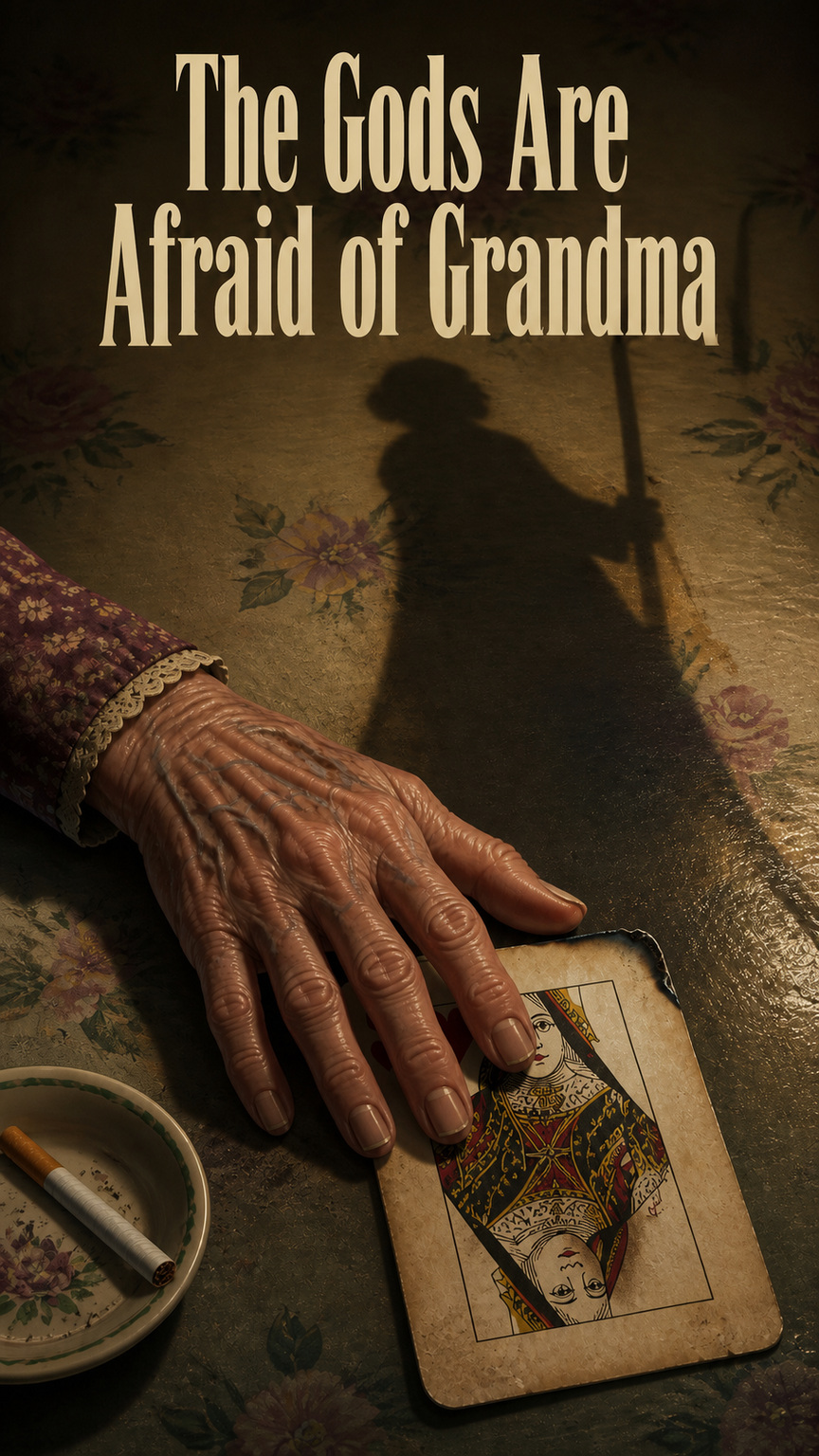
Grandma Valka was halfway down the drainpipe when I arrived.
She had one slipper braced on the porch roof, one bare foot feeling for the iron trellis, and a cigarette tucked into the corner of her mouth. Rain silvered her white hair against her scalp. At a hundred and eight, she had the build of a bundled umbrella and the grip strength of a dockworker.
I dropped my overnight bag in the flower bed.
“Don’t yell,” she said. “You’ll make me fall.”
“You are making you fall.”
“Then don’t help.”
The gutter had clogged with leaves. She had climbed out the bedroom window because, according to her, ladders were dangerous in the rain. By the time I got under her, swearing and holding both arms up, she was already testing the trellis with her heel.
The rusty bracket tore out of the brick.
For one long second she hung above me, surprisingly quiet. Then a delivery van struck the pothole at the curb. Its back door flew open. A roll of carpet underlay bounced out, hit our hedge, unfolded across the path, and made a thick gray landing pad exactly where Valka came down.
She landed on her backside, took the cigarette from her mouth, and regarded the underlay.
“People throw away good things,” she said.
The van kept going.
I blamed the driver, the road, the weather, and my grandmother, in that order. There was plenty of blame to go around and no reason yet to assign any of it to the divine.
Inside, I made her change out of her wet clothes. She made me eat three potato pancakes fried in lard, with sour cream and a ridge of salt that glittered like frost. She had already eaten four. A bottle of plum brandy stood by her elbow. Her ashtray stood by the bottle.
Our family had spent decades trying to improve Valka. We brought nicotine patches, low-sodium soup, sensible shoes, railings, pill organizers, and articles printed in type large enough to imply a threat. She accepted everything with gratitude. The patches stopped drawers from rattling. The soup went to a neighbor’s dog. She hung onions from the railings and stored sewing needles in the pill organizer.
Then she outlived the neighbor and the dog.
“One cigarette after dinner,” I said.
“Certainly.”
“That one counts.”
“Then I’ll smoke it slowly.”
She dealt cards across the oilcloth. We played gin while rain ticked the kitchen window. Valka won the first hand, the second, and the third, although during the third she paused with two fingers pressed to her neck.
“What?” I said.
“Bad card.”
Her face had gone the gray-yellow of old newspaper. I reached across the table. Under my fingertips, the pulse at her wrist stumbled, vanished, returned once, and vanished again.
From the pantry came a muffled voice.
“Oh, for pity’s sake. Not on my shift.”
Something struck the shelves. A jar broke. Valka’s heart gave a hard, offended thump beneath my fingers and resumed its beat.
She pulled her wrist away. “You’re peeking at my cards.”
I opened the pantry. A crock of pickles rocked on its base. Cloudy brine spread between the tiles. Nobody was there.
“Mouse,” Valka said behind me.
“The mouse swore.”
“You would too, living on what you buy.”
I wanted to call an ambulance. She wanted to finish the hand. We compromised by arguing for twenty minutes and finishing the hand. She beat me with three queens, went upstairs, and fell asleep before I had finished checking that her breathing sounded like her ordinary breathing: raspy, uneven, and stubbornly present.
I stayed in the chair beside her bed until midnight. Rain hissed against the window. On the sill, her forgotten cigarette smoldered in a saucer.
I had just reached for it when a single cold drop squeezed through the closed window, fat as a grape, and struck the ember dead.
There were limits to coincidence. I had found mine.
Downstairs, the loose porch step was no longer loose. Fresh nails shone in wood that had been soft with rot that afternoon. A man in a reflective vest knelt over it, tapping one nail with a little brass hammer.
“Road maintenance,” he said without looking up.
“On her porch?”
“Approach infrastructure.”
“At twelve fifteen?”
He glanced at a wrist on which no watch appeared. “Time-and-a-half.”
Rain ran off his shoulders but did not darken the vest. The pothole at the curb was gone. In its place the asphalt rose in a smooth black patch, warm enough to steam.
“Was that your van?” I asked.
“What van?”
“The one that dropped a mattress under my falling grandmother.”
“Underlay,” he said. “A mattress would have bounced her into the roses.”
He shut his eyes.
“Road maintenance,” he repeated, less hopefully.
I took his hammer. He let me, which frightened me more than if he had turned it into lightning.
“Inside.”
“I have no authority inside.”
“You’re going to discover some.”
I herded him through the kitchen with the hammer raised. He stopped at the pantry threshold as if he had hit glass. From behind the door came furious whispering.
“She caught him,” said one voice.
“Of course she caught him,” said another. “He wore the vest.”
“People trust the vest.”
“People trust roads. They merely tolerate you.”
I opened the door.
The pantry was four feet deep and currently held two more people, neither of whom had been there when I searched it. A broad woman in an apron crouched beside the broken pickle jar, pinching shards out of the brine. A narrow person in a yellow raincoat sat on the flour bin and swung one spotless boot.
The apron woman pointed at the man. “He has muck on my floor.”
“It’s your floor?” I said.
“For the relevant purposes.”
The person in yellow looked me over. “You’re the grandchild who hides the cigarettes.”
“Which grandchild?”
“The anxious one.”
“That does not narrow it down.”
“This is why I said we should recruit the tall niece.”
“She lives two counties away,” said the road man.
“Rain travels.”
“Not usefully.”
The apron woman slapped both palms on her knees. A blue flame leaked between her fingers and vanished. “Enough. She’ll wake.”
“Who are you?” I asked.
They looked at one another, each waiting for someone of lower rank to answer.
The road man finally cleared his throat. “We are powers of longstanding local recognition.”
“Gods,” said the weather god.
“Some of us preserve ceremonial precision.”
“Some of us fill potholes.”
“That is an exercise of authority.”
The apron woman shoved a cloth into his hands. “Exercise it on the brine.”
They were gods. I believed them immediately, not because of the fire or the dry raincoat but because they had the same bad teamwork as the committee at my apartment building, combined with the vanity of people who expected statues.
The hearth god had held authority in Valka’s house since the first stove fire burned there. The road god governed the lane, its ditches, its crossroads, and—as he insisted twice—the lawful approach to the gate. The weather god had the valley’s rain and wind, although not temperature, which belonged to a cousin no one liked.
“People still worship you?” I asked.
The road god drew himself up. “They touch their dashboards and beg to arrive. They curse my bends and thank my bridges.”
“They check my face before they leave the house,” said the weather god.
The hearth god wrung pickle brine into the sink. “They bring families to my table. That will do.”
Their power, authority, and scraps of worship sounded less like a golden age than a collection of jobs nobody had managed to abolish.
“You fixed her heart.”
The hearth god’s mouth tightened.
“You dropped the underlay,” I said to the road god. “And you put out the cigarette.”
The weather god looked pleased. “One drop. Very neat.”
“Why?”
All three answered at once.
“Civic duty.”
“She’s beloved.”
“Deferred contractual exposure.”
Silence followed. The road god stared at his knees.
“Explain the last one.”
“No.”
“Then I wake Valka.”
The effect was extraordinary. The weather god slid off the flour bin. The hearth god blocked the door. The road god, still holding the wet cloth, whispered, “There is no need for escalation.”
So I had them.
I brought the card deck from the kitchen and set it on an upturned crate. “Start talking.”
Their story emerged badly.
Forty-six years earlier, when Valka was sixty-two, her heart had stopped for seven minutes on the floor of a bus depot. At the threshold before the underlying afterlife—a place the gods described variously as a cardroom, a tollhouse, and “nothing you are equipped to picture”—she found the three of them playing cards.
They had not caused her death. They agreed on that loudly. They had, however, attempted to delay her passage.
“Why?” I asked.
“There was a jurisdictional uncertainty,” said the road god.
“He owed her,” said the hearth god.
“We all owed her,” said the weather god. “Small things. Then larger things. She notices.”
As a girl, Valka had left bread at the hearth when everyone else had forgotten. She had cleared roadside shrines during a flood and spent three nights insulting the rain until it moved off the wheat. None of those acts had been offered as a bargain, but gods accumulated obligations the way old houses accumulated jars: untidily and beyond counting.
They tried to settle with a game.
“You cheated,” I said.
“The rules permit cooperative play,” said the road god.
“He dealt from the bottom,” said the weather god.
“You marked the queen.”
“Because you kept forgetting which suit was dominant.”
“You changed it four times.”
“Valka caught you,” I said.
The hearth god smiled despite herself. “Before the second trick.”
Valka had taken over the deal and changed the stakes. If she won, their old debts remained due, and when she returned she could name the forfeits. Before she could do so, paramedics restarted her heart. The game, accepted freely and interrupted before collection, remained binding.
“What can she ask for?”
The pantry filled with evasions.
Not everything. Nothing universal. No power beyond their domains. No command that erased another person’s choice. They could not drag her back from the dead, give her endless life, or bar her from the afterlife. But within their authority, they could owe service, yield privileges, surrender worship, perhaps even lose the offices that made them gods.
“Perhaps?” I said.
“We did not let her finish stating the stakes,” the weather god said.
“The paramedics did that.”
“You kicked over the table.”
“The floor shifted.”
“It was a floor.”
The road god pressed the wet cloth to his face.
They had spent forty-six years postponing Valka’s return. The hearth god nudged circulation when her heart misfired at home. The road god diverted vehicles, tightened steps, and once moved a runaway wheelbarrow uphill. The weather god broke heat waves over her roof and sent rain after sparks.
They could only work within their domains. They could only correct what they caught. Their efforts cost them: a washed-out culvert left waiting while the road god softened Valka’s fall; a whole afternoon’s rain held in a cramped cloud while the weather god cooled her fever; six kitchen fires burning too hot elsewhere while the hearth god coaxed strength through one old heart.
And still Valka had arthritis, a smoker’s cough, blood vessels the hearth god called “an insult,” and a liver that prompted all three to cross themselves in different directions. The lard still clogged. The smoke still scarred. Age still narrowed the spaces between emergencies.
“We are not making her healthy,” said the hearth god. “We are catching plates before they hit the floor.”
“Not all plates,” the weather god said.
Nobody spoke for a moment.
Upstairs, Valka coughed in her sleep. I had heard that cough all my life. Now I heard the gaps between the gods’ shifts.
“Protect her better,” I said.
The road god lowered the cloth. “We have just described—”
“I’ll keep your secret. I’ll get the family to stop nagging her, stop asking why the woman who salts bacon keeps passing her medical checks. In return, one of you watches her at all times.”
The weather god laughed once, then saw my face. “Oh. You mean it.”
“No gaps. No missed heartbeats. No falls.”
“We can’t.” The hearth god’s voice was quiet now. “She is alive. Alive is not the same as sealed.”
“Then make it the same.”
“That is not a thing.”
“You’re gods.”
They flinched as if I had called them frauds.
“Within domain,” said the road god.
“At cost,” said the hearth god.
The weather god picked at a strip of yellow rubber on one cuff. “And until.”
The word emptied me. My prepared threats, my lists, all the sensible instructions I had carried into the house—nothing in them could get purchase on until.
I shuffled the deck because my hands needed a job. One card clicked against another. “Where’s the marked queen?”
No one answered.
I searched the deck. Three queens. The fourth had always been missing from Valka’s cards; as a child, I had accused her of losing it. She told me incomplete decks taught adaptability.
“She kept it,” I said.
The gods began searching the kitchen with such frightened incompetence that I almost enjoyed myself. The road god opened the refrigerator four times. The weather god looked under the same chair twice. The hearth god stood very still, eyes moving toward the bread box, away from it, then back.
Inside the bread box, beneath a dish towel and two stale rolls, sat an old tobacco tin. In the tin lay the queen of hearts. A brown thumbprint marked her throat. One corner had been singed, one warped by water, and one was gritty with something that might have been road dust.
All three gods recoiled.
“So this is what you’re afraid of.” I held the card by its clean edge. “I could burn it.”
The hearth god grabbed my wrist. Her palm was fever-hot. “No.”
“Or I could give it back to her.”
The weather god said a word that rattled every window in the house.
Above us, a floorboard creaked.
Valka came into the kitchen in her nightdress and wool socks, carrying the iron fireplace poker. She looked at the gods, at my captured wrist, and at the queen between my fingers.
“You,” she said.
The road god attempted a bow. The pantry shelf caught him behind the head.
“You.” Valka pointed the poker at the hearth god, who released me. Then at the weather god. “And you still owe me three dry Thursdays.”
“Those were conditional,” said the weather god.
“Sit.”
They sat.
Valka took the queen from me, rubbed the marked throat with her thumb, and placed it face down on the table. Her hands trembled. I had not noticed that before. Or I had noticed and filed it under things to correct.
“How long have you known?” I asked.
“Long enough.”
“They’ve been keeping you alive.”
“They have been interfering.”
“You nearly fell off the roof.”
“I came down.”
“On a carpet.”
“Underlay.” The road god sounded offended.
I turned on him. “Do not help.”
Valka leaned the poker against her chair. “You came to watch me.”
“You climbed out a window.”
“Before you came.”
“That is not better.” My voice sped up. “You smoke, you eat whatever you want, you don’t sleep, you go on the roof, and apparently the only reason you haven’t died six hundred times is that three incompetent gods are terrified you’ll take their jobs.”
“Offices,” the road god said.
“I will put you in the pantry.”
He was already mostly in the pantry, but he moved his chair backward.
Valka waited until I ran out of breath. Waiting was one of her cruelties. She could leave silence on the table until you filled it with the thing you had meant to hide.
“I can’t keep doing this,” I said.
“Then don’t.”
“I can’t not do it either.”
She looked at me. The gods looked anywhere else.
The words came badly, as they always had. “I know you’re going to. I know. But when the phone rings, every time, I think—”
That was as far as I got.
Valka’s hand closed over mine, card and all. Her skin was thin and hot. The blue veins stood up under it. Nothing divine smoothed them away.
“You want me not to leave you,” she said.
I nodded.
“I cannot promise that.”
The gods found the table fascinating.
“I can promise no roof in the rain,” she said. “Not because it is your rule. Because I frightened you.”
“You frighten them more.”
“They have better reasons.”
The hearth god made a small, unwilling sound that might have been agreement.
“And the cigarettes?” I asked.
Valka considered this outrageous addition. “Not in bed.”
“You already agreed to that.”
“Then we have made excellent progress.”
I laughed. It came out wet and embarrassing. Valka squeezed my hand once and let go before either of us could make a ceremony of it.
The queen remained between us.
I could have torn it. I could have hidden it and kept my bargain over everyone’s head. For one ugly moment, I wanted to. The card was leverage over weather, fire, roads, perhaps death’s very doorstep. It was the best pill organizer our family had ever found.
But it was not mine.
I slid the queen across the oilcloth to Valka.
The hearth god shut her eyes. The road god muttered what sounded like a prayer to himself. The weather god reached for the brandy, thought better of it, then reached again.
Valka tucked the queen into the deck. Her knuckles worked slowly. She shuffled once, badly, and pushed the cards toward me.
“Your hands,” I said.
“Are a hundred and eight years old. Deal.”
I dealt five cards to each of us. The gods crowded close, damp, ash-smudged, and unable to relax. Valka lifted her hand, took one look at their faces, and smiled.
“We were in the middle of a game,” she said.
“The previous table is no longer available,” said the road god.
“This one is mine.” She nodded to the empty chair beside her, and this time the invitation was for me. “Stay.”
I put my phone face down. Rain worried the roof, the stove flame burned blue, and every road beyond the windows ran somewhere I could not follow. I pulled my chair in anyway.