His Infernal Majesty Says No
As a reigning hell lord, no matter how cruel and tough you portray yourself, your darling daughter’s request on her birthdays always turn you into a mushy enforcer. However on her 18th birthday, she wants to go to a human college which you are against
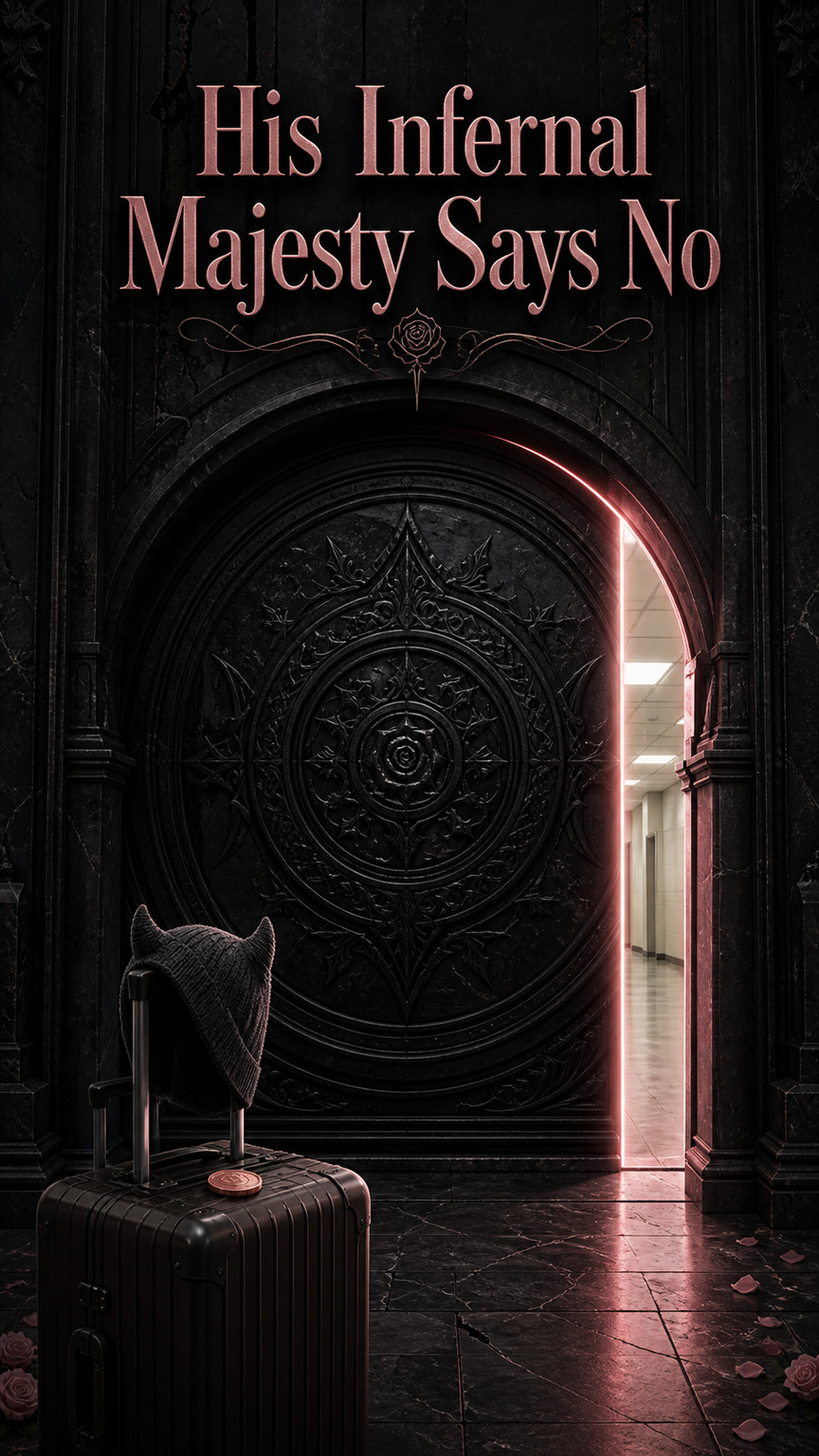
At eleven minutes before my daughter’s eighteenth birthday audience, I sentenced a tax reeve to thirty years in the tally vaults.
He had brought ledgers, witnesses, and the carcass tag from the last pack beast in his district. Fever had killed the animals. Without them, the ore carts had stopped; without ore, his quarterly payment had fallen short by nine iron bars. His defense was thorough. I disliked thorough defenses. They suggested that circumstance might outrank me.
“The vaults, Majesty?” my chancellor asked. He had perfected the courtier’s trick of making a question sound like praise.
“The lowest vault,” I said. “Seize his house against the deficit. His family may keep their clothes.”
The reeve’s wife stood behind the petition rail. Two boys clung to her skirts. She did not beg after that. Fear had taught her the value of conserving breath.
My decree was still being copied when I noticed that the ribbons above the western arch were scarlet.
“Who approved those?”
Six courtiers looked up. The reeve was dragged toward the side door. Everyone else looked at the floor.
My chamberlain swallowed. “The decorating staff believed red would more suitably honor the throne.”
“My daughter asked for rose.”
“A nuanced distinction, Majesty.”
“Then nuance their wages to nothing until the distinction is corrected.”
The chamberlain hurried away. Rose was not pink, as I had explained that morning, nor was it the color of fresh flame. It was the color of the paper flowers Nimelza had cut for herself when she was nine, because the royal gardeners had presented her with black lilies that hissed at guests. She had wanted a gentle color. I had dismissed three gardeners and compelled the fourth to breed a thornless variety by supper.
This was how her birthdays worked. Once a year, before the court and under the protection of custom, my daughter asked for something. When she was six, she had asked for a pear cake. I had made pears available in every infernal market by the following week, although three trade ministers resigned and one orchard arrived with its bewildered goats. At twelve she asked for a morning without screaming from the punishment galleries. I relocated the punishments beyond the eastern vents and fined the masons when the first new chamber carried sound. At seventeen she requested that no one bow to her until noon. Two barons forgot to stand upright. I put them in neck braces.
Cruelty requires consistency. So, apparently, did tenderness.
Nimelza entered the audience hall as the last scarlet ribbon came down. She wore no crown, only the smoke-gray dress she had chosen and the soft-soled slippers I had ordered warmed to precisely the temperature of bathwater. Her dark hair was pinned up with one bent silver clasp. I had given her better clasps. She preferred that one because I had fastened it badly on her seventh birthday and she had laughed until her nose ran.
She glanced toward the side door through which the reeve had vanished.
“What did he do?” she asked.
“Failed me.”
Her gaze moved to the wife and boys, then back to me. “I see.”
She did not say it with approval. Nimelza had become skilled at placing four or five unspoken sentences inside two harmless words.
The servants brought her breakfast tray to the little chair beside my throne: pear slices, hot chocolate, and a roll with the seeds scraped off because she hated how they lodged between her teeth. I inspected the cup before she drank. Lukewarm. I sent the cupbearer to kitchen duty for a month and ordered another.
“I could have drunk that,” Nimelza said.
“You should not have to.”
“That isn’t the same as saying I couldn’t.”
“It is your birthday. Don’t argue over chocolate.”
Her mouth tightened at one corner. “May I make my request now?”
The court arranged itself to witness my surrender. Even the reeve’s wife looked up. They expected a menagerie, perhaps, or a holiday for kitchen cats. My marshal had prepared contingencies for snow, music, fireworks, a temporary ban on spiders, and the release of any prisoner whose offense Nimelza found tedious.
I leaned back. “Ask.”
“I want to attend a human college.”
No one moved. A fresh cup of chocolate steamed in the cupbearer’s hands.
“No,” I said.
Nimelza watched me as if I had mispronounced a common word. “You said I could ask.”
“You have asked. I have answered.”
“I was admitted.”
That landed less like an argument than an opened trapdoor. Around us, courtiers discovered urgent flaws in the rose ribbons.
I rose. “Seal the royal gate. No member of my household crosses without my hand on the seal. Clear the hall.”
The reeve’s wife tried to speak before the guards removed her. My marshal interpreted clearing the hall as a military evacuation. Within a minute there were only abandoned petitions, a spill of hot chocolate, Nimelza, and me.
She looked at the spill. “You frightened him.”
“He frightened himself.”
“He was carrying boiling chocolate.”
“Then he should have had firmer hands.”
She picked up her breakfast roll and tore it in half. It was an old habit from when her hands had been too small to manage one neatly. She ate one half and wrapped the other in a napkin.
“Come with me,” she said. “I have documents.”
I had expected tears, or at least the advantageous trembling of the lower lip that had obtained an indoor pony on her eighth birthday. Instead she led me to her sitting room and opened a writing desk I had commissioned for her. The false bottom was not my work.
Inside lay human forms, examination results, correspondence, a residence contract, and a letter offering enough scholarship money to insult the royal treasury.
“You applied under my roof.”
“Mostly from the west laundry. Your wards interfere less with the signal there.”
“My wards kept you alive through six assassination attempts.”
“Five. The scorpion pie was meant for you.”
“You ate the crust.”
“It was good crust.”
For a breath we were discussing pastry, and she was ten again, and the solution to danger was to remove every scorpion within a day’s flight. Then she slid the admission letter toward me.
She had completed human equivalency examinations under a shortened version of her own name, supplied authenticated records, interviewed twice, and earned a place in an engineering program. She showed me the first-year timetable. Materials, mathematics, design, a laboratory in which students broke beams to learn why they failed.
“We break beams here,” I said.
“Here they confess before they break. I want to learn what a structure does when nobody has ordered it to stay standing.”
“You can hire human tutors.”
“I don’t want tutors who know your guards are outside the door. I want bad dining-hall food and a roommate who doesn’t care which fork I use. I want to be wrong in a room where nobody gets punished for noticing.”
The last sentence had been practiced. I could hear the clean edge on it. She heard it too and looked down at her papers.
I began with the dangers because dangers were countable. Human iron. Human doctors. Infernal rivals who would follow her across. The political value of a royal heir. The ease with which eighteen years of careful survival could end in an unlocked residence window.
She had answers. The room had a lock and only one ground-level window. The campus employed night staff. She had tested common metals against her skin. She had arranged money through a lawful exchange and learned the four-minute walk from the human gate to the residence desk. She had packed medicines, copied her records, and practiced folding her horns under a knitted cap.
“You have not practiced being unguarded,” I said.
“No. You never let me.”
“Because the first failure could kill you.”
“It could.”
I had prepared for denial. Agreement left me holding my anger without a handle.
She touched the admission letter. “There is a final confidential check at nine. I have to complete it myself. Then I have to arrive before midnight or they give the room to someone else.”
“You arranged a deadline so I could not investigate.”
“Yes.”
“You used your birthday audience to corner me.”
“Yes. I thought you’d care more about breaking the custom in public than about stopping me. I was wrong.”
Her fluency had begun to roughen. Good. Anger restored the proper order of things.
“You will withdraw.”
“No.”
“That was not a request.”
“Mine was.”
At nine, the confidential check appeared on a flat pane of human glass balanced on two poetry books. The woman on the screen wore a blue sweater and spectacles. Behind her stood a filing cabinet with one drawer that did not quite close. I had crushed rebellions with tidier headquarters.
“Good evening,” she said. “Can you hear me?”
“Perfectly,” I said.
“I need the applicant to answer.”
Nimelza sat at the desk. I stood behind her, which was my right in every room I owned.
The woman verified Nimelza’s date of birth, course, funding, residence choice, and intention to enroll. She asked each question plainly and waited through the faint crackle in the connection. When I corrected the amount of Nimelza’s available funds, the woman did not look at me.
“Will you be traveling with anyone?” she asked.
“No,” Nimelza said.
“Yes,” I said.
The woman made a note. “The residence booking is for one student. Guests follow the visitor policy. Security arrangements need approval in advance.”
“My guard does not seek approval.”
She finally looked up. “Are you the applicant?”
“Do you know to whom you speak?”
“No. Applicant, are you choosing to enroll?”
Nimelza’s shoulders lowered by a fraction. “Yes.”
“Has anyone required you to accept the offer?”
“No. He’s requiring me not to.”
The registrar typed. No shock, no moral pronouncement, no admiration. “Do you have an emergency contact?”
“My father.”
“Can the college contact him by telephone?”
“Not by telephone. I have a signal mirror, and there is a one-use return token in my luggage.”
“Does the residence staff know how to use either?”
Nimelza opened her mouth. Nothing came out.
The registrar waited.
“I wrote instructions,” Nimelza said at last. “But they would have to know what I am. If the mirror opens in the residence, it could show the other students. Or let someone on this side see them. I can keep it covered, except if I’m unconscious, then—”
She stopped. Her fingers had pressed white marks into the edge of the desk.
I could have filled the gap with twelve guards, a physician, and a small occupying force. The answers crowded my teeth.
The registrar asked, “Do you have a local contact who understands your medical needs?”
“No. I thought the standard clinic would be enough. I checked everything they list, but they don’t list me.”
“All right. Standard emergency care is available. Staff may share necessary information if someone’s life is at risk. We can’t promise more than that. If you enroll, do you understand?”
Nimelza took a breath. “Yes.”
“You can update an emergency plan after arrival. You still need to check in at the residence desk before midnight. Bring the identification we discussed. Ordinary luggage only.”
“Define ordinary,” I said.
“The applicant can email if she has a question.”
The screen went dark a minute later. Nimelza remained at the desk, looking at her own reflection.
“You did not solve for incapacity,” I said.
“I know.”
“You would expose yourself or endanger strangers.”
“I know. I thought I had it.”
The admission papers trembled when she gathered them. Her grand speech, if she had prepared one, did not survive the first real hole in her plan.
I summoned my advisers.
They came eager to transform affection into an operation. The marshal recommended six guards dressed as students, with another twelve in nearby rented rooms. The chancellor suggested purchasing the residence, then the neighboring buildings, then the college if negotiations became discourteous. My chamberlain proposed replacing Nimelza’s assigned roommate with a trained attendant of similar age.
“Replacement by incentive, of course,” he said. “Or by a discreet impediment to the original person’s arrival.”
“No,” Nimelza said.
They continued. A private dining hall disguised as a student café. Faculty contracts backed by penalties. A tunnel beneath her laboratory. A compulsory midnight report. The marshal had already drafted a response plan for any human who saw her horns; the chancellor called it a memory-hygiene measure.
With every proposal, I watched Nimelza become quieter. I mistook that silence for concession until she took the folded half-roll from her pocket and set it beside my hand.
“I withdraw my request,” she said.
The advisers stopped.
“Nonsense,” I said. “I am considering how to grant it.”
“You’re moving this court into a human building and calling it college. I don’t want that.”
“You cannot demand protection and then object to its shape.”
“I didn’t demand protection. I asked to go.”
“With an emergency plan that fails the moment you cannot hold a mirror.”
Her rehearsed confidence was gone now. “Yes. It fails there. So I’ll defer. I’ll find a contact who agrees to know. I’ll apply again, and I won’t wait until my birthday to tell you. But I won’t go with people spying on my roommate.”
The chamberlain cleared his throat. “The young highness has expressed a prudent willingness to revisit the timetable. We might describe the outcome as a strategically postponed fulfillment.”
“Leave,” I said.
He bowed too quickly. The marshal and chancellor followed. At the threshold, the marshal looked back for orders regarding covert deployment.
“If you send anyone across tonight,” I told him, “I will assign you to the tally vault beneath the reeve.”
That he understood.
Nimelza gathered her papers and the half-roll. “The registrar needs an answer. The signal is clearer at the gate.”
“You are not crossing.”
“I heard you the first time.”
She walked out carrying the small case she had packed before asking permission.
I remained in her sitting room. On the desk lay a list in her tight handwriting: socks, notebooks, medicine, cap, soap, spare clasp. Beside emergency contact, she had written father, then drawn a box around it as if ink could make me usable from another realm.
The royal gate stood at the end of a bare basalt corridor. I had always liked its simplicity. No heraldry, no carved victories: only a doorway filled with pale moving air and, at its center, the black disc of my seal. The disc did not merely prohibit passage. It made prohibition material. That was the kind of magic I trusted.
Nimelza sat on her case before it, the human glass on her knees. The registrar’s crooked drawer showed behind a box asking whether the applicant wished to relinquish her place.
“Nine minutes,” Nimelza said without looking up.
I put my palm against the seal. It was cold.
She glanced at me then. “You don’t have to watch.”
“This gate is mine.”
“Of course it is.”
I could leave the seal where it was. In nine minutes the problem would become next year’s problem, and by next year I could strengthen the wards, close the west laundry, acquire the college, or persuade Nimelza that engineering was beneath her. The court would remember that I had said no and made the realms obey.
I turned my hand. The seal resisted because I had ordered it to resist everyone. It split the skin across my palm before recognizing the difference between everyone and me. The black disc came free.
Pale air rushed through the doorway. On the glass, the registrar looked up.
Nimelza stood. “What are you doing?”
“Your identification,” I said. “Is it in the outside pocket?”
“Yes.”
“That is a foolish place.”
“It is the place she told me to put it.”
I reached for her case. She pulled it closer. I released the handle.
From my coat I took a plain copper token. It could open one brief route home for its holder. It carried no mark by which I could find her, a defect I had previously considered intolerable.
“Does it report where I am?” she asked.
“No.”
“Can anyone follow it?”
“No.”
She held out her hand. I set it there.
Footsteps rang at the far end of the corridor. The marshal appeared with four guards despite possessing a strong instinct for self-preservation.
“Stay behind the third arch,” I said. “All of you. No disguises, no watchers, no one across.”
“Majesty, if the heir is unescorted—”
“Choose your next word with care.”
He chose none.
Nimelza tapped the enrollment box. The registrar asked her name, her intention, and whether she understood the emergency limitation. Nimelza answered. Her voice was not steady, but the answers were hers. The registrar told her to bring the screen to the residence desk and wished her a safe trip.
The moving air brightened. Beyond it waited a tiled passage with a humming light, a metal door, and a printed arrow taped crookedly to the wall. No trumpets. No receiving delegation. An ordinary route into a place that had made no arrangements to fear me.
Nimelza put on her knitted cap. One horn made a small peak in the wool.
“It’s showing,” I said.
“I know. I’ll fix it outside.”
“Six pairs of socks are insufficient.”
“There are shops.”
I had not considered shops a serious answer to anything. She bent to lift her case.
“You aren’t coming,” she said.
It was not quite a question.
“Your residence has a visitor policy.”
For an instant, her face folded as it had when she was small and trying not to laugh during an execution notice. Then it settled. She stepped through.
The pale air shivered around her case and closed behind her heels. She hurried down the passage. At its far end, a human hand took her papers and waved her through the metal door with two minutes left. The printed arrow stirred. At midnight, the route narrowed to a blank doorway, and my daughter was gone.
I replaced the seal without closing it to her token. The marshal waited behind the third arch, pale and obedient.
“The court is still assembled,” he said.
Of course it was. There were sentences to sign, shortages to punish, and a family without a house waiting somewhere beyond the audience doors. In the hall, Nimelza’s rose ribbons hung at last, exactly the shade she had asked for. Her warmed slippers were gone. Her pear cake remained beneath its silver cover.
I sat on the throne. The chair beside it stayed empty.
“Bring the next petition,” I said.