I Really Need a Sidekick
I really need a sidekick
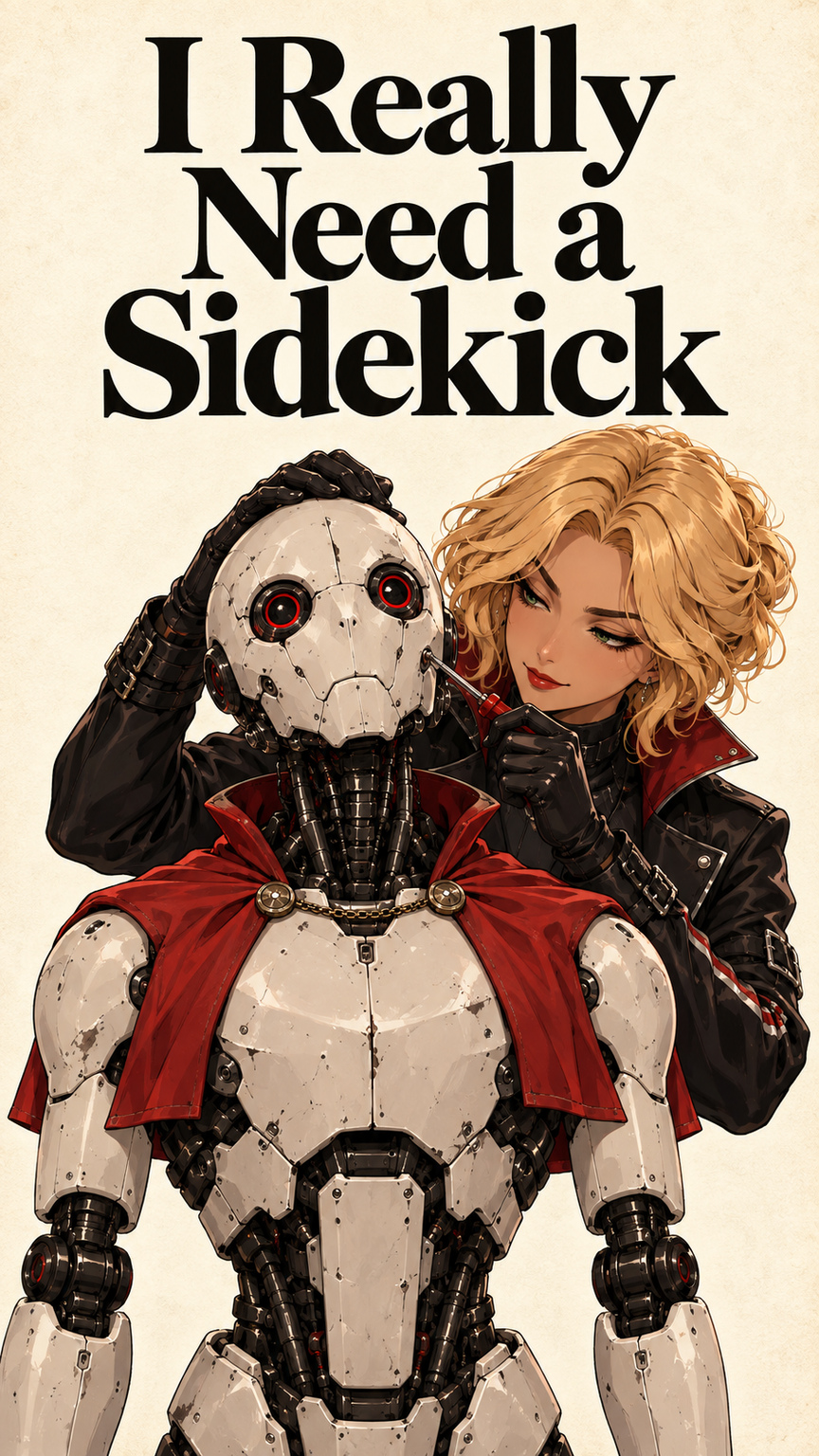
Rococo was watching me in the workshop mirror while I tightened the left side of his face.
“Do that entrance again,” he said.
“It wasn’t an entrance. I went to fetch a key.”
“And yet you swept your coat back.”
I had. The coat was black with a red lining, and the effect deserved testing before I wore it into the Gilt Rotunda. Unfortunately, its hem had caught the drawer I’d left open. Rococo had watched me reverse through the door to free it.
I steadied his scarred white head with my palm. “Look left.”
Both red optics turned in their sockets. The new bearing whispered. That was better; a sinister glance should not sound like a boot in gravel.
“I really need a sidekick,” I said.
“For the coat?”
“For the theft.”
He turned his whole head towards me, beautifully. “Oh. Tell me.”
The Rotunda offered six hundred to anyone who could steal its golden peacock. Twenty minutes inside a theatre full of moving scenery, with Beryl Hilt defending it. I’d entered once before. My ingenious escape case had shut with me inside it, and I had spent eleven minutes explaining through a ventilation hole that the catch was supposed to do that.
I had since repaired three clocks, a trouser press, and a very fine espresso machine for people who began every consultation by asking whether I’d got out yet.
This time I had a plan involving a hatch, a counterweight, and another pair of hands. I showed Rococo the little sketch under my elbow. He studied it while I fitted his cheek plate. Black mechanisms vanished under white enamel, except for the narrow gaps his original maker had left at the jaw.
“Where are the spectators?” he asked.
I tapped the margin of the sketch. “Here. But they won’t see us until we come out.”
He put a finger on my pencilled exit. “With the bird held high?”
“Ideally.”
“And what am I doing?”
“Holding the hatch.”
He waited.
“Then coming out too.”
He’d been the Rotunda’s resident villain when it still put on plays. I’d seen him tear a paper wedding contract into pieces so tiny that the heroine had protested about how long she’d have to kneel there collecting them. He’d retired after the theatre changed hands, though he still came to me for adjustments. Last month he’d wanted a quieter wrist for pointing accusingly at dinner guests.
“Half the money,” I said. “You can lift the peacock. I’ll open the way.”
“I can manage that. How much running?”
“Almost none.”
“Ottilie.”
I looked under the bench at his right knee. Its cooling fan was running even now. A cracked motor housing made it heat up under a fast load; if he hurried for much more than half a minute, the joint locked itself straight. Letting it cool took the better part of an hour. I’d ordered the replacement housing. It was coming from somewhere that apparently counted hours differently.
“No jumping,” I said. “No prolonged running. We walk in, we get the bird, we walk out.”
“Good. Shall I bring a cape?”
I showed him the snag in my hem.
He considered it. “A short cape.”
We practised the hatch manoeuvre with my bench lid. A squeeze on his shoulder meant stop; two taps meant move. He lifted the heavy lid one-handed while I crawled beneath it, then waited for me to wriggle out before asking whether this was the triumphant part.
“You’ll know the triumphant part.”
By noon we stood under the Rotunda’s painted dome, wearing protective goggles and listening to the referee. Rococo had chosen a red cape that reached only to his elbows. I had pinned my blonde hair up with considerably more care than the undertaking deserved.
The audience sat behind clear screens on three sides of the playing floor. At the back of the floor, the peacock glittered on a plinth between two castle towers. Wide pieces of scenery stood on low wagons: a forest, a palace window, an enormous plywood moon. Brass strips in the floor gave their wheels smooth runs over the old stage seams. A low gallery stretched across the front, above our entrance, with a bank of handles for hauling the scenery about.
Beryl Hilt leaned on its rail, loading her paint rifle. She wore last month’s winner’s sash twisted around her forehead to keep the sweat out of her eyes.
“You both have to cross the line under that arch with the prize,” the referee said, pointing to the red frame through which we’d entered. “One direct paint hit on either of you ends the attempt. Body or clothes. Props don’t count. You may move anything inside the floor boundary. Breakages come out of the purse.”
Rococo looked over the audience. Someone waved. He bowed so low that his short cape fell over his head, and straightened with a practiced flick that made it look intentional.
“No case today, Ottilie?” Beryl called down.
“I’ve moved beyond cases.”
“Glad to hear it.”
People laughed. It was a perfectly reasonable thing to say, and I resented her for it.
“You’ll want to watch the towers,” I said. “We shall be entering from above.”
Rococo looked up at the battlements. I could have corrected myself. The referee had not rung the bell; there was still a moment in which to be a woman with a sensible plan and a regrettable mouth.
Then someone behind the screen said, “Oh, good.”
The bell rang.
We ducked behind the palace window as a paint pellet snapped against its frame. Beryl pulled one of her handles. The forest wagon slid across the floor, leaving a bright, bare lane between us and the castle.
“Above?” Rococo asked.
“There’s a stair behind the left tower.”
“You drew a hatch.”
“I know what I drew.”
He waited for my next instruction, which was worse than arguing. I peered through the palace’s painted window. A pellet struck its sill. Beryl worked the rifle’s pump, grinning.
The castle stairs were genuine, built for actors to stand on the battlements. They were also on the far side of the exposed lane. My hatch would have taken us underneath that lane, almost to the bird. I could still take it, if I wished to crawl quietly through a plan I’d just publicly disowned.
“The forest comes back when she releases that handle,” Rococo said. “It’s on a counterweight. We could follow it.”
We crouched, waited, and followed the trees as they rolled home. Rococo kept pace at a quick walk. I could hear Beryl moving along the gallery to find an angle, and twice a pellet hit a painted trunk at head height. We reached the castle stairs with both our clothes clean.
It took three minutes to climb them. Rococo went sideways, good leg first, and I kept trying to help at precisely the moments he needed me to get out of his way. At the top we crouched behind the battlements. I inspected the narrow walkway across to the other tower.
Below us lay the peacock, gleaming, apparently no wiser than a real bird about the trouble it had caused. A large clock over the red arch showed fifteen minutes remaining.
“I’ll have to go down backwards,” Rococo said.
“Can you face the audience for the first few steps?”
He looked at the steep return stair on the inner face of the tower. “No. Keep my cape clear, please.”
I gathered his cape in one fist and followed him. The spectators got a prolonged view of his feet.
We were still descending when the clock sounded the halfway chime. By the time we reached the plinth, his knee fan was whining. The peacock was bigger up close, a brass body with folded tail feathers made from thin sheets of gilded metal. I’d watched previous attempts. Lift it, and the tail sprang into a fan as wide as my outstretched arms; a little pump in its belly played a fanfare through its beak. There was no disabling either without forfeiting the prize.
“Straight into the passage when you have it,” I whispered. My original hatch lay at the far end of that passage; from this side we could simply open it. “She’ll come round as soon as she hears.”
He put both hands beneath the bird. I watched the gallery through a gap in the castle wall.
The fanfare was louder than I remembered. The tail opened with a metallic rattle, and for a moment there was nothing in the world but that magnificent, stupid bird.
Rococo rose with it held above his head. The audience cheered. He turned to give them the full spread of gold, and they cheered again. He tilted the peacock down towards me, an invitation so obvious I stepped beside him and swept my coat back.
It worked. The red lining opened. My hand found my hip. I heard somebody whistle.
Then Beryl’s pellet took a chip out of the plinth beside my elbow.
We lurched into the passage. A castle door slid across its far end. Beryl had reached another handle.
“Back,” I said.
Rococo was already moving. The peacock’s tail caught both walls; he turned it edgewise and hurried after me. We came out beside the plinth as Beryl sent a shot through the space we’d just left. I seized Rococo’s arm and pulled him towards the moon wagon, the only cover outside her castle.
We had almost reached it when his right knee gave a shrill warning. He took one more stride, stiffened, and went sideways. I got under his arm. Together we staggered behind the moon, which boomed as another pellet hit its painted face.
He lowered himself onto the wagon’s timber base and kept the bird off the floor. I put my hand near the knee. Heat pressed against my palm.
“Done?” he asked.
I nodded. He stretched the leg along the base. Beyond the plywood I heard Beryl’s boots go back across the gallery.
“You had to show them the bird,” I said.
“They came to see it stolen.”
“They came to see us win.”
“I think they’d have enjoyed that too.”
I tugged at the cape trapped under his elbow. It wasn’t in the way of anything. I simply needed something to do with my hands.
“You were supposed to keep moving.”
“You struck a pose, Ottilie.”
“For a second.”
“It was a good pose.”
That made me angrier. I had been pleased with it; I still was. I let go of his cape and looked out past the moon. A pellet struck the edge, close enough to send a splinter into my hair. The clock showed six minutes.
“Can you walk?”
“Slowly. Not across that.” He nodded at the open floor between us and the arch. “Can you push this wagon?”
I looked down. Four broad castors, each with a foot brake. A wide timber frame supporting the moon. It had carried two lovers and a papier-mâché pig in a production I’d attended years ago.
“With you on it?”
“The pig was much heavier.”
“I remember the pig.”
“I was inside it.”
I laughed before I could help it. He’d had a splendid entrance, rolling down a hillside in pursuit of a tenor. They’d repeated it twice because the audience wouldn’t stop stamping.
He shifted the bird into one arm. “I had hoped this might be rather like that.”
“You could have said.”
“You were so pleased with that hatch.”
Behind the screen somebody began a hopeful, uneven clapping. Other hands joined it. They couldn’t see us doing anything, but apparently the sight of the moon being repeatedly shot was enough to sustain their interest. I smoothed the cape I’d crumpled in my hands.
I bent and released the first brake.
“Then hold on to the moon,” I said. “I don’t want it tipping over.”
He tucked the peacock against his chest and wrapped his other arm round an upright. “What are you going to do?”
“Push. You tell me where she’s going. Keep your feet inside.”
I freed the remaining brakes and tested the wagon against my boot. It rolled more easily than I’d expected. The moon was solid plywood, eight feet across, and the wagon’s base was narrow enough for the arch. We would have to turn sideways to get the moon through. First we had to reach it.
We came out from beside the castle with the moon facing Beryl’s gallery. I shoved at the frame, keeping my body within its shadow. Rococo leaned to peer round the side, then pulled back as a shot cracked against the paint.
“Still up there. Moving left.”
I took short, hard steps towards the arch. The castors thrummed over a seam, and the moon swayed. Rococo tightened his grip on the upright. His good foot slid towards the edge; I squeezed his shoulder and held the wagon still while he drew it in. Two taps, and we moved again.
He risked another look. “Faster. She’s at the stairs.”
I put my shoulder to the wood. The floor seemed much larger now I had to propel two people and an astronomical object across it. My goggles slipped down my nose. I shoved them up with a wrist, smeared them with sweat, and shoved harder.
Beryl came off the stairs to our left. Rococo pointed. I ran round the back of the wagon and dragged its right corner towards me, swinging the moon between her and us. The wheels swivelled reluctantly. Paint smacked into the face as it came round.
“Nice,” Rococo said.
I had no breath to answer. We were twenty feet from the arch, moving sideways now, with the edge of the moon aimed at the opening. Beryl trotted beside us, looking for an angle. She was quick enough to outrun the wagon; a palace wagon stood between her and our unprotected rear, and she had to go round it.
“She’s coming behind,” Rococo said. “Turn again.”
I hauled the frame. Rococo leaned into the turn, but the right front castor caught at one of the brass strips. The moon stopped turning. Beryl’s boots squeaked on the far side of the palace.
“Wheel!” I gasped, pointing.
He followed my hand, reached down, and shoved the castor round. I pulled again. The moon swung just as she cleared the palace, and her shot hit it squarely. The audience made a noise I felt in my ribs.
Now we were behind our shield, backing towards the arch, and the moon was broadside to an opening two feet narrower than itself.
I dragged the wagon until one corner bumped a red post. We had perhaps a yard left to travel. Beryl was coming straight towards us. As soon as we turned the moon to fit, she’d have a clear shot at our backs.
“You’ll have to turn it,” she called. “I’ll have you then.”
Rococo drew his good foot in beside the leg that still lay stiff along the base. I crouched lower, wishing I’d taken the coat off before we’d started. Its hem was everywhere.
The peacock stared out through its fan of feathers. It had been shrieking intermittently all the way across the floor; the tune had begun to repeat in my head.
“Hold the tail towards her,” I told Rococo.
He set the bird’s feet on the wagon between us and the moon, gripping it from behind. The tail rose in front of our crouched bodies. Its metal feathers overlapped closely enough that I couldn’t see through them.
“You’re crouching?” he asked.
“As far as I go.”
“Come closer. Your coat.”
I gathered the hem under my knees and squeezed beside him on the timber base, one boot still on the floor. He put an arm across my shoulders to keep me inside the fan.
“You’ll have to shove,” I said. “Against the post. When I tap.”
He released my shoulders and reached for the red upright of the arch. I held his shoulder and planted my boot on the floor beside the nearest castor. We had to pivot before we could push through; he would have to keep the bird facing Beryl while the wagon turned beneath it.
Two taps. He pushed the post; I shoved against the floor. The wagon turned. The moon moved edgewise into the arch, taking our shelter with it.
Beryl fired. A feather buckled against my goggles.
Rococo kept the bird turned towards her while the wagon swung beneath him. I squeezed his shoulder; he stopped pushing, and I stamped backwards against the floor. The wagon rolled through the gap.
Her second shot struck the peacock’s belly. Its fanfare faltered, then came back a note lower.
My boot slipped. For a moment we stopped with the moon jammed against one post and half the wagon still on Beryl’s side. Through a dented gap between feathers I saw Beryl lifting her rifle. She was close.
“Again,” I said, and planted my heel flat.
Rococo shoved the post hard enough to scrape white enamel off his knuckles. The moon tore a strip of red paint from the arch. My coat ripped under my knee, freeing the cloth caught against the wheel, and we shot through together.
A pellet struck the floor behind us. The referee rang the bell. The clock above him still had forty seconds left.
For several seconds I couldn’t hear him over the audience. Rococo still held the peacock in front of us. I tapped his wrist until he lowered it.
Beryl stood on the other side of the line with her rifle hanging from its strap. She glanced between the dent in the tail and my clean goggles.
“I was sure I had you,” she said.
“So was I.”
She laughed once, sharply, and rested her rifle against the arch. I tried to get off the wagon. My legs declined. I sat back down beside Rococo and began laughing too, which used more breath than I had available and made a dreadful squeaking sound.
He looked at me, then lifted his face towards the audience and gave them the villain’s laugh I remembered from the wedding scene: rich, cruel, delighted. It set me off again. I wiped my eyes beneath my goggles, leaving dirty streaks across my cheeks.
The referee came round with the purse. He held it out, reconsidered, and glanced at the damaged peacock.
“We’ll settle the repairs afterwards,” he said.
That seemed fair. I took the purse before he could develop the thought.
People were standing behind the screens. They weren’t asking about my case. They were calling for us to do something else.
“They want an encore,” Rococo said. He sounded almost shy now there was no immediate need to project.
“I can’t push you back across.”
“No. Just help me stand. We can bow.”
I got to my feet and gave him my shoulder. He rose on his good leg, holding the battered bird. I began to bow, but he stopped me with a squeeze.
“Wait for the fanfare.”
The peacock wheezed through its ruined tune. I stood with my arm around his waist, sweat cooling down my back, and waited with him. At the final dreadful note we bowed together. More stamping. More demands.
I could have stayed there all afternoon.
“Give me the bird,” I said.
He passed it over and leaned against the arch. I held the bird against my chest, stepped beyond his reach, and turned the red lining of my coat towards him.
“Oh,” he said softly. Then, loud enough for the whole Rotunda: “You treacherous woman.”
I smiled at him over the bent golden feathers and waited for the boos.