A Question for the Sky
An orbital civilization has taught its citizens for eight centuries that the earth below is lifeless. A heat-radiator mechanic finds a newly handmade cloth kite tangled in the station’s vanes, carrying a child’s question written in a language preserved only in maintenance labels. The mechanic begins an improvised correspondence with the planet below through discarded supply capsules.
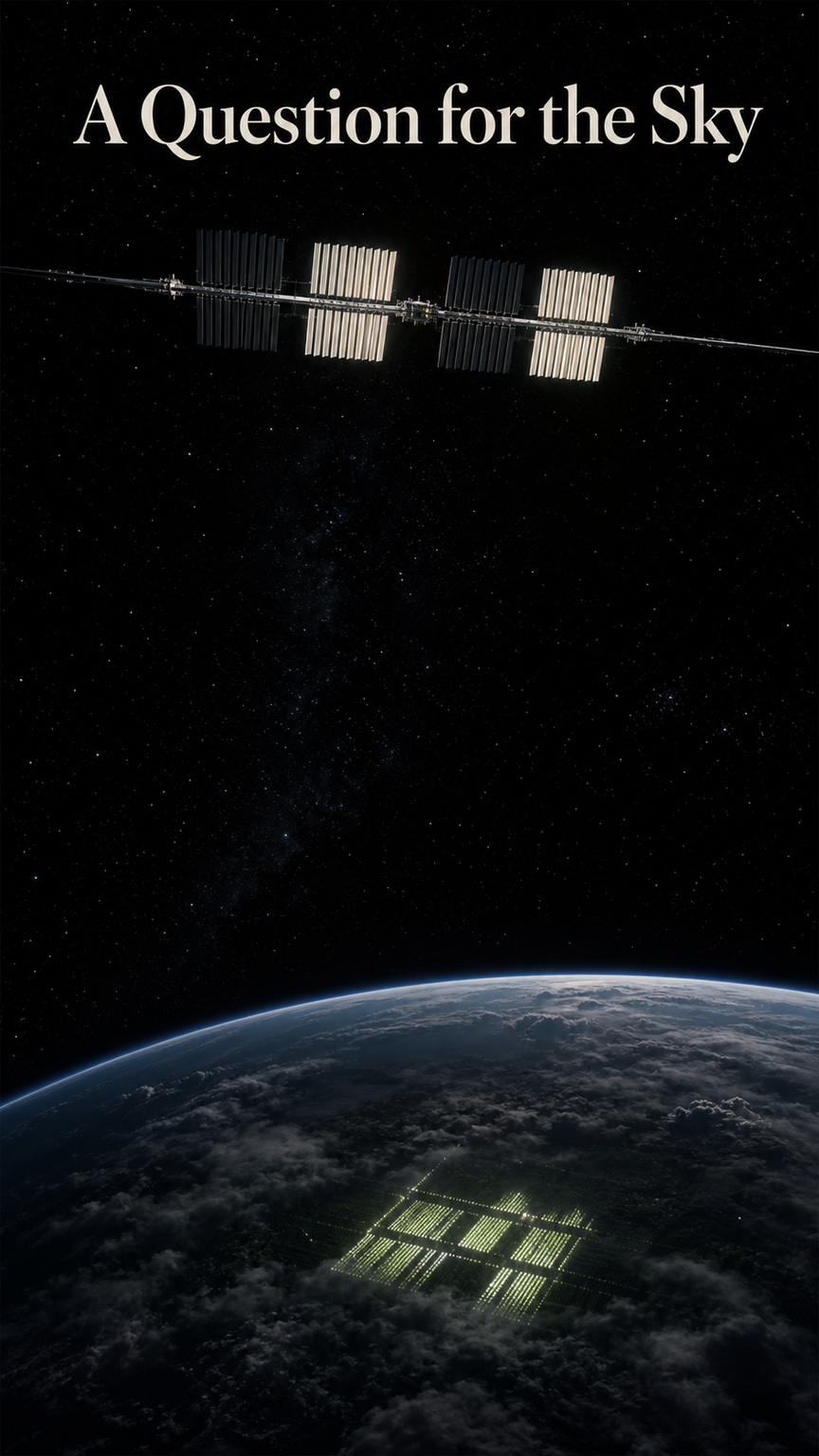
The dead world blinked at Sairu while she had both arms inside radiator bank seven.
Her helmet display had painted a false hot seam along the bank’s shielded edge, and she was halfway through proving it false when a second line appeared far below: green-white, straight for twenty kilometers, then broken into three blocks. Not lightning. Not a fire. The blocks held their proportions while the station rolled and the earth slid beneath her boots.
Sairu braced one knee against the service rail and magnified the radiator sight. The false seam vanished under proper focus. The ground lights did not.
They lay across dark terraces at the edge of a cloud mass, too regular for any lesson she had been given about the surface. Eight hundred and twelve years ago, the last ground habitats had failed. Since then: poisonous air, sterile soil, weather wearing down empty works. Every child aboard learned the sequence before they learned the station’s pressure alarms.
Three luminous bars faded. Another set brightened.
Sairu knew the shapes because she spent her shifts obeying them. The old service script survived on isolation collars, pressure doors, and the undersides of panels nobody had thought worth replacing. The first block meant ABOVE. The second meant WORKER.
The third was the question mark stamped beside manual overrides.
“Control, bank seven,” she said. “Hold roll compensation on my visor.”
“For the hinge test?” the duty operator asked.
“For my eyes. Ten seconds.”
“That’s not a test category.”
“Then call it glare.”
The stars steadied. Below, the lights went out in strips from west to east. Darkness remained for six breaths. Then the whole message returned, except that the middle block had changed. Not WORKER now. LIVING WORKER: the little diagonal that distinguished a warm hand from a powered tool.
ABOVE LIVING WORKER?
Sairu stopped breathing.
At the southern edge of the terraces, several tiny heat traces moved between the bright strips. The sight could have manufactured one bad pixel, not warm bodies crossing separate rows. Magnification broke each bar into terraced reed beds, thousands of pale tips kindling like a field of stars only after a person reached them. Star-reeds, for lack of a name. The trace cooled; the reeds shone. A mechanism could store and shape living work, never begin it. One trace was smaller than the others and darted twice back to a patch that had failed to shine.
More glyphs opened around it, awkwardly spaced.
PIRU. CHILD. ASK.
The name had been made from service-script sound signs, each one kilometers long.
“Bank seven?” the duty operator said. “Your ten seconds are gone.”
Sairu saved the raw frames without classifying them. A contact classification would dispatch the station’s survey routines. She knew that. Her thumb still hovered over the tag until the small heat trace crossed a blazing row and vanished into the cooler dark beyond it.
“Glare cleared,” she said. “Continuing inspection.”
The ground fell behind the horizon. Bank seven waited with its ordinary fault: hinge twelve had taken four-tenths of a second too long to turn.
Mechanisms answered when touched. That was why Sairu liked them. A stuck hinge gave resistance, heat, a measurable delay. You found the cause and worked it until the answer changed.
For the rest of the inspection, the old question stayed at the bottom of her visor.
ABOVE LIVING WORKER?
Lassan watched the frames three times before saying anything. The maintenance archive occupied a narrow compartment between the machine shops, where cabinets built for physical labels stood beside newer storage columns. He kept a bowl of sour yellow berries on his desk. He pushed it toward Sairu without looking away from the ground.
“No, thanks.”
“They’re going soft.”
“That doesn’t improve them.”
“It improves the urgency.”
On the wall, Piru’s name burned across a continent of darkness.
Sairu pointed. “You read it.”
“I recognize four signs and a question marker.”
“You read more than that.”
“ABOVE is secure. The distinction between worker and living worker is secure. This could be CHILD, or junior, or restricted access by minors.” Lassan enlarged the first and second displays until the terrace boundaries showed. “The change is important. Someone revised a category.”
“Piru.”
“Likely a name. It could identify a crew, a district, a tool series—”
“A tool series didn’t run back to fix a dark row.”
Lassan looked at the moving heat traces. He rubbed one thumbnail over the edge of his desk. “No.”
That single word loosened something in Sairu’s chest. She had expected argument and found herself angrier without it.
“Then why are we talking about tool series?”
“Because the frames can support living operators and an intended question. They do not support a surface census, a history, or the age of the smallest operator. Not yet.”
He brought up a service label used on coolant junctions two decks below. Its letter forms had rounded over centuries of recutting, but ABOVE and the living-hand diagonal were there. Beside it he placed a label scan from the station’s founding hull. Piru’s grammar resembled the older one.
“They preserved it,” Sairu said.
“Or inherited something that shares its source. The oldest forms are closest. That’s provenance, not an explanation.”
“Eight centuries of empty-world instruction, and you want to correct my verb.”
“I want the first true record we make to remain true tomorrow.”
The compartment door opened behind her.
Orvek did not ask why a radiator mechanic had put a private optical hold on ground-facing frames. Her wrist slate already showed the access trail.
“You used glare authority,” she said.
“There was glare.”
“From twenty kilometers of orderly vegetation?”
Lassan quietly moved the berry bowl away from the edge of the desk.
Sairu showed Orvek the changing message. She watched the supervisor’s eyes pause on the heat traces, then return to the time code.
“Next useful night pass?” Orvek asked.
“Fourteen hours, fifty-one minutes. The terraces will be within bank seven’s surface angle for ninety-four seconds.”
“And you want?”
“To answer.”
“That isn’t a radiator function.”
“They used a maintenance channel.”
“They used light. The similarity doesn’t grant you a channel.”
Sairu heard herself speed up. “We can give them one packet. Shielded face for dark, emissive face for bright. Their pattern tracks the station. They must have a heat sight. Four vane groups are enough for low-resolution blocks. We confirm we’re alive, confirm Piru was seen, ask for receipt.”
“Closing four groups stores heat in the spine.”
“For less than a minute.”
“At current load?”
“Thirty-eight seconds below the conservative limit. Forty-seven below mandatory abort.”
Orvek turned to Lassan. “Do we know they’ll read it?”
“No. The old script gives us a defensible order for LIVING, ABOVE, RECEIVE. Their display suggests the same reading direction.”
“Do we know that word is Piru?”
“No,” he said. “A name is the best fit.”
“Good. At least one of you still knows that word.”
Sairu pointed again at the small trace. “They asked whether a worker lives up here. We do.”
“And the standard contact tag centers every available ground optic on the source, writes coordinates into the survey ledger, and requests a communications assessment,” Orvek said. “Did you apply it?”
“No.”
“Did you nearly?”
Sairu’s silence answered.
Orvek pulled the thermal record from bank seven. “One packet. No contact tag, no locator request, no networked optics. Local heat-eye only. Thirty-five seconds, because your hinge twelve is already late. If spine temperature crosses yellow, all groups open.”
“We can do it in thirty-eight.”
“Then remove three seconds of message.”
“Which three?”
“Mechanic’s choice. Supervisor’s limit. Put the optical excursion in the maintenance log.”
“That will expose it.”
“It will expose me. I’m authorizing the excursion.”
Orvek signed with one thumb and handed the slate to Sairu. “Repair the hinge before you use it to talk to a planet.”
Fourteen hours later, hinge twelve still lagged.
Sairu had replaced its drive braid, cleaned the bearing track, and run it through a hundred turns. Unloaded, it matched the rest. Under radiator heat, it came late by two-tenths of a second—better, not good.
“Nine minutes to surface angle,” Orvek said over the service channel. “Bank spine at sixty-one.”
Sairu floated beside the manual console in the radiator hub. Lassan had strapped himself at the script display behind her, a paper copy of the packet tucked beneath one hand as though electrons might become careless.
“Sixty-one is cold,” Sairu said.
“It is the starting number.”
“I know what it is.”
“Then we have achieved ordinary conversation.”
Lassan glanced between them. “The second block should remain RECEIVE, not SEE.”
“You changed that twice,” Sairu said.
“Because SEE implies an eye. RECEIVE allows a sensor, a reader, or a witness.”
“We have ninety-four seconds and four blocks.”
“Language remains language at speed.”
“Surface angle,” Orvek said. “Talk later.”
The world’s night opened on the hub display. The terraces were dark, a faint ribbed geometry in infrared. Sairu selected four vane groups. Their emissive faces glowed on the station’s outer cameras; their shielded backs disappeared against space. From below, through a powerful enough heat-eye, the whole radiator would become a label board crossing the stars.
“Packet one,” she said. “Mark.”
She closed two groups and left two open: ABOVE.
“Hold three,” Orvek said. “Turn.”
Sairu moved the next combination through LIVING. The four indicators changed together except twelve, which hung amber and snapped over late.
“Hinge lag point three,” she said.
“Spine sixty-seven. Continue.”
WORKER took six turns. RECEIVE took eight. Piru’s sound signs were worse: the old service script had never been designed to name children, only couplings and hands assigned to them.
“Seventy-four,” Orvek said. “Twenty seconds to yellow.”
“Piru marker beginning.”
“Order error,” Lassan said. “Second sound first.”
“That’s what I have.”
“Your lower pair is inverted.”
Sairu looked. Hinge twelve had left a bright corner where the block required dark.
“Resetting.”
“No reset,” Orvek said. “Thirteen seconds. Shorten.”
Sairu abandoned the name. She turned the groups through RECEIVE once more and then the service glyph for RETURN SIGNAL. Twelve struck its stop hard enough to send a tremor through the console.
“Yellow,” Orvek said. “Open all.”
“One confirmation mark.”
“Open all.”
Sairu’s hand stayed on the controls for one hot, stupid beat. Then she obeyed. Emissive faces swung toward space. Heat poured out of the spine in a rising red wash.
Cloud had already reached the western terraces. A pale bank crossed the signal field, swallowing row after row. Nothing lit beneath it.
“Did they receive?” Sairu asked.
Lassan scrubbed through the ground frames. “No display visible.”
“That isn’t what I asked.”
“It is what the evidence can answer.”
“Bank spine declining,” Orvek said. “Hold full emission. Sairu, hinge twelve is now point six late.”
Below, the last clear terrace vanished under cloud.
They had said they were alive. They had failed to say to whom.
The station made them wait fifteen hours and nine minutes for another usable angle.
Sairu spent the first three repairing hinge twelve. A hairline distortion in its hot-side stop had escaped every unloaded test. She replaced the stop, ran the group hot, and watched four green indicators turn together. That answer should have satisfied her. It did not.
She found Orvek in the small galley beside radiator control, eating lentils from a pouch while reading the excursion log.
“Any change?” Orvek asked.
“Twelve is clean to point zero four.”
“Good.”
“On the ground.”
“Cloud.”
Sairu hooked a foot under the opposite restraint. “They repeated before. If they saw us, they’ll repeat.”
“Probably.”
“They will.”
Orvek squeezed the pouch flat from the bottom. “You don’t improve probability by saying it harder.”
“And you don’t make this smaller by putting it under radiator maintenance.”
“I put an unplanned thermal excursion under radiator maintenance because it was one. I put the unexplained optical pattern under a safety hold because that keeps the raw frames local until review. Both entries name me.”
“Review by whom?”
“Someone who isn’t running on half a sleep cycle. Have you eaten?”
“Yes.”
Orvek waited.
“A roll,” Sairu said.
“Get another.”
She caught Lassan outside the archive. He carried two label rubbings and had purple berry juice on one cuff.
“The packet was readable,” she told him.
“Parts of it.”
“We answered.”
“We emitted a syntactically plausible sequence toward the observed grid.”
“Do you practice making everything sound dead?”
He stopped. “No. I’m trying not to finish their meaning for them.”
Sairu had no quick reply to that, which annoyed her more than the sentence deserved.
Lassan held out his slate. The standard contact form showed the terrace grid centered in a red square. Eight observing systems were listed beneath it, ready to acquire the same coordinates on approval.
“The form doesn’t merely record our observation,” he said. “It begins a search. Surface motion, heat sources, routes in and out. Whatever those lights are, the people operating them did not ask for that.”
“They made a question twenty kilometers wide.”
“For something crossing above them.”
“That’s us.”
“Yes. Not necessarily every eye we own.”
Sairu enlarged the image. Even after the cloud, faint cooling scars marked the rows used twice. The living-hand diagonal was paler than the terraces around it. At several points, the infrared record showed sudden drops where bodies had knelt to the reeds. The lights had not come free. Whoever tended those rows had spent stored sun from the plants and warmth from their own skin.
She had nearly answered a question by handing its origin to the station.
“I didn’t apply the tag,” she said.
“I know.”
“I knew what it did.”
Lassan tucked the rubbings under his arm. “Before or after your thumb stopped?”
She pushed away from the wall too hard and had to catch the next rail.
On the third pass, the cloud broke into long gray islands. Between them, the terraces shone.
Not the question this time. Four tight blocks rose in sequence at the grid’s northern edge.
ABOVE. LIVING. RECEIVE.
Then Piru’s name, with the sound signs in the order Sairu and Lassan had argued over. The child had received enough of their damaged packet to identify its intended recipient and correct their spelling.
“Receipt confirmed,” Sairu said.
“Piru attribution strongly supported,” Lassan said.
“Bank spine fifty-nine,” Orvek said. “Keep watching.”
The grid changed. One small mark brightened beside Piru’s name. Six marks opened beside LIVING HANDS. The heat-eye showed bodies moving with them: the small trace and several taller ones, one person working two rows when a bleached strip failed.
“Seven operators,” Sairu said.
“Seven markers,” Lassan corrected. “Several operators visible.”
The marks faded. A new sequence began, using warning terms Sairu had seen on survey mounts.
NO EYE.
Her hands tightened around the console grips.
“They want us to stop looking,” Orvek said.
“Then why send again?”
“Wait,” Lassan said.
On the surface, two people crossed the lit rows. The first warning vanished. It returned with an extra block, but cloud shadow cut its lower half away.
NO EYE—CENTER.
“No centering,” Sairu said. The contact form’s red square seemed to float in her memory.
The terraces went dark long enough that Orvek called, “Thirty seconds to our reply angle.”
Light returned in a longer, rougher order.
POSITION MARK: NO.
EYE MOVE: BELOW CALL FIRST.
The last terms were not elegant. CALL was the old label beside a manual service summons. FIRST had been inserted after the sequence, forcing three adjacent rows to bleach almost white. The small heat trace—Piru, likely Piru, only Piru if the evidence held—moved out of one cold patch and into another worker’s arms.
Sairu took her hand off the reply controls and read the sequence again.
“They saw the auto-center,” she said.
“Or they know what centered observation means,” Lassan replied. “No coordinate record. No search unless they summon it. That reading fits all three revisions.”
“Reply window,” Orvek said. “Thirty-four seconds authorized. Same abort. What are you sending?”
Sairu had built six possible messages during the wait. Explanations. Assurances. Questions about the reeds, the language, the people beyond the grid. Every one now felt like reaching past the thing Piru had actually said.
“Manual status,” she said. “Position not stored. Eye waits. Next dark pass, surface begins.”
Lassan scanned the blocks. “Use READY, not WAITS. We don’t know whether their grammar carries duration.”
“Fine.”
“And omit surface. BELOW is attested.”
“Fine. Orvek?”
The supervisor studied the thermal forecast. “Twenty-nine seconds. Their last signal cost them. Ours can be shorter.”
Sairu loaded the packet.
The vanes began to turn.
“Mark,” Orvek said.
POSITION. NOT STORED.
Hinge twelve landed with the others.
“Spine sixty-six.”
EYE. MANUAL.
“Seventy-one.”
NEXT DARK. EYE READY.
“Fifteen seconds.”
BELOW CALL FIRST.
Lassan leaned toward the display. “Third block—”
“I see it.” Sairu corrected the inverted pair without resetting the message. “Mark.”
“Seventy-eight,” Orvek said. “Open.”
This time Sairu opened every group on the word. The radiator brightened into its ordinary uninterrupted sheet. Heat left the station. On the surface, the terrace grid held dark.
For four seconds, Sairu thought that was the answer.
Then a single receipt mark appeared at the northern edge. It shone green-white, dwindled to infrared, and went out. The moving traces withdrew between the rows. No grander display followed. The reeds had already given enough.
Orvek released her restraint. “I’m extending the safety hold. I’ll take the audit when the deferred contact record surfaces.”
“It will surface,” Lassan said.
“It has my name on it.” She looked at Sairu. “Disable automatic centering on this optical set. Local manual acquisition only. Put the change in my maintenance entry.”
Sairu opened the configuration. The grid’s coordinates waited in temporary memory, not yet written to the survey ledger. She cleared them, then removed the acquisition set from automatic ground search. A warning asked whether she meant to reduce observational coverage.
She confirmed.
Lassan began his record beside her. He entered the attested glyphs, the moving heat sources, the number of visible tenders as a range, and the restriction in its three corrected forms. He did not write child after Piru without marking the translation uncertain. He did not write civilization. He did not write alone.
Outside, hinge twelve and all its neighbors turned emissive faces toward the black. Sairu watched their temperatures fall into alignment, one clean gradient across the bank.
The next return window sat fourteen hours away. Until the ground chose to shine, there was nothing more for her hands to do.