The Last Watcher of Jupiter
For thirty years, the mecha of Jovian Station have faced Jupiter to contain whatever lives beneath its storms—until every machine turns toward deep space and kneels, except hers.
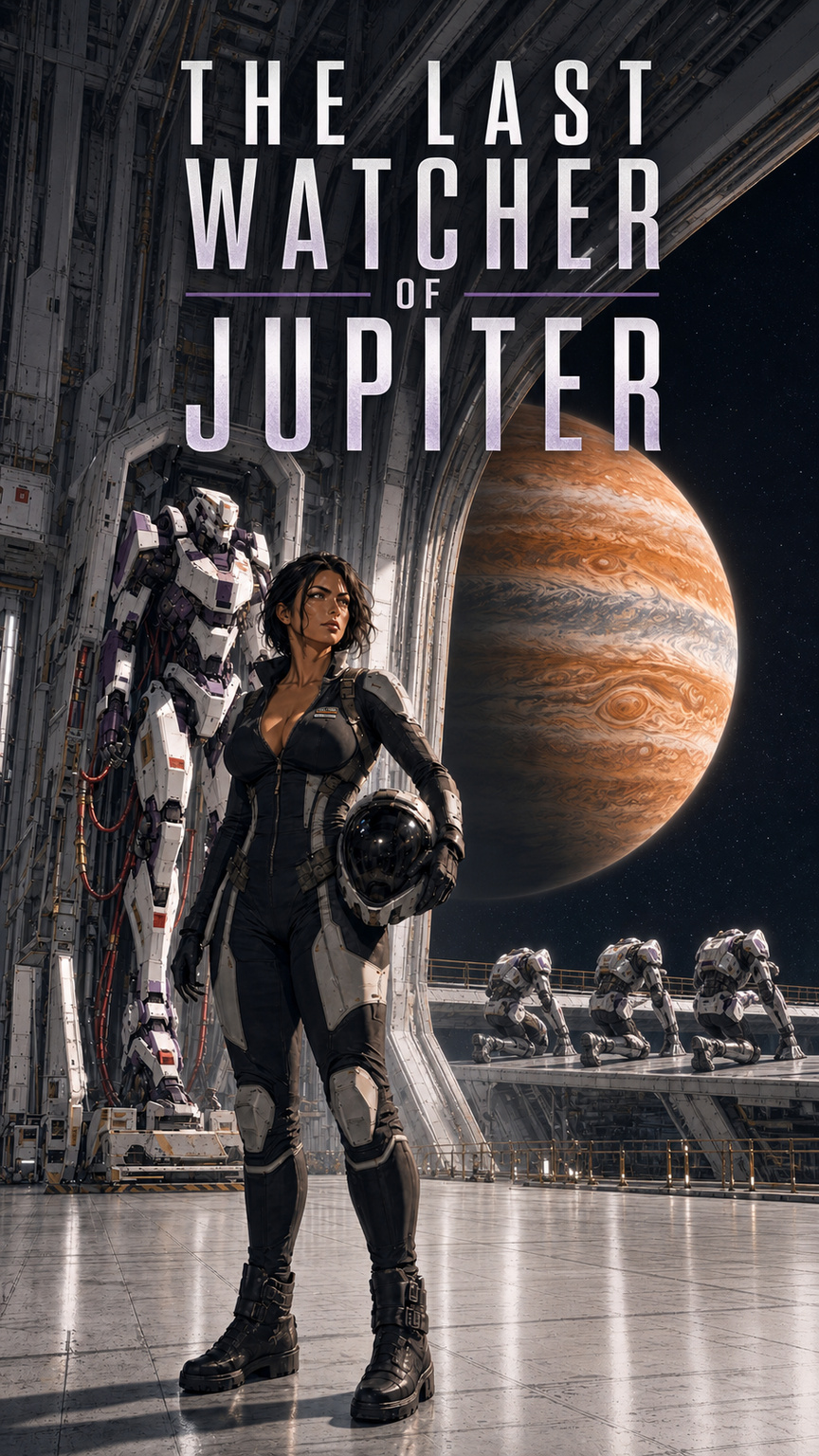
Jupiter filled the lower half of Varai Tzur’s canopy, banded cream and rust beneath the faint green mesh of the quiet lattice. She brought Cairn Nine through the last three degrees of its watch turn by hand. The old frame answered in the order it always did: left ankle, right hip, then the shoulder emitters, each correction arriving a fraction late.
Eight years with the analog integrator, and she still counted that lag in her teeth.
“Nine on mark,” she said.
Twelve mecha hung around Jovian Station’s outer boom, all facing down. Their long legs were folded under them to clear the habitat ring; their emitters aimed through the storm tops toward the electroplasma mass moving below. It had no name. The field team had measured it across a span larger than a continent, rising and sinking through charged hydrogen, branching when the lattice tightened, closing again when it relaxed. Alive, Romesh Ival said. Intelligent, she did not.
For thirty years the watch had kept its upper currents below inhabited orbit. Not a prison, Varai thought. More like holding a river out of a stairwell.
“Seal check,” Idris Pawel said from station command.
The responses came around the formation, some crisp, some tired. Varai pressed two fingers to the rim of her collar.
“Nine sealed. Suit feed at ninety-eight.”
“Four sealed,” Nadja Sile said. “Left glove’s cold again.”
“Noted for turnover.” That was Naveen Okoro in engineering. “Don’t flex the wrist past—”
“I know where it leaks, Naveen.”
“It doesn’t leak. It conducts.”
“My hand is cold either way.”
Someone laughed once, without opening a channel. The sound was more breath than amusement. Then Idris called coolant figures, Romesh gave the organism’s upper margin, and the watch settled into its ordinary work.
At 03:17 station time, eleven machines turned their backs on Jupiter.
There was no warning motion. One instant Varai held the phase marks of Cairns Eight and Ten at the edges of her canopy; the next their shoulder arrays crossed like shutters. All along the boom, white frames rotated in exact unison. Heels swung toward the planet. Knees opened. Arms lowered with palms out, the hard-braced posture used when a carrier took hold of a machine in deep space.
Every departure thruster showed amber.
Cairn Nine stayed where Varai had put it, facing down.
“Abort rotation,” Idris said.
Varai already had both hands on her controls. The quiet lattice fell away so quickly that Jupiter’s horizon seemed to brighten. Nine’s emitter load climbed through yellow.
Voices struck the shared channel together.
“Three, no response—”
“My sticks are live, actuators aren’t—”
“Six has launch arm. I did not—”
“Clear the channel,” Idris said. “Pilots, bodies first. Can you move inside your cabins?”
Answers came unevenly. Yes. Yes, but the turn had thrown a knee against a console. One pilot had lost a tool bag. Another couldn’t see past a shoulder plate now blocking the station lights.
Nadja breathed close to her microphone. “Four’s harness caught me. I can move. Rotation override shows accepted and does nothing.”
Varai looked down. Without the other eleven emitters, the green field had shrunk to a cone beneath Cairn Nine. Far below, a pale seam opened in the storm. It was too straight to be weather. Romesh’s organism plot rose beside it, the upper edge advancing.
“Romesh, rate.”
“Not yet.”
“You have the plot.”
“I have six seconds of it.”
Nine’s hips trembled as the single emitter pushed against a current built for twelve. Varai let the frame drift half a degree east, caught the bucking phase, and returned. Coolant temperature climbed.
Idris’s voice sharpened. “All traffic below the inner ring is halted. Habitat sections two through five are sheltering. Thrusters?”
“Still amber,” Nadja said. “Arming bars at sixty.”
“Mine too,” another pilot said.
“Confirm no one has a departure burn loaded.”
The confirmations tangled. Idris called the frame numbers again until each pilot answered separately.
Naveen cut in on the engineering channel. “Varai, Nine’s command log is clean.”
“I know. It didn’t turn.”
“That’s not what I mean. No rejected command. Nothing reached the analog integrator.”
Varai checked the outer formation. Eleven machines knelt toward the same empty patch of black, their braces squared as if something waited there to receive them. Stars showed between their fingers.
“What reached the others?” she asked.
“I’m pulling it apart.”
Romesh said, “Ascent rate now. Point four kilometers a second and increasing. That is the organism’s upper current, not the storm front.”
“Cause?” Idris asked.
“The lattice collapsed.”
“Cause beyond that.”
“I don’t have one.”
Varai watched Nine’s emitter temperature cross the first red line. “One frame buys how long?”
Romesh hesitated just long enough to be honest. “At this load, four minutes before your field degrades. Less if the current keeps narrowing.”
“Naveen?”
“Three and a half before the shoulder loops soften their mounts.”
“Good. A disagreement.” Varai rolled Nine two degrees and spread the field. The upper current bent with it, not much, but measurably. “Romesh, tell me what it follows.”
They gave the organism a pulse: one shallow contraction, then release. The pale seam slowed after the contraction reached it and resumed when the field relaxed. Romesh asked for a second pulse at a different interval. Varai supplied it while the others knelt behind her.
“Response follows field arrival,” Romesh said. “Not whatever the machines are facing. Within measurement delay, the deep signal and its motion don’t correlate.”
“So it isn’t calling them,” Idris said.
“I did not say what the deep signal is doing.”
“You said enough.”
“I said the rise is a reaction to loss of containment.”
The distinction mattered to Romesh. It mattered to Varai too. They had a hazardous life moving upward because the walls had vanished, not an enemy coordinating an attack.
Naveen’s first analysis arrived as three traces laid over one another. A radio packet repeated an authenticated station codeword. An optical source pulsed along a rotating plane of polarization. Under both, a slow magnetic sweep crossed the formation.
“All three agree on a vector,” Naveen said. “Standard correlators treat concurrence as recovery authority.”
“Recovery for what?” Nadja asked.
“Docking-brace and retrieval alignment. Then departure preparation.”
“Whose recovery code?” Idris asked.
“The codeword is ours. The optical sequence isn’t in current service. The magnetic shape—hold on. No, that’s an artifact. I can’t date any of it.”
“Can it hear us?”
“At the measured range, any answer takes minutes to get there. If there’s something there to answer. The signal is not speech.”
Varai widened a cooling valve. It stuck at seventy percent, then yielded with a knock she felt through her seat.
“Why Nine?” Idris asked.
Naveen was silent for two breaths. “Because I made it worse eight years ago, after the micrometeor tore through its correlator bay.”
Varai almost smiled. “You made it fly.”
“I replaced a destroyed correlator with a slow analog stack. It requires Varai to acquire formation manually. It also can’t authenticate three simultaneous channels.”
The repair had cost Cairn Nine autonomous navigation and made Varai argue for its continued place on every watch roster. Now the same deficiency kept one machine facing Jupiter.
“Then make the others worse,” she said.
“Working on it.”
Idris directed a cargo shutter across the deep-space line. The station’s outer freight galleries had armored leaves for loading under radiation storms. One leaf crawled over the black patch toward which the machines knelt.
As it crossed Cairn Four’s sightline, Nadja’s amber thruster bars flickered.
“Four lost optical,” Naveen said. “Command confidence falling.”
“My right hip is back,” Nadja said. “No—gone. Locked again.”
The shutter covered the optical pulses, but radio still arrived around it, and the magnetic sweep passed through the station’s thin frame. The correlator restored concurrence as soon as its internal model filled the missing channel.
“That was less than a second,” Nadja said. Her breath hitched. “I can’t pull anything in a second.”
Each cockpit had a mechanical service link below the pilot’s seat. Pull it, and the correlator lost its path to the drive frame. Under maintenance conditions it was a heavy red handle and a nuisance. Under full joint load, Naveen said, the sudden transfer could shear an actuator collar and let a limb whip free.
“Detach the eleven frames from the boom,” Idris said.
“No,” Naveen answered before Varai could. “Their docking braces are carrying rotation load. Release clamps now and the frames leave with thrusters half-armed.”
“Can we cut correlator power?”
“Same bus as local control until the service link is out.”
“Can the pilots pull under load?”
“They can. They may lose their frames.” Naveen corrected himself. “Or a pressure hull, depending on which joint fails.”
Idris said nothing for a moment. The station commander had thirteen thousand people behind his risk windows and eleven pilots in machines pointed away from safety. When he spoke again, his voice was measured.
“No service pull without an unloaded indication. Confirm.”
Some pilots answered at once. Others did not.
“Confirm,” Idris repeated, calling numbers.
Nadja’s reply came last. “Four confirms. I don’t like it.”
“You don’t have to.”
Varai looked along the outer boom. The magnetic sweep was slow, its baseline clean because eleven frames held the same brace. Cairn Nine had not entered that geometry. It could.
“If I cross the baseline while the shutter blocks optical,” she said, “does concurrence fail longer?”
Naveen began, “Moving Nine through the outer formation will couple your emitter into—”
“How much longer?”
“I need the path.”
Varai sent him one: out from the lattice cone, over the freight spine, down the line of kneeling machines. Cairn Nine would become a moving magnetic error between the source and each correlator.
Romesh said, “Leaving your current position releases the upper seam.”
“For how long?”
“At least twenty seconds before you can reestablish useful counterphase. The ascent may accelerate. That’s not a prediction of damage at the station.”
“Idris?”
“Habitat shutters draw from the same reserve as traffic control.”
“I need moving windows.”
“I know what you need.” He was talking to someone off-channel. Figures flashed onto Varai’s display: occupied sectors, shelter counts, power margins. “I can brown out three habitat sections for forty-two seconds. Then life support circulation loses priority.”
“Forty-two is enough for one pass.”
“You don’t know that.”
“It’s enough to find out.”
Idris took three more confirmations before he gave the order. Habitat lights vanished from the ring in broad dark wedges. Freight shutters began moving, not all together but in a sequence that cast shadow windows across the kneeling frames.
Varai folded Nine’s emitter to minimum. The pale seam below immediately sharpened.
“Cairn Nine leaving hold.”
She kicked away from Jupiter.
The frame rose past the boom with its old fractional delays, too slow in the ankle, stubborn at the shoulder. Varai flew it as she always had, through anticipation instead of correction. Behind her, the single green cone disappeared. Ahead, eleven machines presented their backs, close enough now that she could see frost whitening the edges of their radiator vanes.
“Four entering shadow,” Idris said. “Magnetic error rising. Four, report unload.”
“Right knee falling. Hip still—still loaded.”
“Nine, two degrees outward,” Naveen said. “No, hold. Your left emitter is coupling. Fold left, not both.”
Varai folded the left shoulder array. Cairn Nine slipped between the boom and Four.
Nadja grunted. “Hip free. Service is behind my right thigh. I have to get under the harness.”
“Window six seconds,” Idris said.
“Don’t count yet.”
“Five.”
“I said don’t—” Nadja’s breath turned rough. Something struck metal inside her cabin. “Got it. Pulling.”
“Load?” Naveen asked.
“Knee clear. Hip clear. Pulling now.”
The service link came out with an audible crack over her microphone. Cairn Four’s thruster bars went black.
“Four local,” Nadja said, each word clipped short. “Left side answering. Right emitter control is under the brace.”
“Can you dog it inward?” Varai asked.
“If you stop moving the floor.”
Varai held Nine against the magnetic push while the shutter window moved past. Nadja released one hand from somewhere, cursed once in a small voice, and hauled her emergency emitter lever through its detent.
Cairn Four’s shoulder array turned toward Jupiter.
“Four inward,” Nadja said.
Green light opened below her machine.
It was only a narrow panel of lattice, uneven beside the seam, but the organism’s upward edge spread instead of sharpening. Varai brought Nine around and joined it. Two emitters now. Coolant alarms multiplied across both displays.
“Next sector,” Idris said.
The release did not become smooth.
Frame Two missed its first window because its pilot had lost feeling in two fingers and refused to pull until she could hook the handle with her whole hand. She freed it on the second shadow. Frame Six reported unload, then corrected: left ankle still at twelve percent. Its pilot waited until Varai crossed the baseline again and the number fell to zero. Idris held the shutter while station lights dimmed to embers. Naveen changed Varai’s approach by half a degree, then changed it back when the boom flexed under magnetic load.
At Frame Seven, two pilots talked over the count.
“Stop,” Varai said. “Seven owns the channel.”
“I don’t have shoulder unload,” Seven said. “Not pulling.”
Idris’s count ended.
“Window closing,” he said.
“Then close it.”
They let the signal take Seven’s frame again and moved on. No one called the refusal wasted time.
At the next shadow, Seven’s pilot rolled her body against the restraint to reach a manual trim wheel. It did not move the machine, but it shifted enough hydraulic pressure to clear the shoulder indicator.
“Now,” she said.
Naveen answered, “Condition good—wait, right collar is climbing. Pull before twelve. Before—”
The link released at eleven.
They recovered Three and Ten in overlapping windows. Nadja, breathing more steadily, walked each freed pilot through the awkward reach under the harness. She never said it would not hurt. She said which buckle to slacken and where the handle would strike the thigh when it came free.
“Count inward emitters,” Idris said.
Answers collided.
“Five—”
“Six if Twelve holds—”
“Twelve is not local.”
“Again,” Idris said. “By frame. Nine?”
They counted seven.
Below them, the upper current had broadened across the storm, brighter but no longer needle-straight. Romesh’s projected band still touched the station’s orbit.
“Seven emitters don’t stop it,” Romesh said. “The rate is falling, but the wake remains hazardous.”
“We know what eight does,” Varai said.
“We know what nine sustains under normal conditions.”
“Today isn’t normal.”
“No.” Romesh enlarged the uncertain band. “Eight may slow the upper edge. It will not give us a safe reshape.”
They freed Twelve on the third pass. Its pilot pulled cleanly, dogged the emitter inward, and called the phase before Idris asked.
Eight green planes met above Jupiter.
The pale seam stopped climbing.
No one cheered. Romesh waited through two sensor returns and said, “Upper rate below zero point zero two. That is slowed, not contained.”
“Need ten,” Varai said.
“Confirmed,” Idris replied. “Habitats two through five have thirty seconds of shutter reserve. Confirm occupied maintenance sector on the outer boom is clear.”
The confirmation came late. Idris asked again. A maintenance chief reported two workers still crossing an access tube.
Varai could see the next shutter ready above Frame One. “I can take the window.”
“Negative. Sector occupied.”
“Their tube is shielded.”
“Sector occupied. Hold.”
The organism’s current pressed against the eight-part field. Cairn Nine’s analog traces swelled across Varai’s display, growing bright at the edges. She could feel the integrator warming through the console beneath her palm.
They held.
When the maintenance chief called clear, Idris opened the shutter. They released One, then Eleven. Ten emitters faced down, their fields ragged and mismatched after the forced turns.
Varai took the center phase because Cairn Nine was already there. “Four, shorten west edge. Three, you’re pushing through Seven.”
“Three correcting.”
“Too far. Back half.”
“Seven sees it.”
“Eleven, don’t copy the formation average. Your shoulder is hot.”
“Then give me a lower phase.”
Varai did. The lattice ceased being a set of separate green panels and became one warped plane, tilted away from the habitat ring. Jupiter’s storm tops flashed as the organism’s charged wake met it. The field did not drive the life downward. It bent the rising current sideways, spread its charge through a longer reach of atmosphere, and lowered the hazardous edge below their orbit.
Romesh watched three returns. “Wake band below station minimum. Still falling.”
Idris said, “Confirm below minimum.”
“Confirmed below minimum. The organism remains elevated relative to the start of watch.”
“But not reaching us.”
“Not on current measurements.”
Only then did Varai notice the smell in her cabin, hot resin and old insulation.
“Nine integrator temperature is past scale,” Naveen said. “Varai, break center phase.”
“Two frames still under signal.”
“Ten can hold the reshape. You are burning the stack.”
“Eight and Five still have armed bars.”
“Their shadow windows are next. You don’t need to carry center.”
Varai moved to break phase. Cairn Nine answered at the left ankle, then the right hip.
The shoulders did not move.
A white spark crossed the edge of her console. The analog trace collapsed into a flat line.
Cairn Nine’s emitter went dark.
The lattice shuddered. Frame One took center without being asked; Four widened west; Eleven cut its overheated shoulder and compensated with the other. Nine green planes held, then Eight’s pilot pulled her service link in shadow and brought a tenth online.
Frame Five’s correlator isolated cleanly, killing its thruster arm, but an emitter interlock had fused during the kneel. The frame was safe and dark.
“All departure bars black,” Idris said. “Confirm all twelve.”
He called them one by one. Every pilot answered. Some answers came with coughing, some after checks of seals and coolant, one after a confused search for a microphone knocked loose in the first turn.
“Deep signal persists,” Naveen said. “Correlators physically isolated. It has no command path.”
“Source motion?” Idris asked.
Romesh answered. “Insufficient baseline.”
“Intent?”
“No evidence.”
Jupiter rolled below them, its bands sliding at different speeds beneath the geometry they had repaired. The organism’s upper current spread under the lattice and slowly descended. It had responded to pressure and release. That was all they knew.
Forty minutes after the machines knelt, the next watch took formation.
There were ten working emitters instead of twelve. Nine could sustain the quiet lattice. Ten could reshape it safely. They had exactly enough, which was another way of saying they had nothing spare.
Varai remained strapped inside dark Cairn Nine while Naveen walked her through manual cooldown. Without the integrator, the frame had no formation sense at all. Her canopy showed only Jupiter, the boom, and the green edges of other people’s work.
“Coolant bypass open?” Naveen asked.
Varai leaned past the dead console and put her glove on the physical wheel. “Half.”
“It needs three quarters. The lower line may stick.”
“It always sticks.”
“The upper one sticks. Lower is—no, you’re right. Lower started after the last seal change.”
She put both hands on it. The wheel moved one notch.
Nadja came onto the private channel. “Four is stable. My hand’s warm now.”
“Good.”
“It’s swollen.”
“Less good.”
“Medical’s meeting me at the lock. They asked whether I pulled the link against load.”
Varai looked at the flat trace where Nine’s old lag used to live. “You didn’t.”
“I know. I wanted someone else to say it.”
“You waited for your window.”
Nadja let out a breath. “Yes.”
Idris began the formal handoff on the shared channel. Ten frames answered inward. Two reported safe offline. Habitat circulation returned section by section. Traffic remained stopped. The distant signal continued repeating its three-part command into correlators that were no longer connected.
When Idris reached Cairn Nine, Varai turned the coolant wheel another notch.
“Nine safe offline,” she said. “Pilot remains aboard.”
“Relief tug will reach you in fourteen minutes.”
“Copy fourteen.”
Below her, the field held without Nine. Varai watched its uneven edges settle as the new pilots corrected one another, some too quickly, some after a repeated count. She listened until their timing became a watch instead of an emergency.
Then she took her hands off the wheel and waited for the tug.