Late for Dinner
One of the neat things about being married to one of the most feared generals in the kingdom, is that she will show up with her legion and eviscerate your foes, if your battle is making you late for dinner.
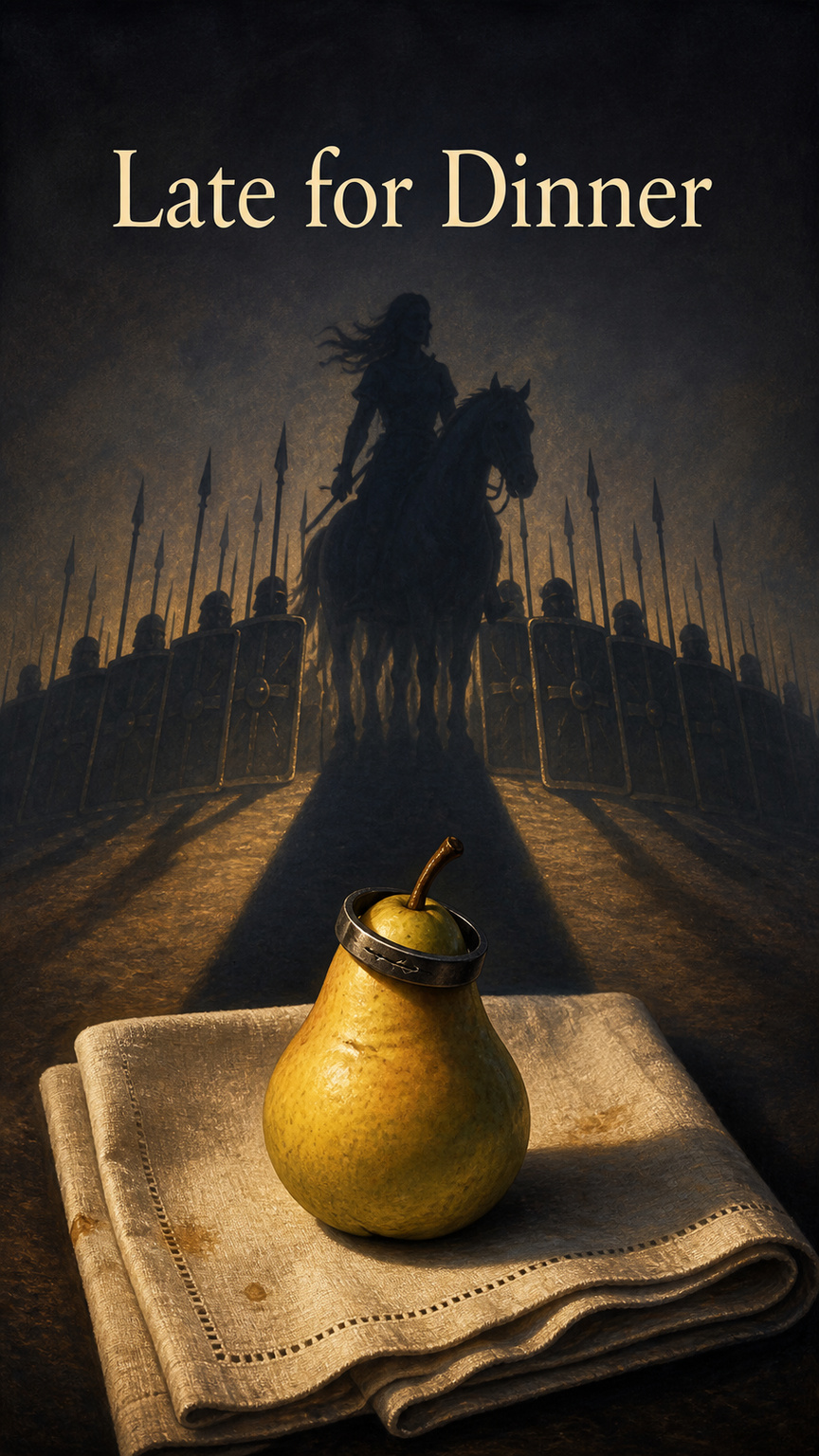
The first warning that dinner would be late was a man in enemy colors stepping out of the ditch and saying, with surprising courtesy, “Please stop the mule.”
The carter hauled the reins. The mule, who had no opinion about border wars but strong opinions about men appearing from ditches, stopped somewhat later. By then the wagon had slewed across Plover’s Cut, the crock of cream had tipped into the onions, and three spears had risen from the thorn scrub on the western bank.
Rellan looked back. More soldiers had closed the road behind him. Ahead, where the sunken track climbed toward the barley fields and Juniper House, a mounted pair waited beneath a dun-colored banner.
His household guard reached for his sword.
“Don’t,” Rellan said.
The guard did.
Everything after that happened with the graceless speed of a cupboard collapsing. A crossbow snapped. The bolt struck the wagon rail rather than the guard, but the mule lunged, the carter lost the reins, and the left wheel climbed the chalk bank. Rellan caught one glorious glimpse of the pears he had spent half the morning choosing as they rose around him like green stars.
Then the wagon overturned.
He landed among sacks of flour and something sharp enough to be either a buckle or the expensive cheese. The guard struck the road hard and lay with one leg pinned beneath the wagon shaft. The carter rolled free, swearing after her mule as it tore north through the startled soldiers, trailing half a harness and all hope of arriving home with dignity.
Steel rang twice. Somebody cried out. Then a different voice, furious and frightened, shouted, “Alive, you fools. He is worth nothing dead.”
The fighting stopped.
Rellan lay in the white dust and considered that sentence. His left ear rang. Rosemary crushed beneath his palm made the air smell clean and domestic, which felt insulting.
A narrow man in a battered officer’s coat came down the road. Blood darkened one sleeve, though he did not seem to notice it. The silver braid at his collar had been cut away in places, perhaps sold, perhaps used for bandages. He glanced at the guard, the carter, the broken wagon, and finally Rellan’s iron wedding ring, engraved with the broken spear that marked Nerava’s dispatches.
“Rellan of Juniper House?”
Rellan pushed himself upright. “At present, Rellan of the ditch.”
The officer stared at him. His soldiers did not. They watched the banks, the mouths of the road, the evening sky. Their boots were caked with two colors of mud, and several wore cloaks with the badges ripped off. Not an ambushing force, then. A force that had run until it found a hole and mistaken that for safety.
“Captain Cadren,” the man said. “You will come with me.”
The guard strained against the shaft. Rellan heard the breath whistle between his teeth.
“I will not,” Rellan said. “But if your people lift this wagon, we can discuss the matter while my guard keeps his leg.”
Cadren’s mouth tightened. He had prepared himself for terror or defiance. An objection about furniture did not fit anywhere useful.
“You are in no position to bargain.”
“That is a man under a wagon, Captain. It is not a bargain.”
For a moment Cadren seemed likely to refuse merely because Rellan had made agreement difficult. Then one of the enemy soldiers said, “Sir, the south watch saw riders.”
Cadren looked toward the hidden southern mouth. “How many?”
“Couldn’t tell.”
“Then why are you telling me?”
The soldier had no answer. Cadren rubbed dust across his forehead and ordered four soldiers forward.
They raised the wagon enough for the carter to drag the guard clear. Rellan crawled after him and tore a strip from his dinner linen to bind the swelling leg. The cloth had been white when he packed it. Now cream, onion skins, and road dust had made a map of it. He hung the remaining linen from the wagon shaft.
Cadren waited until the knot was tied.
“General Nerava is encamped three miles east of here,” he said.
“Four and a half.”
“You will write to her. My company requires unhindered passage to the western road, with our arms and wounded. Once we are clear, you will be released.”
Rellan sat back on his heels. “No.”
Several spear points shifted closer.
Cadren looked almost relieved. This, at least, was a kind of answer he understood. “You mistake your circumstances.”
“You mistake my marriage. I cannot order Nerava to move a legion.”
“You can ask your wife to spare your life.”
“I can ask. She can say no.”
The carter made a small sound that might have been a laugh if she had not immediately pretended to cough.
Cadren’s face reddened. “Write.”
“My paper is under the wagon. My ink is in the cream. And the messenger you send will be taken by the first patrol outside this cut.” Rellan looked at the sun balanced above the bank. “You would do better to leave now. I am expected home for dinner.”
Silence spread outward from Cadren. Even the guard opened his eyes.
“Dinner,” Cadren repeated.
“My wife has been away for five months.”
“My company has been without bread for two days.”
“Then we are both having poor afternoons.”
That was the wrong thing to say. Rellan knew it before Cadren’s expression changed, but knowing a mistake at once did not make it less made.
Cadren ordered the ring tightened.
His soldiers dragged a splintered handcart from the ditch across the southward track and built a rough breastwork of baskets, wheels, and Rellan’s winter kindling. The household party was left inside a narrowing oval around the overturned wagon. The enemy did not rush them. Cadren wanted Rellan standing and recognizable, and every one of his exhausted soldiers knew it.
Rellan wanted, with increasing pettiness, his pears back.
He had planned this evening too carefully. Nerava had eaten campaign food for five months: hard biscuit, salt meat, whatever could survive both a saddlebag and an officer’s conscience. He had promised no officers, no petitions, no maps on the table. Just roast onions with thyme, soft cheese, pears warmed in honey, and the two of them in a room where nobody called her General.
For once, nobody was meant to obtain anything by saying his wife’s name.
Now Captain Cadren had built a fort out of dinner.
The bank behind the wagon was steep but not impossible. Rellan waited until Cadren had gone to berate the south watch, then pushed through the thorn scrub on hands and knees. Chalk crumbled beneath his boots. He made six feet, caught hold of a root, and discovered too late that it belonged to a dead thistle.
He slid back into the road in a shower of dirt and landed on a basket of onions.
An enemy soldier laughed. Another joined him before remembering he was under orders. Cadren turned. The laughter stopped badly, one man choking on the last of it.
“Again,” Cadren said to Rellan, “and I bind you.”
“You could have said the bank was loose.”
“This is not hospitality.”
“No. At Juniper House we warn people about the footing.”
The guard caught Rellan’s sleeve before he could continue. Pain had blanched his face. “Sir. Perhaps less talking.”
It was sound advice. Rellan ignored it for another quarter hour.
He tried offering the enemy food, which Cadren took for an insult until one of his own soldiers snatched a dirt-coated onion and ate it raw. That broke something. Hungry people came forward from both ends of the ring. The carter cursed them for thieves, then began throwing bruised pears hard enough that they had to catch them. For a little while the battle reduced itself to complaints about rot, stones in the bread, and who had taken the cheese.
Rellan watched the light creep up the eastern bank. The cut would fall into shadow before the fields above it. Nerava would reach Juniper House at sunset. She would find the table laid, the kitchen hot, and his chair empty.
She would wait perhaps three minutes before asking where he was.
Perhaps two.
At the last crossroads, his guard had offered to ride ahead when smoke first showed above the western road. Pride had kept Rellan from sending him. He had wanted to solve one ordinary delay without summoning the kingdom’s most feared general like a household remedy for mud. Now, listening to Cadren repeat the same orders to soldiers who had begun pretending not to hear, Rellan’s worry shifted.
It was no longer that Nerava might fail to come.
It was that she would.
Cadren returned to find him sitting on the wagon bed beside the wounded guard.
“I will give you quarter,” Rellan said.
Cadren stopped. “You.”
“Yes, unfortunately. Lay down your weapons before my wife arrives. I will stand before her and the crown’s officers and say you surrendered to me. Your wounded will be treated. No one here will take revenge.”
“You have just explained that you command nothing.”
“I command my word.”
“Can your word open the western road?”
“No.”
“Can it keep my soldiers out of prison?”
“I don’t know.”
Cadren gave a short, ugly laugh. “Then you offer a prettier cage.”
His company had crossed the border expecting an easy march behind two larger columns. The larger columns had broken. Cadren said this in pieces, as if each piece had been forced from him by the inconvenience of Rellan not understanding. Farms had shut their gates. Bridges had been burned behind them. Three men sent to bargain at a village had not returned.
“My soldiers know what waits if they put down steel,” he said. “Your people call your wife the Ash General.”
Rellan had heard the name. Nerava disliked it. Not because it frightened anyone, but because the battle that earned it had been fought in spring rain and there had been very little ash.
“My people call her a dozen foolish things. She keeps terms.”
“Because her husband says so?”
“Because she does.” Rellan stood. The movement made the world tilt briefly; he caught the wagon rail. “But she also knows this ground. If she comes, she will take the heights before you see a boot. She will close both mouths. She will leave you nowhere to retreat and nothing useful to threaten except me. And when she sees you threatening me, Captain, your afternoon will become worse.”
Cadren glanced upward despite himself.
Above the western bank, a flock of plovers burst from the barley. They wheeled once, flashing pale undersides, and fled east.
Nobody spoke.
Far beyond the cut, a horn sounded one low note.
The enemy soldiers knew an army horn. They did not know that one. Rellan did. He had heard it outside six towns, from balconies and muddy fields, each time before Nerava came home only long enough to leave again.
Cadren seized Rellan by the front of his coat. “Tell her you are alive.”
“She cannot hear me.”
“Then climb the bank.”
“Your archer nearly killed me when I was standing beside a wagon. I am not showing Nerava a ring of armed people and letting her guess which ones have discipline.”
The horn sounded again, farther north than before.
Cadren released him and began shouting. Half his company rushed to the south barricade. The other half rushed north. A horse screamed from somewhere above, then came sliding riderless down the chalk, its reins cut and its eyes white. Men scattered. One fell. Another lost his shield and crawled after it until Cadren kicked it back to him.
Dust rose beyond both banks.
Then soldiers appeared along the western rim.
They did not cheer. They did not wave weapons or announce who they were. One moment the ridge held thorns and yellow grass; the next it held a line of dark shields, each overlapping the next. Bowstrings drew together with a soft, enormous creak.
On the eastern rim, mounted troops rose against the pale sky. At the north mouth, legionaries advanced behind rectangular shields. The southward track vanished behind another rank. Cadren’s company, which had spent an hour making Rellan’s world smaller, discovered that theirs had shrunk to the width of Plover’s Cut.
The first flight of arrows struck the road beyond Cadren’s outer ring. Dirt jumped in a perfect line. His soldiers recoiled from it into one another.
The second flight did not warn.
Rellan pulled the carter down behind the wagon. Arrows hammered shields, split spear shafts, and drove men from the banks. At the northern barricade, Cadren’s soldiers charged because standing still had become worse. They met the legion with a crash that shook kindling from the cart. Figures pressed, stumbled, disappeared behind shields. A man rolled into the ditch clutching his arm. Another lay very still beneath the dun banner.
The legion kept coming.
This was what fear of Nerava misunderstood. People imagined fury because fury made comforting sense. Fury wasted itself. Nerava’s battles moved with the dreadful economy of a hand clearing a table: this removed, that contained, the necessary space made empty.
Rellan saw her at last on the eastern bank.
She sat a gray horse without a plume or bright armor. Five months had sharpened her face and put new silver at one temple. While officers shouted around her, she looked down into the cut until she found the overturned wagon.
Until she found him.
Everything in her went quiet.
Cadren saw it too. He dragged Rellan upright and set a sword beneath his jaw.
The pressure was light. Cadren’s hand was shaking.
“General!” he shouted. His voice cracked on the second syllable. “Western passage, or your husband dies.”
Nerava raised two fingers.
The legion stopped so quickly that the sudden absence of impact seemed louder than the fighting. Shields remained locked. Bows stayed drawn. Somewhere in the cut, a wounded man begged somebody he could not see for water.
Nerava looked at Cadren. “No passage.”
“I will kill him.”
“Then you will still have no passage.”
Cadren’s fingers clenched in Rellan’s coat. Around them, his soldiers had begun lowering their weapons without permission. One man flung down his spear and shouted, “I take the quarter!” A sword followed. Then another. The legion’s ranks did not open, and the bows above remained drawn.
Cadren shouted, “Hold!”
No one did.
Rellan saw his stained dinner linen hanging from the wagon shaft. He reached for it.
Cadren jerked him back. The blade nicked skin this time, a bright small sting. Nerava’s bow line adjusted. Rellan knew that movement too. It meant the next decision would be very fast and would not belong to Cadren.
“Captain,” Rellan said. His mouth had gone dry. “Let me raise the cloth.”
“She’ll loose.”
“She might. You have not given her much to work with.”
Cadren stared at the ranks closing both ends of the cut. His command had come apart one dropped weapon at a time. He wanted a road. He wanted not to beg. He wanted the last hour to have meant something.
Rellan wanted to go home.
“It is quarter,” Rellan said. “Not victory. Not freedom. Living through the evening. Take it.”
Cadren’s sword lowered half an inch.
Rellan pulled free, snatched the linen, and climbed onto the overturned wagon. The wounded guard swore at him. The carter told him to get down. Someone on the bank shouted his name as if volume could make him less exposed.
He raised the dirty cloth.
Nerava’s gaze moved from it to his face. “Is that yours?”
“Yes.”
“Terms?”
“They put down weapons. They live. Treat the wounded. Hold them for the crown if you must, but no revenge here.” Rellan heard himself beginning to rush and forced the rest out plainly. “I gave my word.”
Cadren said behind him, “He promised protection.”
“I promised you would live,” Rellan snapped. “You kept arguing about the road.”
Cadren’s formal rage cracked. Beneath it was plain embarrassment, arriving late and unwelcome.
Nerava watched Rellan. Not the cloth. Not Cadren’s sword. Him.
“Do you stand by it?” she asked.
“I do.”
She lowered her hand.
“Quarter stands,” she said.
The words moved through the legion faster than a horn call. Bows eased. Shield ranks opened narrow lanes. Officers repeated the terms. Cadren’s soldiers dropped what remained in their hands and stumbled toward custody.
Cadren stayed where he was.
Rellan climbed down from the wagon. His knees nearly folded when his boots touched the road. He held the stained linen out to the captain.
“You wanted my marriage,” he said. “There it is.”
Cadren looked past him at General Nerava, who had dismounted and was coming down into the cut. Then he looked at the linen. He took it as though it weighed more than his sword.
The sword fell from his other hand.
Nerava passed Cadren without a glance. She stopped before Rellan and touched one finger to the cut beneath his jaw.
“You’re bleeding.”
“A very little.”
“You are standing on one foot.”
Rellan looked down. This was true. “The other has an onion in the boot.”
Her eyes closed. For one dangerous instant he thought she might either embrace him or demand an accounting before he could breathe. Instead she took his face between both hands and pressed her forehead to his.
Around them, the feared legion stripped weapons from prisoners, carried the injured to level ground, and cut panicked horses free of tangled harness. Nobody looked at their general.
“You brought the legion,” Rellan said.
“I was with the legion.”
“All of it?”
“The rear cohorts are at Juniper House.”
“That is not better.”
Her thumbs moved once against his cheeks. “You were late.”
“I noticed.”
“There was smoke on the western road. Your wagon had not passed the east post. A patrol found the mule.”
Behind Rellan, the carter cried, “You found him?”
Nerava turned her head. “He is eating barley in my command tent.”
“That animal has no respect for rank.”
“So I gathered.”
The carter went to help with the guard, satisfied that her mule had survived and aware that the man beside her still needed help.
Rellan looked at Cadren’s company kneeling in small, exhausted groups. “Thank you for stopping.”
Nerava’s attention came back to him. “You asked me to.”
“I was not certain that would be enough.”
“Neither was I.” She glanced toward the still figure beneath the dun banner, then to the legion surgeons already moving among both uniforms. When she spoke again, her voice was lower. “It had to be.”
She assigned Cadren’s prisoners to three separate watches, ordered every wounded person treated before questioning, and refused an officer who tried to arrange the legion along the road for her departure. There would be no victory display at Plover’s Cut. The living had enough to carry out.
By the time Rellan and Nerava reached Juniper House, night had settled over the barley. Campfires covered the eastern fields in orderly rows. Soldiers had watered their horses in the orchard trough, stacked shields beside the kitchen garden, and left a respectful empty circle around the house itself.
Inside, the dining room candles had burned down by half. The roast onions were black at the edges. The cheese was somewhere under a wagon. Of twelve pears, four had returned in a legion supply cart, and only one had escaped bruising.
Nerava unbuckled her sword belt at the door. For a moment she looked around for somewhere proper to set it. Rellan pointed to the peg beneath his market cloak.
She hung it there.
They sat at the kitchen table instead of the dining table. Rellan could not bear the sight of all the unused plates. Nerava ate cold bread, one roasted onion, and two damaged pears with the concentration she gave any meal after campaign. Without the officer’s coat and sword, she seemed at once more familiar and more tired. The silver at her temple was not dust. He wanted to ask when it had appeared. He wanted to complain about the cheese.
For a while they listened to each other eat.
Then Nerava said, “Did you know I would come?”
Rellan turned the one perfect pear in his hands. “I knew you would notice.”
“That is not what I asked.”
“Yes.” He looked at her. “I knew.”
“Did you want me to?”
The honest answer had changed during the afternoon. “By the second horn.”
Nerava leaned back. Something in her shoulders loosened—not much, but enough that he could see how tightly she had held herself since the cut.
“I wanted one evening,” he said, “when nobody used me to reach you.”
“Cadren did.”
“He tried.”
“And you offered him quarter.”
“He was afraid of you.”
“He had cause.”
“I know.” Rellan set the pear on his plate. “Sometimes I hate how much cause everyone has.”
She did not defend herself. Her hand stayed beside his on the table, and she waited.
Rellan picked at the split in the tabletop. “Cadren thought I was a gate he could put a knife against.”
“You are not a gate.”
“I know that. You know that. It was a crowded afternoon for slower learners.”
Her mouth twitched.
“I did not send for you,” he said, “because I did not want to need the Ash General every time a road went wrong.”
“Good. I dislike that name.”
“You dislike all your names.”
“Not all of them.” She reached across the table and turned his wedding ring once around his finger. “Next time the road goes wrong, send for Nerava.”
He covered her hand with his. “There will not be a next time.”
Outside, three thousand soldiers answered the first-watch horn with one vast shift of armor and canvas.
They both listened.
“There had better not,” Nerava said.
Rellan glanced toward the window. It was only a moment. When he looked back, the unbruised pear was gone from his plate.
Nerava bit into it without shame.
Rellan began, at last, to laugh.