Leave the Names
Your caravan strips dead cities for a living, and the code of the trade is older than any of them: take the metal, leave the names. Yesterday your apprentice sold a name. - A salvage culture with its own ethics for the world's endless ruin layer — names as the one sacred residue.
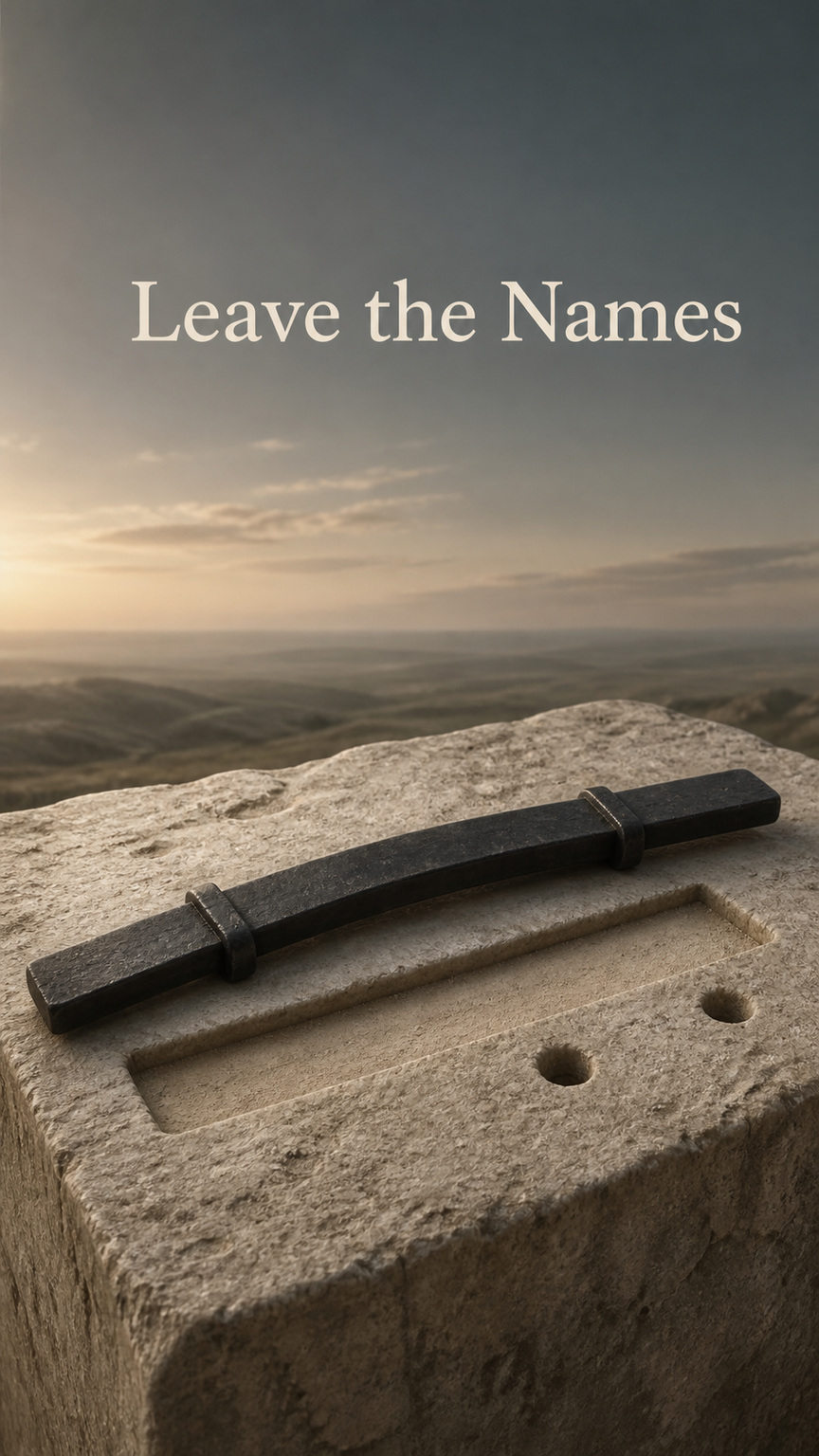
By first light, Kedra had the third wagon on the scales and a hole in the leave ledger.
“Rear axle, four hundred twelve,” called the rigger at the weights.
“Four-ten if you scrape off his breakfast,” the cook said. He was trying to fit a lidded pot beneath the seat without spilling the soaking water.
“Four-twelve,” Kedra said, and marked it. “Move the water casks forward. Not both. The left one.”
Harness buckles clicked up and down the line. The draft animals had been walked, watered, and persuaded into their collars; now they stamped in the pale dust as if the road delay were a personal offense. Beyond them, Cerdovan held the last blue shadow of night in its roofless courts.
Kedra turned back one page. Clean copper, twenty-three sheets. Lamp rail, nine lengths. Green glass, six nested crates. At the bottom were the things that had been exposed and supported but not taken: three mortuary indices, the lettering from the east exchange, and the paired city strips. One strip still had no second witness mark.
The witness spaces covered the cutter’s oldest rule. Metal could enter the buying book; an original surface that named a person or place remained where it had been found, along with any identifying tally joined to one. Departure waited for proof.
“Who checked the north cistern after Beshan?”
The calls thinned. A buckle tongue dropped against iron.
Under the lead wagon, the driver said, “You’d better tell her what you paid with.”
“I paid for it,” Beshan answered too quickly.
Kedra closed the ledger on one finger. The new brake leaf showed black beneath the axle, its oil not yet furred with road dust. Yesterday the old leaf had clicked under load. Beshan had told her the crack was walking. She had ordered it bound in wire until they cleared the shelf road.
The new leaf was not in the buying book.
“Out,” she said.
Beshan slid from under the wagon with the wrench still in his hand. His hair was full of grit from the axle bed. “The pin sits clean. I put two collars on because the old shoulder is worn, but the second collar can come off if it crowds the hub after heat. I checked the draw—”
“Where is the cistern strip?”
The wagon line stopped. He looked first at the ledger, then at the city.
Kedra held out her hand for the wrench. When he gave it to her, she passed it to the driver. “Where?”
“Lurem has it.”
The cook set down his pot. Water crept around the lid and darkened the dust.
“For the brake leaf?” Kedra asked.
Beshan nodded. Then the words came in a rush. “It was intact when I delivered it. I cut outside the letter bed, left two fingers of backing, braced the lip before lifting, and the east mate is still seated. Lurem’s reader takes either original strip. He said he would price redemption for one day, but use began at first bell. I meant to buy it back after the shelf settlement, before the keepers closed inventory. There was no damage when I left.”
“You meant to cross first.”
“If we missed the gate, the bond was gone.”
“When did you cut it?”
“Before the last descent.”
Kedra saw that descent again: the lead animal kicking sideways at a sheet of loose tin, the wagon leaning into its trace, the new leaf taking the weight with a hard clean groan. The old one, bound as she had ordered, would have parted. Three wagons had been nose to tail behind it.
“I had six other offers ready,” Beshan said. “Coil wire, half the glass, my winter share, repair labor through—”
“He refused them.”
“Yes.”
“And you did not wake me.”
His mouth opened. Nothing came out.
Kedra turned to the crew. “Unload the scale. Wagons around.”
The driver stared at her. “The shelf gate closes before noon.”
“We aren’t taking the shelf yet.”
“The animals have already walked out their stiffness.”
“They can walk it back in.”
The cook lifted the pot with both hands. “This was noon meal.”
“Then keep the lid on.” Kedra pointed down the line. “Casks stay forward. Glass wagon takes the outside turn. Tie the clean metal again.”
“It is tied,” the rigger said.
“Tie it for a turn made angry.”
She gave Beshan no tool. “Your cutting and buying marks are suspended. You touch no blade, ledger, or trade seal. You work only when I name the task.”
He swallowed. “For how long?”
“Turn the second wagon.”
She watched him go to the traces before she checked the turning room between the wagons.
They heard the dissolution engine before they reached the north court. Its drums worked out of step, one deep and one quick, with chain drag between. The city had built the machine to surrender its own civic metal under authority: tagged beams, public fittings, lintels, rails. Either original city strip fitted the reader and released the tags. A copied inscription did not fit the foundation teeth.
Lurem had found plenty still tagged.
An iron beam crept across the court on hooked chains. Behind it, two flattened lintel plates knocked against each other as they approached the rollers. Their letters had already folded inward. On the far side of the moving line, Sovet and two keepers knelt beside chalked squares, recording what passed before it lost position. Sovet held up a numbered board. Nobody at the engine looked long enough to read it.
Kedra stepped onto the loading block. “Feed off. Slack the west chain.”
One of Lurem’s hands reached for the clutch. Another looked toward the counting shed.
Lurem came out buttoning one cuff. “You ring my floor now?”
“Your west drum is pulling across the guide.”
He looked once. “Feed off,” he called. “West chain to half.”
The clutch dropped. The quick drum stopped, but the iron beam continued to crawl on stored tension. A mortuary index tilted from a sled. Sovet caught its lower edge with a padded hook and shoved it back without crossing the painted moving line.
“All chains down,” Kedra said.
“Half,” Lurem corrected. “Down under that load, the reader twists and keeps my strip.”
“The strip from the north cistern,” Sovet said. He did not look up from the chalk square he was redrawing. “Cerdovan, upper line complete, lower edge cut outside the witness holes. Removed yesterday.”
Lurem spread his hands. “Sold yesterday. Clear face, seller’s mark, full exchange. If this is a caravan dispute, take it past my line.”
Kedra could see the strip in the reader housing, brass behind a narrow glass guard. The words CERDOVAN ran upright. Its irregular lower teeth sat in the machine as they had once sat in the cistern foundation. The reader did not speak them or remember them. It held their shape, and the old mechanism released what that shape had authority to release.
“Beshan,” Kedra said. “Can the load be set without bending it?”
He had remained behind her, hands open and empty. “Yes. If the north pawl is still taking. If it’s not, the west drum has put twist through the reader and we need to back-wind before we lift. If the guide shoe cracked, we need a cradle under the whole—”
“Look.”
He crouched at the painted line. For a few breaths he said nothing.
Lurem tapped his cuff flat. “He looked yesterday. That was part of his payment.”
Beshan’s face went still.
“North pawl is taking,” he said at last. “The guide shoe is whole. Back the west drum one tooth. No more.”
“You may direct that task,” Kedra told him. To Lurem she said, “Set the load. No new feed.”
“Until?”
“Until we settle custody.”
Lurem watched the caravan bunching at the court entrance, the casks sweating dark rings onto their racks, the clean-metal wagon bright under its tarp. “My custody is settled.”
Sovet laid the numbered board beside the folded plates. “Not my inventory.”
Kedra crossed to him. “How much passed?”
“Do you want a number or an answer I can witness?”
“Both.”
“Then stop asking while the pieces move.” He pointed with his chalk. “I have thirteen entries. There may be fifteen objects. That lintel was two when it had a wall and one when his chain lifted it. I have not decided what it is now.”
Behind them, Beshan told a hand, “Left, not right. One tooth. Stop. Stop there.”
The west drum settled. The reader housing gave a sharp tick.
Lurem said, “Now we can discuss my property.”
Lurem was neither hiding the receipt nor offering to tear it up. He had an engine crew already paid and buyers expecting clean civic alloy. Calling him a thief would not move one chain backward.
“Your cost,” she said.
“Brake leaf. Fitting credit. Four hands since first bell. Engine charge. Two canceled deliveries if the feed stays off.”
“The fitting was Beshan’s.”
“The collars were mine.”
“They’re worn stock.”
“They held.”
The driver called from the wagons, “They did.”
Kedra did not turn. “No one asked the axle.”
“It was becoming a long silence,” the driver said.
Lurem named a figure. Kedra named one lower. He repeated the cost of the brake leaf and added the half-day already spent. She offered the copper sheets. He asked for the nested glass as well. She refused. He began again with the leaf, exactly as if she had failed to hear.
Sovet moved past them carrying his padded hook. “Bargain somewhere that is not on my last unmapped edge.”
Kedra stepped aside. “Clean-metal wagon. All of it as weighed this morning. And the shelf-road bond.”
The complaint from the crew came in pieces.
“That is our profit.”
“That is our road.”
“I have water for the shelf, not the low bends.”
“You have water for either if you stop spilling meal into it,” said the cook.
Lurem looked toward the tarp. “Sheet, rail, and bars?”
“As weighed. You return the strip intact. Feed ends now. Your hands work with Sovet until every recoverable piece is out of your mixed lots and back under his mark.”
“My hands work through sunset.”
“They work until he releases the lots.”
“Sunset.”
“Then the bars come off the wagon.”
Lurem glanced at the stopped engine. A delivery chain swayed against its hook. “Until the present lots are released. New labor after sunset is keeper charge.”
“Agreed. The brake stays with us.”
“The brake stays. Clean metal and bond to me. Strip, cessation, present-lot labor to you.” He pointed to the ledger under Kedra’s arm. “Write it. Two witnesses who are not your apprentice.”
The cook said, “My hands are wet.”
“Dry one,” Kedra told him.
The driver came forward as second witness. Sovet refused the pen when Kedra offered it.
“I witness return after I see return,” he said.
Lurem supplied one of his hands instead. They marked the terms on the loading block while the animals shifted and the shelf-road margin ran out.
The reader jammed on the third lift.
The glass guard was off, the load cradled, and Beshan had worked the first two retaining pins free under Kedra’s eye. When the rigger took up the chain hoist, the folded lintel still caught in the west line rolled half a handspan. Torque crossed the housing. The brass strip leaned until its cut edge touched iron.
“Down,” Lurem said.
“No.” Beshan’s voice cracked. He put both hands behind his back as though holding them there. “Down will fold the lower tooth.”
Kedra saw it: one bright contact point, already shaving a curl from the strip’s backing.
“Hold the hoist,” she ordered. “Block the west line.”
“With what?” the rigger asked. “You just sold our blocks.”
“They are not his until the strip is out. Use the short oak.”
The crew moved. The cook held an animal that objected to the engine noise. The driver and one of Lurem’s hands shouldered the short block under the chain guide. Sovet came to the reader with folded pads but stopped beyond reach.
“Pad the face,” Kedra said.
“Not until the witness holes are visible.”
“Sovet.”
“If you rush me, you can have the strip without my return mark.”
Kedra forced her hands still. “Beshan. Sequence.”
For the first time that day, he did not spend words ahead of the problem. He lowered his face beside the housing, looking along the strip rather than at her.
“Take the hoist two links higher. The load will move before the reader does. When it moves, hold the upper pawl. Not the lower.”
“The upper pawl is under tension,” Lurem said.
“Yes.”
“It will bite whoever holds it.”
Beshan pointed. “Use the collar wrench through the eye. No hand there.”
Kedra took the wrench from the driver and set its handle through the pawl eye. “You have the release task only. Nothing else.”
“Two links,” Beshan said.
The rigger lifted. Kedra leaned her weight into the wrench as the pawl tried to climb. The iron shuddered through her shoulders. Beshan slipped Sovet’s first pad behind the exposed backing, waited for the housing to ease, then placed the second without touching the letters.
“West line back to the chalk nick,” he said.
“That takes the block out,” the driver said.
“It takes the pressure off it first.”
“Say when.”
“Now. Half. Stop.”
The strip straightened between the pads. Sovet bent close enough to see the two round witness holes.
“Face recorded,” he said. “Lift.”
Beshan drew the lower pin. The reader let go with a flat iron knock, and its counterweight dropped a finger’s width. Sovet received the strip on both padded palms.
Kedra released the wrench. Her forearms shook. Beshan noticed and reached for the tool, then stopped himself.
“Take the housing apart,” she said to Lurem’s crew. “No one seats another key.”
Lurem checked the written bargain before he gave the order.
They worked through the afternoon. His hands opened the mixed lots. Kedra’s crew separated structural rail from inscribed plates and held each piece where Sovet could compare it to his squares. A mortuary index that still held its joined identifying tallies went back under padding. Copper from beside it could be claimed only after the plate lay exposed and supported; Kedra made the rigger wait while Sovet set wedges beneath a cracked corner.
“It is free,” the rigger said.
“It is hanging,” Sovet replied.
“It weighs less than my boot.”
“Then your boot can wait.”
At midday the cook served the soaked meal cold. Lurem ate standing beside the clean-metal wagon that would soon be his. Beshan did not ask for a bowl until the cook shoved one against his chest.
“Use the spoon,” the cook said. “I’m not inventorying fingers too.”
The folded lintels could not be put back where they had belonged. One had been crushed through three letters. Two public plates had lost their wall positions when the chain dragged them into a single pile. Sovet marked those pieces into a context-loss lot, each on its own line. He did not pretend the lines restored anything.
Near dusk they carried the city strip to the north cistern. The empty anchor bed was a long pale wound above the dry basin. Beshan’s cut had been neat. That made the absence worse to Kedra’s eye: supported lip, clean backing, no accidental fracture to blame.
Sovet would not let them seat it yet. He took Kedra and the driver across the court to the east exchange, where the mate remained in its foundation. Both strips bore CERDOVAN, but the letters alone proved nothing. He cleaned the reverse edges, pressed wax into the irregular teeth, and compared the impressions against the cistern bed. Then he checked the old witness holes and the dark seams where each strip had rested against its own stone.
“Same inscription, matching foundation teeth,” he said. “Two public anchors. Record that before you lift it.”
The driver balanced the ledger on his forearm. “Recorded.”
“Read the locations back.”
He did. Sovet corrected “north court” to “north cistern, inner public face” and made him repeat it.
At the empty bed, Beshan sorted shims by thickness. His hands no longer hurried.
“Left end first,” he said. “The third tooth is proud. If we square the right edge before it drops, the witness holes won’t meet.”
Kedra nodded permission for each tool. He used wood, cloth, and the blunt setting bar. No cutter. When the third tooth settled, the strip moved a fraction sideways and the old witness holes appeared behind it, round within round.
“Hold,” Sovet said.
Everyone held. He checked the mate at the exchange once more. Only then did he set his mark through the first hole and hand the second marker to Kedra.
When the last fastener seated, something struck once beneath the cistern floor: the reservation rail taking the paired anchors again. Back in the court, Lurem called that the surviving civic tags had locked against the idle engine. The crushed plates remained crushed. The mixed positions stayed entered as lost. The mechanism reserved what was still joined to Cerdovan and nothing more.
Sovet wrote until the light failed.
Kedra made the disposition by lantern beside the provision wagon. The crew needed to hear it; Beshan did not need an audience larger than the people who would carry its cost.
“Your buying and cutting privileges are removed,” she told him. “Your next share goes to keeper labor, including hours after sunset today. You stay here until Sovet finishes the present inventory.”
Beshan looked toward the court. Lurem’s last mixed bin still stood open under canvas. “All of it?”
“Every lot opened by that strip. You will be provisioned for twelve days. Bedding, water, meal, lamp oil. No trade seal. No cutting kit.”
“If it takes longer?”
“Sovet sends the count. We send more food.”
He nodded once. “And after?”
Dismiss him now, and Sovet lost the skilled hand the inventory required. Carry him onward, and the crew absorbed keeper labor he owed. Kedra’s order to bind the cracked brake went into the day’s account too, but it did not cancel his cut.
“Sovet signs the inventory,” she said. “I read it. Continued apprenticeship depends on what is in it and whether you finish.”
His lips worked around a fuller answer, then gave it up. “Understood.”
The cook handed him a sack. “Twelve days means twelve. Don’t start being hungry on ten.”
“There are thirteen meal packets.”
“One is mine.”
“It’s in my sack.”
“Then guard it carefully.”
Before dawn, they transferred the clean metal to Lurem and watched him mark receipt. The shelf-road bond went into the same case. Kedra checked the lead brake herself: new leaf, two worn collars, pin clean in its shoulder.
“Low road adds three days,” the driver said.
“Four if the south bend is wet,” said the rigger.
The cook climbed to his seat. “It will be wet because I have four days of water for a three-day road.”
“Left cask first,” Kedra called. “Glass wagon inside on the bends. Put a lead line on the rear animal.”
The wagon that had carried clean metal rode high enough to rattle every loose board. At the first low turn, the lead wagon leaned, the brake leaf took its weight, and the collars held.
Behind them, from the north court, Beshan called an inventory number. Sovet made him call it again with the location.