Life with a Girlfriend with Shrinking Powers
Life with a Girlfriend with Shrinking Powers
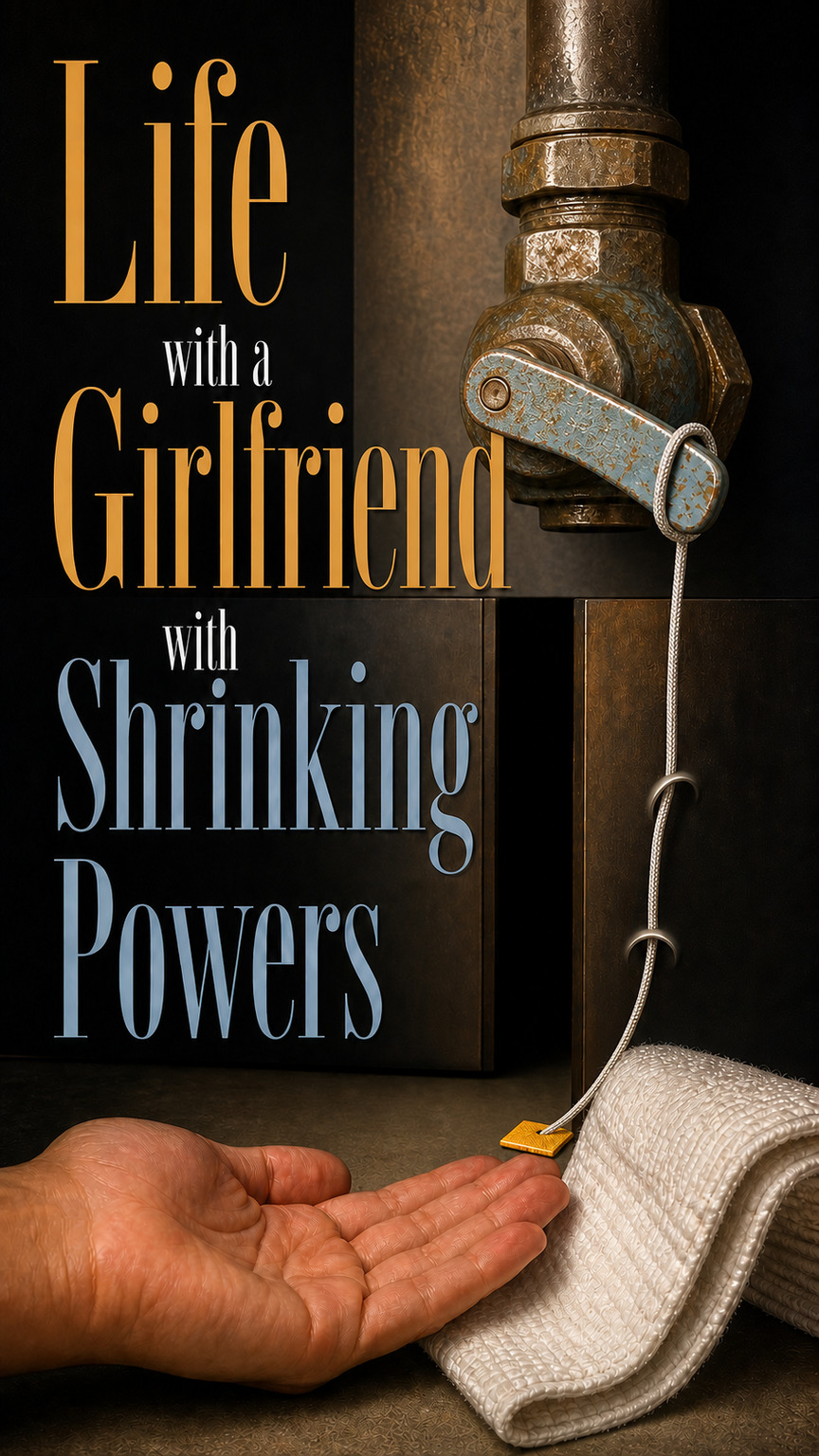
At twenty-nine, Miles Arden had learned that adulthood mostly meant putting warning labels on things no reasonable person would mistake for safe. Living with Luz Navarro in their third-floor apartment had merely improved his materials.
On Saturday morning, a yellow strip crossed the unplugged countertop mixer: DO NOT PLUG IN—LUZ WORKING. Another blocked its speed dial. A third marked the bright nonslip mat where Luz, twenty-eight and already wearing the fitted work clothes that changed with her, planted both feet.
“Fifteen centimetres,” she said. “Ten minutes.”
Miles checked the exhaust fan, burner knobs, taps, drain plug, door, and mixer cord. “Air still. Water off. Machines dead. Route clear.” He lifted both ordinary battery radios. They resisted splashes, not soaking; hers sat snug beneath her sleeve, dry and well under the two-hundred-and-fifty-gram limit for things she could take with her. “Radio check.”
“You are standing half a metre away.”
“Radio check.”
Her voice crackled from his speaker. “Your devotion to procedure remains extremely attractive.”
Luz took one controlled breath to a five-count. The change belonged wholly to her; Miles could neither start nor stop it. Over the next five seconds, she diminished smoothly toward the height she had chosen until she stood fifteen centimetres tall on the mat, still unmistakably the adult woman who had shared his apartment, bills, and terrible weekend breakfasts for four years.
Because she was below half her ordinary height, her own living process would begin an automatic return at twenty-four minutes. Miles started independent timers for twenty and twenty-three, warnings that neither controlled nor extended the change. She planned to be done long before either sounded. He opened the shallow emergency tray: flashlight, glucose gel, utility cord, and a dry towel folded into a ramp.
Luz glanced at the card beside the spool. “One tug, stop. Two, pull steadily. Three, give slack. Did you think we forgot overnight?”
“Redundancy saves lives.”
“Are you labeling gravity next?”
“Only the dangerous direction.”
She laughed and climbed the towel into the dry mixer housing. At that size, short falls worried him less than moving parts or drafts. She weighed very little and could scale the internal ribs easily, but useful relative strength did not grant full-sized torque. Their rule was plain: Miles did not touch, lift, enclose, or carry her without a direct request. He steadied the unplugged housing, never her, while she reset its jammed latch with a screwdriver she had kept against bare skin during the change. Anything loose would have remained behind at ordinary size; anything picked up now remained whatever size it already was.
Eight minutes later she descended without help and stepped onto the mat.
“Returning,” she said. Three slow breaths, then eight seconds of growth restored her ordinary hundred and sixty-eight centimetres. Only when she had finished did Miles offer a hand.
Her fingers trembled faintly against his.
“Cold?” he asked.
“Hungry.” Luz withdrew her hand and reached for toast. “Which is your fault. You turned breakfast into a safety audit.”
They logged eight minutes and the tremor together, then added toast, water, and a warm mug to the recovery. The record was supposed to be shared evidence, not permission Miles issued. For six hours Luz would not start another safe cycle; attempting one sooner risked an immediate uncontrolled return and a much longer recovery.
Miles looked at the untouched glucose gel, then at the protocol sheet. Checking its boxes was easier than asking why he had seen that tremor before.
The drip beneath the kitchen sink had learned patience.
It waited through breakfast, then tapped once against the basin while they cleaned. Miles crouched and aimed a flashlight behind the fixed toe-kick. A cold-water branch line vanished into the narrow void. Green-white corrosion furred a bend deeper than either of them could reach, and the wood beneath it was dark with damp.
The apartment stop valve turned grudgingly under his hand. The dripping slowed, but did not stop.
Luz knelt beside him. “There’s a quarter-turn handle behind the bend.”
“I see it.” Miles tried reaching through the toe-kick gap and scraped his knuckles. “Maintenance can’t come until Monday.”
“On a fresh cycle, I could inspect it.”
“No plumbing.”
The words came too fast. Her gaze moved from his face to the protocol sheet on the counter.
“You actually wrote that in?” she asked.
After a fan had kicked on during a routine two months earlier, Miles had added three new strips to every fan switch. Luz had been safely on the mat across the room, but the sudden current had knocked her flat. He still sometimes woke hearing her radio clatter.
“Water moves harder at your size,” he said. “Cold hits you faster. Pipes have edges, gaps—”
“All useful facts. None of them lets you turn our checklist into your list of permissions.”
“It’s one line.”
“About what I may do with my body.”
He wanted to say he was only trying to keep her safe. The sentence felt noble right up until he imagined hearing it from someone who had edited his choices while he slept.
“The fan was a near miss,” he said instead.
“And we changed the fan protocol together.” Luz rubbed her fingers, then tucked both hands beneath her arms. “This isn’t that.”
He noticed the motion. “Has the shaking happened again?”
“I told you. I missed breakfast.”
“That isn’t an answer.”
“Neither is ‘no plumbing.’”
The drip struck the basin between them.
In the end, they agreed to stop using the sink, leave the basin under the line, and wait. No shrinking for the repair, not because Miles had forbidden it, and not because Luz had conceded the principle. They had postponed both the plumbing and the argument.
Rain pressed a grey evening against the windows. Six hours after her morning cycle, warmed, fed, and recovered, Luz prepared for a different job: a dropped hinge pin in the dry cabinet beside the sink.
“Twelve centimetres,” she said. “Fifteen minutes.”
They cleared it together. Sink taps off. Drain plugged. Dishwasher disabled. Exhaust fan dead. Cabinet empty and dry. Both radios tested. The bright mat and open emergency tray stood beside the cabinet. Miles set an electric hotplate across the room, safely beyond the marked work zone, and put soup on low.
Luz changed on the bright mat, five counted seconds from ordinary height to her practiced minimum, and Miles started both warning timers. At twelve centimetres, her voice kept its familiar adult pitch but could barely cross a quiet metre. The radio made conversation easy.
“Pin’s aligned,” she reported from the cabinet. “I’m setting the clip.”
Miles stirred the soup. “Three minutes. I should label this spoon.”
“Warning: may contain spoon.”
The corroded bend, weakened past endurance by the damp, gave way under ordinary building pressure with a crack like a plate breaking.
Cold water punched through the base cabinet, struck the opposite wall, and sheeted across the kitchen floor. Miles killed the hotplate, yanked its plug, and lunged toward the cabinet.
Luz stood on the dry mat outside it. She had made it clear of the hinge before the flood reached her.
“Reverse now,” Miles said.
Her expression sharpened. “Facts, Miles.”
He heard the command in his own voice and hated that it had arrived before thought. He forced himself to look.
“Branch line split behind the toe-kick. Apartment stop still isn’t holding. I can see the hidden handle, but I can’t reach it. Water’s moving toward the outlet.” His timer showed eighteen minutes left before her hard return. “Eighteen minutes.”
“Cut the kitchen breaker.”
He ran to the panel. The kitchen went dark and the refrigerator hum died. When he returned with the flashlight, water had spread halfway across the floor, but Luz remained on the mat.
“I can reach that handle,” she said.
“Luz, I’m afraid.” The admission felt less useful than a wrench and twice as heavy. “I don’t think that makes the choice mine. But I am afraid.”
She held his gaze for one beat. “Good fact.” Then she pointed at the emergency tray. “I’m going in. Ramp.”
Miles laid the towel from the mat to the cabinet threshold. He set his open palm beside it as the other option, still and uncurled.
Luz chose the ramp.
In the cabinet, the broken line turned the flashlight beam into a field of flying silver. Luz stayed behind the pipe braces, climbing where they shielded her from the direct jet. Water that would have been spray against Miles’s wrist could sweep her into the dark gap behind the cabinets.
“Clip on the handle,” she said over the radio. “I can move it.”
Miles rolled towels into a dam between the flood and the dead outlet. With his other hand he called the unit below, warned that water was coming, and then called emergency maintenance. Each glance away from the cabinet felt like a betrayal, but containing the flood was work only his reach and speed allowed.
“Clip’s clear,” Luz said. “Handle’s seized. I can’t get the torque.”
Relative to her weight, she could climb like a champion. Against a corroded full-sized valve, twelve centimetres of leverage remained twelve centimetres.
Miles pulled the utility cord from the tray. “I can feed this through the gap.”
“Do it.”
He pushed the dry end beneath the toe-kick. A ricochet struck the cabinet wall and became a sudden sideways sheet. Luz disappeared from the brace.
“Luz!”
Her radio hit something, crackled, and gave him a burst of static. He saw her land on the shallow shelf below, roll, and push upright. A short fall at her weight was usually forgiving. The cold water was not. It washed around her boots and dragged at her legs.
Miles thrust his hand toward the gap.
“Don’t,” her radio managed.
The word vanished beneath static.
He stopped with his fingers at the opening. Every frantic part of him demanded that he reach in, close his hand, tear wood away until he had her out. But a blind grab could drive her into the pipe, and wrenching the cabinet could split the line farther—or block the only clear route for her forced return.
Lost communication had a protocol. Freeze or de-energize hazards first. Offer a route. Do not seize.
The breaker was off. He withdrew his hand, fixed the flashlight on the shelf, and laid the cord end within her reach.
For several seconds he saw only water. Then the cord twitched and began sliding into the dark.
Miles knelt in the flood with the cord wet between his fingers. Luz vanished behind the pipe, visible only in fragments: a sleeve, one boot, the brief shine of the radio that no longer worked.
The cord moved around the hidden valve. He waited.
Two distinct tugs reached his hand.
Pull steadily.
He leaned back, building force instead of jerking. The line quivered. The valve handle shifted a fraction—and the wet loop slipped free.
One tug.
Miles stopped instantly.
His twenty-minute alarm sounded. The bright little chime was absurd under the roar of the leak.
Three tugs.
He fed slack into the gap. When Luz crossed the flashlight beam, he saw her hands shaking hard enough to make the cord jump.
“I can tear the toe-kick out,” he called.
One tug: stop.
He closed his eyes for half a second. There it was again, fear dressed as a solution. He could make the opening larger, but he could also collapse wet wood into her route and worsen the rupture.
“Options,” he said toward the gap, forcing his voice level. “The valve failed on the first pull. The exit is still clear. I can keep the cord slack, build the dry ramp, or pull when you signal. We are past twenty minutes. The hard return starts at twenty-four.”
Luz edged close enough that her unamplified voice reached him between surges of water. “I’m colder than I told you. It’s happened on the last three cycles.” She braced a hand against the pipe. “My early return may hesitate. Less than three minutes to the hard limit.”
Miles’s throat tightened. Cold or low blood sugar could hold off a chosen early reversal by as much as twenty seconds. Nothing extended the twenty-four-minute maximum. If automatic return began inside that narrow void, the cabinet would trap her before she reached half height.
“Exit now is safest,” he said. He made himself add, “That’s my assessment. What are you choosing?”
“One more attempt. The loop slipped because it sat in front of the clip. I can get behind it.”
He wanted to say no. He could say that he would not participate in a plan he believed certain to kill her, but this was not that. It was dangerous, legible, and required both of them.
“At the twenty-three-minute alarm, I stop pulling and open the exit, whatever the valve is doing,” he said. “That is what I can do.”
Luz nodded once. “Agreed.”
She took the cord back into the dark.
The water chilled Miles through his trousers while he waited. He imagined Luz crawling behind the stiff handle, using strength enough to lift her own body many times over but not enough to turn the metal. He imagined the safety clip she had shifted, the narrow angle she alone could see, the countdown neither of them controlled.
The cord moved. Slack vanished one centimetre at a time.
Two deliberate tugs.
Miles leaned back on Luz’s rhythm. The cord tightened. For a breath, nothing yielded. Then the valve handle groaned around its stem.
The changing angle drove the spray harder. White water erased the interior of the cabinet.
One tug snapped through the cord.
Miles froze. The handle stopped moving.
He could not see Luz. His timer counted upward. Twenty-two minutes, thirty-eight seconds.
The cord loosened, shifted, tightened. Luz was changing position before the handle could pin her. Miles supplied no help she had not requested. He barely breathed.
Two tugs.
He pulled.
The cord bit across his palms. Somewhere beyond the spray, Luz kept the loop seated behind the cleared clip. Miles leaned with his full weight, steady, steady, until the handle struck its stop.
The jet died.
Water pattered from the cabinet roof. In the sudden quiet, the twenty-three-minute alarm began to chime.
Miles released the cord. He wanted to reach into the dark so badly his hands hurt. Instead he swept the shallow dam into dry towels, fixed the flashlight on the toe-kick gap, and spread a clean cloth from the shelf to the mat.
“Exit is lit,” he said. “Ramp is dry.”
Luz emerged on hands and knees. She stood once she cleared the cabinet and walked down the cloth, slower than before. At the last wet gap she looked up.
“Hand,” she said.
Miles placed his palm flat and still. She crossed it as a bridge, stepped onto the bright mat, and lifted both arms away from her sides.
“Returning.”
She chose three slow breaths.
One.
Two.
On the third, nothing happened.
Miles saw the tremor in her legs. He kept his hands off her. “You’re on the mat. The route is clear. Breathe again.”
Luz inhaled. Five seconds passed, then ten. Her change finally began. Over eight long seconds she rose to ordinary height, wet clothes changing with her while the full-sized cord fell loose from her hand. She was back before the twenty-four-minute limit.
“Blanket?” Miles asked.
“Yes.”
Only then did he wrap it around her shoulders. She accepted glucose gel, water, and the chair he nudged into place. Emergency maintenance was already on the way. The outlet remained dead. The valve remained closed. Below them, the water stopped spreading.
Miles crouched beside Luz, close enough for their knees to touch. He did not mistake the ending of danger for the end of the argument.
After warmth, soup, dry clothes, and the branch line’s professional isolation, they sat at the kitchen table beneath the old protocol sheet.
Miles took down the page he had amended alone.
“I’m sorry I wrote a veto about your body into something we’re supposed to share,” he said. “I made fear sound like authority. And I kept labeling things because labels let me pretend I could guarantee your safety.”
Luz held a warm glass between both hands. “I’m sorry I hid the tremor. It happened three times, and I kept thinking that if I told you, the information would become permission for you to decide.”
“It almost did.”
“Yes.” She met his eyes. “But you needed the truth to spot for me. I can owe you accurate information without owing you the final choice.”
“And I can say I’m afraid without turning it into an order.”
They wrote the next page together. Symptoms had to be disclosed before a cycle because coordination required facts. Bodily decisions remained Luz’s. Either partner could decline their own part in a plan. Until they installed an accessible shutoff extension, waterproof communication, and a verified dry route, Luz chose no shrinking around live plumbing. Not forever. Not as punishment. A boundary for conditions they could change.
Days later, with the branch repaired, the water isolated, and the kitchen power off, they installed an external valve pull. Luz chose a twelve-centimetre cycle and inspected the cord routing from the bright mat.
Miles offered his open palm beside the towel ramp.
She grinned and pointed to the towel. “That route.”
He moved his hand away.
At the valve, she checked the seated loop, then gave two tugs. Miles pulled steadily. The handle closed with a smooth, satisfying turn.
When Luz had returned beside him, they taped up the new protocol sheet. Half the lines were in his square handwriting and half in her quick slant. At the centre, beneath the rules for honest facts and chosen help, they had written the one instruction neither of them could use alone:
TWO TUGS: PULL STEADILY.