Lightning Carries One
You have a power, the ability to teleport by riding lighting your desired location, or so it seems to others. However if you tried to teleport someone with you, they always go insane and age a little.
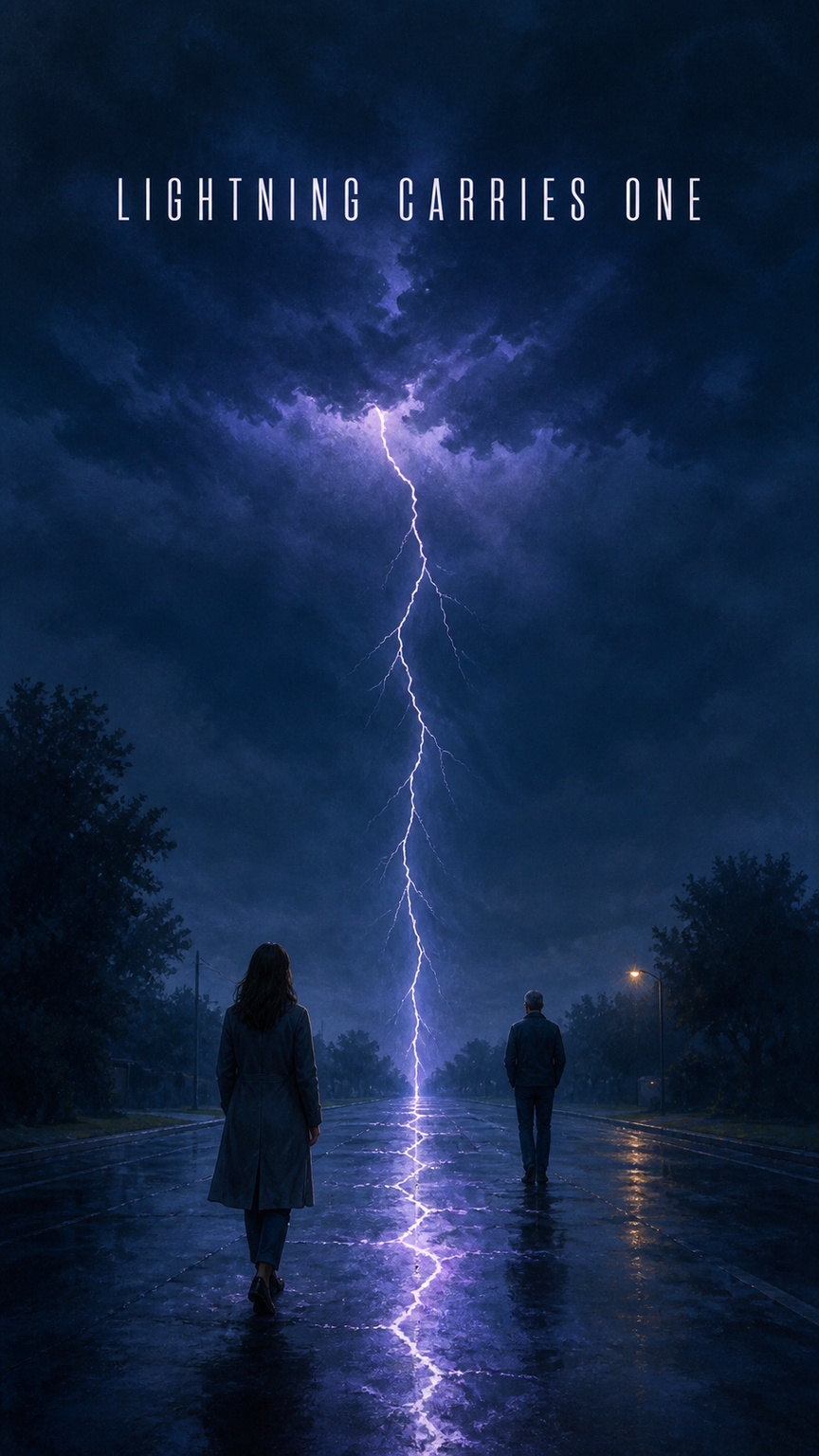
To anyone watching, Hazel came out of the lightning. To Hazel, she simply arrived.
White fire filled the old departures hall, outlining the cracked skylights and the rows of plastic seats. Then it was gone. Hazel stood on the yellow line where buses had once nosed into the building, her coat dry despite the storm gathering over the river.
Tobin had chosen a seat beneath the dead clock. He was already on his feet, one arm over his face, the other clamped around a grocery bag. The flash had caught the silver in his beard. There was more of it than at the Christmas she remembered. With Tobin, Hazel had learned to check a date before saying how long ago anything was.
“You said here,” she said.
“I said meet me here.” He lowered his arm. “I did not say drop out of the ceiling.”
“The roof is intact.”
Tobin glanced up at the broken panes. “Your gift for reassurance remains very specialized.”
They had not been alone together in nineteen months. He looked past her toward the loading bays, where weeds trembled between the doors. Hazel smelled ozone and the dusty sweetness of wet concrete. Her arrivals left no scorch mark, though people always looked for one.
“Is that it?” she asked, nodding at the bag.
Tobin tucked it under his arm. Through the thin plastic she saw the squared shape of a notebook, its cover bowed and furred at the corners.
“Some of it.”
“You told me you had the complete record.”
“I told you I had a notebook.”
Thunder rolled somewhere beyond the river. Tobin’s shoulders rose before the sound reached them. Hazel pretended not to notice; he noticed her pretending.
“Terms first,” he said. “We take the bus to the old house. We get off where I say. We walk when I say. You don’t touch the notebook unless I hand it to you, and you don’t use lightning.”
“The trip takes no time my way.”
“That’s why we’re not going your way.”
Hazel could have crossed the distance between one blink and the next. She had done farther before breakfast: an empty beach, a mountaintop blue with cold, the roof of a hotel where a security camera later showed a woman erased by one bolt and drawn by another. There was never a journey. There was here, the intention of there, and the clean clap of arrival.
Tobin pushed through the side door into the wind. Hazel followed him to the bus stop.
He took the window seat.
It was a small theft, ridiculous enough that Hazel nearly laughed. As children, she had claimed every window and given Tobin the aisle on the grounds that younger brothers needed easier access to washrooms. He had believed her until he was twelve.
Now he pressed the grocery bag between his knees and watched rain begin to stipple the glass. Hazel sat beside him. The driver argued with a passenger over a wet transfer. Someone behind them opened a container of fried onions.
“When did you last sleep through a night?” Hazel asked.
Tobin kept looking outside. “No clinic questions.”
“It isn’t a clinic question.”
“You put numbers in it.”
“There are no numbers in what I just asked.”
“You were saving them.”
The bus lurched away from the curb. Hazel caught the seat ahead. Tobin did not move until the abandoned terminal had slipped behind a row of warehouses; then he reached into the bag and took out the notebook.
It was worse than she remembered. Eight years ago it had been a cheap black book from the kiosk in the departures hall, bought because Tobin was taking a night class and had forgotten paper. It had gone into his coat new. It had come out with its spine bleached gray, its pages swollen, and both their handwriting inside.
That night, the last bus had been canceled after a signal box took a strike. Hazel, six months into making solo crossings and certain the trick concerned only distance, had told Tobin to grip her sleeve and picture the childhood house. Two stranded passengers saw one bolt take them from the terminal. A doorbell camera recorded them arriving on the front lawn in the same second. Hazel remembered the promise and the lawn. Tobin remembered the distance between.
Hazel had examined photographs. Photographs were not fibers, ink, sequence, pressure marks. She put out her hand.
Tobin opened the book himself.
On the first page, beneath the kiosk’s stamped date, Hazel had written in block capitals:
YEAR THREE, OR THE THIRD YEAR WE COUNTED. THE RED HALL RETURNS AFTER SLEEP. DO NOT CALL LIGHTNING THERE.
The last stroke of the final E hooked backward. Her handwriting did that when her hand was cold. She reached for the page.
Tobin closed the book on her fingers before she touched it.
“You wanted me to bring it,” he said. “Not surrender it.”
“I need to authenticate the ink.”
“No.”
“Tobin, if this is going to establish anything—”
“There. You did it already.”
“Did what?”
“Turned me into an unreliable container and the book into the important part.” He put it back in the bag. “That might be a record. I’m your brother.”
Hazel lowered her hand. Outside, the bus passed blocks of new glass apartments where the tire shop had been. “I know who you are.”
He gave her a quick, tired look. “Which year?”
She had prepared an answer to almost every accusation. Not that one.
At the first stop, Tobin did not stand. The doors opened, breathed cold air, and shut again.
“You said you would direct us.”
“Not this one.”
“Then why did you reach for the cord?”
He looked down. His hand was still lifted from his lap. “I thought the bakery was next.”
“The bakery closed when we were teenagers.”
“Yes, Hazel. I also know that.”
Two stops later he pulled the cord so hard that three people looked around. They got off beside a shuttered laundromat. Rain freckled the pavement, not yet heavy enough for an umbrella.
Hazel’s first apartment occupied the third floor, above rooms that had once shuddered with washers. She had lived there at twenty-two, proud of her sloping kitchen and the bathroom door that never closed. Tobin had slept on her floor for one summer after their father threw out his drums.
“This isn’t on the way,” she said.
“It was then.”
“The house is east.”
“You wanted home. This counted.”
He led her into the alley. Fire stairs striped the brick with rust. At the bottom of the downpipe, he pressed a palm to the wall.
“Third-floor water heater,” he said. “Behind it, there was a paper crown with seven blue points. You wrote ‘Queen of Radiators’ inside because you got the pilot light going with a barbecue match and singed off half your eyebrow.”
Hazel stared at him. “You stayed here.”
“The crown was gone by then. You said you hid it because no one had seen you fix anything before, and being proud felt embarrassing.”
“I could have told you that.”
“You could have.” He straightened too quickly and caught the wall. “You didn’t.”
A truck struck a pothole at the mouth of the alley. The bang came just as lightning sheeted inside the clouds. Tobin folded, one hand gripping his hair, breath trapped high in his throat.
Hazel caught his left wrist. Her thumb tapped the pulse twice, paused, then three times and twice again.
Tobin went very still.
She released him. “Sorry. I don’t know why I—”
“Blue kitchen,” he said.
“What?”
“Second winter in the blue kitchen. I couldn’t stop hearing the rain hit before it fell. You made up that tap so I’d know which moment your hand was in.” His face had shut against her. “You did it every bad night for months.”
Hazel looked at her thumb. “A conditioned response could survive without explicit memory.”
“Wonderful.”
“I’m not dismissing it.”
“No, you’re promoting it to a variable.”
The joke had the old shape of their jokes, but no invitation in it. He pulled the notebook out, tore a folded sheet from between two pages, and handed it to her.
It was a sketch of that apartment, but wrong. The narrow kitchen opened into the hallway of their mother’s later duplex; the hallway opened into the cupboard under the stairs of the childhood house. Rain hung beyond every window in long beads, each one shaded in pencil. Beside the kitchen door, a smaller drawing showed Tobin’s shoe with the sole peeled back.
In Hazel’s hand: DAY 414. HIS SHOES ARE GOING. MINE ARE NOT.
Below it, in Tobin’s cramped script: She says that means the place wants one of us more.
Under that Hazel had written: I said might. Stop making me sound mystical.
Despite herself, Hazel almost smiled.
“You were irritating there too,” Tobin said.
“That part is persuasive.”
For an instant his mouth changed. Then thunder pressed along the roofs and the almost-smile went away.
The next bus left them beside a row of narrow duplexes. Their mother had rented one for eleven months after selling the childhood house, though Tobin insisted they had lived there for four years twice.
He walked past it.
“Tobin.”
“It’s around the corner.”
“That’s a retaining wall.”
“I can see the wall.”
He turned down a lane, stopped at a locked service gate, and turned back. Hazel opened the map on her phone.
“Give me the next address.”
“It doesn’t work by address.”
“It does out here.”
“Out here changes when I’m not looking.”
“The streets aren’t changing.”
“I know.” He said it with careful force. “I know which part is doing it.”
Hazel found the pedestrian route. It was longer than necessary because the creek footbridge was under repair, but it was knowable: six turns, thirty-eight minutes, no weather involved except the weather itself. She set off. Tobin followed until the second turn, where he stopped beneath a young maple.
“You’ve lost it,” he said.
“The route is on the screen.”
“Not that route.”
“Then explain the other one.”
He took out the notebook, opened to a page, closed it, opened somewhere else. “We left the blue kitchen after the pipes froze. Or before. We followed the upstairs landing into the room where Mom kept the sewing machine, except she didn’t own it yet. You were thirty. Then you were seventeen all morning and kept asking why Dad’s car wasn’t outside.”
“I need the sequence.”
“That is the sequence.”
“You’ve just told me three incompatible things.”
“Yes.”
“Start with the kitchen. What happened immediately after you left?”
Tobin’s fingers worried at the notebook’s softened corner. Rain came harder, ticking through the maple. “We walked.”
“For how long?”
“Until my shoes opened. No, that was before the red hall. We slept in the room with all the coats.”
“How many nights?”
“They weren’t nights.”
“Then what distinguished one day from another?”
“Stop.”
“Meals? Sleep cycles? Changes in hair growth?”
“I said stop.”
“If we can establish even a relative chronology—”
He shoved the notebook into the bag. “This was a mistake.”
He walked away from the mapped route, fast enough that Hazel had to run. By the time she caught him, rain was bouncing off the pavement. They took shelter beneath the striped awning of a closed florist. The wind shoved the wet edge of it against the window with a hollow slap.
Tobin stood at the far end, hugging the grocery bag to his chest.
“I’m trying to understand,” Hazel said.
“You’re trying to make it hold still.”
“So I can understand it.”
“So you can decide whether it qualifies.”
She wiped rain from her face. Across the street, lights came on in the duplex where their mother used to live. For a moment Hazel expected to see the old sewing machine in the front window. There had never been a sewing machine there.
“You asked me to retrace the route,” she said.
“I asked you to walk it.”
“What is the difference?”
Tobin laughed once, without humor. “About eight years, from where I’m standing.”
He looked older under the awning than he had in the terminal. Not eight years older than he should be; eight years had passed for both of them. But his face carried an extra alteration that photographs from the day before the crossing did not. The clinic had estimated eleven to fourteen months of accelerated aging. The two people Hazel carried afterward had each come back with smaller changes: five months, perhaps; seven. Both had returned with memories no one could place, habits learned in rooms that did not exist, terror of distances that were supposed to be empty.
They had consented. Hazel had repeated that until the word lost all edges.
“The other two knew about your symptoms,” she said.
“They knew your description.”
“They signed—”
“I begged you not to do it again.”
“I thought you might have been the exception.”
“You thought I might have been made wrong.”
“No.” The answer came too quickly. Hazel tried again. “I thought there might have been another cause. Medication, the electrical injury, an existing—”
Tobin turned his back.
The rest of her careful sentence dissolved. Rain streamed from the awning in front of them, a bright curtain under the streetlamps. In her desk at home, the second and third reports still bore different colors of her ink: blue for shared symptoms, red for contradictions. She had given the contradictions twice the space.
“I used them to make you easier to believe,” she said.
Tobin did not turn.
“That isn’t quite—” Hazel stopped herself. “No. It is. You told me what happened, and I kept needing the damage to belong to something else. So I carried them.”
“And when they came back?”
“I stopped.”
“You stopped carrying people. You didn’t call me.”
There was no neat cause for that. Shame had not prevented her from visiting; it had made every possible visit seem to require a conclusion first. She had spent eight years refining the absence.
“I didn’t know what I could say.”
“You usually survive that problem.”
His affection, when it appeared, still had a barb in it. Or the barb had affection in it. Hazel could not tell which arrangement belonged to now.
“I’m sorry,” she said.
Tobin rubbed his forehead. “An apology is a different afternoon.”
“Do you want to go home?”
“Which one?”
Hazel let the question remain a question.
After a while, he set the grocery bag between them. He took out the notebook and selected three pages, holding the rest closed with his palm.
“These,” he said. “You don’t get the others because you finally said one true thing.”
“All right.”
“And you don’t get to tell me what order to remember them in.”
“All right.”
The first page was mostly a list: peaches, two candles, half a packet of crackers, six dry socks, no matches. Tobin had drawn a chessboard and accused Hazel, in the margin, of inventing a bishop. Hazel had replied that he had forgotten how bishops worked. Three lines later, she recorded that they had not seen a sunrise in ninety-two sleeps.
The second page described rain halted beyond the windows of the blue kitchen. It also described a quarrel about toothpaste, Tobin’s fever, and Hazel carrying him along a hallway that lengthened whenever she looked toward its end. The entry broke off and resumed in different ink.
I KNOW THIS HALL, Hazel had written. I HAVE CROSSED IT ALONE. ALONE, NONE OF IT REACHES THE ARRIVAL. TOBIN IS MAKING TIME STICK, OR MAKING ME KEEP ENOUGH OF IT TO WRITE.
Tobin’s note beneath it said: You don’t keep it. I do.
Her reply: Then the notebook stays with you.
The final page was creased nearly through. At the top, Hazel had drawn the old terminal as a small box. Around it she drew the laundromat apartment, their mother’s duplex, the childhood house, and several rooms Hazel did not recognize, each enclosing the last. Arrows did not lead east or west. They led inward.
We do not go where I point, she had written. We go through everything I meant by the place. Lightning is only what the outside sees.
Lower down, after a spill had blurred several lines, one sentence remained clear.
IF I FORGET AT THE HOUSE, DO NOT LET ME TAKE ANYONE AGAIN.
Hazel read it twice. Her first impulse was to ask whether the ink had been dated. The impulse passed without becoming speech.
“There are years in here,” Tobin said. “Some of them are boring. Some are bad. In one, you wouldn’t speak to me for a month because I lost the can opener.”
“A month?”
“Maybe six days. It was a very important can opener.”
“Did we find it?”
“You were sitting on it.”
Hazel laughed. It escaped before she could judge whether she had permission. Tobin looked offended, then briefly young, then neither.
He took the pages back. “We can finish walking.”
This time, when he turned away from the route on her phone, Hazel put the phone in her pocket.
They reached the childhood house after dark.
It belonged to strangers now. The porch had been rebuilt, the maple cut down, the front door painted a blue their mother would have disliked. Tobin stopped across the street. Hazel crossed halfway before noticing he was no longer beside her.
“We always went through the side gate,” she said.
There was no side gate. A cedar hedge had grown into the space between houses.
Tobin watched her. “Out here, we used the front.”
The knowledge had come from her body, not her memory. So did the sudden ache across her shoulders, the weight of someone carried for too long. Hazel’s right hand curled as if gripping the backs of Tobin’s knees. For one sickening instant, the street seemed roofed. Rain shone in the air without falling. A hallway opened through the blue front door. It smelled of cold toothpaste and canned peaches; behind Hazel, someone dragged a shoe with its sole loose.
Then water struck her face. The street was a street again.
Lightning branched above the house.
Her power gathered in the familiar space behind her ribs. It required no gesture, only a desired place. Her dry apartment presented itself at once: lamp lit, kettle waiting, the whole wet distance made into none. The storm had given her a road.
Tobin stepped backward onto the curb.
Hazel kept both hands where he could see them. The charge rose, brightening the bones of her fingers. She let the lamp and kettle blur until there was nowhere for it to carry her. The light faded. Thunder broke over the roofs. She remained in the road until an approaching car forced her to the sidewalk.
“I wasn’t going to take you,” she said.
“I know.” His breath came unevenly. “My body doesn’t.”
Hazel nodded and moved farther away, under a tree too young to shelter either of them.
“I think I traveled those years,” she said. “Every time. Alone, the landing restored what the trip spent and stripped the journey out of me. With you, something stayed anchored. Time, the notebook, some of the aging. Not cleanly.”
Tobin picked at the bag’s handle. “That sounds like you.”
“It may be wrong.”
“That sounds less like you.”
“I believe it happened. I believe you lived it. I believe I did too, even though that is not the same as remembering.” She looked at the blue door. “And afterward, you told me not to carry anyone. I did it twice more.”
He did not forgive her. He did not say that believing was enough. His face tightened at some weather occurring years away from the rain around them.
“I’ll send pictures of pages,” he said at last. “The ones I choose. You don’t ask for the rest.”
“All right.”
“If I stop, I stop. If we meet, we walk or take the bus. No demonstrations.”
“All right.”
“And don’t say ‘all right’ like we’ve completed a form.”
Hazel opened her mouth, found no better phrase, and shut it.
Tobin shifted the notebook under his coat. “Good. That can be the first thing you practice.”
They stood across from the house until the upstairs lights came on. A child moved behind the curtains and stared down at the two wet strangers. Tobin lifted one apologetic hand. The curtain snapped shut.
“Did I ever believe you in there?” she asked.
Tobin considered. His gaze went to her shoulder, where the vanished weight still ached.
“Sometimes,” he said. “Sometimes you were awful. Once you carried me for three days because my shoes were gone.”
“Three days?”
“Or three miles. Don’t make that the good version.”
“I won’t.”
The answer was small, and he took it without thanking her. When the bus appeared at the far end of the street, Tobin walked toward the stop. Hazel followed several paces behind, not because she had learned patience, and not because ordinary roads could repair what the other journey had done. She followed because he had chosen the route and had not yet told her to leave.