
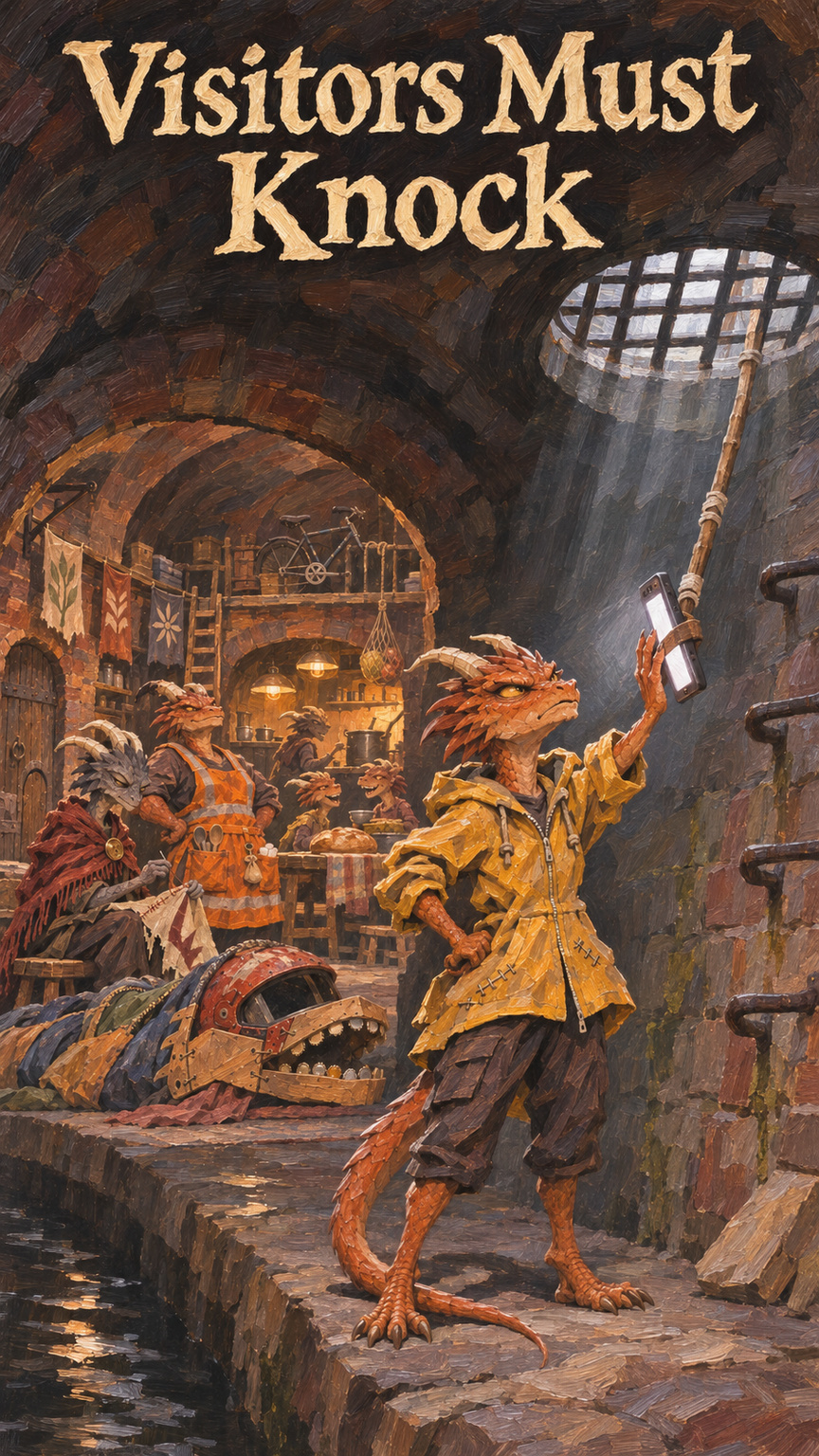
The phone came through the grate at ten past nine, strapped to a stick.
Tikka had been waiting for a delivery of thirty-six bread rolls. She was wearing her best yellow raincoat, which had taken an evening to shorten and another evening to put a tail hole in. A rectangle of white light appeared beside her nose.
“There are monsters in the sewer,” somebody said above her.
“Then stop poking them,” said Tikka.
She pushed the stick away. The phone struck a bar, showing the camera her thumb, three claws, and part of a drainpipe. Someone screamed. Someone else laughed so hard that the stick rattled on the pavement.
Tikka withdrew into the brickwork. The rolls arrived eleven minutes late, lowered in two shopping bags by a cousin who had eaten one on the way.
“You have to stop talking to them,” he said.
“They have to stop putting things in my face.”
The following evening she watched the clip on her own phone, leaning against the laundromat wall to borrow its wireless connection. Her hand looked like an orange glove. Half the comments said it was an orange glove. Others thought it was a puppet, a marketing campaign, or a very large rat.
Tikka looked at her three claws. She could not see how anybody had arrived at rat.
She showed the clip to Grandmother Vetch, who watched it twice, then enlarged the hand.
“That sleeve needs mending.”
“Grandmother.”
“I am looking.” Vetch handed the phone back. “Nobody can tell what you are.”
That had been true of most things for two years. Humans noticed claws, a tail, the yellow raincoat moving below the shop counter. Then they looked back at whatever was happening on their phones. Tikka had learned to pay the right money and leave before they worked it out. She disliked the little pause at the till when she had to decide which coin was which. She liked choosing her own biscuits.
Four days after the incident with the stick, the clan prepared its second arrival feast.
The grocery net descended through the old delivery shaft, loaded with onions, rolls, two sacks of rice, and a packet of marshmallows somebody had successfully argued were eggs. Tikka steadied the load while three cousins worked the bicycle crank on the gallery above. A fourth sat on the saddle, making unnecessary bell noises.
“Off,” Tikka called. “It isn't a horse.”
“Neither was the last horse.”
“We are still not discussing that.”
The net settled on the flagstones. Aunt Skillet snatched the marshmallows before they could be distributed and carried them into the kitchen under her apron. She was broad even for a kobold, with rust-red scales and an old cooking burn on one horn. The apron had once been a human's orange safety vest. Its pockets held spoons, salt, and things other people had been forbidden to eat before supper.
The feast hall occupied a dry side chamber of the sewer. Beyond its raised threshold the working channel went about its disagreeable business; here, smoke found an old vent, shelves climbed the walls, and nine household banners hung from iron brackets. Their first winter's sleeping ledges were now storage. Behind them lay sleeping rooms with doors, small doors cut inside larger doors, and the occasional smaller door somebody had added without asking.
Tikka stepped over a cousin asleep in a colander. She took the rice to Skillet, checked the two entrance alarms, and returned to find three hatchlings arguing about the dragon's jaw.
“It won't close.”
“His finger's in it.”
“That's why it won't close.”
She disengaged the jaw from the finger. The new dragon head had a red motorcycle helmet for a skull, plywood cheeks, and two rows of bottle-cap teeth. A nephew inside it demonstrated the bite, missing her wrist by less than she liked.
The dragon's body stretched half the length of the hall. Sleeping bags of several colors had been joined into a magnificent succession of lumps, with zip fasteners up its spine. Underneath, a dozen relatives were trying to agree which way was forward. Their old dragon had been reeds and painted leather. This one could be taken apart and washed.
Vetch sat on a stool beneath the clan banner, sewing a tear in its lowest corner. She was slate-gray, with pale horns worn smooth at their tips, and wore a red shawl fastened with a brass button the size of a saucer. A rechargeable battery lay in the fold beside her knee. She tested it against her tongue, frowned, and placed it in a small velvet-lined box.
“That doesn't tell you if it's charged,” Tikka said.
“It tells me which one is mine.”
“All the batteries belong to the clan.”
Vetch shut the box.
When they had arrived, all eighty-seven of them had been crouched around a supper fire. There had been a noise too large to belong to the room. Then the room, fire and all, was gone, and they were crouched between a loading bay and a row of dumpsters under a sky flashing blue and red.
They had brought their clothes, their bowls, the banner, and one furious chicken. Nobody knew what had done it. Tikka had spent the first month looking for the edge of the place, and the second trying to learn enough human speech to ask where such an edge might be. There was always more city.
On that first night Vetch had counted them by the light of a vending machine. She had counted again when they found the sewer, and again when the youngest were asleep. Eighty-seven.
Tikka could still recall the ache of the curb against the backs of her legs while her grandmother counted. She had not known what the lights on the machine meant. Now she knew which button gave you crisps, which gave you nothing, and where to hit it if the packet stuck.
“Do we have to take the dragon past the entrance?” she asked.
Vetch drew her needle through the cloth. “We've never done the procession without visiting every door.”
“There's a camera in every other hand up there.”
“Then we'll close the hatch. It is what the hatch is for.”
“What if they open it?”
Vetch looked over her sewing. “You made the latch.”
Tikka did not like that answer as much as she ought to have.
The doorbell chimed.
It had four different chimes, all of them chosen by people who no longer lived where the bell had come from. This was the cheerful one. Tikka hated it most.
She checked the little screen above the kitchen door. Two humans stood at the northern entrance. One wore a black cap and carried a case. The other, a tall woman in heavy gloves, was levering at the hatch with a steel bar. Flat rectangles of wire stood in a stack on her trolley.
“Expected?” asked Skillet.
Tikka shook her head.
A metallic snap traveled down the passage. On the screen the hatch came up, Tikka's latch hanging from it by one bent screw.
The man put the case down, opened it, and lifted out a wheeled thing with a lamp for a face.
By the time the crawler reached the first bend, Tikka was above it, clinging to the iron rungs that crossed the inspection passage. Its light swept the brickwork. A cable trailed back to the entrance, bright yellow and very new. The humans followed, stepping over the little tripline she had laid across the passage.
“See?” said the woman. “That's deliberate.”
The man held a monitor against his chest. In its top corner Tikka recognized the red word LIVE. Comments climbed one side of the picture.
“All right, everybody,” he said. “We're underneath the location from the video. Our connection's running back to the van. No cuts, no actors.”
“Don't promise that yet.”
He lowered his voice. “People like the promise.”
The woman held a laminated card in front of the crawler. Tikka could read EXOTIC ANIMAL RECOVERY and a telephone number.
“Leave that in for customers,” the woman said. “Everything we take is quarantined before sale.”
She extended a metal pole. At its end, a padded loop opened and closed. With it she lifted the mat over Tikka's first pit.
Tikka's tail tightened around a rung.
The woman shone her torch into the hole. “That would hurt.”
“A little.” The man angled his monitor toward the crawler's view. “Somebody's gone to a lot of trouble.”
“Bring the carriers.”
Tikka had not understood the flat wire things at first. Then the man opened one, shaking it into a box with a little door.
“How many can we take?” he asked.
“Let's find out how many there are.”
“The buyer wanted an adult pair. Young, if there are any.”
“Then keep your voice down. You'll send them deeper.”
The woman looked up.
Tikka flattened herself against the brick, but the lamp had already found the yellow of her raincoat. The loop came at her astonishingly fast. It caught her hood and pulled her away from the wall.
For an instant she dangled over the passage. The woman's face came closer: gray eyes, a little scar beside her mouth, no amazement at all.
“Easy. I've got you.”
Tikka wriggled backward out of the coat and dropped. Her claws struck stone. She fled under the trolley as the woman made a grab for her tail.
“That's one!” the man shouted. “Did you all see that? Turn it around. Get it in the light.”
Tikka forced herself into a gap behind a broken wall tile. The pole scraped after her, reaching much farther than an arm. She crawled until her shoulders hurt. At the far end she fell into Skillet's flour bin.
“Coat?” asked her aunt.
Tikka spat flour. “They've got cages.”
Nobody laughed when she said it.
The drum went quiet. The dragon sagged as its occupants came out from under it.
Vetch stood, pulling her shawl around her shoulders. “Back ladder. First hearth take the little ones. Leave the pots.”
“Chain on it,” said a cousin who had just come down from the upper gallery. “I went up to see who was coming. There's a chain through the top.”
Vetch began folding the banner.
Tikka knew the other ways out. Most were body-wide pipes, branching into dark that became smaller dark. They could get out. In pairs and threes, without their things, they could squeeze through to a city whose streets none of them quite agreed on. Perhaps she could find them again.
“They don't know how many of us there are,” she said.
Vetch paused with the banner across her arms.
“Two humans. One thing with wheels. They're expecting two of us and some little ones. We can give them something bigger to chase.”
Tikka took hold of the dragon's jaw. “Hang this over the east drop. Put the body on it. I can make the head move from the gallery.”
“Their wheel thing will look underneath,” said Skillet.
“I'll cover the eye.”
“Then they'll stand back and poke it. You just met their long stick.”
The lost coat lay across Tikka's thoughts, yellow and empty in a human hand. She set down the head.
Vetch put the banner back on its bracket.
“The dragon already walks,” she said. “It goes to every door.”
Her youngest son looked at the sleeping bags. “With us in it?”
“Does it generally walk without you?”
Skillet was looking up at the grocery rope. “If it's going into the hall, it can take my net.”
“Your net?” said Vetch.
“Do you want to discuss ownership now?”
Tikka looked from the rope to the cloth and then toward the inspection passage. She could hear the crawler scraping the wall, trying a new turn. The humans were taking their time. They thought the holes belonged to them already.
She began shaking the onionskins out of the net.
The dragon came out backward.
This was unfortunate, but familiar. Its tail reached the inspection passage first, followed by a green flank, a quarrel, and a sudden entire-body shudder when somebody stood on somebody else's hand.
“Other left,” Tikka whispered through the cloth.
“You said left.”
“I was speaking to the head.”
“Then say head.”
The tail withdrew amid muffled complaints. At last the red helmet nosed around the corner. Behind it the sleeping-bag body rose and fell in the slow procession step. Under the cloth, people passed the bundled net from shoulder to shoulder while its rope uncoiled from the gallery behind them. They had carried baskets this way during feasts in the old hall, stealing food from whichever basket passed within reach. This load was less popular.
The crawler's lamp struck the bottle-cap teeth.
“What is that?” said the man.
The woman brought her pole around. For one lovely moment it pointed away from every small, vulnerable body in the corridor.
Tikka pulled the jaw cord. The teeth snapped.
“Blankets,” the woman said. “They're under blankets. Get the camera closer.”
The head retreated, beckoning with its open mouth. The crawler followed. So did the humans.
“Keep them together,” the woman said. “Don't let them get down those side holes.”
Tikka, under the dragon's chin, could see a procession of feet: clawed feet beneath cloth, then two pairs of enormous boots.
They were in the hall.
Beneath the raised head, the bearers unrolled the net onto the floor in front of Tikka. They drew the long flap hanging from the dragon's chin over it, hiding the mesh beneath a rug of cloth that stretched from her feet to the threshold. Then they crept clear along either wall. Tikka held the helmet at the rug's far end. High on the kitchen gallery, the bicycle bell gave one soft, indignant ping.
The man stepped over the threshold for a better view, planting a boot on the cloth. The woman followed, pinning another fold and reaching for the dragon's head. Its jaws opened, and Tikka saw her raincoat still caught in the loop of the capture pole.
She snapped the jaws again. Vetch, beside her under the helmet, hissed, “It's three at the door.”
“This isn't the door.”
“It's the feast hall door.”
Tikka snapped a third time.
Beside the head, a flap of sleeping bag dropped over the crawler. Its light vanished beneath blue cloth. The dragon split along its back.
Kobolds burst from its sides, clear of the net; others came down off the shelves. The cloth lifted with the ropes beneath it, and the humans lurched into each other. Someone in the gallery pedaled furiously. The man dropped his monitor, and it swung against his knee on its strap.
The net rose around them.
For a breath they hung above the floor, boots kicking among empty sleeping bags. Then the bicycle frame gave a sharp metallic crack.
One boot found stone. The woman braced herself, pulling hard against the ropes. On the gallery a cousin cried out. The crank jerked backward.
“Off the pedals!” Skillet shouted. “Take the rope!”
Hands closed on it all along the gallery. Tikka saw the net rise, stop, and rise again as more relatives crowded onto the line. The man clutched at a shelf. Three uncles removed his fingers from it, one at a time, with the concentrated care of people separating sticky sweets.
The woman had a knife.
Tikka saw the blade come up against the net. She seized the dragon head's handles and thrust the helmet at the woman's wrist. Vetch shoved with her. The knife struck the flagstones, and Skillet kicked it under the flour bin.
The woman swung the capture pole sideways. It swept a row of bowls from a shelf. Tikka ducked under it, jumped, and caught the raincoat. The pole bowed under her weight.
“Let go!” the woman shouted.
Tikka dug her claws through her own good collar and pulled. Vetch caught the pole below the woman's hands. More hands joined hers. The pole disappeared under a pile of relatives and the wooden dragon jaw.
By the time the net was secured, one human had lost his cap and the other was shouting that she couldn't feel her left foot. Skillet checked, freed the foot from a fold, and drew the ropes tight somewhere else.
“Better?” she asked.
The woman glared at her.
“You can have it uncomfortable if you prefer.”
Tikka stood in the middle of the hall, holding her coat. Its hood was torn nearly off. Around her, relatives were checking hands and tails, finding the littlest ones behind the kitchen door, arguing about whose part of the dragon had turned first.
The man in the net stared at them.
“How many are there?” he said.
From the gallery came a triumphant bicycle-bell noise, followed by the sound of something falling off the bicycle.
Tikka laughed. She couldn't help it. She laughed until she had to sit down among the sleeping bags, where Skillet gave her half a marshmallow.
The crawler was still running under its blue covering. Tikka could feel its wheels worrying the cloth when she picked it up. She carried it to the table and balanced its belly on a bread bowl, leaving the wheels spinning in the air. Then she took the man's monitor and propped it against a pot.
The man watched her reach for the cable.
“They've seen you,” he said. “There's no putting that back.”
Tikka looked at his monitor. Blackness filled the picture, but the comments were still climbing. Some demanded that he take the lens cap off. Others accused him of faking the whole thing. One had written, in capitals, WHERE IS THE RAT.
She could unplug it. They could take their supper into the sleeping rooms and let the city decide which parts had been a trick.
Vetch approached the table. There was a split in her shawl and flour between her horns.
“Can they hear us?”
“I think so.”
“Everyone out, then.”
Tikka looked at her.
Vetch beckoned to the gallery, then the kitchen door. “Come down. Bring the ones who can't manage the step.”
“They'll know where we live.”
“Those two knew.”
“There are more than two watching.”
Vetch rubbed her thumb along the tear in her shawl. For a moment she looked toward the little passage behind the kitchen, one of the ways out that would fit a person who left everything behind.
“I know,” she said. “Get the banner straight.”
It took a while. Nobody could find the youngest of the second hearth, who was eventually discovered asleep inside the dragon head. One household insisted on standing together. Another couldn't stand together because two of its members were not speaking. Skillet wanted the bowls picked up first.
Vetch counted them while they sorted themselves out.
Eighty-seven.
Tikka took the cloth off the camera.
At first its picture showed the ceiling. She tilted it down, and there they were: copper, rust, gray, one elderly green aunt; horns and claws and tails; a child turning around to see which end of himself was appearing on the screen. Behind them stood the shelves and doors and the steaming supper pots. The dragon lay open across the floor.
“I am Vetch,” said Vetch, in careful human speech. “This is my clan. We live here.”
“Tell them about the bicycle,” somebody said.
“They can see the bicycle.”
“They can't see it's broken.”
Vetch waited until the speaker subsided. Then she looked into the lens again.
“If you have business at our door, you will ask before opening it.”
“And no sticks,” Tikka said.
Several relatives agreed loudly. Someone wanted to know whether sticks as gifts were included. The man in the net began explaining himself, but Skillet turned the camera toward the feast and asked who had opened her marshmallows.
By then the crawler's monitor was showing a room full of kobolds all talking at once, and Tikka could no longer read the comments.
They delivered the captors to the pavement in the grocery net. The police were already there; someone watching had recognized the van and called them. Tikka stayed just below the hatch while questions were shouted in both directions. One officer bent down to look at her. She held up the cage she had dragged out behind her, and he stood up again to speak to his colleague.
It took a long time. Eventually Vetch sent up a message saying that further questions could wait until after supper, which was very late.
By the next evening there was a rope barrier on the pavement, three requests for an interview, and an envelope from the city office. There were also flowers, a threatening letter, a bag of bread rolls, and a carefully wrapped orange glove.
Vetch put the envelope on her stool. Skillet inspected the rolls. Tikka put the glove on the dragon's nose.
They moved the defenses. They mended the net. Tikka replaced her hood with a better one, using cloth she had saved when she shortened the raincoat. The bicycle would require discussion, money, and somebody with the sense to measure the shaft before buying another.
Above the entrance they fixed a painted board.
MONSTERS IN SEWER.
VISITORS MUST KNOCK.
The first knock came just as Skillet was disputing the correct number of marshmallows in a bowl. It was a small knock, three taps on metal, followed by silence.
Tikka checked the doorbell screen. A human stood on the other side of the rope barrier with a parcel under one arm. Both hands were in view. The human had stepped back from the hatch and was waiting.
“Who is it?” called Vetch.
“Someone who can read.”
“See what they want,” said Skillet.
“Don't open it yet. I've no shawl.”
“Ask about a bicycle.”
“We are not taking the first bicycle we're offered. We just discussed this.”
Tikka went up the ladder. Behind her, the argument acquired two more voices. She bared her teeth, put one claw on the latch, and called through the metal.
“How many of you?”