The First Call
The kingdom laughed when a rooster marched to war in battered armor, but years later, when the last surviving soldiers saw an enormous feathered warrior emerge from the burning battlefield with arrows in his back and dawn behind him, they realized the legends had gotten one thing wrong: he had never been anyone’s mascot.
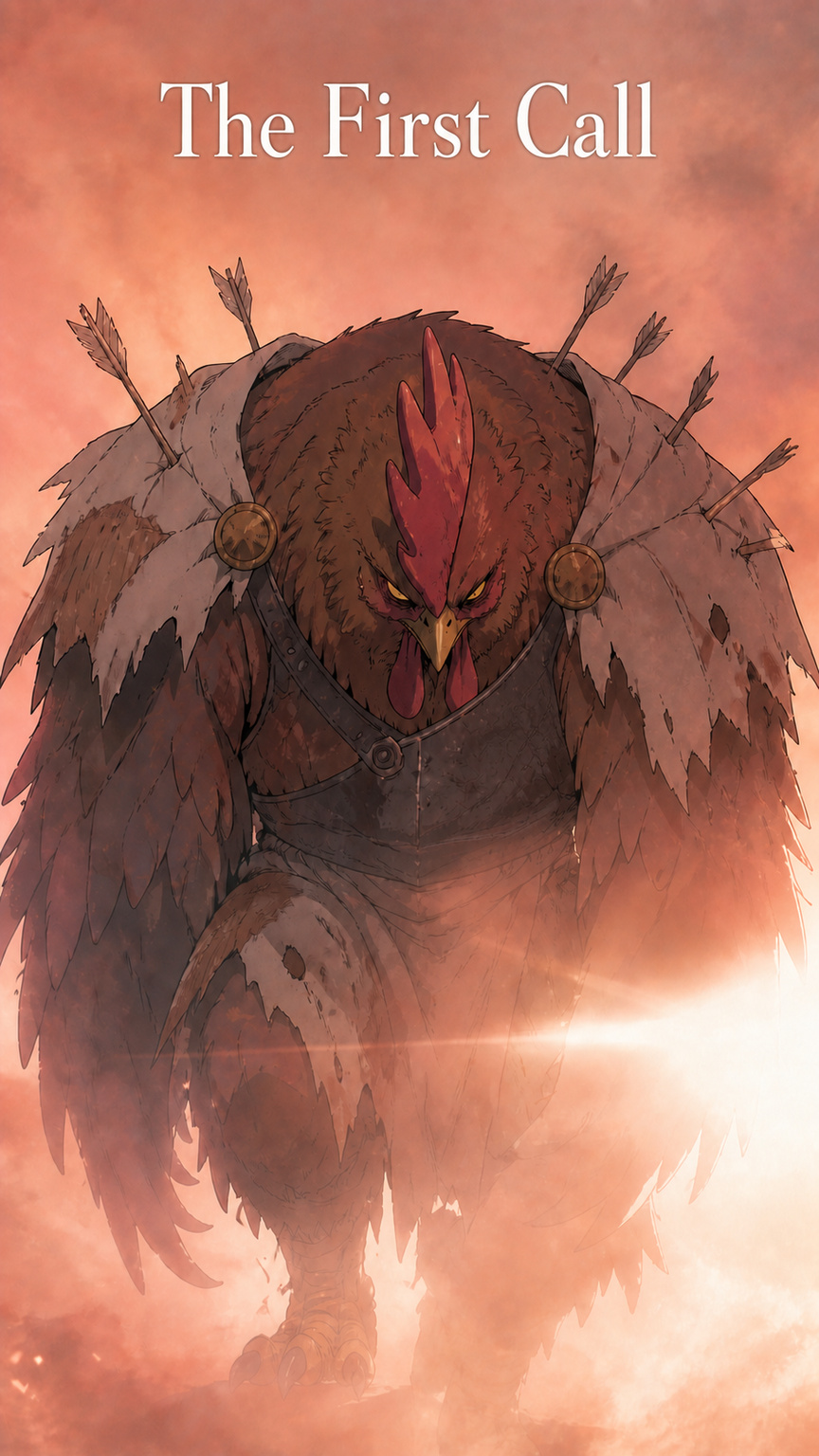
The rooster arrived at first call, marching in the ditch because the king’s infantry had filled the road.
He came up no higher than the buckle on an infantryman’s boot. Mud darkened his red feathers, and the armor fitted over him in narrow, battered plates: breast, back, shoulders, and two jointed guards that moved when he lifted his wings. Whoever had made it understood both metal and birds. Whoever had last repaired it had used a kettle patch and three kinds of rivet.
The young armorer noticed all that before she noticed the laughter.
“What rank is he?” someone called from the pike carts.
“Dinner.”
“Too stringy.”
The rooster kept pace beside the wheels. He did not startle at the first horn or the stamping horses. When a wagon lurched toward the ditch, he climbed the bank, let it pass, and returned to the firmer ground without breaking stride.
The armorer had been mending a buckler strap on her knee. She put it aside when she saw the loose plate lifting behind his left wing. “Hold there.”
He stopped.
That earned another laugh. A junior officer leaned down from his saddle and knotted a strip of royal blue through the rooster’s back plates. “There. Our luck has put on colors.”
The soldiers cheered their new mascot. The rooster reached back, caught the cloth in his beak, and worried it free. He dropped it under the officer’s horse.
Even the armorer laughed then. She was nineteen, the army was clean, and nobody had yet taught her how quickly a joke could become an account of what had happened.
She tapped the ground beside her. The rooster stepped over. He watched her hands while she lifted the loose plate, trimmed the kettle patch, and set two proper rivets. There was room under the lame for a finger’s breadth of travel, then another hidden fold beneath that. More room than any rooster could need. She tried to open it farther. His beak closed around the leather guard on her wrist—not hard, but exactly.
“All right,” she said. “Only what’s loose.”
He let go.
When she finished, he scratched a brass harness ring out of the mud and pushed it against her boot. Then he returned to the verge. He refused the grain tossed after him and marched east while the army’s road bent north.
By supper, he had joined them in the story.
For seven years the rooster appeared at wars that were not quite the one being told about him.
He came to the armorer after the river campaign with a shoulder hinge crushed inward. The king’s host had won its ford that day, so the men said their little bird had brought the current down. Yet the grit beneath his plates was white road chalk, not river sand, and the arrowhead caught in the hinge had the long, dark barb used by the army they had driven east a month before. He paid with a stirrup buckle and left before the victory horns.
He came again during the winter siege. This time three lengths of cage wire had wound around his leg guard. Every strand was cut cleanly in two places. Black pitch glazed his breastplate and smelled of pine instead of the marsh tar used by the king’s sappers. The armorer soaked it off, eased the swelling beneath, and showed him the padded strap before she buckled it. He inspected it with one bright eye. At dusk he vanished through a drain beneath the eastern wall.
By then there were songs without verses and stories without witnesses. Recruits watched for red feathers before an assault. Drivers swore the rooster could take the first direct light of dawn into his body once, if he chose, and stand higher than a siege tower for nine minutes. Afterward, they said, he was cold enough to frost grass in summer. No two tellers agreed on where they had seen it. The armorer did not believe them, though the folded plates under his ordinary plates began to trouble her.
Belief was less useful than upkeep. She kept narrow rivets in a separate box. She learned how far he would permit her to lift a wing and which touch made him draw away. He learned that she would stop. That was trust, and because it was real, she mistook the story wrapped around it for real too.
The third time, he arrived while she was teaching new hands to sort damaged mail. One shaft through his back plates bore the king’s grey-and-blue fletching. Another, lodged along his breast, bore the enemy’s black. Neither had reached flesh. The recruits crowded close, delighted by proof that their mascot had fought in the middle of everything.
“Back up,” she told them. “He can’t see my hands with your knees in the way.”
She removed both shafts. Beneath them she found ash, more pine pitch, and the fine red dust of the east road. She could have followed the evidence then. Instead she burnished the plates and sent the recruits to supper with a story about how many arrows their luck could carry.
The rooster did not stay to hear it.
Seven years after first call, the king’s host narrowed to three soldiers beside the east road.
Seven minutes remained before sunrise. Smoke from the ruined camp pressed low over the marsh, turning the causeway ahead into a grey strip that appeared and vanished. Behind them, the royal standard burned in a ditch. Ahead, somewhere past the smoke, harness bells kept ringing and then stopping.
The armorer was a sergeant now. Her last officer had died with one hand hooked in her apron and one order left in his mouth: fire the prepared road before dawn. The enemy’s wagons were not to cross the causeway. Neither were the enemy’s wounded, scavengers, camp children, stolen animals, or anyone else the smoke might be hiding. The officer had made it sound simple because he did not have enough breath for exceptions.
The scout lay on the bank with his cheek to the wet grass. “Movement. East lip.”
“How many?”
“Four.” He raised two fingers, changed it to three. “Three upright. Something low. No—there’s a wheel. Might be two wheels.”
The field surgeon sat against the milestone, binding his own thigh above a deep cut. He drew each breath through his nose before speaking. “If it’s the fire wagons, four is enough.”
“Can you cross?” the sergeant asked.
“With a shoulder, perhaps sixty paces. Not quickly. If the bleeding starts again, put me down before I put you down.”
The pitch line ran from the roadside jars into reeds beneath the causeway. A slowcord waited in its clay gutter. Once lit, it would give them six minutes to get west of the low ridge. The sergeant had a coal nested in her tinder horn and the striker in her fist.
The scout wiped his streaming eyes. “Now five shapes. Or the smoke moved.”
“Pick one.”
“Smoke moved.” He listened. “Harness again. No marching feet.”
The surgeon pulled the bandage tighter and went pale around the mouth. “By the time you’re certain, the cord won’t give us six minutes.”
There was no commander left to ask. There were no reinforcements behind the ridge, only the dead and the westward trail of those who had run before the line broke. The sergeant had spent the night making the last order ready because readiness was a thing her hands could still provide. The jars were uncapped. The reeds were soaked. The cord had been measured twice.
Something rustled below the bank.
The rooster climbed out of the ditch.
He was small as ever, though soot had turned his feathers almost black. The left wing guard hung by one strap. A burn had curled the tips of his tail, and he favored his right foot. Still he hauled himself onto the road and faced the causeway.
The scout gave one exhausted breath that might once have been a laugh. “Knew our luck wasn’t dead.”
The rooster walked past him.
The sergeant crouched, already reaching for the broken guard. “Here.”
He stopped beyond her hand. When she showed him the rivet pliers, he looked once at the smoke ahead and stepped around her.
“Not that way.” She moved to block him. “West.”
He left the road, passed through the wet reeds, and returned to it on her other side. His limp made every third step dip. He continued east.
The sergeant struck spark to tinder. The coal caught. She touched it to the slowcord, and a red point began to creep along the gutter.
“Three uprights,” the scout said. “Certain now. One pushing the wheels.”
The rooster entered the smoke.
The red point moved past the first notch cut into the clay. Five minutes.
“Could still be a fire cart,” the sergeant said.
The scout did not answer. He had lowered his head to the roadbed. The surgeon watched the slowcord.
From within the smoke came a wooden crack, then a horse’s scream. Harness bells scattered into a wild, receding jangle. A fire rose where no fire had been, orange through the grey.
The surgeon said, “That cart was loaded.”
The red point reached the second notch.
The sergeant slid her knife beneath the cord and cut away the burning length. She crushed it under her heel. The unburned end went into her tinder horn beside the coal.
No one asked whether that was a new order.
Beyond the causeway, men shouted in the enemy’s hard field cadence. A second voice answered from farther north, where the king’s retreating sappers had abandoned two more pitch wagons. Fire came from both sides of the road now. One wagon rolled backward without horses, its flames tilting as it gathered speed. It struck something with a crash that shook the reeds.
“That was the east rail,” the scout said. “Causeway’s blocked.”
The sergeant stared into the smoke where the rooster had gone. On her workbench across seven years: white road chalk, black pitch, royal feathers, enemy barbs, cage wire cut twice. Damage from every banner, always carried out of a fire that threatened the same road.
The stories had put him beside their victories because that was where they had happened to see him afterward.
“Light,” the scout said.
The horizon had opened beneath the smoke. A blade of direct sun lay across the far end of the causeway.
For a moment there was only a small rooster in it.
He stood beside the burning wreck with his injured foot lifted. Light ran red along his neck and flashed in the battered hinges she had repaired. It touched him fully. He did not change. Beyond him, dim figures struggled with the handcart, trapped between the wreck and the fire advancing through the reeds.
Then he set his foot down.
His armor opened first. Pins rolled through curved slots. The narrow lames drew apart over hidden bands, each battered patch lifting into its place in a design the sergeant had handled for years without understanding. His body rose inside it. Legs thickened; claws tore furrows in the road; red feathers streamed upward through the smoke. His breast climbed above the wagon roof, then above the causeway posts. When he spread his wings, the air struck the marsh flat, but he did not fly. He braced.
The scout turned the quarter-hour sandglass from his map case. “Nine, wasn’t it?”
“If they kept that part straight.”
The rooster drove one armored shoulder against the burning wagon.
The first push failed. A black-fletched arrow struck between the plates on his back. He lurched, caught himself with one wing, and shoved again. Iron screamed along stone. The wagon shifted half its width.
The figures behind it became people: an old man at one handle of the cart, two younger adults at the other, a child beneath a wet blanket, and a woman dragging a mule whose pack bore scraps of royal blue on one side and enemy black on the other. Loot, laundry, surrender rags—the sergeant could not tell. The rooster did not look for a uniform.
More arrows crossed the light. One glanced off a shoulder plate. Two sank into the flesh below his raised wing. They did not grow with him. They remained ordinary arrows, absurdly small against his body and no less harmful. Blood darkened the feathers beneath them.
“Six minutes,” the scout said.
The rooster hooked his beak under the wagon’s flaming drawbeam. He pulled backward, step by deliberate step, until one wheel dropped from the causeway into the reeds. Fire crawled up his loosened wing guard. He beat it against the stones, once, twice, keeping his weight on the beam. No magic closed the wounds. No flame turned aside for him.
The handcart squeezed through. The old man fell, rose, and pushed again. The mule balked at the rooster’s legs; the woman covered its eyes with her sleeve and led it under the shadow of his breast. Last came two limping figures the scout had counted as one. They crossed without thanking anyone. They were still running when the rooster released the beam.
He did not turn toward the charred royal standard. He did not come to the sergeant. He shoved the wagon one final foot, enough to spill its burning load harmlessly into black water, and only then backed down the causeway.
He sagged against the drawbeam. The shoulder hinge she had mended after the river held; the newer strap beside it had burned through.
“Four minutes,” said the scout. “He’s coming.”
The enormous rooster limped toward them with dawn at his back and three arrows standing from his blood-wet feathers. Each step brought the road’s tremor through the sergeant’s boots. At the near end he folded his legs and lowered himself, not gracefully, beside the milestone. Heat rolled off him. His breath came with a low rough click.
The sergeant took one step closer. He drew his wing tight over the arrows.
She stopped.
The surgeon held up both empty hands. His voice was slower now, each word placed around pain. “The shafts stay their size. You won’t.” He pointed first to the deepest arrow, then to his forceps. “May we pull this one?”
The rooster watched him. Then he opened the wing far enough to expose the first shaft and laid his beak on the road.
“Three minutes,” the scout said.
The sergeant climbed between the unfolded back plates. The workmanship made sense at this scale: sliding braces, doubled straps, stops that kept metal from biting into living flesh. She cut the shaft short. The rooster’s muscles clenched beneath her knees.
“Hold it straight,” the surgeon said. “Not up. Straight.”
She pulled. The rooster struck the stone once with his beak but did not close the wing. Blood followed the arrow. The surgeon pressed folded linen to the wound.
At the second shaft, the sergeant reached too soon. The wing snapped shut, knocking her back a pace.
“Wait,” the surgeon said.
They waited. Smoke moved over the sun, thinning the light but not ending it. The rooster’s breathing slowed by one harsh click. He opened the wing again and shifted until the second arrow pointed toward the sergeant’s hands.
This one had lodged against a rib. She could feel its angle through the pliers.
“Two minutes,” said the scout. “Little less.”
“Turn it a finger toward me,” the surgeon said.
“He’ll bleed.”
“He already is. A finger.”
The sergeant turned and drew. The arrow came free. The rooster’s foot gouged four trenches in the road, but his wing remained open until the surgeon packed the wound.
The third shaft sat shallow in muscle. The surgeon showed it to him. The rooster pulled away.
“Leave it,” the sergeant said.
“That one can stay through the change,” said the surgeon. “The deep ones could not.”
The scout knelt by the glass. “Half a minute.”
Heat poured out of the rooster so fast that mist formed over the wet road. The great plates began to settle. The sergeant jumped down. Pins slid back through their slots; bands folded beneath lames; the giant breast sank toward them. At the glass’s ninth-minute scratch, a small wounded rooster lay inside armor suddenly too cold to touch barehanded.
The remaining arrow was once again large beside him. It had not moved deeper. Blood still seeped from the two packed wounds. He shivered hard enough to rattle every rivet she had ever set.
The surgeon slumped against the milestone. “Now the shallow one.”
He raised the forceps and waited.
After a moment, the rooster extended his wing.
They used the unburned slowcord to lash two spear shafts into a litter. The sergeant gave the rooster water in the cup of her palm, then set her wool lining beside him. He stepped onto it only after she moved her hand away.
The scout studied the fork beyond the marsh. “East branch drops more gently.”
“Water?” the sergeant asked.
“I saw willows. I didn’t see water.”
The surgeon eased himself onto the litter. “How far?”
“Two miles. Perhaps three.”
“Call it three.”
The rooster climbed out of the wool. He tested his bandaged foot, crossed to the east branch, and stopped there while they lifted the litter. The sergeant took the heavier end. The scout adjusted his grip twice.
“Ready?” she asked.
“No,” said the surgeon. “Go.”
They went. The rooster kept to the verge, choosing his ground around stones and ash. When the litter fell behind, he waited. When all four were moving again, he continued toward the willows.