Not About That
“J-Just because I have to turn into a girl to use my magical powers doesn’t mean I’m trans! Being a magical girl isn’t about that!”
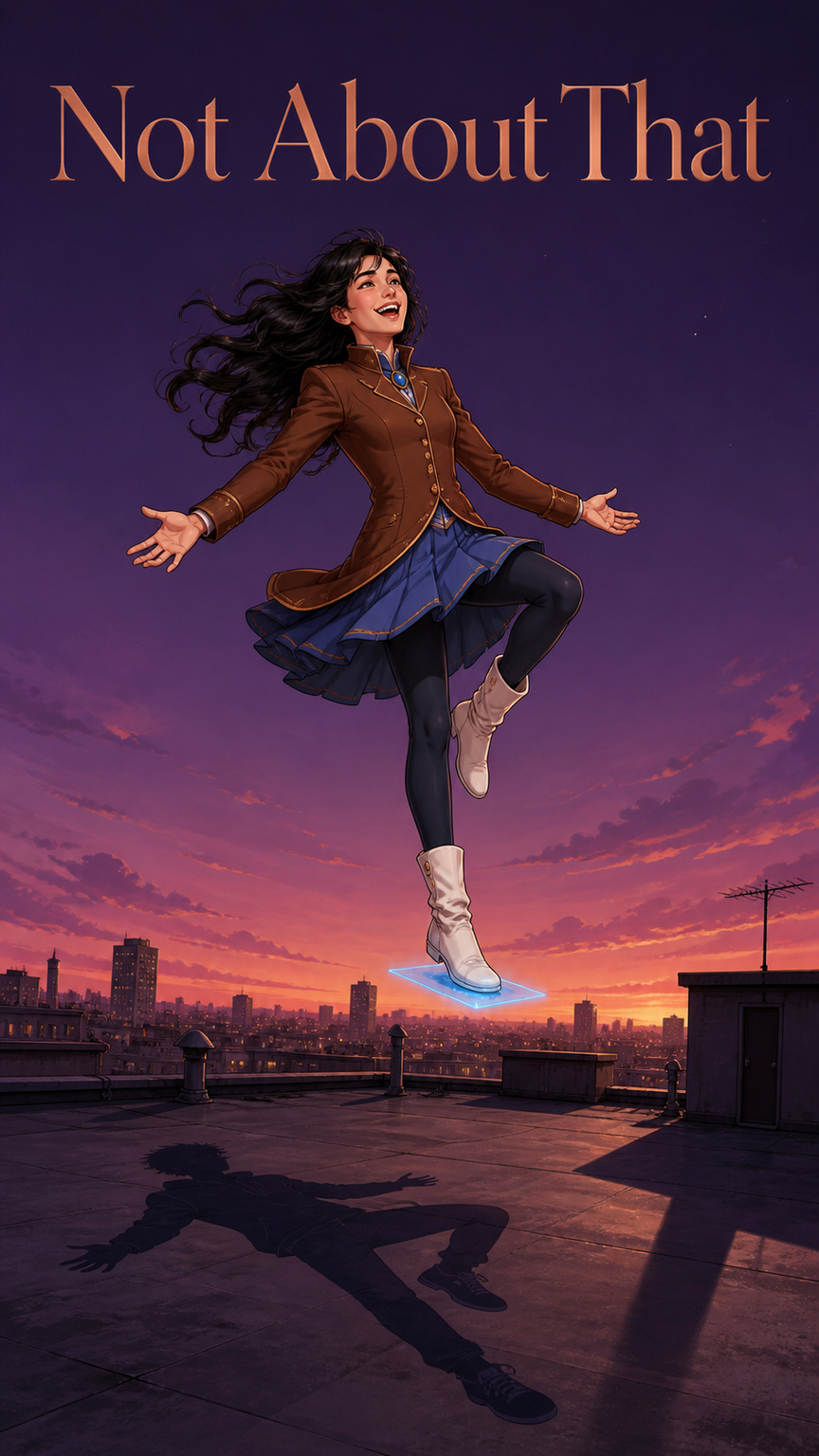
Lowen discovered the first problem with stealing a magical focus when his feet stopped fitting the roof.
He had known about the rest. The label tied to the copper clasp had been blunt enough: LIFT-STEP, SINGLE FIGURE, FEMININE, GROUND COMPLETELY BEFORE RELEASE. The clasp had lain for years in the family practice box between a cracked rain-calling comb and six spools of ribbon that only worked for their aunt. It had no mind with which to want him, no mouth with which to call him anything. Sarena had explained that part until he could repeat it while half asleep. A focus shaped what a living person supplied.
Lowen had supplied his power deliberately. Three breaths, both thumbs against the blue glass inset, and yes.
Then the roof seemed to drop six inches.
His sneakers drew tight, flashed white, and became soft boots fitted to feet a little shorter than his own. Dark tights smoothed up unfamiliar legs. A blue pleated overskirt snapped around his hips beneath a short copper-buttoned coat, all of it as neat as if somebody had ironed lightning. His balance went wandering and came home somewhere lower. His hair, usually an argument with gravity, slid in a heavy black rope between his shoulder blades.
Lowen grabbed the chimney cap before the new weight of it pulled his head back. His hand was narrower. His voice, when he said, “Oh,” came out bright and unmistakably a girl’s.
That was not the problem.
The problem was that the body felt wonderful in motion.
He pushed away from the chimney, wobbled once, and stepped where there was nothing. A pane of blue light rang beneath his boot. The next step lifted him above the clotheslines. On the third, wind poured cold along his tights and under the copper coat, and the whole block opened below him: tar roofs, green water tanks, laundry courtyards, tram wires, a bakery chimney smoking sugar into the late-afternoon air.
The sky was busy. It was always busy. Two magical girls in red delivery capes skimmed west with insulated supper boxes hanging between them. A little practice circle on the school roof burst into applause when one of its members managed a somersault, then into jeers when she came out backward and dropped her wand. High above, a woman in yellow oilskins towed a string of rain clouds toward the vegetable district. Somebody trailing pink sparks had written WAIT FOR ME across half a city block.
Lowen laughed. The sound startled him, and then the startling made him laugh harder.
The chalk circle Sarena had drawn for tomorrow waited beside the water tank. She had promised him a supervised trial after school, provided he did not touch anything alone, improvise, show off, or listen to their cousin about “unlocking his instincts.” At fifteen, Lowen was old enough to know that “three out of four” would not impress her. He had obeyed three anyway. Mostly.
He stepped higher. Each blue pane appeared only after he committed his weight, which was alarming for exactly one attempt. After that it was the best thing anybody had ever invented. His new center of balance turned a clumsy hop into a clean, buoyant sweep. He could feel the focus answering through the clasp at his chest, taking the lift he gave it and laying the next foothold into the air.
Across the alley, a coral-clad girl banked around an aerial and kicked both heels together. Her path flared into a gorgeous hook.
Lowen could do that.
He could not, in fact, do that.
His heels struck. The blue pane tipped nearly vertical. He shot past Sarena’s chalk circle, past the water tank, and straight over the parapet with enough speed to make every rooftop in the city wheel sideways.
He flung out a foot. Light cracked under it and redirected him upward instead of back. The laundry courtyard fell away. His stomach stayed behind.
“No, no, no—”
A gray shape rose over the opposite wing of the building. Sarena had one arm through a paper grocery sack and three silver wind-knots streaming from the other. Her transformed coat was longer than his, slit for movement, with faded red lining that flashed when she turned. She saw Lowen, saw the stolen clasp, and dropped the sack.
Oranges rained into the courtyard.
Sarena snapped two fingers. A wind-knot unreeled beneath Lowen, caught him behind the knees, and flipped him onto a laundry canopy. He landed in somebody’s sheets. The metal frame groaned, sprang him up again, and returned him to open air wearing a damp pillowcase like a veil.
Sarena caught the back of his coat.
For three breathless seconds they hung beside the fifth-floor balconies: Sarena braced on two trembling wind-knots, Lowen bicycling his shorter legs, the pillowcase over both their heads.
From an open kitchen window, the fifth-floor auntie shouted, “Sarena, why is your brother in my clean wash?”
“Research,” Sarena shouted back.
Lowen yanked the pillowcase free. “You dropped the oranges.”
“I’m going to drop you.”
“You won’t.”
“Today has been surprising.”
She hauled him onto the opposite roof and let go only after both his boots touched tar. Blue light pooled under his soles. Instead of draining away, it pushed him into an undignified half crouch.
Sarena stared at the clasp pinned beneath his chin.
Lowen tried to tuck his long hair behind one ear. The wind put it back in his mouth.
“Tomorrow,” she said.
“Technically it is tomorrow somewhere.”
“Not even cousin-level reasoning. That was pantry-moth reasoning.” She pointed at his feet. “Don’t bounce.”
He immediately bounced.
Sarena caught his sleeve before he floated over a vent. “How much lift did you stack?”
“I took maybe nine steps.”
“Lowen.”
“Fourteen? The last one was complicated.”
“You cannot revert until you put it back into a controlled landing.”
“I read the label.”
“Did you read it while hurtling past the place I told you to land?”
He looked across the courtyard at the chalk circle, small and reproachful beside their water tank. “I was coming around.”
Sarena bent to inspect one of his boots, then his knees and wrists. She did not ask permission in words; she held out her hands and waited for his nod before touching. That was how she did injury checks with everybody, even people she had just pulled out of chimneys. Lowen resented the courtesy more than grabbing would have deserved.
“Nothing twisted?” she asked.
“No.”
“Head clear?”
“Clear enough to notice you’re crushing a tomato.”
One of the fallen groceries had landed behind her heel. Sarena moved her boot. Red pulp clung to the sole.
“That,” she said, “was for dinner.”
Lowen smiled despite himself. The unfamiliar cheeks shaped it differently, narrower at the chin. Sarena’s gaze caught on his face, moved to the blue panes still guttering beneath his boots, then returned.
“You like being—”
The fear had been waiting inside the delight, thin as a trip wire. It pulled tight before she finished.
“J-Just because I have to turn into a girl to use my magical powers doesn’t mean I’m trans! Being a magical girl isn’t about that!”
His voice carried beautifully. It crossed the courtyard, struck brick, and came back smaller.
Sarena’s hand dropped from his wrist.
For a moment the only sound between them was a delivery cape flapping overhead.
“I was going to say flying,” she said.
Lowen’s face burned. “Well, you looked—”
“I looked at you.”
“You know what I mean.”
“No.” Sarena wiped tomato from her boot on the roof gravel. Her movements had gone careful and plain. “I don’t think I do.”
“I’m just saying you shouldn’t assume.”
“I didn’t.”
“You were about to.”
“Apparently you can air-step and hear the future.”
She tugged one silver knot loose from her wrist. The wind holding it went slack. Lowen watched the strand fade and told himself she was only conserving magic. She gathered the surviving groceries without offering him a hand.
“Where are you going?” he asked.
“To put these inside.”
“I’m still stuck.”
“Then stay on the roof.”
“I can ground it myself.”
Sarena glanced at him, and there it was: not a diagnosis, not secret knowledge. Anger. Worse, the kind she did not trust him to handle without turning it into another argument.
“Of course you can,” she said. “You’ve been doing excellent research.”
She disappeared into the stairwell.
Lowen lasted until the door banged shut before trying to cross the courtyard.
The sensible method would have been to wait. The humiliating method would have been to call Sarena back, apologize, and admit that the thought of anyone enjoying this body on his behalf scared him more than the five-story drop. The available method was to study the coral girl, who had circled back and was now hovering above a florist’s roof while arguing with her friend about whose turn it was to carry a bucket.
She bent one knee, swept her arms, and descended in a spiral.
Lowen bent one knee.
From the stairwell doorway, Sarena said, “Her power is ribbons.”
He startled. His boot hit a blue pane at the wrong angle. He pinwheeled off the roof.
Sarena swore and dove after him.
This descent was slower, if no more dignified. Lowen slapped footholds into the air whenever he neared a balcony, which kept him from hitting brick and also kept him from going down. He bounced from the fourth-floor laundry rail to a striped awning, from the awning to a blue pane, and from the pane into Sarena’s shoulder. She shoved him away, missed her own wind-knot, and both of them landed in a balcony planter.
The planter belonged to no magical tradition. It responded to their arrival by breaking.
Soil poured through the railing. Lowen and Sarena clung to it while a rain of basil struck the courtyard below.
“That was basil,” Lowen said.
Sarena’s mouth twitched.
“Do not laugh.”
That finished her. She made one strangled sound, then buried her face against her sleeve.
“I almost died.”
“You almost got seasoned.”
Lowen started laughing too. His grip loosened. A leftover pulse of lift peeled him off the balcony and sent him drifting backward.
Sarena’s laughter stopped. “Lowen. Left foot down. Flat.”
He heard instruction as command, the change in her tone as proof she had decided what he was, and he kicked left harder than he needed to. The pane flashed. Instead of lowering him toward the courtyard, it shot him across it.
He crashed through three lines of laundry and emerged in a white shirt, two aprons, and a pair of enormous bloomers. The fifth-floor auntie leaned from her window with a wooden spoon.
“Boy,” she called, “if you stretch those, you buy them.”
“Sorry!”
He tore free and struck another foothold. Behind him, Sarena said, “Lowen, stop making steps.”
“Then I fall.”
“You float. That focus wants to spend the lift. Let it.”
“You said left foot.”
“I made a bad call.”
He glanced back. Sarena hung three yards away, one boot planted on a wind-knot that shook under her. Dirt streaked her cheek. Her transformed coat had ripped at the elbow, and one of the groceries bulged from its pocket as if she had hidden a turnip there during battle.
“You never say that,” Lowen said.
“You never listen long enough.”
He pulled the white shirt off his head. “You laughed.”
“Also bad.”
The apology arrived without polish and without asking anything from him. That made it harder to refuse.
Lowen held still.
The stored lift carried him upward by inches, gentler now. Sarena drifted beside him without touching. Across the open side of the courtyard, the city shone in fragments between buildings. Magical girls crossed every strip of sky: one seated sideways on a crescent of green glass, one pumping a broom like a scooter, four holding hands around a wobbling globe of rain. None of them looked over. A boy in a girl’s body hanging among laundry was not the strangest part of anyone’s afternoon.
The blue light around Lowen’s boots thinned.
“There,” Sarena said. “You feel the sag?”
“No.”
“Your right hip dropped.”
“Maybe this body has a lower right hip.”
“It doesn’t.”
“How would you know?”
Sarena’s face closed again.
The words left the same silence as his outburst. Sarena had told him what his hip was doing, and he had dragged her transness into the answer as if it were an accusation. Once could have been panic. Twice was something uglier.
Below, the courtyard chalk marks waited where Sarena had practiced landings with him in sneakers all summer. Heel, bend, hold. She had drawn ridiculous little faces beside his worst attempts and a crown over the one good one. She had spent three weeks talking their mother into letting him try a focus at all. Lowen knew that. He had known it when he opened the practice box early.
“I’m going down,” he said.
“Good.”
“Alone.”
“Less good.”
He let himself sink. Sarena followed at a distance.
At the third floor, a warm gust rolled through the courtyard carrying sugar smoke from the bakery chimney. Lowen’s long hair lifted before the rest of him. He liked the tug at his scalp. He liked the coat tails fluttering around his legs and the easy, buoyant alignment of this body. Liking it did not feel like a verdict until he imagined saying it aloud.
The gust slid under the remaining lift and carried him past the courtyard circle. He reached for a foothold by reflex.
“Don’t,” Sarena said.
He made one anyway.
The pane caught the wind like a sail.
Lowen rose through the courtyard faster than Sarena could follow. Balconies blurred by. He cleared the roofline, hit the colder current above it, and kept going. The building shrank beneath him. His next foothold appeared faint as breath on glass.
“Lowen!”
Sarena came over the parapet with only one wind-knot left. She stretched it until the silver line shivered. She could reach him or brace a landing, not both.
The city had changed color while they argued. Windows burned amber. Streetlamps pricked on below. The girls who had filled the afternoon sky were heading home in twos and threes, their trails crossing violet dusk. Lowen saw no one near enough to reach him before his last pane failed.
Sarena held up her remaining wind-knot. With her other hand she pointed at the copper belt fastened over Lowen’s coat.
He understood. The knot could turn his fall, but not carry him. Sarena would have to anchor it, and he would have to take it.
Lowen shook his head. The silver strand was the only thing under her boot.
Sarena bared her teeth at him. Then she stepped off it.
She dropped past the parapet, let the knot unspool just long enough to turn her toward the roof, and landed beside the water tank. Her knees buckled. Before Lowen could decide whether that was part of the plan, she wrapped the strand once around the tank’s iron leg and threw its loop back into the air.
It rose toward him and stopped a foot short.
The final blue pane bent under Lowen’s boots. Sarena waited below, one palm pressed to the tank, her hair loose in the wind. She was offering exactly what she had, not an answer to anything else.
“Sarena!”
She looked up.
“I said it like being you was awful.”
Her hand tightened on the silver line. “You did.”
“I’m sorry.”
She did not forgive him. She snapped her wrist, and the loop jumped another six inches.
Lowen stepped off the pane to meet it.
For one plunging second he had neither light nor line. Then he caught the loop in both hands. His long hair tangled around his wrists. He dragged the knot over his head and worked it beneath the copper belt, trusting the magical coat to hold where his grip might not.
The blue pane shattered above him.
Falling was nothing like flying. His stomach climbed into his throat; the wind packed his overskirt with cold. The knot went taut at his waist and swung him toward the building in a wide, ugly arc. On the roof Sarena slid a yard across the tar before her shoulder struck the water tank. She held on.
Lowen kept his hands off the magic. The chalk circle rushed up beneath him. He turned his hips the way Sarena had shown him all summer, found the roof with both soles, and let his knees fold.
His heels held for one beat. Then his momentum pitched him sideways and rolled him out of the circle in a storm of hair and blue pleats.
Light washed over the chalk. The roof gave a deep satisfied thump, and all the stored lift vanished.
Lowen lay on his back, abruptly and wonderfully heavy. The silver knot loosened from his belt. Several feet away, Sarena sat against the water tank with one hand clamped over her torn elbow.
Neither of them spoke until their breathing slowed.
“I did like it,” Lowen said.
“You laughed for half an hour.”
“Seventeen minutes.”
Sarena gave him a look but did not finish his thought for him.
“I wasn’t scared of being you,” he said. The sentence came apart after that. “I mean, I was scared, but not of— It sounded like—”
“Lowen.”
He stopped.
Sarena looked at the dusk instead of him. “Don’t make me the thing you have to not be.”
There was no clever answer hiding behind his teeth. “Okay.”
“And don’t steal my practice box.”
“Our practice box.”
“See, this is why apologies take you all evening.”
Lowen sat up. His long hair had wound itself through the wind-knot and around two copper buttons. Sarena came over and crouched in front of him. She worked the silver strand loose without yanking, though the set of her mouth warned him not to mistake care for pardon.
When the knot was free, Lowen put his thumb on the blue glass. Then he stopped.
“Do you have your phone?” he asked.
Sarena narrowed her eyes. “Why?”
He nearly said it did not mean anything. That would have been the same mistake in a fresh coat.
“I want a picture,” he said. “Of me like this.”
Sarena studied him, the long hair and the blue pleats and the face he had enjoyed wearing. “For you?”
“Yes.”
She drew her phone from an inside pocket and held it upright. Lowen stood in the chalk circle. He tried arranging the overskirt, then his hair, then both at once. Every position looked like somebody else’s idea of a magical girl.
Sarena’s phone clicked while his hair was still caught in his mouth.
“Not that one.”
Sarena took the battered turnip from her coat pocket and aimed it at him like a wand.
Lowen laughed. Her phone clicked.
“I’m still mad,” she said.
“I know.”
He pressed the blue glass and deliberately let go.
The copper coat loosened into his old sweatshirt. The pleats snapped back into jeans. His feet lengthened inside battered sneakers; his balance climbed; his hair sprang short and stubborn around his ears. Lowen missed the wind along its vanished length immediately.
The focus came loose in his palm. He handed it to Sarena, and she put it away without promising him anything.
“Do you believe me?” he asked.
“You’re my brother.” She looked down at her phone. “You’re also blurry.”
Lowen leaned over her shoulder. In the photograph, his long hair crossed his mouth, his copper coat shone in the last daylight, and one hand was still trying to rescue the crooked overskirt. The ridiculous turnip floated at the edge of the frame. He was laughing too hard to pose.
“Send me that one,” he said.
Sarena did. She kept the terrible first one too.