Realms
Your twelve-year-old sister is dying, and the only cure is a living heartseed sold in a market beyond a hidden portal. The dealer will accept no money—only your place in every memory your family has of you. When you refuse the bargain, stealing the heartseed may be your last chance to save her.
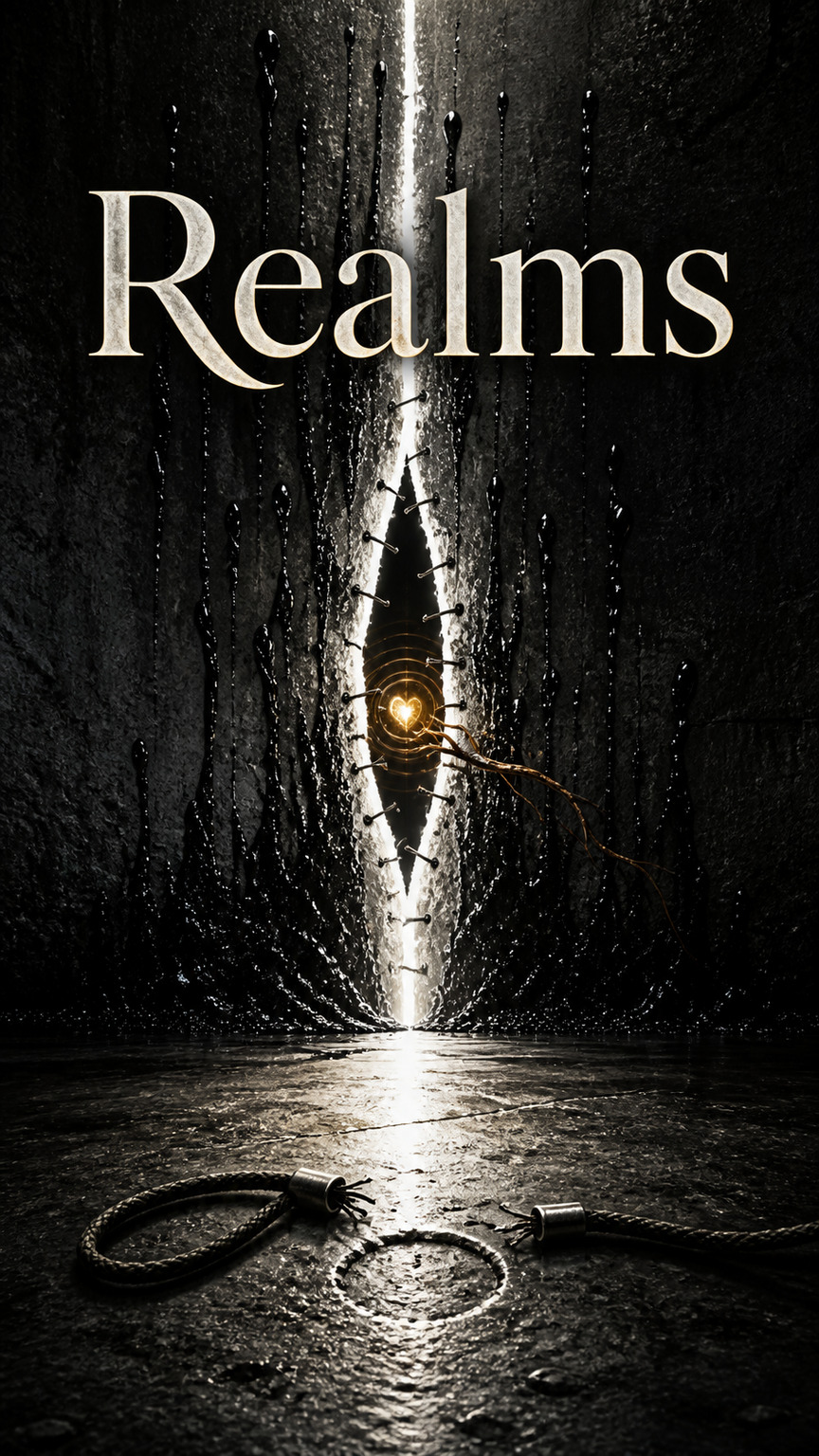
The portal looked less like a doorway than a wound.
It hung in the abandoned tunnel below Queen Street, twenty feet of white light stitched into wet concrete. Black rain crawled upward around its edges. It spattered the ceiling and left the floor beneath it dry.
Someone had painted above the wound:
RUNNERS GO IN
DEBTS COME OUT
Underneath, in smaller letters: sometimes.
I stood behind the yellow line with a borrowed pack on my shoulders, Lena’s hospital bill folded in my sock, and my phone pressed to my ear.
“Cal-Cal,” Lena’s saved voice whispered through the speaker. Machines breathed behind her. “You said you’re getting groceries. If you bring those cardboard pears again, I’m reporting you to the government.” She paused to catch her breath. “Come back before visiting hours, okay?”
The message ended. I put the phone in my jacket beside her photograph.
“Name?” asked the woman at the folding table.
Her silver throat tag read M. Voss — Licensed Exit Witness. A cracked tablet, a thermos, and a pistol lay in front of her. The pistol was the least alarming thing in the tunnel.
“Cal Mercer.”
“First crossing?”
I considered lying. M. Voss looked at the clean knees of my jeans and waited.
“Yes.”
“Then say it like you prefer living.” Voss pointed to the wall beside her. Something translucent pulsed under the concrete there, thick as a buried vein. It disappeared into the rim of the portal. “The seam is alive. I can prompt it. I can’t order it. If it stops recognizing this route, your reasons won’t persuade it.”
Behind me, Tuck sighed theatrically. He was tall, short one piece of his left ear, and wrapped in a coat whose original owner had probably fought hard.
“He paid for a guide,” Tuck said. “He gets a guide.”
“He paid you,” Voss said. “That makes him a customer with company.”
Tuck smiled. “Cruel distinction.”
Voss took a dull metal disk from a locked case. At her touch, the buried vein pressed closer to the surface. She made me declare my name again, then held the disk against the living seam. Pale lines spread across the metal.
“The disk stores the mark,” she said. “It does nothing by itself. The seam has paired it to your declared name, this entry, and tonight’s return window. It remembers the route, not your wrist. Lose it before you open an exit and you become local. Lose it after the exit opens but before I stamp it closed, and momentum may carry you through while whoever holds the disk keeps one usable trail behind you.”
“So I don’t lose it.”
“A gifted student.”
I tied it around my bare wrist with doubled cord. Tuck pulled back his sleeve and showed me a separate disk on a leather thong, its markings dim but visible.
“Mine,” he said. “No sharing, no heroic clasping of hands, no sentimental nonsense.”
Voss glanced at the hospital bill corner protruding from my sock. “Your sister needs a transplant, not a miracle.”
“Her name is Lena Mercer. She’s twelve. Her numbers got worse this morning.”
“That doesn’t change what a heartseed costs.”
“No,” I said. “It changes what I’m willing to pay.”
Voss’s expression tightened. “That’s what worries me.”
I checked my pack: water, protein bars, flares, copper wire, a knife, and a fistful of diner salt packets. An old Runner-forum post by GutSaint72 had claimed salt discouraged wet trouble. Half the replies said the account was a fraud. The other half said the writer was dead.
Tuck stepped through the wound. The white seam swallowed him with a wet pop.
Voss looked at me one last time. “It doesn’t care why you enter.”
“I know.”
“Not yet.”
I played one second of Lena’s message—Come back—and crossed.
Sound went first.
The tunnel vanished. Pressure filled my skull. I landed knee-deep in red grass, under a blue sky crowded with doors.
Thousands drifted overhead: painted doors, steel doors, doors small enough for a hand, one round door wider than a stadium. Some opened on fire or water or lamplit rooms. Others stayed shut. None explained where we were, and I had no breath to ask.
Tuck was already walking toward a white road. His voice reached me a beat late. “Don’t stare. Everybody eventually sees a door they want.”
I looked down. The grass bent away from my boots without touching them.
Far ahead, a city of copper towers and crooked awnings rode the shell of something vast and sleeping. Its plated back rose and fell. With each breath, the whole city climbed against the sky and settled again.
“Deepmarket,” Tuck said. “Where wanting something is the first way you tell it how to hurt you.”
At the city gate, a living figure made of warm smoke stretched across the road. Faces opened and closed inside its body like bubbles.
“Terms,” it said. “One emotionally weighted memory from each entrant. I select. You cross the collection line, you consent.”
Tuck stopped before a white groove in the stones. “Can we refuse?”
“Yes.”
“Can we enter after refusing?”
“No.”
He crossed. The smoke touched his brow. Tuck staggered and muttered something about the smell of his father’s truck.
I wanted to rush past him, but the gatekeeper spread across the road.
“Do I choose the memory?” I asked.
“I select.”
Lena’s heart was failing while I negotiated with smoke. I stepped over the line.
A cool finger touched my forehead.
Something came loose.
There had been a girl named Priya. I knew she had given me my first kiss, and that it had once mattered. I could no longer see her face, recall the place, or find a single sensation from the event. The knowledge remained like a label on an empty drawer.
I folded over, grasping for what wasn’t there.
Tuck caught my collar. “Walk.”
“It took too much.”
“It took something heavy. That’s the stated price.”
“You make that sound fair.”
“I make it sound finished.” He pulled me through the gate. “Save your anger. Things here can smell it.”
Deepmarket rang around us like a drawer of knives. Living merchants barked offers from stalls built into the sleeper’s shell. A woman with beetle wings uncorked jars of thunder. A three-headed hen laid warm brass eggs into a velvet basket. A mirror-eyed seller tracked pieces of my reflection as I passed. On one table, inert maps had been pinned flat beneath a net of pale, breathing roots.
I kept one hand over Lena’s photograph.
“How much?” I asked.
“For my remaining fee?” Tuck said. “You have it.”
“For the heartseed.”
He stopped in an alley glazed with green wax. “You don’t buy a heartseed with cash.”
I pulled seven hundred dollars from my jacket. “You said half up front.”
“Half my fee.”
The money shook in my hand. “You knew this was all I had.”
“I knew it was more than you could afford to lose and less than the market would notice.”
My knife came out.
Tuck drove two knuckles under my ribs. I dropped to one knee, gasping, while a thin antlered merchant paused at the alley mouth with an empty bottle ready.
“Put it away,” Tuck said. “Deepmarket’s living substrate feels expressed want. Strong want makes a heavy price. Anger is just another thing it can sell back to you.”
I sheathed the knife. The antlered merchant clicked his tongue and left.
“You said the Realms run on want,” I said.
“Runner shorthand. I know this market. Anyone who claims to know every door in that sky is selling a map.”
He led me to a blank wall furred with hair-thin roots. It had no handle, only a shallow depression that warmed when we approached.
“It opens for honest shame,” Tuck said.
“That’s convenient for you.”
He put his palm against the wall. “I abandoned a friend because his boots fit me better.”
The roots shivered but did not open.
Tuck swallowed. “He was alive when I took them.”
A slit appeared in the wall.
My turn. I tried to offer the time I’d stolen groceries, but the roots stayed cold.
“I was relieved,” I said. The words scraped on the way out. “When the doctors said Lena might die. For one second, I imagined the waiting ending, and I was relieved I wouldn’t have to be afraid every morning.”
The wall opened wide.
The shop beyond was warm and dark. Roots hung from its ceiling and braided through its shelves. Glass jars held plum-sized lights, each beating at a different rhythm.
Behind the counter sat a child-shaped figure in a gray suit. White hair framed an unlined face; its hands were wrinkled as old paper. A thin shadow tied it to the roots beneath the counter.
Tuck said, “That’s an avatar. Don’t mistake the shape for a child.”
The dealer smiled. “Hello, Tuck.” Its eyes turned to me. “Cal Mercer.”
I touched my token.
“The shop reads what the entrance marked,” it said. “It does not need your trust.”
I put the hospital bill and Lena’s photograph on the counter. “She needs a heartseed.”
Roots slid over the paper, the photograph, and the edge of my hand. I pulled back. On the highest shelf, one light changed its rhythm. A label flowered across the jar: Lena beneath our kitchen table, knees drawn up, daring me to find her.
“The seed is tuned,” the dealer said. “Your records describe the damage. Your want supplies the weight. Your living tie supplies the direction.”
“Price?”
Every heartseed beat at once.
“Twenty years.”
“Mine?”
“Whose else did you bring?”
“Take them.”
Tuck swore softly.
The dealer leaned across the counter. “You neglected to ask which twenty.”
I pictured years as blank squares and tried to make them cheap. “Which?”
“The best. The ones in which your body is strong, your judgment clear, your love returned. The seed takes nourishment where nourishment is richest.”
My certainty faltered. The dealer saw it and smiled wider.
“Another price, then. Your place in your sister’s remembered life.”
“What does that mean?”
“She keeps the repaired years. She and your mother lose their lived memories of you. My roots bend their attention so photographs feel mislabeled, your room feels available, your messages feel sent by mistake. History remains. Birth and hospital records remain. Objects remain. They simply build painful explanations around a person they can no longer remember.”
A root curled across the counter like an offered pen. “Say you consent, and Lena wakes stronger.”
The clean heroic answer rose to my mouth.
I had rehearsed it through every careful doctor conversation: anything. My years, my blood, my place at the table. Brother traded for sister. A sacrifice so complete nobody could accuse me of feeling relieved.
The root touched my fingers.
Then I heard Lena’s message in my head. Not the saved sound—the demand inside it. Come back. She had asked for pears and time and her brother. She had not offered her mind for me to carve pieces from. Neither had our mother.
Priya’s empty drawer opened inside me. The gate had taken one memory after stating its terms to the person who owned it. This bargain would take thousands from people who weren’t in the room and call my permission enough.
I drew my hand away.
“No.”
The dealer’s smile vanished. “The traces would hurt less with time.”
“You don’t get to make forgetting me their cure.”
“Then why did you come?”
I looked at the jar marked with Lena’s face. “I thought I came to pay.”
“And now?”
I took out my knife.
“Now I steal.”
Tuck gave one short, disbelieving laugh. Then the shop tried to kill us.
Roots dropped from the ceiling. One caught my ankle and slammed me against the floor. Others wound around Tuck’s arms and throat. Shelves folded inward as the living shop pulled its heartseeds out of reach.
The dealer’s jaw opened too far. A shriek like metal on winter rail shook the jars.
I tore open the salt packets and flung them into its mouth.
The crystals struck wet tissue. The child shape convulsed. Its thin shadow whitened where the salt drew moisture from it, and the roots nearest the counter loosened.
“GutSaint72,” I wheezed. “One useful post.”
Tuck ripped an arm free. He seized a low jar and smashed it against the shelf. A flock of tiny living lights burst out, biting at every root they touched.
“Wrong one!” I shouted.
“It looked hostile!”
“That’s your selection rule?”
The dealer pointed at Tuck. The wall behind him split open. Beyond it, the white road ran clear toward the gate, and his own token shone through his shirt.
“Guides may leave,” the dealer rasped. “Customers pay.”
The root around Tuck’s throat released him.
He looked at me, then at the open wall. For one breath he was already gone. I saw it in the angle of his body, the hand closing around his own disk, the instinct nine years had sharpened.
He ran for the road.
The roots hauled me backward. I clawed at the waxy floor while Lena’s jar receded overhead.
Tuck reached the threshold.
Then he stopped.
“I have enough stolen footwear,” he muttered, and turned back.
He threw his weight onto the root around my ankle. It bucked, flinging my knife from its sheath. Tuck kicked the blade toward me. It spun too high. I grabbed for the handle and caught the edge.
Pain opened my palm.
I held on, sawed through the root, and rolled free. Milk-colored fluid washed over the floor. The shop shuddered.
Tuck drove his shoulder into the dealer avatar. Its child-shaped body folded against the counter, all paper skin and braided root underneath. I climbed the shelves as they contracted around me.
The labels blurred: antlers, a furnace, six fingers, a blue eye. Then Lena, under the kitchen table.
I caught her jar against my chest.
The shop’s defensive reflex struck like a kicked elevator.
Every root snapped toward the route marks on our tokens. The wall, ceiling, and floor became a throat throwing us out. Tuck grabbed my jacket as the shop hurled us through a corridor of spinning doors. Brief openings flashed around us—salt water, red stone, a room full of candles—but our stored marks burned white as the living shop shoved us toward the same wet seam.
The Queen Street seam answered the stored marks by opening two circles onto the tunnel, their edges overlapping. Voss stood beyond them with her stamp raised.
Tuck crossed first on his own mark. I followed, still holding the jar.
A dealer-root whipped out of the folding corridor and caught my wrist. The cord snapped. My disk vanished backward into the shop, but the threshold was already open and my body was already falling.
I struck tunnel concrete.
The jar shattered under my hand.
For one dead second, I thought I had killed the seed.
Then the light found the fresh cut in my palm.
It entered like a hot thread pulled through every vein. I watched roots of gold climb beneath the skin of my wrist and disappear toward my chest. A second rhythm struck under my heart.
Voss stamped Tuck’s disk closed. Then she was above me, pistol in one hand, the other holding my shoulders down.
“Where is the heartseed?” she demanded.
My chest answered twice.
Tuck lay bruised beside me. He stared at the glow under my ribs.
“That,” he said, “is not where he planned to put it.”
I woke cuffed to a clinic bed. The room smelled of bleach, burned toast, and the mineral sharpness of the portal rain. Beyond a reinforced inner door, I could hear the return tunnel’s old pipes ticking.
My cut hand was bandaged. Heat branched from it to my chest. Beneath my pulse, the heartseed kept its own patient rhythm.
Voss sat in the corner with a paperback. Tuck occupied the next bed, one arm in a sling and pale rings around his throat.
“Lena,” I said.
Voss set down the book. “Alive.”
“Did she get it?”
“The seed rooted in the first fresh blood it touched. Yours. Removing it now would probably kill both of you.” She raised a hand before I could fight the cuff. “It was tuned to Lena’s damaged cardiac pattern, not to her body as a host. Your blood is carrying a surplus of whatever repair factors it makes.”
“Then give her all of it.”
“No.”
The old word rose—anything—but this time I heard what it tried to hide.
Voss continued. “The clinic told your mother every known risk and most of the unknown ones. She consented to one screened transfusion. Lena was awake enough to assent. One. Monitored. Her numbers improved, but they aren’t normal. This bought time. Nobody here can promise how much.”
Better, I thought.
Not cured. Not safe forever. Better.
The word hurt so beautifully I had to close my eyes.
Voss put my phone in my free hand. Lena appeared on the screen, washed pale by hospital light but sitting higher against her pillows than she had that morning.
“Cal-Cal,” she said.
The dealer had offered to erase that voice from her. Hearing it now nearly broke me.
“Hey,” I managed.
“You look terrible.”
“Tuck looks worse.”
From the next bed, Tuck lifted one finger without opening his eyes.
Lena’s smile faded. “They said you stole something alive and now it’s inside you.”
“That’s the short version.”
“Did you know that would happen?”
“No.”
“Did you ask me before deciding this was worth it?”
I looked at the cuff, the bandage, and the faint gold under my skin. “No.”
“Then if there’s a next time, you ask. Before another transfusion. Before another miracle. I get a vote.”
“You get a vote,” I said. “And I don’t donate again unless the clinic says it’s safe enough, you want it, and our mother agrees. I stay for the monitoring. All of it.”
“Good.” Lena breathed carefully, but the breath reached the end without a cough. “Also, pears in cans. The government has standards.”
I laughed. She did too. For a few seconds we were only brother and sister, arguing over fruit.
After the call, Tuck pushed an envelope across the gap between our beds.
“The unpaid half,” he said. “And part of the paid half. I delivered you to the wrong price without telling you.”
“You came back.”
His gaze went to the boots at the foot of his bed. “That doesn’t make the first time unhappen.”
“No.”
“I’m helping close the route anyway.”
Voss stood. “So am I. The entry was mine to witness. The breach is mine to contain. I don’t get to become a line in somebody else’s report because your guide is unreliable and you’re catastrophically stupid.”
“Accountable allies,” Tuck said. “Warmest room in the city.”
Only then did Voss open the evidence pouch from the return. Tuck’s stamped disk lay inside. A clipped cord lay beside it.
She checked the pouch again.
“Your token never crossed,” she said.
The heartseed’s second rhythm quickened.
From beyond the reinforced door came three soft knocks.
A child’s voice spoke through the steel.
“Cal Mercer.”
Voss drew her pistol. Tuck reached beneath his pillow. I kept Lena’s phone in my hand.
The heartseed answered the knock with one hard, hungry beat.