The Rooms the City Forgot
In a coastal city grown from engineered coral and muscle, residents lease symbiotic apartments instead of owning them. A municipal pruning worker discovers that one housing tower has quietly grown illegal rooms around people erased from the census. The building cannot speak, and nobody knows whether it is protecting its residents or responding to something they placed inside it. The worker has until sunrise to classify the new growth as housing or disease.
The knife went in hot.
Lirenn drew it back from the tower’s flank and touched the ceramic spine to the heel of her glove. Heat came through the rubber. Below her hanging cradle, the sea worked black and silver against the reef foundations; above, six hundred leased rooms tightened and released around sleeping bodies. The tower’s night pulse should have traveled in long, lazy bands. Here it broke twice against a ridge that did not appear on her municipal section.
She scraped away a frill of fresh coral. Under it, muscle the color of uncooked shellfish shivered around a seam. Warm air feathered the salt on her wrist.
Solid wall, according to the section.
“Bordu.” She pressed the throat of her mask. “Exterior east, tier eighteen. Warm exhalation through load muscle. Irregular pulse.”
Her supervisor’s reply rasped from the cradle speaker. Behind his voice, the night office pumps beat their patient three-count. “Old vent?”
“No lumen on record.” Lirenn set a tension prong on either side of the seam. The needles leaned apart. “There’s volume behind it.”
Silence lasted one pump beat. “Sunrise intake in fifty-one minutes.”
“I can see the sea.”
“Then you can see the light coming.” Bordu was tired enough to let irritation show. “If it’s a bloom, the first perfusion will drive it into the feed trunk. Housing or disease before that. No third box.”
The seam breathed against her glove.
Lirenn clipped the cradle’s safety tongue to a ring of legal balcony bone and changed blades. “Open an emergency line for tier eighteen.”
“Already holding it.”
“Holding isn’t opening.”
“It is at this hour.”
She could picture Bordu with one hand on the tower map, counting the lit rooms above the ridge. He protected totals. Six hundred sleeping tenants gave him reason to.
“Eleven minutes,” he said. “Then I send the debridement team.”
Lirenn slipped the thin knife into the seam. Pressure, grain, pulse. The muscle resisted on the inward stroke and yielded sideways, organized around something more complicated than a tumor. She cut with the grain.
The wall opened its wet red lips on a room.
Not a cavity. A room. Pale lining cupped an alcove wide enough for a sleeping mat. An air gill folded near the ceiling. A load rib had grown diagonally through the far wall, and a clay cup sat in its fork. There was a sandal under the mat.
A hand shot through the opening, caught her wrist, and dragged the blade away from a dark tube behind the lining.
“Not there,” a man said. “Feed.”
Lirenn twisted free and braced both boots against the cradle. “Let go.”
“You were cutting the feed.”
“Move your hand.”
He did. He was broad, gray-haired, and bare to the waist, his skin stippled with the harmless salt rash that came from living too long in unbalanced rooms. No lease seal shone under his collarbone. Behind him, another person kicked aside the sleeping mat and lifted the clay cup before it spilled.
“How many?” Lirenn asked.
“Five,” the gray-haired man said.
A woman called from deeper in the growth, “Six floors if that tube fails.”
The man glanced back. A partial answer, and he knew it.
Lirenn enlarged the cut upward. “Names. Work.”
“Mular. Graft tender.”
“Former,” said a compact woman crouched beside the air gill. She pushed a flexible reed through its folds, clearing a clot of gray mucus. “Kevi. I know the routes. The east exit’s sealed.”
The woman at the feed tube trapped it briefly under one knee, leaving both hands empty. “Eshun. Supplies.” Then the vessel kicked free and she caught it, squeezing in a slow, alternating rhythm to milk dark fluid past a pinch.
Two more people waited in the next alcove: an older woman with one knee bound in reed splints, and a fever-bright man holding a wet cloth against his mouth. Five. None wore lease seals.
Lirenn touched her mask. “Occupied growth. Five unbound residents. Send a medical cradle and ward clamps.”
“Unbound occupants,” Bordu repeated. The change was small and deliberate. “Is it differentiated?”
Lirenn looked at the gill, the load rib, the feed line Mular had stopped her cutting. “Not enough data.”
“Seven minutes.”
Mular stepped back as she climbed through. The lining tried to grip the tread of her boots, then loosened after half a second. Accommodation response. She marked it on her wrist slate.
The hidden space branched around the tower’s older anatomy. Every wall was curved, but not randomly. One chamber held sleeping mats. Another had shallow waste channels with mineral crust around carefully patched lips. Heat sacs nestled beneath a rack of drying shirts. The chambers borrowed everything—air, salts, waste clearance, muscular lift—from legal floors whose residents had paid to seed the tower with their microbial cultures.
They also gave back. A warm return vessel pulsed toward the main night reservoir. Thin resident-matched linings filtered waste. This was not dead shelter carved from flesh. It was participating.
At Lirenn’s feet, a translucent bud no larger than her thumb nosed blindly from a crack and tightened around her boot lace.
It had no place in a mature apartment.
She sliced it free. Clear gel bled from the stem.
Mular flinched. “You could tag before cutting.”
“Tagging gives it time.” Lirenn pinched a sample into a vial. “How long has it been budding?”
“It does that near new seams.”
“How long?”
“We prune them.”
“Mular.”
“Three months. Maybe four.”
Kevi pulled the reed from the gill and wiped it on her trouser leg. “Longer.”
Mular’s head turned toward her.
“Don’t,” she said. “She found us. We’re past tidy.”
The floor clenched. Eshun’s fingers slipped on the feed tube. She caught it with both hands, forced it into the crook of one knee, and raised empty palms. “No one step on the blue ridges. Please.”
It was the please, ordinary and breathless, that told Lirenn how close the feed was to failing.
She uncapped a dye thorn and pressed it into the return vessel. Yellow dye raced through orderly capillaries in the sleeping chamber, reached the waste lips, then dispersed evenly through the heat sacs. Housing differentiation. But a second plume vanished into the wall behind Mular and did not return.
“What’s in the service sinus?” she asked.
“Scar tissue,” Mular said.
Kevi snorted once.
“Move.” Lirenn pointed the dye thorn at him.
“There isn’t room.”
“Then make it.”
He planted himself before a low opening veiled in pink membrane. A graft tender’s stance: feet apart, hands empty where she could see them, braced for her cut. Lirenn mistrusted anyone who made her anatomy wait upon a confession.
Her mask cracked with static. Bordu said, “Air demand spike on nineteen.”
Above them, the tower’s slow pulse stumbled.
Eshun locked the tube between her knees and raised her empty hands. “Which stack?”
“East six.”
“That’s us.” She pinned the tube beneath her knee, took both hands away, and pointed through the curved wall. Without her pumping, fluid immediately darkened. “Our feed pinches their air return when this chamber fills. Cut through my room to the gill root. Straight up.”
Mular said, “No.”
“You have another route?” Eshun put both hands back and pumped.
When the tube softened, she let it go for one beat. “Use your mouth for one.”
Lirenn checked the wall’s vibration. Six rapid tremors: legal apartment alarms traveling through load ribs. “Which chamber is yours?”
Eshun jerked her chin toward the heat sacs and drying shirts.
“There’s a support rib behind it,” Mular said. “You cut blind, you drop the alcove.”
“Not blind.” Lirenn took a resonance peg from her belt and struck the wall. The tone came back split. “Rib at two hands. Air root at four. Heat sac between.”
Eshun pinned the tube beneath one knee and lifted both hands. “My stores are under the sac. Kevi, take this.”
She took over. Only then did Eshun move. She swept sealed packets of salt cake, a bundle of clean cloth, and three jars into her apron. Lirenn helped lift the drying rack. They had no time for the shirts. Eshun looked at them once, then pulled the room’s reed divider away and wrapped it around the fevering man’s shoulders.
She tucked the last fold beneath the fevering man’s arm and let go. “Clear.”
Lirenn drove two clamps into the support rib. Ordered nouns steadied her: rib, sac, root, cut. She opened the heat sac, caught its hot brine in a waste bowl, and divided the wall. The gill root inflated into the cut with a soft, awful bloom. Air roared past them. Somewhere above, six alarms slowed and stopped.
The new passage collapsed Eshun’s sleeping alcove into a narrow service duct. Her drying shirts settled in the brine.
Eshun set the jars in the crook of the load rib and steadied the last one with her wrist. Her hands came free. “Can they breathe?”
Lirenn listened to the wall. “Yes.”
“Then leave the rack.” Eshun handed a salt packet to the coughing man. Once he had it, she let go. “Small bites. Not the whole thing.”
Bordu came over the speaker. “Nineteen is recovering. What failed?”
“Illegal growth compressed a legal air return.”
“Disease criterion.”
“One criterion.”
“A floor lost air.”
“And differentiated tissue accepted a relief path.”
“At the cost of a room that shouldn’t exist.”
Eshun’s face went still. Lirenn turned down her speaker, too late.
“Bring your clamps,” she told Mular. “Service sinus. Now.”
He stayed in front of the membrane.
Kevi, still squeezing the tube, said, “If he won’t, cut around him.”
“You said you knew the routes.”
“I know when one closes.”
Mular’s prepared explanations had come apart. “It wasn’t—the cultures would have died. Once the bindings vanished, the lining shed us. You know rejection. We only needed a cavity through molt, but the census refreshed before—”
The hidden feed bucked under Kevi’s hands. She swore and leaned her weight onto it.
“Object,” Lirenn said. “Location. Connection.”
Mular swallowed. “Comb. Behind me. At the nutrient wick.”
“Living?”
“Cultures are. Ceramic isn’t.”
“Connections?”
“Five roots. Maybe more now.”
“Move.”
This time he did.
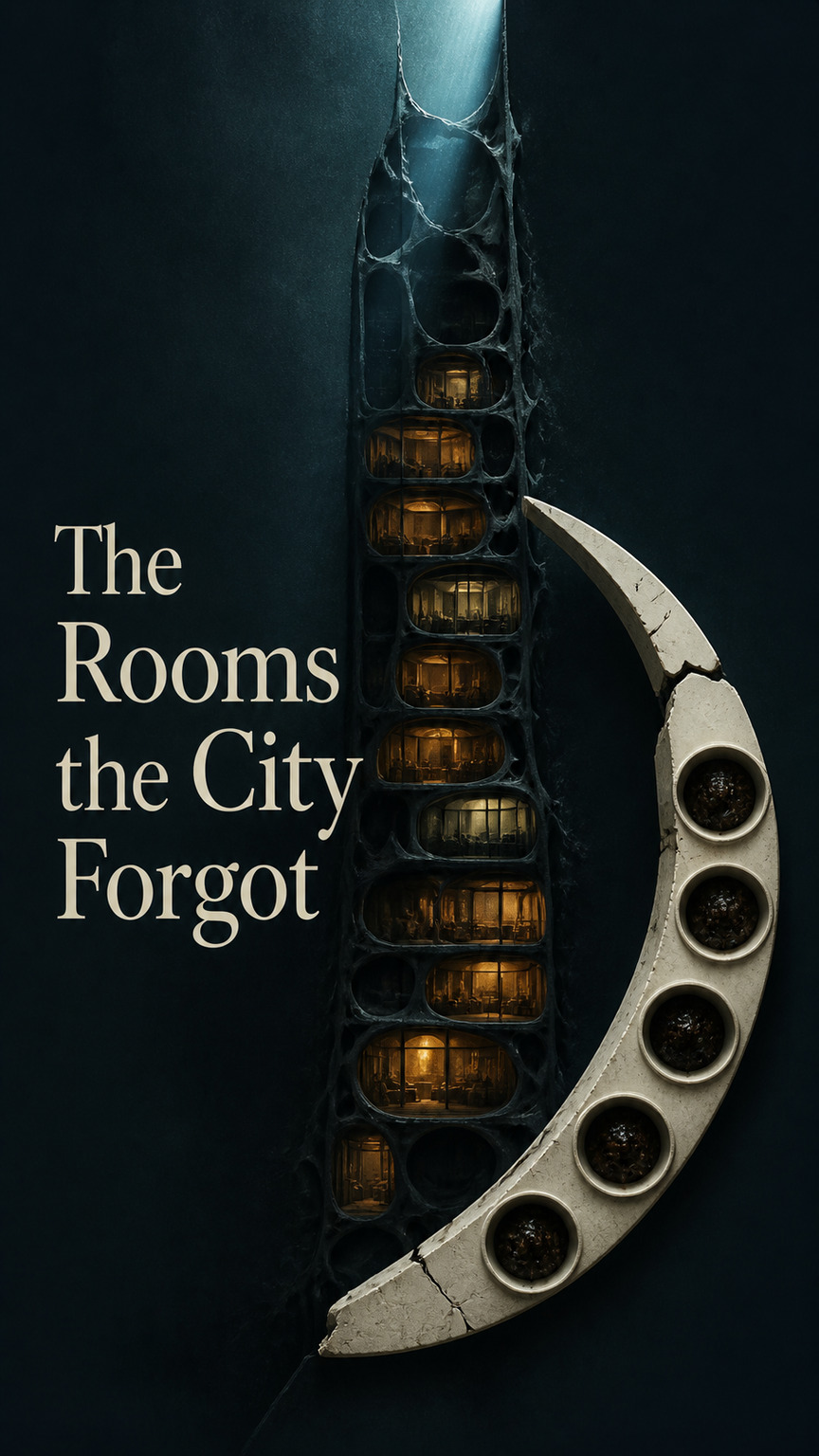
Lirenn cut the membrane along its slack edge. The service sinus was a cramped vertical throat between old lift muscle and the saline trunk. A nutrient wick ran through it, thick as her arm. Lashed to the wick was a crescent of fired ceramic punched with dozens of fine holes. Five dark clots had been threaded through the holes and spread across its teeth. From them, pale roots entered the tower lining. Smaller buds clustered wherever the roots crossed.
The comb had no pulse of its own. It transmitted tug and chemistry. Nothing more that Lirenn could measure.
“You put lease buds on a common wick,” she said.
“Withdrawn buds,” Mular said. “Our own. They weren’t stolen.”
“That isn’t what I asked.”
He crouched beside the comb but did not touch it. Without the speech he had prepared, his words came singly. “Full-floor molt. We decoupled. Temporary. We had repair tokens.”
Kevi called from the other chamber, “Show her.”
The older woman pushed a waxed paper packet across the wet floor. Inside were five municipal repair slips, each stamped before the last floor molt. Their ink had feathered, but the detachment times remained legible. Lirenn held them beside the lease-scar register on her slate. Five withdrawals. No rejections. On the morning the buds should have been replanted, the census refresh had copied active bindings into its new table and archived everything unattached as duplicate residue.
The refresh had archived five bindings while five bodies remained. Lease linings had then shed whoever the table no longer paired.
“We went back to the lease desk,” Kevi said. “It told us to bring active seals.”
Eshun knelt by the fevering man and poured water into the clay cup. She set the skin down before she spoke. “He doesn’t need the desk story. He needs the medic.”
“Cradle’s coming,” Lirenn said.
“When?”
Lirenn checked the request. Bordu had placed it behind the debridement team.
“Bordu.” She reopened her speaker. “Move medical ahead of cutters.”
“Not until classification.”
“Fever in an enclosed growth.”
“If it’s disease, I don’t put a ward cradle against it.”
Lirenn looked at the man’s wet cloth, then at the buds stippling the comb roots. “Conditional approach. External basket, isolation hood, no tissue contact.”
A pause. Bordu’s voice returned less flat. “If you cut an exterior egress first.”
“Kevi, can your east route take a basket?”
“No.”
“Can it be widened?”
“Not before the light.”
“Another route?”
Kevi squeezed the feed tube once more and passed it back to Eshun. Then she crawled past Lirenn into the sinus and shoved both hands behind the old lift muscle. “There. Skin to outside. Two ribs, no trunk.”
“That faces the drop.”
“That’s what baskets are for.”
“Open it,” Bordu said. “Then I send medical. If the cut compromises lift, I send cutters with them.”
Conditional. It was not trust, but it was room to work.
Lirenn put Kevi on the resonance peg. She struck where Lirenn pointed, badly at first, too hard, and the sound muddied. Lirenn caught her wrist.
“Tap. Don’t punish it.”
“I deliver parcels.”
“Tonight you tap.”
Kevi’s second strike found the first rib. Her third found open air between the ribs. Lirenn cut a narrow oval while she held the membrane back. Cold salt wind punched into the sinus. Kevi barked a laugh when it hit her face, then began tying the basket line to the load rib before anyone asked.
Behind them, the comb roots twitched in a wave. New buds swelled along the wick.
Sunrise was lifting pressure through the tower.
“Thirty-two minutes,” Bordu said. “I need the category.”
Lirenn pressed a tension gauge into the wall beside the comb. The needle climbed. Autonomy suggested disease. Resident-matched linings and organized rooms suggested housing. No reading turned contraction into testimony. She could classify only what changed when the stimulus did.
“We detach the stimulus,” she said. “Cap the wick. Shunt viable rooms to the old lift return. Then test regulation.”
Mular’s hand closed over the comb. “The buds die off the feed.”
“Maybe.”
“They’re our bindings.”
“They are also driving immature growth into a nutrient vessel.”
“And if the rooms shed us when you take them?”
Lirenn sorted the things she knew. “Lining, load, air. They have all three. The comb may have started them. It doesn’t follow that it still has to hold them.”
“Doesn’t follow.” He repeated the uncertainty, not the hope.
The fevering man coughed hard enough to fold around Eshun’s arm. She passed his weight to the older woman, waited until her hands were free, and said, “Take mine first.”
Mular stared at her.
“My room’s gone,” she said. “My bud isn’t buying it back.”
Kevi tightened the basket knot. “Mine next.”
The older woman shook her head. “No. Last.”
The order stalled there, everybody watching the five empty culture cups.
Lirenn set five culture cups in the cool recess of her kit. “No bud dies dry. Each goes into quarantine medium. Mular unthreads. I cap. Kevi holds the egress. Eshun: feed, breath, basket. Bordu: suppress sunrise flush to this tier.”
“I can reduce it by twelve percent,” Bordu said.
“Twenty.”
“Twelve without starving seventeen.”
“Twelve. Do it.”
The tower’s pulse eased under her knees.
Mular unwound the first root. His fingers, steady when tending flesh, fumbled against the ceramic hole. “This one forks. It didn’t before.”
“Trace both.”
“One’s in the wick. One’s—no, one is the wick.”
“Color.”
“Gray. Red at the tip.”
“Cut gray. Leave red clamped.”
“If you’re wrong?”
“Bleeding. Clamp closer.”
He obeyed. The gray root came free with a suck of clear gel, and Lirenn dropped its clot into the first cup. She capped the shallow wound on the wick with mineral paste. Kevi called the basket distance in blunt half-measures. Eshun answered only when she had passed the fevering man into the hood and the medic’s line had taken his weight.
“He’s out,” she said, hands free for a moment. “Feed’s slipping.”
Then she was back on the tube.
Second root. Third. With each detachment, the small buds along the wall softened. But the largest chamber convulsed when Mular freed the fourth. A support rib bowed inward, driving Lirenn’s clamp toward the feed line.
“Release the chamber clamp,” Mular said.
“Hold it,” Bordu said through the speaker. “Loss of load on eighteen east.”
Kevi shouted, “The vent is closing.”
Three instructions, three failures. Lirenn put her palm to the rib. Vibration ran toward the legal floors. Load. She looked at the vent membrane dragging across Kevi’s shoulder. Air. At the feed tube whitening under Eshun’s grip. Flow.
“Load clamp stays. Kevi, wedge vent with the drying rack. Eshun, let the feed go for three beats.”
Eshun looked at the fevering man’s empty place.
“Three,” Lirenn said. “Then catch.”
Eshun released. The tube snapped straight. Pressure surged into the room; the rib lifted enough for Mular to pull the fourth root clear. One beat. Two. On three, Eshun caught the tube against her forearm and resumed pumping, jaw tight.
Kevi jammed the ruined drying rack into the vent. “Open.”
“Load recovering,” Bordu said. “Continue if it holds above eight.”
Mular bent over the fifth root. Sweat ran from his nose onto the ceramic. “This is the old woman’s. It’s grown through two teeth. I can’t—I need to break the comb.”
The older woman had crawled to the exterior cut. She did not offer advice. She braced her splinted knee and held the basket line.
“Break it,” Lirenn said.
“The fragments will tear the clot.”
“Score between the teeth. Fold inward.”
His first scoring stroke skittered. His second bit. The ceramic cracked with a small domestic sound, like a cup set down too hard. He folded the crescent inward and freed the last culture with both hands.
Lirenn sealed the wick.
For six pulse cycles nothing improved. The hidden rooms held their strained shapes. The tension gauge stayed high. Gray buds continued to quiver along the fringe.
Bordu said, “Response?”
“Wait.”
“Perfusion in eighteen.”
“Wait.”
On the seventh cycle, the immature buds nearest the capped wick deflated. On the eighth, dye that had vanished behind the wall reappeared in the old lift return. Thin at first, then steady. The sleeping chamber’s air gill reopened around the drying rack. The load rib pushed back against Lirenn’s clamp, not in a blind spasm but in time with the tower’s carrying band.
Detached from the comb, the rooms regulated.
Lirenn wrote the category on her wrist slate.
HOUSING: UNBOUND, OCCUPIED, STRUCTURALLY DIFFERENTIATED.
Below it she added: INVASIVE FRINGE REQUIRES PRUNING. CULTURES AND COMB QUARANTINED. TEMPORARY FEED AND EXTERIOR EGRESS MANDATORY.
The letters shook with the tower’s pulse. She signed them anyway.
“Bordu. Housing.”
He did not answer at once. Above, more rooms began their dawn contractions, squeezing night-cooled waste toward the lower reservoirs. The legal tower needed its circulation.
“Give me measures,” he said.
Lirenn read them: return flow, gill interval, rib load, bud deflation, the twelve-percent intake reduction. Bordu repeated each number to someone in the night office. No one congratulated her. The debridement crew became a fringe-pruning crew. Medical hauled the fevering man into the external basket. The census still held five archived rows. The lease table still saw empty tissue.
Mular placed the broken comb in the quarantine jar. His fingers stayed on the lid after he had sealed it.
“It comes with us,” Lirenn said.
“I heard.”
“Your cultures stay wet.”
He nodded, once. That was all he had for her.
Kevi widened the exterior cut by the width of two fingers, enough for the older woman’s splinted knee. Eshun salvaged one unbroken jar from the brine, sniffed it, and poured it into the feed channel. She put the jar down.
“Salt broth,” she said when Lirenn looked at her. “Not precious.”
Morning entered the new egress as a blade of diluted gold. Under the stronger perfusion, a dark margin began to rise along the service sinus—fringe tissue, still hungry, still capable of taking what the floors above required.
Lirenn changed knives. Bordu called out the next pressure reading. Kevi held the vent. Eshun counted three beats and caught the feed. Mular lifted the quarantine jar out of her way.
Lirenn set the blade against the dark edge and followed it toward the light.