The Beloved World
A saint is someone who would kill their beloved for the sake of the world. A demon is someone who would burn down the world to save their beloved. Somehow, the two of them fell in love with each other.
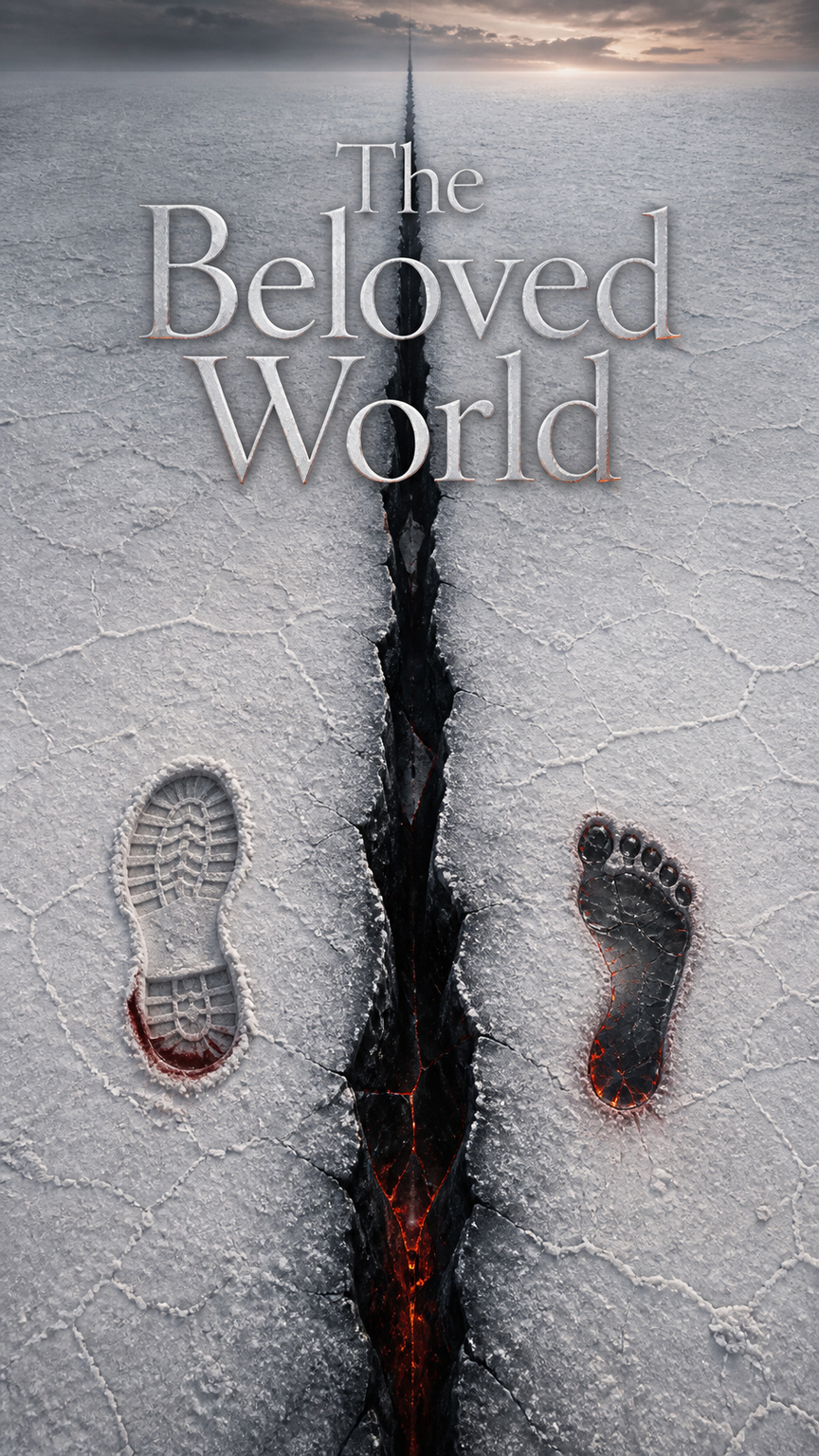
By midnight the Salt Crucible had skinned both of Sennara’s boots white. Salt furred the seams, worked through the leather, and worried the old scar under her left heel. Iverax walked barefoot ahead of her. Each step melted a dark print in the crust, and each print hardened into glass before she reached it.
“Slow down,” she said.
He looked over one shoulder. His horns swept back close to his skull, black against the starless bowl of sky. “You said that last night, and then you objected when I did.”
“That was in bed.”
“My mistake. I thought you admired consistency.”
“I admire breakfast. Give me the pear.”
He tossed it. She caught the strip of dried fruit one-handed, chewed twice, and spat out a grain of salt. Under her coat, the ash-silver knife knocked against her spine. The binding around her ribs tightened with every mile toward the fissure, a wire pulled through flesh by the approaching dawn.
Iverax watched her swallow. He had been watching her all night: her breathing, her limp, the hand she kept away from the knife. Heat showed faintly through the seams of his chest, not light exactly, but a red suggestion beneath brown skin. The worldfire inside him knew morning was close.
“How long?” he asked.
“Three hours.”
“You said three hours an hour ago.”
“Then stop asking questions you hate the answers to.”
He smiled. It was the smile that had once made her put a dagger to his throat and, much later, made her drag him naked across a rented room by his belt. Too much tooth. No apology in it.
“We could turn around,” he said.
“No.”
“There is an inn six days north. The owner cheats at cards and puts rosemary in everything. You threatened to break his fingers.”
“He pinched my ass.”
“I broke his fingers. You threatened his knees.”
“Fond memories.”
“We could make more.”
The words were light; the space after them was not. Sennara looked past him to the center of the basin, where a hairline blackness divided the salt. At black dawn that fissure would open. She would put ash-silver through Iverax’s heart at the one instant his death could pour the worldfire harmlessly into the deep earth. The binding would follow it out of her, taking her blood, her breath, and whatever the priests had mistaken for a soul.
Kill him sooner, and the fire would escape without direction. Fail to kill him at dawn, and it would consume him from within and cross the world looking for fuel.
There had never been a version in which both of them lived.
“Walk,” she said.
His smile went away. He walked.
They had met when Sennara was thirty-six and still believed demons smelled of grave dirt.
Iverax, already a century old, smelled of rain, blood, and the orange he had been eating when she kicked down his door. He was sitting on a table in an abandoned tollhouse with his shirt open and his boots in his lap. Her blessed sword touched the hollow beneath his jaw before the door struck the wall.
“Sennara,” he said around a mouthful. “Your portraits are unfairly grim.”
“Your wanted notices leave out the horns.”
“Artists struggle with majesty.”
She had expected pleading or violence. The stupid flirtation delayed her by half a heartbeat, long enough for her sword to warm in her grip. Not from his skin. From something behind it, vast and waking.
“If you kill me now,” he said, and for the first time there was no smile, “you kill everyone between here and the eastern sea.”
She pressed the blade until blood welled. “Convenient.”
“Do it, then. We can be wrong together for a very short time.”
That was how her own hunters found them: saint and demon glaring at each other, neither willing to make the first fatal mistake. Her brothers loosed their crossbows without listening. Sennara knocked the first bolt aside. The second hit her high in the back, punched through her mail, and opened its silver hooks inside her shoulder.
Iverax could have fled. Instead he burned the crossbow strings out of the hunters’ hands, caught Sennara before her knees struck the floor, and carried her down into the tollhouse cellar while blessed arrows shattered stone around them.
“Don’t touch it,” she gasped when his fingers found the bolt.
“Excellent. I was afraid you might ask for help.”
“The hooks turn when you pull.”
“I know what a barb is.”
“You don’t know this one.”
“Then explain it, you infuriating woman.”
The cellar door jumped in its frame. Dust sifted over his hair. She told him where to cut, when to twist, when to stop. His hands shook only once, when the barb scraped bone. Hers shook constantly. She bit down on the leather belt he gave her and screamed anyway.
When it was out, he held the bloody device between two claws.
“Holy,” he said.
“Supposedly.”
“Your friends seem lovely.”
“They’re not my friends.”
She took the bolt from him and broke it against the floor.
Something in his face changed then. Not forgiveness. They had done nothing yet that could be forgiven. It was recognition, mean and reluctant: she could reject her own kind; he could stay when flight was sensible. The old words, saint and demon, had failed to finish either of them.
It was not love. It was barely a truce. But when he helped her stand, his arm around her waist felt less like capture than the first dangerous answer to a question she had not meant to ask.
The wind rose across the Crucible and drove salt against Sennara’s mouth. Iverax stopped beside a cut in the basin where black rock showed through. He held out his hand.
“What?”
“Your foot.”
“Still attached.”
“Bleeding.”
She glanced down. Red had soaked through the split seam at her heel. “It’ll last.”
“I wasn’t asking about the fucking boot. Sit.”
She sat because he was right, which remained one of the least attractive things about him. Iverax crouched and lifted her foot onto his thigh. His palms were fever-hot. He unlaced the boot with the concentration of a man defusing a bomb, then swore at the raw crescent in her skin.
“Your bedside manner has deteriorated,” she said.
“My last patient stabbed me afterward.”
“You liked it.”
“Not where you put it.”
He tore a strip from his shirt and wrapped her heel. The cloth smelled like him: cedar smoke, sweat, and the bitter soap he claimed not to use. His thumb rested a moment against the inside of her ankle. Sennara could feel his pulse there, too quick.
She caught his wrist. “You’re hotter.”
“You say the sweetest things.”
“Iverax.”
He looked at her fingers around him, not at her face. “We’re nearer the fissure.”
“Is that all?”
“Isn’t it enough?”
It was not an answer. The binding under her ribs drew tight enough to make her vision spark. She released him before her grip became a plea.
He finished the knot, too carefully. “There. You may now march to our deaths without an undignified limp.”
“I can limp with dignity.”
“You do nothing with dignity. It’s one of your better qualities.”
He kissed the scar above her ankle. An absurdly courtly gesture from a half-naked demon kneeling in salt. She put her hand between his horns and held him there until his breath caught.
The first time she had done that, there had been rain beating on a stable roof and three dead hunters outside.
They had survived the ambush by falling together through a hayloft floor. Sennara cracked two ribs. Iverax took a consecrated knife through the meat of his thigh and complained more about the hay in his trousers.
They drank the stablemaster’s plum liquor while Sennara stitched him. He insulted her technique. She pulled the thread harder. By the time the bottle was empty, pain and exhaustion had stripped the last politeness from them.
“You keep staring at my mouth,” he said.
“I’m considering sewing it shut.”
“Your pupils disagree.”
“My pupils have poor judgment.”
He leaned back against the stall, hands open at his sides. For once he did not spend a joke to escape the silence. Rain ran through the broken roof and ticked against a bucket. Sennara could hear the horses shifting in the next stall and her own heart behaving like an idiot.
“Ask,” she said.
His expression went briefly blank. “Are you sure?”
“That wasn’t it.”
“Sen.”
“Ask me what you want.”
The wanting reached his face before the words did. “I want your mouth. Your hands. I want you to stop looking at me as if wanting is a tactical failure. And if any of that isn’t yours tonight, tell me now.”
She set the needle down. “All of it is mine. Tonight, I want to give it to you.”
He still waited.
“Yes,” she said. “Come here.”
His first kiss was almost careful. She laughed into it, and caution did not survive. They knocked over the bucket, frightened both horses, and discovered that cracked ribs made certain ambitions impossible and others merely inventive. When he asked again, breathless against her throat, she said yes again. After that there was only rain, heat, the rough blanket beneath her palms, and the startling tenderness of being desired by someone who knew exactly what she had been sent to do.
Later, Iverax lay with his cheek on her stomach and one horn caught in the blanket.
“If you tell anyone about the bucket,” he said, “I’ll burn down a minor principality.”
“There aren’t any nearby.”
“I’ll find one.”
She worked the blanket loose from his horn. “You asked twice.”
“You were drunk.”
“So were you.”
“I am a demon. We metabolize consequences beautifully.”
She laughed hard enough to hurt her ribs. He lifted his head, astonished, as if this were the indecent thing they had done. Then he smiled with no performance in it, and she understood they were in far greater trouble than any hunters could make.
The ruined shelter stood two miles from the fissure, three stone walls and half a roof left from people who had crossed the basin before it became holy. Sennara ducked inside to escape the wind. Iverax followed, bringing his heat with him.
She unbuckled the knife and laid it on the floor between them.
He stared at it. “Charming.”
“Swear you won’t ignite before dawn.”
“You know I don’t swear.”
“You swore at a kettle for ten minutes last winter.”
“It had betrayed me.”
“Swear to me.”
He turned away. Outside, salt hissed against stone.
Sennara rose. “If you’re planning something stupid, remember that I know all your stupid plans.”
“You failed to predict the blue shutters.”
“They were hideous.”
“They were cheerful.”
“They looked like a brothel had drowned.”
“You liked that house.”
The last word broke in the middle. He put a hand against the wall. The stone smoked under his palm.
They had lived in that house for eight months, longer than they had lived anywhere. Iverax baked bread badly and ate the burnt crusts before she woke. Sennara sharpened knives at the kitchen table and left filings in the butter. They planted onions, though neither knew how deep onions wanted to be, and in the afternoons they sometimes went back to bed simply because there was a bed and no one had found them yet.
Then a spring flood took the footbridge downstream with four children on the wrong bank.
Sennara tied a rope around her waist before Iverax could stop her. The water rolled trees past them like stripped bones. She reached the children. On the return crossing the rope snagged, and Iverax waded chest-deep into the flood, fire boiling the water around him, to cut her loose.
For six days afterward she shook with fever. He slept on the floor beside her and woke furious every time she coughed.
“Four children,” she said when she could stand again. “Four.”
“I can count.”
“Their mother couldn’t swim. The oldest was nine. What would you have had me do?”
“Live.”
“Answer the question.”
He hurled a cup into the hearth. It shattered, and the pieces glowed. “I don’t give a shit about the question.”
“That’s the problem.”
“No. The problem is that you’ll spend yourself on anyone who asks and call it virtue when there’s nothing left for me.”
“They didn’t ask. They were drowning.”
“And you weren’t?”
He left before she could answer. By summer, the hunters had found the garden. They ran with one pack between them and never went back for the onions.
Now, in the shelter, Sennara crossed the knife on the floor and wrapped her arms around Iverax from behind. His body was almost too hot to touch.
“I did like the house,” she said into his shoulder.
“I know.”
“The shutters were still ugly.”
“Cruel to the end.”
He turned. She kissed him before either could make another argument. His mouth tasted of salt and dried pear. He held himself rigid until she pulled his hands to her hips.
“I want you,” she said. “That isn’t forgiveness in advance.”
“Understood.”
“And it isn’t permission to save me.”
His jaw tightened. “Understood.”
They undressed each other without hurry. There was nothing new to discover, only known scars, favorite places, the small private humiliations of two bodies that had slept, bled, sweated, and wanted together. He knelt to unlace her ruined boot. She bent to kiss the pale notch where her sword had once touched his throat. When he carried her to the least broken stretch of floor, she locked her legs around him and held his face between her hands.
“Look at me,” she said.
He did.
Afterward, her coat covered them both. The knife lay beyond her reach. Iverax traced the binding’s silver ridges under her breasts, his touch so gentle it made her want to strike him.
“Swear,” she said once more.
He closed his eyes.
The binding cinched under Sennara’s ribs. She waited until her hands stopped shaking, then fastened the knife against her back.
Sennara got up and dressed. Iverax did not try to touch her again.
Black dawn did not brighten the eastern sky. It extinguished it.
The stars went out one by one as Sennara and Iverax reached the fissure. Darkness pooled along the crack, swallowing the salt at its edges. The binding tightened. Every silver ridge around Sennara’s ribs lifted beneath her skin.
She drew the knife.
Iverax stood on the other side of the fissure. His shirt hung open. The red beneath his skin had spread from his chest to his throat and down both arms.
“Too soon,” she said.
“Sen.”
“How long have you been feeding it?”
“Walk away.”
“How long?”
He began talking too quickly. “The inn is still there. We could reach it before the next rain. You could break the owner’s knees this time. I could buy you boots that don’t bleed. We could find another house. No shutters, if you insist on living without joy.”
The fissure opened another finger’s width. Heat rolled off him hard enough to sear her lips.
“Iverax. Stop.”
“I planted the onions too deep,” he said. “That’s why they never came up. I read it in a book afterward. Two fingers, not a whole fucking grave.”
“Stop.”
“Come here.”
Not an argument. Not absolution. His hand reached across the black crack between them, palm up, shaking so badly the claws clicked.
She wanted to take it. Her body had already leaned toward him before she understood.
Iverax smiled then, terrible and frightened. His gaze dropped to the knife in her hand. He saw her grip tighten, and he did not close his hand.
Then he opened himself to the fire.
It hit the world with the sound of a door kicked in.
White flame raced out from his feet. The first surge crossed the Crucible before Sennara could draw breath, climbed the basin walls, and swept into the dark beyond. On the western ridge, watchfires vanished. Farther out, the black shapes of houses flashed white. A flock of night birds rose burning and fell.
The binding around Sennara’s chest caught. Silver fire ripped through every line. She smelled her own skin, heard herself scream, and felt the sacred wire come free.
Iverax had done it. He had burned the death out of her.
The worldfire gathered behind him for its second surge.
Sennara crossed the fissure.
He could have stopped her. His hands were fire now. His body had become the hinge of something enormous. But when she came at him, he lowered his arms.
She drove the knife up beneath his ribs.
The blade struck his heart. Heat split her palms. His weight folded against her, mouth open at her temple, no cleverness left in him. For one instant he clutched the back of her coat with ordinary human panic.
“Sen,” he said.
She pushed the blade deeper.
The fire went out.
Not everywhere. The houses beyond the ridge continued to burn. Salt glowed red beneath her knees. But the vast pressure behind the flames collapsed, and the second surge never came.
Iverax sagged in her arms. His eyes were still open. She felt the last beat of his heart through the knife, then nothing.
Nothing answered when she called his name.
Sennara woke after sunrise with her face against cooling glass.
Smoke had covered the sky. People moved through it on the basin’s western rim: burned farmers, soldiers with torn banners, children blackened by soot. Some carried water. Some carried bodies. A woman called the same name until her voice failed, then kept shaping it with her mouth.
The worldfire had taken a valley and the western edge of the Crucible. Beyond that, the fields still stood. Their stubble shone wetly under the ash. Thousands of roofs held. Millions of people had woken to an ordinary morning, cursed the smoke, fed their animals, touched the warm backs of the people beside them.
Iverax lay where she had left him. The demon who had loved her more than all of them was cold.
Sennara crawled to him first. She closed his eyes. She wanted to say something filthy enough to make him laugh, but every word belonged to a world in which he could hear it. She pressed her forehead to the place between his horns until someone nearby began to sob.
Then she stood.
At the rim, a burned man stumbled toward her. She reached without thinking for the heat that had always arrived at her shoulder before danger, before pain, before she admitted she needed help.
There was only cold air.
The man mistook her open hand for an offer. He took it.
Sennara held on.