Sakura-Hearted
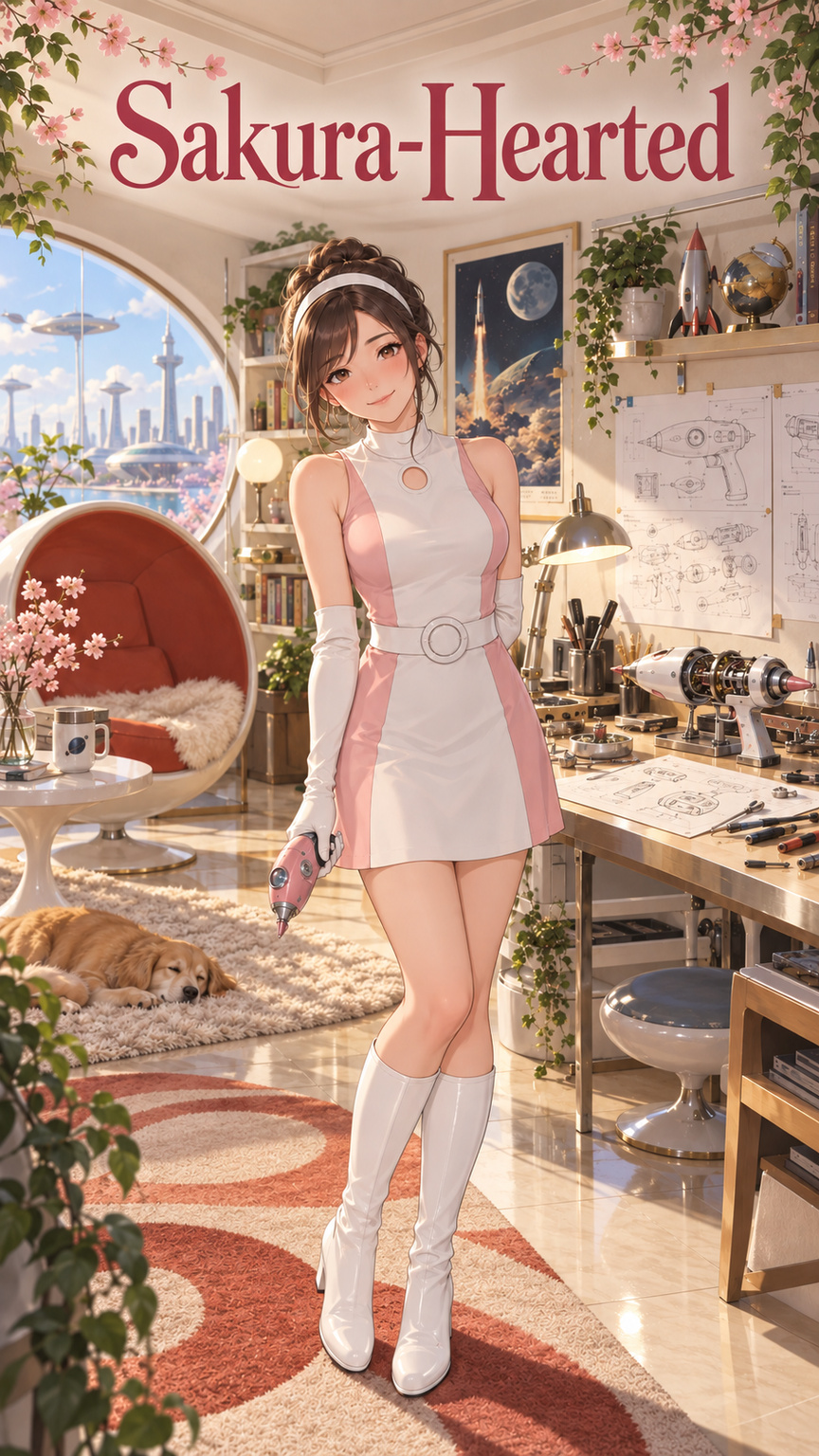
wife happens to be the sweetest loving quiet girl genius in retro-futuristic dresses, white elbow-length opera gloves, white circular-buckled cinch belt, and white knee-high go-go boots, who carries a sakura pink raygun that fits in one hand. she is the most loving wife a husband could have.
A small ringed planet was in the coat cupboard, occupying the hook I used for my jacket.
I stood in our doorway with the anniversary flowers. The planet turned slowly, its cardboard rings almost brushing my chin. Beyond it, somebody had draped a sheet across the entrance to the sitting room.
“Celestine?”
“Just a moment, darling.”
Her voice came from behind the sheet. There was a click, followed by a noise like a teaspoon striking a cup, and then my wife appeared with something pink in her hand.
She took one look at the cupboard. “Oh. That’s where you went.”
The thing in her hand was a raygun, sakura pink, with a little silver muzzle and a dial beneath her thumb. It rested easily in one white-gloved hand. She aimed at a disc underneath the planet; a thread of pink light connected them, and the planet backed out of my way. With a small, careful turn of her wrist she guided it along the ceiling toward the kitchen.
“That’s new,” I said.
“Yes.” She let go of the trigger. The planet stayed overhead. “Hello.”
She came close enough to kiss me, then stayed there for a second kiss while I tried to put my free arm around her without crushing the flowers. She smelled faintly of the orange soap we kept by the workshop sink.
“You’re early,” she said against my cheek.
“I left early.”
“For me?”
“Entirely for you. I nearly left these on the tram in the hurry.”
I held out the flowers. She brought them to her face, paper crackling against the white circle of her belt buckle. For a moment all I could see above them was her brown hair pinned up behind a white headband. Then she lowered them, smiling.
“I love that you always choose the untidy ones.”
“They looked cheerful.”
“They are.” She passed me the raygun so she could loosen the paper. “Will you hang up your coat? Dinner can wait, but I can’t.”
I hung up my coat. I also looked at her. She wore a pink dress with a white front panel and a high collar, shaped like the clothes in old advertisements for holidays on the moon. Her white opera gloves reached her elbows; the broad white cinch belt drew in the dress, and below its short hem her white go-go boots rose to her knees. She had several dresses in that hopeful old style. This one was new, with a little circular opening at the throat that made me want to put my mouth there.
She caught me looking and ran a gloved finger down the front of the skirt.
“I finished it yesterday.”
“The whole thing?”
“The dress. The boots I bought.”
I leaned in to kiss her just above the collar. She tilted her head to make room.
“Happy anniversary,” I said.
“Happy anniversary, sweetheart.”
Behind her, the planet gently bumped the kitchen doorframe.
She took back the raygun, tipped the planet to clear the doorway, and lowered it onto the kitchen counter.
“I tested that path without the rings,” she said. She glanced back at me. “You’d think I’d remember. I only put them on this afternoon.”
She laid the flowers beside it and took my hand.
Celestine pulled the sheet aside. Beyond it stood the moon ride.
For a few seconds I had no words at all. The pointed nose, the cloudy bubble windscreen, the two red seats: I knew every one of them. A blue comet curled along its side, worn almost to silver beneath the boarding step. On the left seat, a repair ran diagonally across the upholstery. I had caught a trouser button on that seam ten years ago.
I put my hand on it.
“You found it.”
Celestine stood beside me with the folded sheet over her arm.
“The amusement hall sold its equipment. I saw a photograph in the listings.”
“But that was months ago.”
“Yes.”
I looked at her. She pressed her lips together, containing a smile, and nodded.
For months I had accepted that the closed-off end of her workshop contained a drying cabinet. We shared the apartment, and I knew the sounds of her work: the whir of a lathe, the little descending note she hummed while looking for a tool. Apparently I did not know the sounds of a moon ride being rebuilt in sections.
“You said there were trays drying in there.”
“There were. I put the small parts on trays.”
I laughed, and she leaned against my arm, pleased with herself.
The machine sat on a broad rubber mat between our round window and the bookcase. Its motor housing had been polished; a power lead ran neatly along the skirting board. Above it hung a pale paper moon and several smaller planets, each with a receiver disc tucked underneath. Our orange egg chair had moved into the far corner. The dining table was set for two, though I could barely see it past a green globe.
“Does it still do the voice?” I asked.
“Oh, yes.”
“And the terrible landing?”
“A gentler version. I replaced the worn cam.”
I crouched to look through a grille. Inside, everything was clean brass and neat wiring. As I stood, I noticed the chrome bands around her little raygun. Rings like those, no bigger than shirt buttons, had been scattered across her bench that morning.
I pointed to them. “Were these the rings on your bench?”
She followed my finger. “The gun? Yes. The old emitter wouldn’t fit. It wasted most of its energy keeping the field steady, so I made it send a sequence of smaller pulses instead. The receivers smooth them out.”
She turned the pink body in her palm. A charge needle rested just short of full.
“How much can it lift?”
“Three kilos on one disc. Less if I want it moving for long. It reaches about as far as our kitchen.”
I put a hand on the ride’s nose. “So this is beyond it.”
“Very much.” She tapped the motor housing with her boot. “We stay on the floor.”
I was thirty-eight, she was thirty-six, and it had been eight years since we had promised to grow old together. I had expected flowers, dinner, and a long evening with her feet in my lap. Instead I was looking for the coin slot on a machine I remembered being embarrassingly excited to board at twenty-eight.
Celestine lifted a saucer from the table. It held a heap of old square coins.
“I’ve been saving these too.”
Getting in required a preliminary discussion about whose knee went where.
The seats had been designed for two adults who were better at sitting upright than we were. I climbed in first and promptly discovered that the steering wheel left room for my legs only if I kept both feet together. Celestine stepped onto the running board, one gloved hand on my shoulder, and settled beside me. The skirt of her dress fanned across the red vinyl. I could feel the edge of her belt against my elbow.
“Comfortable?” she asked.
“Extremely.”
She looked down at my knees.
“Mostly,” I said.
She laid her hand over mine and squeezed it. Then she turned the raygun’s dial to a little clock symbol.
“That lets the coin timer start the scenery,” she said. “Ready?”
I nodded, and she put a coin in the slot.
A bell rang. Somewhere under us a relay clacked, and the room lights dimmed. The nose rose a little; the ride began to turn slowly on its base. We were still a few inches above the rug, but the familiar forward tilt sent an absurd little thrill through my stomach.
“WELCOME, TRAVELLERS,” said the old recording. “THE MOON AWAITS!”
“Oh, that’s him.”
“I thought you’d like to hear him again.”
“You’ve even kept the crackle.”
“I tried cleaning the sound. It didn’t seem right.”
The receiver discs flashed, and the suspended models started along their programmed paths. A blue planet drifted across the window. Pinpoints of light shone through its painted shell onto her glove.
“You’re going to miss something,” she said.
“What?”
“On your left.”
I turned too late. Whatever it was had passed behind my seat, and there was now a large green sphere where my view of the bookcase ought to have been.
“Was that the moon?”
“No. The moon comes last.”
“Last time I didn’t see it either.”
“Last time you were trying to get your sleeve out of my drink.”
I remembered fizzy orange soaking into my cuff. I also remembered explaining that I never normally spilled things, while attempting to retrieve a straw from under her boot.
“You put the cup in the seat.”
“There wasn’t a holder.”
“I’d offered to hold it.”
“You were holding the other one.” She began to laugh. “And trying to steer.”
“The wheel turned. I felt that implied a responsibility.”
Her laughter came in quiet breaths against my shoulder. The ride dipped and I put an arm around her, which was much easier now than it had been ten years earlier, even in the cramped seat. Back then I’d asked whether she was having a good time every few minutes. She had always said yes. I had needed at least six confirmations before beginning to believe her.
“PREPARE FOR THE WONDERS OF THE LUNAR SURFACE!”
She raised her head. “Oh, look, here it—”
The mechanism clicked off. The nose settled and the room lights brightened. A small moon coasted to a stop beside the window, showing us its plain back.
We sat still.
“How long was that?” I asked.
“Ninety seconds.”
“It can’t have been.”
“It was ninety seconds then, too.”
I looked at the coin saucer on the table, well beyond my reach.
“May we go again?”
Her smile spread slowly. “As often as you like.”
We climbed out to fetch more coins and look at what we’d missed. Celestine used the raygun to turn the nearest globe. It was a small planet whose surface had been divided into eight irregular colored regions. Beside a silver lake stood a green tent, scarcely taller than my thumbnail.
I bent closer.
“The tent leaked on the other side.”
“I know. I put the good side facing out.”
There were two boots standing upside down on twigs outside it. Behind the tent, beneath an overhang of painted rock, was a tiny red enamel pan.
“You made the pan.”
“It took three tries to get the handle right.”
I wanted to touch it, but my fingertip was nearly as large as the whole campsite. She brought the planet lower and steadied it with her free hand so I could examine it.
On our second anniversary we’d gone camping in a valley advertised as sheltered. The wind had flattened the tent before we’d finished arguing amiably about which way its door should face. We had eaten hot peaches from that pan beneath a rock ledge while our socks dried on our knees. Celestine had fallen asleep with her head in my lap. I remembered being unwilling to move even when my foot went numb.
She had painted the lake the color it had been after the rain. That was what undid me: the green just beneath the silver.
I bent to kiss the top of her head. Then I kissed her temple, and she set the planet hovering so she could turn toward me.
“Good?” she asked softly.
“Yes. Very good.”
I held her for a while. The raygun rested cool against my back in her hand.
When I let her go, she straightened my collar, though I hadn’t noticed anything wrong with it.
“There’s one place for each year,” she said. “I couldn’t fit the whole hotel on the yellow part, so it has just our balcony.”
“Our enormous balcony.”
“The chair is half over the edge.”
I found it. The chair had three blue legs and one bare silver one, exactly as I remembered. A towel hung from its back, folded into a miniature band of white.
I asked how she had done the towel. It was a sliver of fabric stiffened over a bent wire, she told me, and then she turned the globe toward the next region. I caught her hand. I wanted the long version: the first failed pan, the bad shade of green, the evenings she had sat beneath her work lamp thinking about a wet holiday I had loved.
She grew pink when I said so.
“I liked making it,” she told me. “Sometimes I had to stop because I wanted to come and tell you what I’d remembered.”
“You could have.”
“And spoil it?”
“Possibly worth it. You could have told me about the tent without mentioning the planet.”
“I did. You were brushing your teeth. You said you wanted peaches.”
“I did want peaches.”
“I bought some for tonight.”
She took my hand and led me around the nose of the ride to the kitchen. The ringed planet blocked the cupboard where we kept the glasses. She considered it, then put the raygun down and moved it by hand.
“There’s a button for all of them to return to their stands,” she said. “But then you’d see the rest.”
“We could drink straight from the bottle.”
She glanced at me over her shoulder. “You may. I’d like a glass.”
We found two, poured something cold and sparkling, and stood close enough that I had to raise my elbow for her to open a drawer. She found a pair of scissors and trimmed the flowers. I filled their vase.
“May I put these in?” she asked.
“In the ride?”
“In the sky.”
She took a spare receiver disc from beside the sink and clipped it beneath the vase. When she squeezed the trigger, the vase rose from the counter, water trembling against the glass. The flowers followed her wrist across the room. She set their path above the little table beside the orange chair, well away from our turning seats.
“Will they stay up?”
“For twenty minutes. Then the disc will lower them. There needs to be something beneath it.”
She moved a book off the table to leave room for the vase.
My flowers hovered in the lamplight, untidier than ever. Beyond our round window, evening traffic slid between the towers, the airliners turning on their landing lights. I kept looking back at the tiny campsite.
Celestine watched me looking around.
“I was going to do it in order,” she admitted. “I had a list.”
“Have I muddled it?”
“A little.” She slipped her fingers into mine. “I like seeing which bits you find.”
For the second ride I brought the saucer of coins within reach and put our glasses firmly on the table.
Celestine checked the gun’s charge, brought the models back to their starting positions, and returned the dial to the clock symbol. She sat down beside me. This time I made room for her arm before we began.
The bell rang. The recording welcomed us again. Our sitting room darkened, and the blue planet shone above the bookcase.
“There,” she said. “Look now.”
On my left, behind a crescent of white cloud, was a tiny model of our first kitchen. The table had been made too large for the room, just as the real table had been. Our old kettle stood on it. Two little cups, yellow and blue, hung from hooks over the sink.
I turned to her. She was already watching me, and her expression made me forget what I had been about to say. I leaned in.
A green planet passed between our faces.
I kissed painted cardboard.
For an instant I stayed where I was, nose against a mountain. From the other side came a small strangled sound. I sat back to let the planet pass, and Celestine folded against my shoulder, laughing.
“I thought I’d left enough room,” she said.
“Apparently my approach was unanticipated.”
“I planned it while sitting here alone.”
She lifted the raygun and diverted the planet over the back of our seats. Then she put her free hand on my cheek and kissed me properly. Her thumb was soft at the corner of my mouth; the machine carried us slowly around toward the window.
I heard the lunar announcement begin somewhere behind my ear. I did not turn to look.
When the ride stopped, Celestine stayed close, her hand now resting on my chest.
“I wanted that on the first ride,” she said.
“A planet in the face?”
“No.” She rubbed her cheek against mine. “A kiss. Before we got out.”
“You kissed me at the tram stop.”
“I got tired of waiting.”
I drew back enough to see her. “I thought you were being polite all evening.”
“Even when I asked you to come and sit beside me?”
“You said there was room.”
“There was room.”
She looked down at our knees pressed together and began laughing again. I remembered the younger version of myself squeezing into that seat as though any accidental contact would have to be explained in writing. There had been orange fizz all over my sleeve and this lovely quiet woman beside me, and she’d said there was room.
“I was trying very hard,” I said.
“I know, darling.” She smoothed the front of my shirt. “I liked you so much.”
“And then you asked me out again.”
“You were already saying goodnight. I was afraid you’d go home and think I hadn’t enjoyed it.”
I remembered that too: her holding the tram door with one elbow to ask whether I was free the next evening, and my nodding from the platform because, after several hours of unnecessary talking, I had briefly lost the ability.
I kissed her forehead.
“What would you like this time?”
“Your arm around me. And another go.”
She reset the scenery with a touch of the dial, turned it back to the clock symbol, and set the raygun in the little tray beside her seat. I reached for another coin.
“We still haven’t seen the front of the moon,” I said.
“We might.”
“Is there something on it?”
“Yes.”
She tucked herself against me, carefully at first, shifting until her shoulder fitted beneath my arm. I could smell the flowers as they passed above the little table. Her belt buckle caught the light, a brief white circle against the pink of her dress.
“Will you tell me?”
“Later.” She took my hand and drew it a little farther around her. “This is nice.”
I dropped the coin into the slot. The bell sounded; the nose lifted. She rested her head on my shoulder, and I bent mine to touch her hair.
The blue planet passed. So did the little kitchen, and the campsite with its upside-down boots. She shifted her hand into mine and settled still closer as the ride turned us toward the window. The paper moon came into view, softly lit, travelling across the dark glass. I saw the beginning of something painted on its face, and then Celestine raised her mouth to mine.