One Night's Mercy
"Please," the queen begs on her knees, "save that dragon from my daughter."
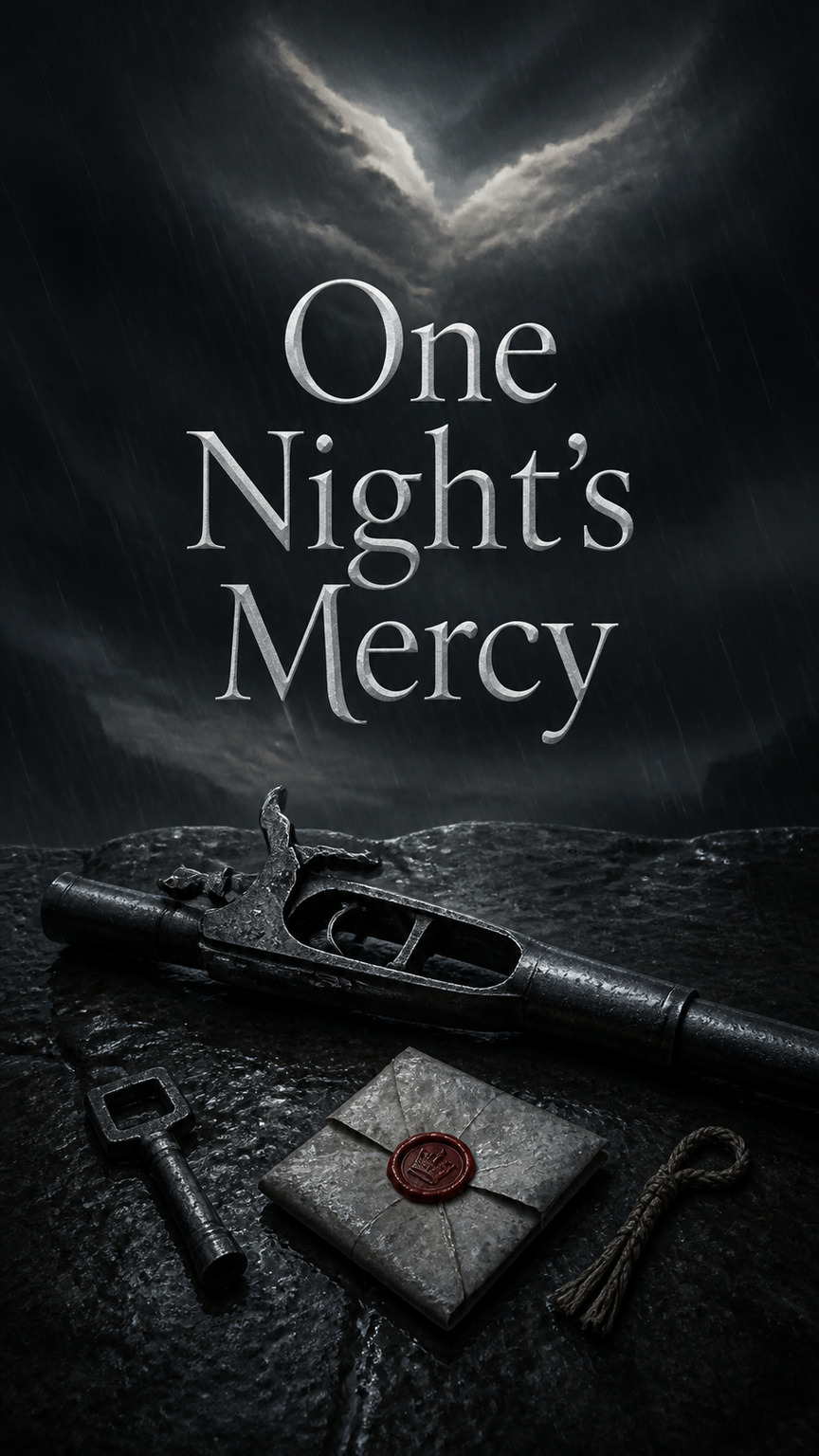
“Please, save that dragon from my daughter.”
Queen Urrava was on both knees in the scale and soot of Imer Quast’s forge. Two royal guards stood behind her, wet to the shoulders. Hovan Setch stood with them, rain running off his cropped hair. All three had heard her, which meant she had not come to be forgiven in private.
Imer left the bellows open. The coal dimmed around the hinge strap he had been heating.
“Which dragon?”
Urrava’s hands rested palm-down on the floor. She had removed her rings. Careful, even now. Nothing metal to cut her when she knelt.
“Thelrax. Daziel has him in the north quarry. The throat is pierced, both wings are weighted, and she means to use a spear at first light.”
Hovan said, “I saw the wound before the rain closed the ridge. He can breathe. Fire, perhaps twice. Short.”
“How short?” Imer asked.
“Eight paces. Two bursts at most, from that wound. I may be wrong about how much strength he has left.”
“And the quarry road?”
“The bridge is under,” said the queen. “My riders cannot reach her before dawn. You can use the inspection chute.”
The chute Imer had cut through the hill when Daziel was still young enough to steal his chalk and draw wolves on new stone. The chute ended behind the quarry drums. It was narrow, steep, and meant for men who understood why a frayed rope could be worse than a cracked beam.
He looked past Urrava to the guards. “You came to order me back into service.”
“No. I came to bargain. If you go, your dismissal is rescinded, your forge levy ends, and the crown repays—”
“Keep it.”
“Then name what you require.”
“The truth she doesn’t have.”
Urrava’s gaze shifted once, toward Hovan. He did not help her.
Imer wiped his hands on his apron. “Daziel thinks her husband broke the nest seal against your instructions. That is why she can grieve him and still call his death a consequence of his own pride. You would not be kneeling here if that were true.”
Rain drummed on the forge hood. One guard swallowed.
Urrava rose no higher. “I authorized an armed survey.”
“Of a sealed nest.”
“Of the copper behind it.”
“The writ.”
“Imer—”
“The paper, or get out of my forge.”
Her balanced patience went out of her face. “Give it to him.”
The older guard unbuttoned his soaked coat and produced an oilskin packet. Inside lay a folded writ with the royal seal and Daziel’s husband’s name beneath the command to open, inspect, and secure. Urrava’s signature ran across the bottom. A second object dropped into Imer’s palm: a square iron key for the inspection gate, its teeth filed to the quarry’s old pattern.
“You kept the original,” he said.
“I kept the only proof that the command was mine.”
“And let the dead man carry the blame.”
“I let the court believe what it was prepared to believe.”
That was as near as Urrava came to saying she had chosen it.
Imer folded the writ small and put it inside his shirt. “You stay here.”
She stood. The guards almost moved to help and thought better of it. “Daziel will hear me.”
“She has heard you all her life. Tonight she needs to see the paper before she sees another royal face.”
“Bring her back.”
“I’m going to stop the rig. What Daziel does after that is hers.” Imer took his waxed coat from its peg. “Hovan. Lamp oil?”
“Half a flask.”
“Take the full one. And the thin hemp, not that court rope. Those knots have never been wet.”
Hovan exchanged the guards’ clean coil for the blackened line beside Imer’s door. Urrava called Imer’s name once, but by then he was testing the rope between both hands.
The storm had put a brown river through the lower lane. Imer and Hovan crossed it on the remains of a fence, then climbed the sheep track with their shoulders turned into the rain. Beyond the ridge, the abandoned quarry showed itself only when lightning filled its cut faces: three pale steps descending into blackness.
The inspection gate had swollen in its frame. Imer drove Urrava’s key in with his palm.
“Knot,” he said.
Hovan tied the lamp to his belt and the rope around a stone horn inside the gate.
Imer pulled it loose. “Again.”
“It held on the road.”
“The road wasn’t trying to peel you.”
Hovan retied it with the tail inside. This time Imer nodded.
They went down the chute backward, boots searching for iron rungs slick with seep water. The close stone took the storm’s noise and turned it into a steady grinding. Halfway down, Hovan’s lamp guttered.
“Oil,” Imer said.
“Wick first.”
“Why?”
“Oil’s full. Wick drowned.” Hovan pinched it higher with two nails. The light steadied. “You asked me to say when I know.”
“I did.”
“You usually dislike it.”
Imer put his foot on the next rung. “Usually I’m right.”
At the bottom they smelled Thelrax before they saw him: rain on hot stone, blood, and the bitter mineral stink of burned rope.
The chute opened behind the winch shed. Through missing boards, Imer saw the snare stretched over the quarry’s lowest shelf. Three anchor lines drew toward it from separate frames, all running over drums he had built. In their middle crouched a dragon the length of a freight wagon, dark hide slick against the limestone. The upper net bit across his shoulders. Its line also carried the short cable from a bolt through the loose skin beneath his jaw. Two sling nets lay over the folded wings, each loaded with quarried blocks and drawn tight to a side anchor.
His throat worked around every breath.
Above him, mounted on the loading gantry, a boar spear sat in a timber stock. Its iron head pointed down between the dragon’s shoulder blades. The counterweight hung over an old lifting shaft.
Princess Daziel stood at the firing lever with a hooded lantern at her feet. She wore no crown. A quarry coat covered her hunting leathers, and a coiled stay rope lay beside her boots.
“I heard the gate,” she said. “I expected my mother.”
Imer stepped through the shed door. “She sent something more useful.”
Daziel’s attention moved to Hovan, then to Imer’s hands. “No tools?”
“Plenty here if you haven’t ruined them.”
“I improved the rig.”
Imer followed the new cord from the spear’s trigger pin down the frame. It passed through two eyes and ended in a loop around the lower drum’s brake pawl.
Anger steadied Imer’s hands. “You coupled the spear to the lower brake.”
“If he pulls the downslope wing free, the drum turns and the spear drops.”
“The lower brake is the first release in the safe sequence.”
“Then don’t release it.”
Lightning showed Thelrax’s eye, open and fixed on them. He shifted one foreclaw. The three lines answered in different notes.
Hovan stayed beside the shed. He raised an empty hand, palm angled away. Approach. The dragon’s nostrils widened, but he did not strike.
Daziel said, “Make him put his head down.”
“I can show pain, space, danger, wait, and approach.”
“You told me a lowered head meant submission.”
“I told you he lowered it when the bolt hurt.” Hovan watched Thelrax’s jaw, not Daziel. “I don’t know a submission signal.”
“Make one.”
“No.”
The word did not challenge her. It ended the request.
Daziel looked back at Imer. “My husband entered the nest with six people. He broke the inner seal. The dragon killed him before the second person crossed. I saw the marks on the wall. One bite. Then, twelve days later, Thelrax flew over the east shelter and burned the roof while eight workers were inside. They had not gone near the nest.”
“I know what he did.”
“Do you? You were already dismissed.”
Imer took out the writ. “For opposing the raid.”
She did not reach for it. “He was ordered to survey a copper seam.”
“Read the bottom.”
Rain struck the paper as Daziel unfolded it. She put the lantern closer. Her eyes moved once through the command, a second time through the names, and stopped at Urrava’s signature.
Thelrax’s claws scraped downslope. One wing weight lifted a finger’s width and dropped.
Daziel refolded the writ along the wrong crease. “She signed this before he left.”
“Yes.”
“She told me he added the weapons himself.”
Imer said nothing.
“He did add them. The inventory proves it. But she sent him to break the seal.” Daziel pushed the paper back against Imer’s chest. “That changes her part. It does not change his neck in that nest. It does not change the shelter roof.”
“No.”
“Then stand clear.”
“Stand down until I inspect it.”
“No.”
“At dawn?”
“The crosswind falls. I get one clean thrust before his throat closes or he tears it wider. I will not leave him to pull loose over the lower camp.”
“Your crew?”
“Evacuated. Nine at the shepherd sheds, two at the bridge watch. I counted them out.”
“And you stay with a trigger tied into a brake that was never made to feel a wing.”
“I’ve held it since dusk.”
The certainty in her voice was not court certainty. It belonged to six wet hours with a lever under her hand.
Imer unbuckled his coat. “I need to go inside the frame.”
“No.”
“The upper line is rubbing. If it parts, you won’t get dawn.”
“I can fire before it parts.”
“Maybe. Or the lower drum turns first and fires for you. I can tell which if I touch the bearings.”
Daziel considered the gantry, the dragon, and the man who had once made her reset a rabbit snare six times because she kept hiding the knot where she could not inspect it. She shifted her grip to the firing lever.
“Go,” she said. “Hovan stays where I can see him.”
The frame had been built to lift blocks. Its braces were sized for dead weight, steady from first lift to last. Imer took a quarry bar from the rack and crawled beneath the lower drum. Water ticked off the axle housing. He put two fingers against the bearing cap and felt the cable creep one strand at a time.
“It’s moving,” he called.
“How much?” Daziel asked.
“Enough.”
“That is not a measure.”
“It will be when I find where it goes.”
Hovan edged toward the shelf. He showed wait: both hands low, the motion slow enough to stop before it became approach.
Thelrax’s head turned. The bolt cable scraped stone. For one breath he went still.
Then he pushed with both hind legs toward the open, descending quarry road.
The downslope wing cradle rose. The lower drum clicked against its pawl.
Daziel locked the firing lever against her hip. “He knows what that means.”
Hovan took longer to answer. “He sees open ground. He is loading toward it. I don’t know what he knows about the spear.”
“Signal wait again.”
“He refused it.”
“Again.”
Hovan did, because refusal once was not refusal forever. Thelrax opened his jaws. Blood threaded from the bolt wound. His chest swelled and stopped short. He dragged downslope another handspan.
“No more,” Hovan said.
Imer had reached the far side of the drum. Daziel’s added trigger cord looked loose from above. Underneath, where it crossed the old brake spring, it had bitten deep into the wet wood. The upper net line bore across that spring at an angle no drawing would have shown.
“Do not cut the upper net,” he said.
“That was your second release.”
“Not now. When it goes slack, the spring lifts the lower pawl. The spear fires.”
Daziel’s face changed very little. Her hand changed more, opening and closing once around the lever.
“Can you uncouple it?”
“If the load holds.”
The left upright gave a dry crack.
Everyone looked at it except Thelrax. He looked at the quarry road.
“Split above the brace,” Imer said. “Daziel, take the stay rope. Hovan, clear the road below him. Loose stone, tools, everything. He needs a straight downslope run with those weights.”
“If I clear it, he may take it,” Hovan said.
“Yes.”
Hovan looked at Daziel.
She wrapped the stay rope around her left forearm while her right hand remained on the lever. “Clear it.”
Hovan moved. He kicked wedges off the track, rolled a dropped maul into the drainage cut, and hauled a handcart sideways by its shaft. Thelrax followed him with one eye. When Hovan crossed in front of the dragon, the jaws opened again.
“Space,” Hovan said, first to them. Then he gave the broad retreating motion Thelrax had accepted before.
The dragon’s answer was fire.
It came broken around the throat bolt, a flat orange burst that reached the edge of the handcart and no farther: eight paces, perhaps less. Hovan dropped behind the stone wheel. Flame washed over the upper net. Imer smelled scorched hemp and hair.
The burst stopped. Thelrax coughed dark smoke and lowered his head, not in submission, not in anything Hovan could name.
“Hovan?” Imer called.
“Sleeve burned. Hand works.”
“Then move the cart.”
“I am moving it.” Hovan’s words came slowly now, with air between them. He rose behind the wheel and dragged the cart until the track lay clear.
The scorched upper net shrank. Its drum turned backward. The lower pawl began to climb.
Imer shoved his pry bar through the flywheel. It caught between two spokes and drove him shoulder-first into the frame. The wheel stopped with the bar pinned across his chest.
The split upright opened another inch.
“Imer,” Daziel said.
“Hold the stay.”
“It won’t hold both.”
He knew. The whole changed load had come into his arms: dragon, wet net, wing stone, spear spring, and every wet turn of Daziel’s new cord. If Daziel fired, Thelrax would collapse and the frame would settle. If she let the upright tear free, the flywheel would take Imer through it.
The spear carriage shuddered overhead.
“Firing now braces the leg,” Daziel said. A work call. No defense left in it.
“It does.”
“You cannot get out.”
“Not while the wheel turns.”
At the track, Hovan pulled the last coil of rope clear with his unburned hand. “Path is open. I think he will take it. I don’t know.”
Thelrax dug in. Downslope. The lower drum pressed harder against Imer’s bar.
Daziel looked at the spear, then at the red dump pin securing its bed over the empty shaft. The pin was six feet from her. To reach it she would have to release the stay rope. The upright would split before she could return.
“Imer.”
He had no useful answer. “Pin needs both hands. Twist left before you pull.”
She took her right hand from the firing lever. The trigger arm jumped but did not fall; the lower pawl, jammed against Imer’s flywheel, held it by half a tooth.
Then Daziel let the stay rope run from her left hand and lunged for the dump pin.
The upright tore. Imer’s pry bar bowed. Daziel caught the pin with both hands, twisted it left, and hauled. It came out to the stop chain.
The spear bed tipped into the shaft. Timber, iron spear, and counterweight fell together. The sound went down for a long time before stone answered.
Freed of the counterweight, the trigger cord lashed across the frame. The flywheel took a quarter turn. Imer lost his feet.
Daziel caught the back of his belt with both hands. His ribs struck the axle, but the pry bar stayed between the spokes.
“Left anchor!” he gasped. “Not upper. Left.”
She seized the release maul and knocked the left wing pin through. The first sling line dropped slack, leaving its stones to drag instead of wrenching the wing upward. Imer dragged the bar backward one notch and found his knees.
“Right now.”
The second pin stuck. Daziel hit it once, reset her footing, and hit it square. The downslope sling line spilled loose.
Thelrax surged. The burned net tightened across his shoulders.
“Upper!”
Hovan was closer. He snatched the maul from the mud, but before he swung, he looked to Imer.
“Yes,” Imer said.
Hovan drove the upper pin out.
The net slipped over Thelrax’s back. For one moment the dragon remained crouched, unheld. Hovan showed approach, small and careful, toward the wound.
Thelrax bared his teeth.
Hovan stopped. “No approach.”
The dragon took the downslope road. The weighted wing slings skidded beside him for three strides, shedding blocks, before the loosened nets slipped clear. On the fourth stride he opened his wings. The torn throat made a hard, wet sound. He ran through it.
At the quarry lip, where the road dropped into the valley, Thelrax jumped.
He sank below the rim. Daziel moved to the edge, empty hands lifted as if they still held rope. A wing struck air once, twice. The dragon rose past the far face and went into the rain without turning toward them.
By dawn the storm had thinned to a cold mist. Thelrax crossed the western ridge low and uneven, then disappeared beyond it. Hovan would not call the flight safe. He would only say the dragon had cleared the rock.
Daziel sat on an overturned block while Imer wrapped Hovan’s forearm. The burn had blistered where the sleeve ended. Imer’s own ribs hurt when he pulled the knot tight.
“Not so tight,” Hovan said.
“You’ll swell.”
“Then leave two fingers.”
Imer left two.
Daziel had dried Urrava’s writ under the lamp. She read it again, folded it on its first creases, and put it inside her coat.
“The nine at the sheds,” Imer said. “Names.”
She gave them. Then the two bridge watchers. Hovan repeated the count while Imer marked eleven strokes in chalk on the winch shed door.
“I’m ending the hunt,” Daziel said. “If he comes at another occupied roof, I’ll answer that. I’m not following him from here.”
Imer nodded.
“I haven’t forgiven him.”
“I know.”
She pressed the writ flat beneath her palm. “I’m taking the long road back. She can read this with me.”
There was nothing useful Imer could add. He handed Daziel the dry end of Hovan’s bandage, and she tied it off.
Before any crew returned, they went back to the broken frame. The spear was gone, but the empty stock still held a cocked spring, and the trigger cord had wound itself twice around the lower axle. One turn of the drum could fire the carriage a second time into whoever stood at the rail.
Daziel held the lamp. Hovan found the oil hole. Imer set a blunt pin across the trigger housing and raised the maul.
“Foot back,” Daziel said.
He moved it. Hovan poured the oil. On the third blow, the pin bent flat.