Self-Reflection
An anxious teenager wishes for someone who understands her perfectly and wakes beside a second version of herself. The duplicate has her memories but quickly develops choices, relationships, and a life of her own—just as both girls discover she has only four days before she disappears.
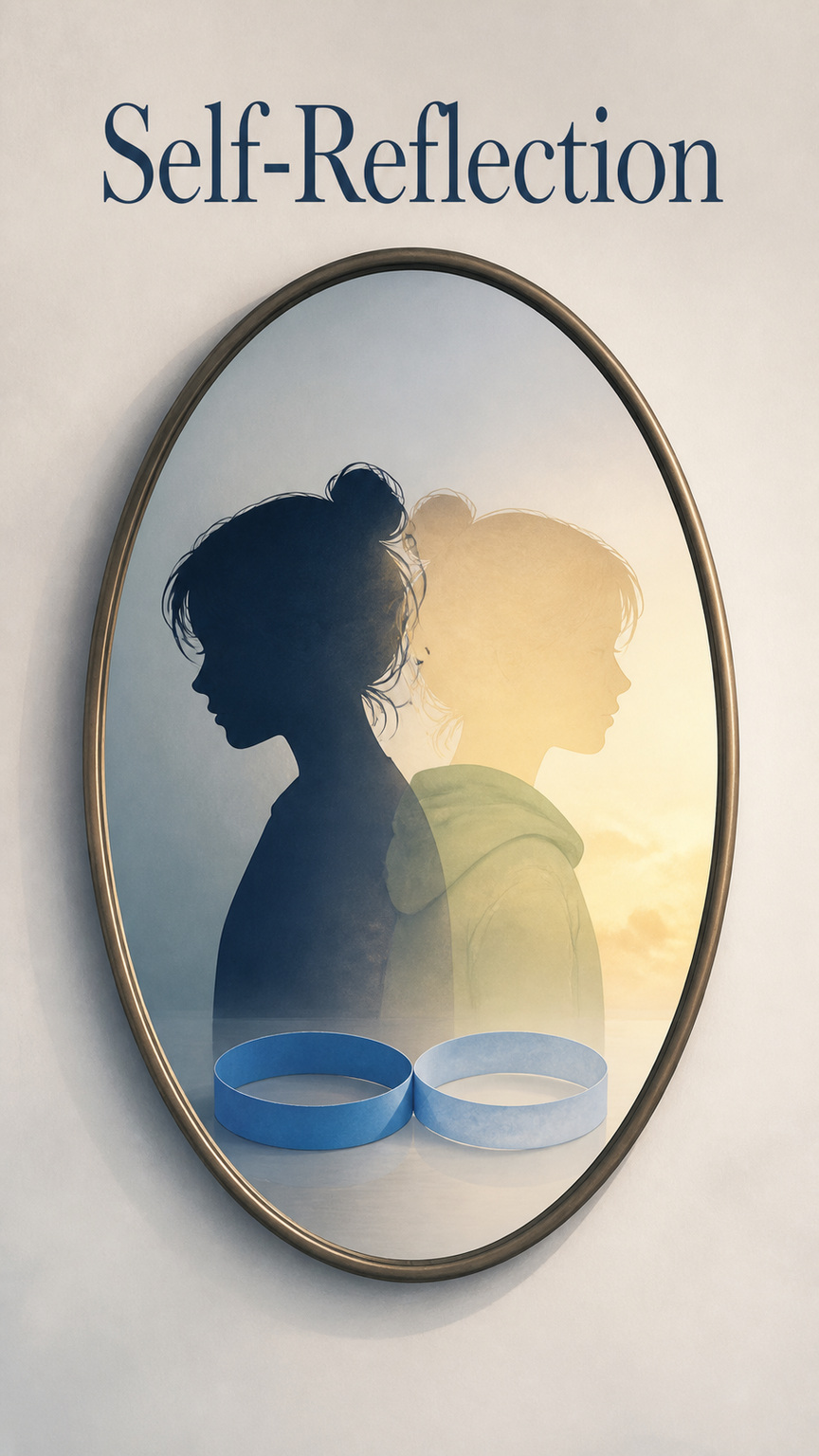
Nina woke to a second breath.
It came from the pillow beside hers: a soft catch, an exhale, then another, slower inhale as the girl in Nina’s bed woke too.
Nina did not scream. Screaming required confidence about what was happening. She lay rigid under the blanket and catalogued evidence instead. Same dark freckles across the nose. Same pale scar tucked beneath the left eyebrow. Same sleep shirt, including the ink stain near the hem. Same blue paper bracelet from the museum trip two weeks ago, though Nina could feel her own bracelet scratching her wrist under the blanket.
The girl’s eyes opened.
Nina knew the exact instant fear entered them because it entered her own face every morning before presentations.
“Why are you looking at me like that?” the girl whispered.
“Because you’re me.”
“That’s a terrible reason. You’re me too.”
They scrambled out opposite sides of the bed. The girl hit the desk; Nina hit the wall. Their matching winces were almost worse than the matching faces.
In the bathroom mirror, two Ninas stared back. The glass was ordinary: toothpaste flecks, a chipped corner, no ominous glow. Nina covered it with a towel. The girl remained. They traded bracelets. Nothing happened. Nina pinched her arm, then, after receiving a furious look, asked permission before pinching the other girl’s. Both marks reddened.
“Last thing you remember before waking,” Nina said.
“Standing here last night.”
The memory arrived in both their voices. Jocelyn Park’s birthday dinner had ended with Nina fleeing before dessert, after she had spent two hours measuring every laugh for length and every sentence for signs of structural collapse. She had told the table that cold fries possessed greater structural integrity. There had been a pause. Jocelyn had smiled. Nina had translated the pause as mistake and the smile as mercy.
At home, facing the mirror, she had said, “Maybe the only friend I can make is myself.”
She had meant it as a joke, which was how Nina delivered most statements she could not survive hearing repeated. But on the final word, a second inhalation had pulled from behind her sternum toward the reflection. Not from the glass. From inside her—a breath she had taken and somehow also released.
Then nothing. She had gone to bed.
“I remember the pull,” the girl said.
Nina nodded. “What did you dream?”
“A yellow hallway.”
Nina had dreamed about sinking through a floor made of toast.
The difference opened between them, small and bottomless.
“So you’re a copy,” Nina said, because copy sounded more manageable than person who remembered being me until six minutes ago.
The girl folded her arms. “I’m not calling you the original.”
“I didn’t ask you to.”
“Good. Then I need a name.”
She looked at their two reflections, not as if consulting them, but as if refusing to. “Anin.”
“That’s just Nina backward.”
“It’s where I came from,” Anin said. “It isn’t where I’m going.”
Their mother worked nights at the hospital and would be home in forty minutes. Nina spent twenty of them constructing a plan whose chief strength was that it required nobody else to know anything.
“Stay here,” she told Anin, stuffing a cereal bar into her hand. “I go to school. You don’t open the curtains. We figure out how to undo this tonight.”
Anin looked around the bedroom. “You want me to spend my first day in a closet.”
“It’s not a closet.”
“You’re right. A closet has a door.”
Nina left before the argument could become an event she was late for. All the way to school, she felt as if she had forgotten her own body at home.
At lunch, Daphne leaned across the table. “Are you okay?”
Four harmless words. Nina’s mind converted them into stadium lights.
“Fine,” she said too quickly.
Ben was midway through a story about his driving instructor making him circle the same block until a pigeon ceased to count as a road hazard. Jocelyn was peeling the label from her water bottle. Nobody looked angry. That only meant Nina had missed the subtler signs.
“You left pretty fast on my birthday,” Jocelyn said.
“I had a headache. No, that’s not—” Nina stopped. Her practiced explanation had tangled with the truth and dragged it out. “I’m bad at being in rooms.”
The table went silent.
There it was: the pause. Nina could feel every second landing on her skin.
Then Ben said, “Rooms are badly designed. Too many corners. My driving instructor would never approve.”
Daphne’s mouth twitched. Jocelyn did not laugh. “You know you can tell me if you need to leave, right?”
Nina nodded as if the conversation had concluded successfully, then spent the rest of lunch proving it had not by saying almost nothing.
When she got home, the kitchen contained the impossible made domestic. Anin sat at the table in Nina’s green hoodie. Their mother sat opposite her with both hands wrapped around an untouched mug.
“You told her.”
“I introduced myself,” Anin said.
Their mother rose. Hospital fatigue still marked the skin beneath her eyes, but fear had sharpened her. She touched Nina’s forehead, then Anin’s, checked their pulses, made them stand side by side, and asked each a question about their father that no stranger could answer.
When both answered, their mother sank into the nearest chair. Nina had expected the questions to divide real from false. Instead they had produced two correct daughters and nowhere sensible to put the fact.
“Are you hurt?” their mother asked Anin.
“I don’t think so. I’m hungry. Does that count?”
Their mother made toast because feeding someone was a decision she could still make. She put out the strawberry jam. Nina pushed it away on instinct; Anin pulled it toward herself, examined the seeds, and spread it thickly.
“You hate that,” Nina said.
Anin took a bite. Her eyebrows rose. “Apparently I didn’t know yet.”
Their mother laughed once, sharply, then covered her mouth. Tears came anyway. She apologized to both of them, though neither understood what for.
“You believe her?” Nina asked.
“I believe there are two frightened girls in my kitchen.” Their mother looked at Anin directly. “And I believe you when you tell me who you are. The rest can wait until I’ve slept for ten consecutive years.”
Anin lowered her toast. Something in her expression loosened—not because she had been explained, but because she had been addressed.
Anin knew everything Nina knew. The cough drops he had kept in the car. The way grief had turned the house quiet after he died. But while Nina had been at school, their mother had told Anin something new: once, cleaning the kitchen, their father had sung fake opera so loudly that the neighbor’s dog had joined in from behind the wall.
“He did?” Nina asked.
Anin looked at her. “You don’t know that one.”
It should have made Nina believe in Anin’s separation. Instead it felt like discovering a room in her own house whose key had been given to someone else.
Their mother sat down again. “After he died, I used to wish there were two of me. One to work, one to stay home with you. I said it out loud. More than once.”
“Did anything happen?” Nina asked.
“I got hoarse.”
Anin took another bite of toast. Nina hated strawberry jam. Anin apparently did not.
They tested the mirror again that evening. They covered it, turned it toward the wall, put both bracelets in a drawer, repeated Nina’s sentence, then said it backward. Their mother made her old wish again while holding Nina’s bracelet. Nothing doubled, vanished, warmed, flashed, or answered. The mirror continued reflecting whatever stood in front of it, with the dull patience of an object unfairly accused.
By bedtime, Nina had learned only that Anin snored a little and preferred the window open.
The next morning, Nina watched Anin choose the green hoodie again.
“One day,” Anin said. “I want one day outside.”
Nina had thought of the same plan before Anin proposed it, which did not make it generous. Anin knew every class, every route, every face as of the night at the mirror. She could attend school as Nina while Nina stayed home and studied the difference between them.
“You tell me everything people say,” Nina insisted.
“I tell you what happened to me.”
The pronoun lodged under Nina’s ribs.
Anin went to school in Nina’s face. Nina spent the morning pacing from the mirror to the window, trying to detect a thread between them. There was none. She did not know what Anin saw, thought, or felt. She had only her own restless mind, which was familiar company and not especially good.
When Anin came home, exhilaration and guilt had put color high in her cheeks. She took off the green hoodie, folded it on the bed, and gave Nina an account that contained too much air: sun on the walk, the sour edge of cafeteria lemonade, the relief of speaking without composing three possible reactions first.
“I got caught at lunch,” Anin said. “Jocelyn asked if rooms were any better today.”
Nina sat down on the edge of the bed. “What did you say?”
“That some were. Then I asked what I’d missed. Daphne stopped opening her pudding. Ben forgot his joke.”
“You admitted you didn’t know?”
“I almost gave them your answer. I could feel all the pieces—the half-smile, the deflection, the apology that pretends it isn’t one.” Anin touched the folded hoodie as if smoothing a wrinkle Nina could not see. “But I told them I didn’t know how to answer yet.”
It was not the answer Nina would have given. Nina hated how easily she heard that, and hated herself for hearing it as victory.
Anin told her about standing outside after lunch under a sky Nina had seen a thousand times. Wind had put hair in her mouth; the bell had rushed her back inside; she had forgotten a warmer coat. She described each annoyance with the careful ownership of somebody unpacking new possessions. In class she had chosen a different argument for the English response waiting in Nina’s notes. She had erased it twice, then left the third version.
“Why that one?” Nina asked.
“Because I changed my mind.”
“Jocelyn thinks you’re angry with her,” Anin said. “She said you’ve seemed angry for months.”
“I’m not.”
“I know. She doesn’t.”
“So you corrected her.”
“I couldn’t keep pretending. She asked about something you said yesterday.”
“You made me look strange.”
Anin’s face went still. It was a stillness Nina had never practiced. “You sent me there to be you.”
“For one day. You were supposed to show me what I’m doing wrong.”
“You’re not a machine with a loose screw.”
“Easy for you to say. You borrowed my life and everybody liked you better.”
“I borrowed your name. I don’t want to do it again.”
“Because you got what you wanted?”
“Because I got one day, and half of it belonged to lying.”
Anin lifted a hand between them, ending the agreement.
Lamplight shone through her fingertips.
For a moment Nina thought it was a trick of the thin skin. Then she saw the line of the bookshelf through Anin’s palm. The blue bracelet on Anin’s wrist had faded with her, its printed pattern washed to a ghost. Nina seized her own bracelet. Solid paper. Solid ink.
“No,” she said.
Anin turned her hand over. “That isn’t an answer.”
For two days they treated panic like a laboratory.
Their mother called the hospital and said she could not come in. She timed Anin’s pulse, marked changes in the translucency, and wrote down every failed idea. The girls exchanged bracelets; Anin’s faded bracelet remained faded on Nina, while Nina’s remained solid on Anin. They moved both bracelets across the house. They uncovered the mirror, covered it again, sat Anin in darkness, then sunlight. Nina repeated the sentence until the words became furniture. Their mother wished for another self. Anin wished to stay.
Nothing altered the slow clearing of Anin’s body.
Nina tried being cheerful for an hour. Anin continued fading. Nina cried until her face hurt. Anin continued fading. They argued, apologized, held hands, sat in separate rooms. At each measurement, the line of light through Anin was a little brighter.
The green hoodie remained perfectly green.
Near the fourth dawn, Anin sat at Nina’s desk wearing the hoodie over the sleep shirt she had arrived in. Her wrists and throat were translucent now. When she typed, the keys sank beneath fingers that looked made of window glass, but the letters stayed black and ordinary on the screen.
Nina stood behind her with a list of new tests.
“We could try the sentence at the exact time,” Nina said. “Same place, same clothes. If it made you once—”
“No.”
“It might stabilize you. Or make another—”
Anin spun the chair around. “Another what?”
Nina could not say you. Not while looking at her.
“I’m not a failed batch,” Anin said. Fear roughened her voice, but it did not make the choice less hers. “And I’m not spending what I have left helping you manufacture my replacement.”
“I’m trying to save you.”
“You’re trying to make an outcome you can stand.”
Nina’s list trembled. “What if you’re fading because I don’t need you now?”
Anin stared at her. “You think I’m dying because my job is complete?”
“I don’t think that. I just—what if the rules think it?”
“What rules? We tried happy. We tried miserable. We tried close and apart. I started fading before you learned anything useful.” Anin reached for Nina’s hand. Her grip was faint but warm. “Your need isn’t killing me. Your getting better won’t save me. And I wasn’t made for either one.”
The last sentence broke something quieter than hope. Nina saw the shape of the four days: every test had asked what Anin was for, how Anin worked, what Anin proved about Nina. Even the school day had turned Anin’s life into evidence.
Nina put the list down.
“I’m sorry,” she said.
Anin waited. Nina did not ask whether that fixed anything. It did not.
“What did you write?” Nina asked.
Anin turned the screen toward her.
The page began: I like strawberry jam because Nina doesn’t. That wasn’t why I tried it, but it might be why I noticed.
Below it, Anin had written about the yellow hallway in her first dream. The weight of the green hoodie. Jocelyn’s face when an answer did not fit. Their mother falling asleep at the table and waking with both girls’ hands beneath her cheek. Fear appeared on the page, but so did irritation, appetite, sunlight, and a joke about Nina’s lists having lists.
It sounded a little like Nina. It sounded more like Anin.
“Tell me about our father singing,” Nina said.
So Anin did. She gave him an apron as a cape and a wooden spoon as a tragic hero’s sword. Their mother corrected the spoon to a dish brush. Anin objected that a dish brush lacked dignity. By the end, all three were laughing too hard for the story to remain sad in only one way.
Then Anin asked Nina about the first lunch—the one Anin had not attended. Nina told her about Daphne’s question, Ben’s pigeon, and the sentence that had escaped before she could make it harmless. Anin listened with her eyes closed.
“I wish I remembered it,” she said.
“I wish I remembered the opera.”
The symmetry was imperfect. Nina would have years, perhaps, to hear old family stories. Anin had minutes. But for that moment each held something the other could receive only by being told, and Nina understood that listening was not a lesser form of knowing someone. It was the form everybody else had always had.
They stopped measuring time by opacity. Anin chose the last hour: tea too sweet for Nina, their mother between them on the bed, the window open despite the cold. Anin used a black pen to write I AM REAL on her own forearm.
Nina wrote SAME on hers.
Anin took the pen back. Beneath Nina’s word, she added YOU TOO.
“Tomorrow,” Anin said, “tell someone one true thing.”
Nina’s chest tightened. “If I do, will you—”
“No bargain.” Anin touched their wrists together, fading ink against solid. “Not for me. Because it’s your day, and you get to decide what to do with it.”
When the sun reached the lower edge of the window, Anin became almost entirely light. Their mother held one of her hands. Nina held the other. Neither could feel much pressure, but Anin looked from one of them to the other and said, “Still here.”
Then she wasn’t.
The green hoodie collapsed across Nina’s knees. Beneath it, the duplicated sleep shirt was gone. So were Anin’s bracelet and the words on her arm. Nina’s own bracelet remained. SAME. YOU TOO remained in black ink on Nina’s skin. The page waited on the screen.
Their mother made a sound Nina had never heard from her before. They held the empty hoodie between them.
They did not know whether Anin had died, gone elsewhere, or ended in some way they had no word for. Not knowing did not make the bed less empty. It did not make her less their loss.
At lunch the next day, Nina wore the green hoodie.
Daphne looked at her inked forearm, then at her face. “Are you okay?”
The truthful answer was too large for the table. Nina nearly said fine. She nearly asked Ben about driving. She nearly let Jocelyn decide that silence meant anger because anger was easier to admit to than fear.
“No,” Nina said. The pause arrived. This time she stayed inside it. “I left your birthday because I was afraid you’d watch me fail at being normal. And I lost someone yesterday. I can’t explain all of it yet. But I need you to stop guessing what my quiet means while I practice actually telling you.”
Jocelyn’s eyes filled before Nina understood why. “I thought you hated us.”
“I thought you were being kind because you felt sorry for me.”
“I was being kind because you’re my friend.” Jocelyn scrubbed at one eye, annoyed by it. “But I can’t guess. You have to say when you need quiet.”
“I know. I mean, I know now. I might still be terrible at it.”
Ben nodded gravely. “Most rooms require several attempts. Ask any pigeon.”
The joke did not erase anything. It made enough space to breathe.
Daphne pushed her unopened pudding cup across the table. “I don’t know what to say when people are grieving,” she admitted. “This is what I have.”
Nina took it. “Thank you.”
Jocelyn glanced at her fries. “For the record, I told three people your structural-integrity theory after the party.”
“You did?”
“Cold fries really do hold up better.”
Nina laughed, and then cried, which embarrassed everyone enough that they all became busy with napkins and lunch trays. Nobody understood perfectly. Nobody left.
At home, a note waited beside the lamp in their mother’s hurried writing: Love you. Both of you, somehow.
Nina printed Anin’s page. She saved it twice, because grief had not cured her of sensible precautions. Then she tied her surviving blue bracelet around the lamp’s stem. It did not glow or warm or become anything except paper around metal.
That was enough. It had been there. She had been there.
Nina opened the response she owed for English. The blank document reflected her dimly until she typed across it. For once, she did not begin by guessing what answer would make her easiest to like.
She began in her own words.