She Literally Has Wings
"bro how did you not know your wife is an angel she literally has wings?" "Well to be honest I thought she was some bird demi human or hybrid or something." "She literally makes everyone smile when she walks in a room." "To be fair she does have an amazing personality that's why we're married."
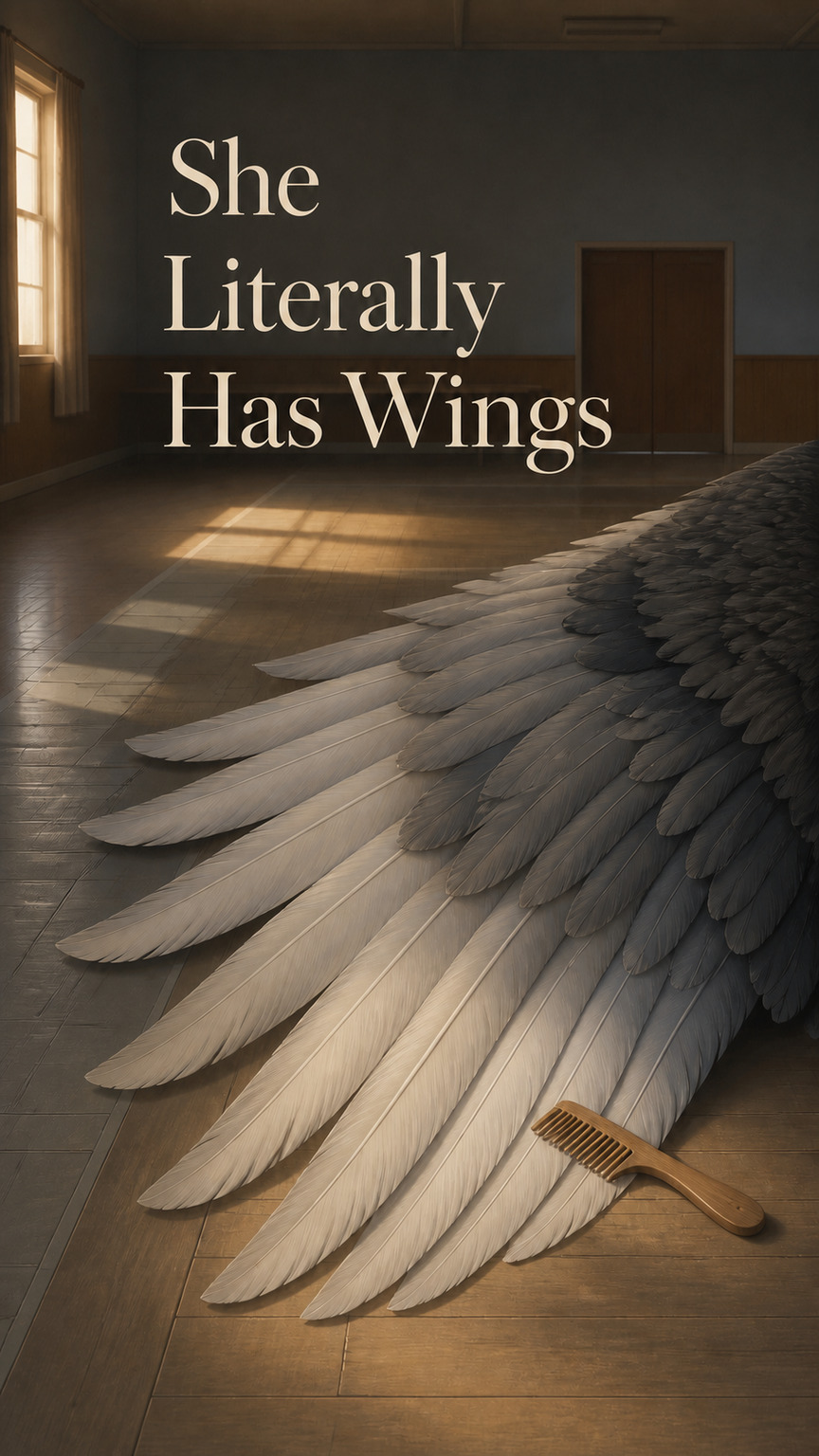
By the time the last tray of roasted carrots reached the serving counter, Coralie had folded her wings as tightly as they would go and still clipped the back of a chair.
The chair skidded half a handspan. Its occupant, a woman fastening a green coat, caught her water before it spilled.
“Sorry,” Coralie said.
“That chair has been trying to kill me all evening.” The woman rose and leaned close. “Did you save me any of the lentils?”
“No cream, extra lemon.” Coralie lifted a paper carton from beneath the counter. She had written a small green leaf on its lid so nobody would give it to the wrong person. “I hid them from Julian.”
The woman’s tired face opened into a grin. “You are an angel.”
“Accurate,” Coralie said, and passed her the carton.
At the other end of the hall, Julian stopped wiping a table.
Coralie saw that much and thought no more of it. She had four warm serving pans to cool, a roll of foil that insisted on sticking to itself, and thirty-six chairs waiting to be lifted upside down. The hall smelled of onions, floor soap, and the damp wool of departing coats. Every time the rear door opened, cold air combed the loose feathers at the edges of her wings the wrong way.
Tomas had already started on the chairs. He worked from the walls inward, leaving a broad path between the serving counter and the coat hooks. He did it without looking at her. Ten years ago he had learned her clearance by getting a primary feather caught between his elbow and a doorframe; since then, he measured rooms with some private part of his mind that apparently had her width marked on it.
Coralie loved him for many reasons. That one had survived more difficult weeks than some of the grander ones.
Julian abandoned his cloth on the table and came toward her.
“Wait,” he said. “Accurate how?”
The woman in the green coat was attempting to put on one glove while holding her carton, purse, and umbrella. Coralie tucked the carton into the purse’s open top.
“Thanks, dear.”
“Your bus is in six minutes.”
“Five if the driver’s feeling cruel.” The woman hurried out, smiling still.
Julian watched the door close. “Coralie.”
She pinched the foil loose. “I call myself an angel.”
“You call yourself—”
“Julian, take the carrots.” Tomas was passing with two chairs braced against his chest. “She can’t reach the cooling rack while you’re standing there.”
Julian took the pan automatically. He carried it three steps before turning. “Did you know?”
“Know what?”
“That your wife is an angel.”
Tomas shifted the chairs higher. “She isn’t.”
Coralie stopped fighting the foil.
Julian stopped with the carrots halfway to the rack. “She just said she is.”
“You probably heard her wrong.” Tomas nodded toward the counter. “She’s winged. That doesn’t make her an angel.”
“I heard four words.”
“Three, if she said what you think.”
Julian stared at him. “That’s your objection?”
Tomas set the chairs onto a table and glanced at Coralie at last. It was a quick glance, seeking confirmation of some small, ordinary misunderstanding. She could have rescued him then. She could have smiled, made a joke about the woman’s choice of compliment, and given him the few minutes he needed to discover his mistake privately.
Instead, Coralie pulled out another length of foil. It tore straight across.
Tomas’s expression changed.
“Oh,” Julian said. The carrots gave a soft hiss against the metal rack. “You genuinely don’t know.”
The rear door swung open before Tomas could answer. A man leaned in, letting a blade of cold cut across the floor.
“Sorry. Dark wool cap? I was at the corner table.”
“Coat hooks,” Coralie said. “Bottom basket, under the silver scarf.”
The man found it and lifted it in triumph. “Knew you’d have it.”
“Close the door, please.” Her left wing had begun to shiver.
He did. He thanked her twice on his way out.
Julian waited until the latch caught. “Tomas. She has wings.”
“People have wings.” Tomas’s hands had gone still on the back of a chair. “People grow them, inherit them, build them and end up keeping them. Her feathers don’t come with a certificate.”
“She called herself an angel.”
“Yes, Julian. I was here.”
The polish in Tomas’s voice was a warning. He used it when he had assembled an argument too quickly and intended to live inside it until everyone else went home.
Coralie stacked two shallow pans, metal ringing against metal. “The drying towels are still in the kitchen.”
Both men looked at her.
“Do you want the floor wet all night?” she asked.
Julian went to get the towels.
Tomas moved toward the counter. “Coralie.”
“The chairs first.”
“Can we just—”
“Not with nine people still here.”
He looked around as if the nine had concealed themselves for spite. Two regulars were dividing the last bread into a cloth bag. A family was searching beneath tables for a missing mitten. Near the coat hooks, a broad-shouldered diner stood motionless with a paper receipt in hand, waiting to ask a question and pretending not to listen.
Tomas lowered his voice. “All right.”
He returned to the chairs.
Coralie carried the empty pans into the kitchen. Her wings made turning sideways through the swinging door easier than walking straight. She had designed that trick during the first month of suppers, along with a hundred other accommodations nobody called miraculous: hook the door with one heel, fold the right wing first, hold the hot edge away from the covert feathers, never trust a child who said they only wanted to touch one.
In the kitchen, Julian was kneeling beside the laundry basket. “How long has he thought you were—what does he think you are?”
“Ask him.”
“I’m asking you whether you knew.”
Coralie set the pans beside the sink. “I knew he didn’t use the word.”
“That is not the same thing.”
“No.”
He waited. Julian had always believed silence was a faulty appliance. If he stood beside it long enough, someone should tell him where the switch was.
Coralie pointed to the basket. “Blue towels. The white ones leave lint.”
He rose with the blue towels gathered against his chest. “You’re both impossible.”
“Those go under the rack.”
“I know where towels go.”
He did not. Two minutes later she found them draped over the serving counter, where water would run onto the floor. She moved them without comment.
At the bread table, one of the regulars was struggling to close her cloth bag. Coralie retied it with a loop loose enough for stiff fingers. At the next table, Tomas crouched and found the missing mitten jammed between a chair leg and the wall. He held it up. The child’s parent laughed with relief; the child seized it and immediately dropped the other one.
Tomas picked that one up too.
Of course he did. He caught cupboard doors before Coralie walked into them and took the laundry off the line when the air changed. Tomas noticed the second thing while everyone else was still pleased about the first.
It did not make his ignorance smaller. That was the trouble.
The broad-shouldered diner finally approached the counter. “Could I take a plate to my upstairs neighbor? The stairs are bad for him tonight.”
“There’s rice, carrots, and half a portion of chicken,” Coralie said. “Does he still hate pepper?”
“With devotion.”
She reached under the counter for another marked carton. “No pepper.”
His whole posture eased. “You remembered.”
“You mention it every Thursday.”
He left looking pleased enough to prove Julian’s case, if a person ignored the carton in his hands and the neighbor waiting upstairs.
Julian did ignore it. The moment the door shut, he came back from the cooling rack and pointed after the diner.
“There. That. Everybody does that when you talk to them.”
“Takes leftovers?” Coralie asked.
“Lights up.”
“The ceiling lights are terrible.”
“You know what I mean.” Julian turned to Tomas. “How did you never put this together? The wings, the whole room changing when she walks in—”
“Because the room doesn’t change.” Tomas lifted a chair. “She does things for people.”
“That man looked ready to cry over chicken.”
“His neighbor came home from the hospital on Tuesday.” Tomas set the chair down more sharply than he needed to. “The woman with the lentils works a late shift and usually finds everything with cream gone by the time she arrives. The kid lost a mitten last week too. Coralie bought a basket so people would stop throwing lost things in the trash.”
Julian opened his mouth.
Tomas kept going. “They smile because she notices them. She notices when you pretend decaf doesn’t give you a headache because you don’t want to inconvenience anyone. She notices when I leave cupboard doors open and closes them hard enough that I can hear her opinion from the other room. She hates pears unless they’re cooked. She needs the soft brush for new feathers and the wooden comb for the long ones, and if you put either back with the handle pointing in, she’ll knock everything off the shelf trying to turn it around.”
Coralie pressed her palms against the cool counter.
It was an excellent inventory. It was love in Tomas’s native form: a crowded workbench, every fact in its place and all the labels facing out.
Julian rubbed the back of his neck. “Fine. You know your wife. But did you think she was a bird person?”
Tomas’s chin lifted. “Something like that.”
“Something like what?” Coralie asked.
The hall quieted around the question. Even the family with the mittens had gone. Only the two bread regulars remained, slowly putting on their coats.
Tomas faced her. “Avian demi-human was my first guess. Then you told me one of your parents didn’t have wings, so I thought maybe hybrid, or a transformation that settled. I knew those weren’t exact.”
“You knew they weren’t exact,” Julian repeated.
Coralie raised one finger. Julian shut his mouth.
One of the bread regulars approached with the tied bag. “Same time next week?”
“Same time,” Coralie said.
“Do you need help with the tables?”
“We’ve got them.”
The regular looked from Coralie to Tomas to Julian, registered enough to know she wanted no part of it, and buttoned her coat. “Good night, then.”
Her companion was already holding the door. They left together without smiling at anyone.
Tomas waited until they were outside. “I didn’t want to make you explain yourself.”
“So you picked an explanation and kept it.”
“I picked a possibility.”
“For seven years?” Julian said.
“Julian.” Coralie didn’t look at him. “Sweep under the bread table.”
“You want me to—”
She handed him the broom.
He took it.
The bristles scratched across the floor. Tomas moved a chair out of Julian’s path, then another. His need to keep doing useful things was so familiar that Coralie could have followed it through a dark house.
She finished covering the carrots. She labeled them with the date. She wiped a bead of sauce from the edge of the counter. Only then did she say, “Angel is the truthful word for me.”
Tomas nodded once.
“It doesn’t prove whatever Julian thinks he has proved. I don’t make people happy. I don’t know who deserves what. I can’t heal anyone, and I’m not going to answer questions about heaven while the rice pans are soaking.”
Julian swept faster.
“I wouldn’t ask you that,” Tomas said.
“You didn’t ask me anything.”
He looked down at his hands. A damp crescent darkened one cuff where he had leaned against the sink. “I thought that was respect.”
Coralie let her wings loosen. The relief was immediate and edged with pain. Feathers brushed a chair on one side and the counter on the other. Tomas moved the chair away, then stopped with his hand still on its back, as if even that small competence might now be evidence against him.
“Moving the drying rack lower was respect,” she said. “Telling your aunt not to touch my wings was respect. You could still have asked what I call myself.”
“Would you have answered?”
There it was: not an accusation, exactly. The first true question, arriving late and carrying all the others behind it.
Coralie considered lying to make the balance cleaner. “I don’t know. When we met, maybe not.”
“And after?”
“After, I kept waiting for a way to say it that wouldn’t turn me into a lesson. Then I liked that you didn’t care about the impressive parts.” She flexed her aching left wing and heard one of the coverts tick against a chair rung. “Then it got embarrassing that I’d waited. So I waited more.”
Tomas absorbed this without reaching for it. His arguments had run out; she could see the discomfort of empty hands.
Julian paused with the broom. “For what it’s worth, I didn’t ask either. I heard angel and started pointing at things.”
“You did,” Coralie said.
He nodded, took the dustpan from its hook, and went back to work.
Tomas pulled out a chair but did not sit. “What do you need me to understand tonight?”
The narrowness of it helped. Not everything. Not forever. Tonight.
“That not making me explain myself isn’t the same as leaving room for me to tell you.”
His fingers tightened around the chair back. “All right.”
“And don’t say it doesn’t matter.”
“I wasn’t going to.”
“You were.”
“I was going to say it doesn’t change why we’re married.”
Julian made a small sound and became extremely interested in crumbs beneath the table.
Coralie looked at Tomas. “Why are we married?”
He answered too quickly. “Because I love you.”
She waited.
Tomas exhaled. “Because you came back after our first dinner, even though I burned the rice and blamed the pot. Because you ask for what you want until I stop pretending I can’t hear it.” His gaze dropped to the badly folded foil at the counter. “You remember the lemon and the pepper, and you still lose your keys twice a week. I wanted all of it. I still do.”
Coralie’s throat tightened, which was inconvenient but not persuasive by itself.
“Those are reasons,” she said. “They don’t answer what you thought I was.”
“No.” Tomas sat at last. “They don’t.”
He did not reach for another defense. That mattered.
Julian finished sweeping and carried the dustpan to the bin. On his return, he lifted the last two chairs onto the bread table. He kept his eyes on the chair legs.
“I can lock the rear door,” he said.
“Please,” Coralie said.
He checked the door, turned off the kitchen light, and collected his coat. At the front entrance he hesitated, visibly searching for something that might release them all from the evening.
Nothing arrived.
“I’ll bring the good coffee next week,” he said.
“Not the dark roast,” Tomas said.
Julian looked at Coralie.
“Not the dark roast,” she agreed.
He left.
The hall felt larger without him, though he had never occupied much space. Tomas checked the stove. Coralie counted the leftover cartons. They worked separately, not performing anger and not pretending it had passed. When Tomas reached for her coat, he held it open low enough that she could guide her wings through the split back herself.
Outside, rain had thinned to a cold mist. Their building stood one block away. On clear nights Coralie sometimes flew that block for the pleasure of landing on their roof, but wet feathers doubled the work, and her left wing had been trembling since the man came back for his cap.
Tomas walked on her right, the side where the pavement narrowed around three overfilled bins. He did not take her elbow. He only moved outward so she had room.
At the corner he said, “Was any of my guess close?”
Coralie watched rain bead on the barbs of her outer feathers. “Close in appearance.”
He waited.
“Not in flight.” She tucked the wing in before it struck a signpost. “The wings do the work, but they aren’t all of it. If I’m emptied out, muscle won’t get me off the ground.”
“Emptied out how?”
“I can’t give you a useful answer yet.”
“All right.” After half a block he asked, “Does anything help?”
“Quiet first. Then hot tea.”
He nodded.
In their entryway, Tomas turned on the lamp and went past the kettle without touching it. Coralie hung her coat, took the wooden comb from the shelf, and held it out to him.
He accepted it by the handle. “Long feathers?”
She opened her left wing across the room, leaving him just enough space to kneel beside it.
“Start at the outside,” she said.