Stay Out of My City
You have incredible powers in a world of heroes and villains, but you refuse to join either side. You threaten both sides to stay out of your city, making it the most peaceful and crime-free city in the world.
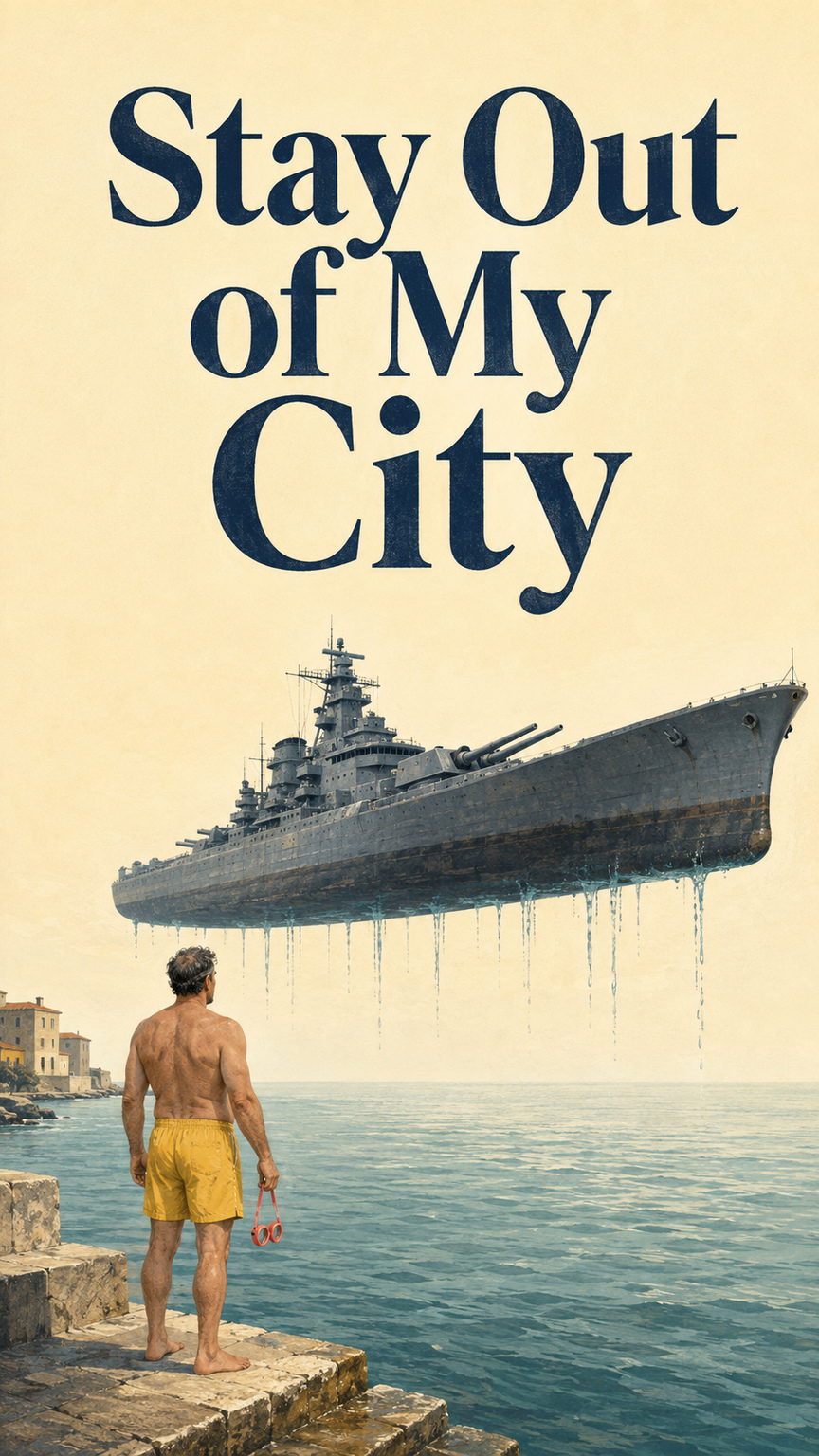
Warren was trying to get the knot out of Elvi’s goggles when the battleship came over the breakwater.
It had no business flying. Water poured from its propellers, and its shadow crossed the ferry steps, the swimming platform, the little procession of people carrying their shoes down to the sea. Up on the deck, Mordant stood between two gun turrets in a coat that streamed behind him. Candescent pursued him through the morning air, drawing back one burning arm.
Elvi pressed against Warren’s leg. She was ten, all cold elbows and excitement about the deep end of the harbor, which they had finally agreed she could swim in.
“Is that really him?”
“Get up behind the wall.”
She went, taking their bag. Warren waited until he could see her crouching beside the lifebelt box, then looked up.
The battleship stopped.
Its trailing water stopped too, hanging in long, clear columns above the harbor. Candescent’s fire spread from her fist toward the ship and stayed there, an enormous orange fork whose nearest point hung over the roof of a fish shop. She hung motionless at its root, one arm extended. The ship’s propellers locked in place; after a few seconds of straining noise, someone aboard cut the engines. In the sudden quiet Warren could hear water dripping off someone’s bathing cap.
He had never held anything this large. It did not feel different from holding a dropped mug. He looked at the thing, decided how it should move, and it obeyed. Beyond the ship came six armored launches, three flying men, and a woman on a silver disc. Warren caught them as they rose over the breakwater. He left their breathing alone. One of the flying men continued to swear.
“Sir,” Candescent called. “If that’s you doing this, I need you to let me finish. His forward cannon is aimed at the hospital.”
Warren could see the hospital windows uphill. He could also see the cannon’s muzzle, wide enough to swallow the front of a bus. He turned the ship until its bow faced the open sea, taking care to clear the lighthouse.
“There,” he said.
She stared at him. He was standing on the bottom step in yellow swimming trunks, still holding a pair of pink goggles. He wished he had put his shirt on.
Mordant began to laugh. “Come up here. Whatever she’s paying, I’ll double it.”
Warren moved the battleship farther out, gathering its launches underneath it. Then he turned Candescent and the other heroes to face him, suspended beside their enemies above an empty stretch of water. He took the rescue loudhailer from its hook by the lifebelt box and lifted himself above the wall, his bare legs dangling in view. From there he could see every craft.
“Nobody’s paying me.” The loudhailer made a startling noise. He turned it down a little. “My name is Warren Dovett. I live here. You people have closed the schools three times this month.”
“We are trying to apprehend a mass murderer,” Candescent shouted back.
Mordant cupped his hands around his mouth. “And I am in a hurry.”
“You’ll both leave. All of you. No headquarters, no weapons stores, no battles. Stay out of my city.”
Candescent pulled against his hold. The flames around her shoulders whitened. Warren watched them, and they bent away from her body in pale, motionless ribbons.
“You should be with us,” she called, with a new urgency. “You could save thousands of people.”
“I’m not joining you.”
“Excellent,” Mordant began.
“Or him.” Warren raised the battleship until everyone on the steps could see daylight underneath its hanging keel. “If you come back armed, I’ll take every weapon apart. If you keep coming, I’ll start taking apart the things you ride in. I can put you ashore alive. You’ll have a long walk home.”
Mordant had ceased laughing. He looked down past his own feet.
“Answer me,” Warren said.
“I understand.”
Candescent looked toward the city before she answered. “We’ll withdraw.”
Warren released her fire toward the empty sky, where it unfurled into a long, harmless glow. He lowered the ship and launches onto the sea outside the harbor, then set the heroes down on the breakwater’s outer end. The floating columns fell as rain. By the time the engines started, Candescent had ordered her people away from the ship.
He held everything in view until it had gone well out to sea, then lowered himself onto the steps and put the loudhailer back. His calves were cold. Behind him, people were talking in the excited, offended voices they used after an unusually bad ferry delay.
Elvi came down the steps with their bag.
“Can we still go in?”
Warren looked at the water. No wreckage, no fuel. The harbor was settling around the swimming platform.
“Yes. Stay this side of the rope.”
She took her goggles from him. “You didn’t fix them.”
He sat down on the wet step, and she waited while he worked at the knot with his thumbnail.
There were tests during the first year. Two gangs believed Warren meant only people in costumes. He helped the police bring the gangs’ armored cars to a halt, and the men who had collected money from the fish shops found that their employers would no longer answer their calls. A hero attempted to establish a training base under the name of a sporting association. Warren lifted its practice tower out of the ground and set it beside the inland road, where the hero had to arrange for it to be dismantled.
After that, the danger of provoking him did most of the work. Brackenport’s police kept their jobs. They could investigate a threat without an unlicensed flying man carrying their suspect off, or a villain breaking him out before supper. The money once spent repairing battle damage went into homes, treatment, schools. Neighbors had time to become useful to one another. The changes seemed slow to Warren while he lived through them.
Elvi was thirteen when Candescent next asked to see him. They met at the disused quarry beyond the inland boundary. Warren had brought Elvi because they were going to the cinema afterward, and she sat on a rock choosing sweets out of a paper bag while Candescent unfolded a map.
“Two days a month,” Candescent said. “We’d transport you. You would retain command of every deployment.”
“Who looks after here?”
“I’d stay myself.”
He looked at her properly. There was a fresh dressing along her jaw. She hadn’t tried to cover it for the meeting.
“You’re needed elsewhere.”
“So are you. That’s what I’m trying to tell you.” She held a corner of the map against the wind. “I spent last night getting people out from under a railway station. There are seven still missing. With you, we might have had everyone out before the roof went.”
He thought about the seven. She let him.
“I’m sorry,” he said eventually. “I won’t sign up.”
She folded the map along its worn creases. “The offer will remain open.”
He bought tickets for the film Elvi wanted, although the creature in the poster had too many teeth and they both knew he disliked things jumping at the camera. Halfway through, she put the sweets between them without looking at him. He was grateful for the dark and for something to do with his hands.
At sixteen, Elvi went with him to meet Mordant in the same quarry. She had a new blue streak in her hair. Mordant arrived without his coat, in a hired car, and kept trying to address her as though she were Warren’s assistant.
“I am proposing housing,” he told her. “Quiet homes for people who have spent their lives moving. My crews have children too.”
Elvi looked at Warren.
“Their children can live here,” Warren said. “Anyone’s can.”
“Naturally they’d need their parents nearby.”
“Then their parents will have to stop working for you.”
Mordant took a folder from the car and did not open it. “Some of them would be killed if they left.”
“By you?”
“By people who are looking for me.” His fingers tightened on the folder. “You could help us. I have things to offer in return.”
“I’m not giving you a base.”
Mordant sat on the car’s sill for a moment. Then he put the folder away. “I suppose you’ll be pleased when they come after my people.”
“No.”
Elvi was unusually quiet walking back. At the coach station she stopped to look at an advertisement for a coastal university. Warren waited, wondering if she would ask about Mordant, but she photographed the advertisement instead. There was a small boat on a very blue sea, full of students hauling a net.
“They do a whole term on the water,” she said.
He came to look over her shoulder.
By the ninth year, Brackenport was the most peaceful city in the world, and the only one that had gone five years without a single crime. Warren had watched visiting researchers try to find the trick. They knocked on doors, invited confidential complaints, checked records, stayed out late. They went home with sunburn and the same results.
For Warren, the change was most apparent at night. People had begun swimming after dinner, when the sea held the day’s warmth. From the ferry steps he heard laughter carrying across the dark water. Children left their bicycles in heaps outside the library. Shopkeepers went next door for a chat with their tills open. A woman stood up at a council meeting and called Warren an obstructive fool because he opposed her marina extension, then asked him to lift a fallen tree off her shed the following week.
Elvi grew taller than the mark he had put on the kitchen door for himself. She found friends who liked the same films, acquired a succession of waterproof notebooks, and came home from the beach knowing the names of creatures he had spent forty years calling little crabs. When her university acceptance arrived, he carried her round the kitchen once before remembering that she hated that now.
She let him finish the circuit.
On the morning Elvi left for university, she woke Warren by dropping his swimming trunks onto his face.
“You promised me a race.”
He uncovered one eye. She was dressed for the water, with her goggles hanging from her wrist.
“When’s your coach?”
“Ten. We’ve got hours.”
He had, in fact, been hoping she would forget. They had raced each other since she was small, and Warren had become accustomed to winning. Lately, winning had required some adjustments that she took increasingly badly.
“The platform stays where it is,” she said.
He sat up. “That was once.”
“It was Tuesday. I was nearly there, and you pulled it past me.” She sat on the end of the bed. “I’ve been getting faster all summer. I want to see if I can beat you.”
On Tuesday he had laughed until he saw her face. She had hauled herself onto the platform and put her towel over her head. He’d thought she would soon find it funny. Apparently she had been waiting for him to get the joke out of his system.
“All right,” he said.
“Properly.”
“Yes.”
At the ferry steps the water was clear enough to show the sand around the bottom rung of the ladder. Two early swimmers were coming in, trailing small disturbances through the harbor’s reflection. Elvi put their towels on the wall and twisted her hair into a cap.
“If I win, you watch the shark trilogy with me when I come home.”
“The one where it eats the helicopter?”
“That’s the second one.”
He had seen enough of that through the kitchen doorway. “And if I win?”
“Any film you like. I won’t complain.”
“I could choose the ferry documentary.”
“You could.” She held out her hand. “Are you coming in?”
He shook on it, then followed her down into the cold water. They lined up by the bottom step, facing the platform. First to touch its ladder. It looked a little farther away this morning.
Elvi counted them off, and Warren lunged forward. For several strokes he could see her cap beside him whenever he turned his head. Then she was ahead. She had a long, unhurried stroke that he remembered teaching her in parts, one arm at a time while she clung to the edge. He tried to go faster. Water came up his nose.
The ladder shone beyond her. He could bring it to himself so easily; Tuesday’s absurd little victory returned to him, the platform sliding across the water while he paddled behind it. He reached forward and pulled himself through another armful of sea.
By the time Elvi slapped the ladder, he was still close enough to kick her feet. He made a last furious effort anyway. She had climbed onto the bottom rung when his hand struck the metal.
“There,” she said.
He coughed. She waited, holding the side of the ladder, until he could speak.
“I swallowed half the harbor.”
“I saw.”
“And you got a better start.”
“Yes.”
He looked up at her. She was smiling now, but she wasn’t doing any of the crowing he had been preparing to resent. That made it harder to produce his next complaint.
“I did try,” he said.
“I know you did. You made that noise.”
“What noise?”
She demonstrated: a dreadful grunt, with a little squeak in the middle. He splashed her, and she stepped neatly up the ladder beyond his reach.
They went home to shower. An hour later her friends arrived, and Warren carried the suitcase to the station while Elvi gave them an imitation of his finish. It was getting less accurate with every telling.
The coach station stood just inside Brackenport’s inland boundary. From its forecourt Warren could see the quarry mouth and, this morning, Candescent waiting beside it. Behind her sat a broad-winged transport and four people in flight harnesses. On the other side of the quarry stood Mordant, two low black gunships, and a van with plated windows.
Elvi followed his gaze.
“Oh, for goodness’ sake.”
“I’ll be quick.”
“You’ve got twelve minutes.” She took the case from him. “And you still owe me three films.”
He walked down the road. The quarry was out of use and empty apart from the two parties. He stopped by the boundary sign, close enough to speak without carrying his voice.
“You shouldn’t have brought those.”
“My escort,” Candescent said. “They stay on our side.”
Mordant inclined his head toward the transport. “And mine stays between me and hers.”
“I came because I heard Elvi’s leaving,” Candescent said. “You may want a change yourself. We could arrange work near her university.”
“How did you hear?”
“She won a scholarship. It was in your local paper.” Candescent drew off her gloves. “I’m not trying to frighten you, Warren. I thought this might be a good time to ask.”
He had bought six copies of that paper. He remembered them stacked on the kitchen table, Elvi laughing when she found them.
Mordant stepped closer. “I can do rather better than work. I own a house overlooking that university’s bay. No rent, no obligations for your daughter. A few obligations for you.”
Candescent put herself between them. “He’s offering to buy you.”
“He has understood the offer without assistance.” Mordant lifted two fingers toward his escorts.
The gunships rose and came forward. Candescent’s people went up to meet them, the transport lifting behind them on its great fans. They were watching one another. All of them were coming toward the road.
Warren took hold before any crossed it.
He raised the gunships, the transport, the van, and everyone with them above the quarry floor. Candescent’s boots left the ground. Mordant, rising beside her, stared down between his polished shoes. Higher up, the four heroes twisted in their harnesses. Their exposed fans strained against Warren until he stopped those too.
He had a clear view of all of it: tons of metal, faces behind glass, the bright mouths of weapons. He turned the whole company until their vehicles pointed away from Brackenport, keeping the people upright. The shadows moved slowly over the bare stone below.
“Put us down,” Mordant said.
“My daughter’s waiting up the road. Get those things away from her.”
“We haven’t crossed your boundary,” Candescent said.
“And you won’t. Either of you.” Warren looked from her to Mordant. “Stay out of my city. Take your weapons away from this road. If I see them pointed here again, I’ll put them on the ground in pieces.”
Mordant’s face had gone grey above his collar. “All right. We are leaving.”
Candescent was looking past Warren toward the station. He resisted the urge to turn; he needed to see what he was holding.
“We need help,” she said.
“I know.”
“You know what you could do.”
He did. He could feel the ease of it, all that weight awaiting his decision. For nine years she had kept asking him, and for nine years people elsewhere had needed her.
“I’m not joining you,” he said. “I’m not joining him. That’s still my answer.”
She shut her eyes briefly. “Then let my people go.”
He lowered the vehicles and set everyone beside them, facing away from the road. Mordant got into the van at once. Candescent waited until her escort was aboard before following. Warren stayed by the sign until the van had driven out of the quarry and the last aircraft had disappeared over the ridge.
Then he ran back to the station.
Elvi had her phone out when he returned. Her case was aboard, one of her friends had gone to get her a drink, and the driver stood by the kiosk with a cup of tea.
“Are you filming me?” Warren asked.
“Yes. Say who won.”
“I’ve just been running.”
“Get your breath, then.”
He stood with his hands on his hips until he could breathe through his nose. She kept the phone pointed at him.
“Elvi won the race,” he said.
“How?”
He opened his mouth to mention the start again. It had been a good start, though. He’d seen the neat push from the step, the way she’d put her head down at once. He ought to learn to do that.
“She swam faster than I did.”
She stopped recording and put the phone away.
“Who’s that for?” he asked.
“Me. When you start saying you let me win.”
Warren looked at her for a moment. That was something he had said, often enough that he could no longer remember which races he’d meant it about.
“I won’t say that about this one.”
“Good.”
She reached up and flattened his hair where it had dried sticking out. He endured it. Then she gave him a quick kiss on the cheek, took the drink her friend offered her, and got on the coach.
At noon Warren was back at the ferry steps. The platform lay beyond the other swimmers, stubbornly distant. He waited until there was a clear stretch of water, then pushed off as he’d seen Elvi do, head down, arms extended.
His goggles filled. He stopped to empty them and tighten the strap, then tried again. By the third attempt he had a little of the movement, the clean slide before the first stroke. He made it halfway to the platform before he had to stop and cough.
He pictured Elvi watching him from the ladder and began laughing, which did not improve his breathing.