The Strength of Ten
Your kingdom is defenseless, and to secure an army, you, the prince, are promised in marriage to one of the daughters of the King of the North, a brutal warrior known for having the strength of 10 men.
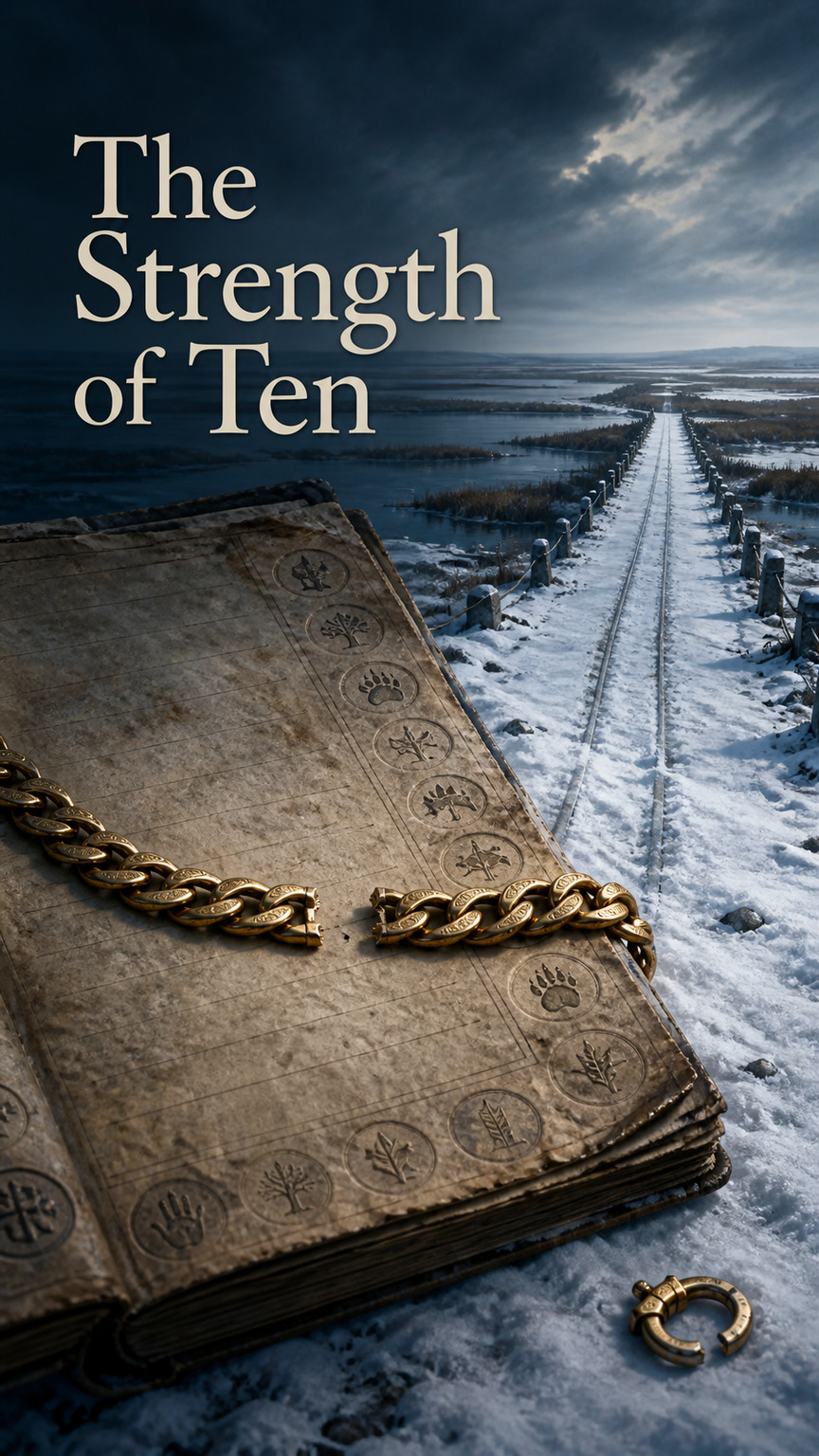
The courier caught Prince Lysander beneath Harrowfast’s gatehouse, before he could offer the gold wedding chain to the steward waiting on the steps.
Snow had packed white in the courier’s eyebrows. His horse stood with its head down between six others, all seven animals trembling from the Frostroad. Lysander’s own six escorts looked scarcely better.
“Greyglass is lost,” the courier said. “The marshal sold the gate. Most of the four hundred border guards were taken in their beds. The rest came south without weapons.”
Lysander felt the chain’s square links through his glove. “How far is the Black Reed train?”
“A hundred and five miles from Ninepin. Six days, if the thaw doesn’t speed them.” The courier glanced at the northern steward and abandoned deference. “We have a hundred and eighty city watch and seventy riders. No seasonal companies. No border line. Come home.”
Home had granaries worth an invasion, river locks worth a dynasty, and no army because Lysander had sent thirteen hundred hungry soldiers back to their farms before autumn. He had called that mercy. Later, when the Greyglass warnings came, he had called Redwater merely outnumbered.
“Ride back,” he said. “Empty the three villages along Ninepin. Put every sluice worker under the watch. Assemble one hundred and twenty grain carts with fodder enough to reach the day-four post on the Frostroad.”
“From what depot?”
“The river stores. Break my seals.”
The courier’s mouth tightened. It was not enough, but it was work that might be done. He mounted again.
Lysander gave the wedding chain to no one. He carried it into King Gorm’s hall himself, resolved to marry whichever of Gorm’s three grown daughters the king required.
An iron-banded oak table divided Gorm’s hall. It was wide enough for maps, a winter feast, or a body laid out for judgment. The king of the North sat beyond it in shirtsleeves despite the cold, thick wrists bare, his old scar-lattice showing pale above his collar.
“Three thousand northerners,” Gorm said. “At Ninepin before the reeds turn green.”
A road clerk beside the wall cleared his throat. “Sixteen hundred can be spared without opening the northern passes.”
Gorm held out one hand. The clerk went still, then removed the copper ration badge from his neck and laid it in the king’s palm.
“Outer arch,” Gorm told him. “Until the last bell. No brazier. Perhaps cold will improve your arithmetic.”
The clerk bowed and left without his cloak. No one watched him go except Lysander.
Gorm smiled again. “Prince Lysander, my second daughter is thirty-two, unmarried, and more useful than many sons. You will have Princess Sigrun. Redwater will have my strength and my host.”
The side door opened before Lysander could answer. Princess Sigrun came in carrying two ledgers and a roll of road maps under one arm. She wore a marshal’s grey coat, damp at the shoulders, and had grain dust on one cuff.
“You will not have three thousand,” she said. “And I will not marry him.”
At thirty, Lysander had crossed one hundred and forty miles rehearsing surrender. “Princess Sigrun, I understand what is required. I accept the match.”
Her eyes settled on him. “Did you come here to request my answer, or to carry it?”
The courtesy he had prepared offered no safe clause. “I came for an army.”
“There is one honest quantity.”
Gorm laughed. “At Rimegate they mistook counting for command too. They built a coal barricade across my road. Ten men could not shift it.”
He stood and braced both hands beneath the table’s edge.
The old stories said a living field-healer had laid those scar paths into him after a spear wound, decades ago, and that Gorm had learned to drive his own heat and strength through them in a single, ruinous effort. Lysander had assumed the strength of ten men was northern embroidery.
Gorm drew one measured breath. The scars along his throat darkened.
On the first heartbeat, the table groaned. On the second, its feet tore splinters from the floor. By the sixth, Gorm had dragged the massive thing sideways across the main doors. The iron bands struck stone. Anyone who left now would need his leave to pass through the private rooms behind him.
“Then I broke Rimegate,” he said. “They yielded before dark.”
His voice held, but one hand shook when he released the oak. A servant hurried forward with furs. Another brought heated stones and broth. Gorm lowered himself into his chair with the careful stiffness of a wounded man.
Sigrun did not look away from her father. “And you withheld their household coal until they did.”
She placed an unsigned route ledger on the table he had moved. Six depot seals marked its first page. Twelve blank spaces waited beneath them.
“You may call troops,” she said. “You may shut doors. But the keepers will not release grain, the remount masters will not open their barns, and the captains will not take the Frostroad until my ledger matches theirs. The seven reeves can replace me if you remove me. Their notices have ten days of road between them.”
Gorm’s face had gone grey beneath its weathered red. He had the strength of ten haulers for six heartbeats. Redwater had six days.
For the first time, Lysander saw that the bride and the army had never been one transaction.
While Gorm withdrew to be warmed, Sigrun took Lysander to the map room. On the way she stopped at the outer arch, dismissed the shivering clerk in the name of her office, and fastened the copper badge back around his neck.
Then she began counting what Lysander had tried not to name.
“Black Reed foot?”
“About forty-five hundred. Six hundred horse. Engineers and siege wagons.”
“Your standing force?”
“Four hundred at Greyglass.”
“No. Your standing force now.”
The map between them showed Reedmarsh as a wash of green ink with one hard black line through it. “A hundred and eighty watch. Seventy couriers.”
“Seasonal companies?”
“Released.”
“Your letter said delayed.”
“I released them early. There was not enough grain for soldiers and households both.”
Sigrun waited.
“I chose the households,” he said. “Then I discounted the warnings from Greyglass because calling the companies back would have admitted that the choice left us open.”
She turned to a clean sheet. No comfort, no accusation. Only a sharper quill.
Three thousand soldiers, she showed him, would consume Redwater’s promised carts before the fourth day and strip Harrowfast’s passes. Sixteen hundred could cross in five days if six depots released grain, grease, socks, traces, and remounts in sequence. Eight hundred shield-spears. Four hundred bows. Two hundred and fifty pioneers. One hundred and fifty scouts. Two hundred and forty drivers, healers, smiths, and depot workers would sustain them.
“No foraging,” she said. “If your carts fail, I turn the columns north.”
“Agreed.”
“I command until Black Reed retreats beyond Greyglass or twenty days pass. You command your watch and workers. Three captain-representatives may refuse pillage, pursuit beyond the border, or abandonment of Ninepin.”
Lysander looked at the causeway. One firm road across thawing marsh, narrow enough to make five thousand less useful. “Evacuate the villages. Open both culverts when the train commits. Anchor wagons in the center.”
“Harrowfast iron travels through your locks,” Sigrun said. “If Black Reed takes the capital, our spring trade pays whatever tariff it names. This is not charity.”
“If your sluice workers are there.” Her quill moved. “Harrowfast supplies three days. Redwater supplies the carts and fodder. One third of the river-lock tolls for seven years goes to wages, injured households, roads, and the three displaced villages.”
Seven years. His council would call it northern occupation written in columns.
“And a public tribunal,” Sigrun said. “You testify about the demobilization, Greyglass, and the letter you sent us. If Redwater’s lawful council finds you broke your office, you accept its decision on the succession.”
There it was. The cost that could not be worn nobly around his neck.
“A wedding after the campaign might make these terms acceptable to your father,” Lysander said. “When there is time to decide it freely.”
Sigrun set down the quill.
He heard what he had done: taken her no, dressed it in a later season, and offered it back as compromise.
“Strike that,” he said. “No wedding.”
She drew a line through the blank marriage clause. “The compact can work without one. Can you?”
He stared at the tribunal provision. He had been ready to give his body to a stranger and remain prince. This asked him to give Redwater facts it might use to remove him.
“I don’t know,” he said.
“Find out before the road freezes without us.”
A second Redwater courier arrived at dusk with his horse spent beneath him. Black Reed’s siege wagons had turned onto the south road. The northern columns had to leave before dawn.
Sigrun read the compact aloud in Gorm’s hall. The king sat under three furs, a hot stone against his ribs. His right hand still trembled. The table remained jammed across the doors.
“I remove you as road-marshal,” he said.
Sigrun laid seven copied notices beside the route ledger, each bearing spaces for a reeve’s mark. “Then no keeper opens a depot until the reeves appoint another marshal. The captains have been told. Ten days, if every road stays open.”
“I have other daughters.” Gorm looked at Lysander. “My eldest is grown and less enamored of account books. Take her.”
Lysander thought of a woman not in the room being fitted to the empty clause. “No.”
Gorm’s gaze hardened. “My youngest, then. All three know their duty.”
“I will not ask either of them to purchase soldiers for me. Princess Sigrun said no. The marriage promise ends there.”
“Then take eight hundred of my household spears. Marry Sigrun tonight, and the Redwater tolls remain mine after seven years.”
Sigrun tapped the force count. “Eight hundred cannot hold Ninepin and the depots will not feed an unauthorized levy.”
The king rounded on her. “You would let his kingdom fall to spite me?”
“I have sixteen hundred people harnessing sleds while you ask which daughter will make you richest. Sign the call, or they unharness.”
Gorm began a tale about Rimegate. His voice faltered when he reached for the table and his shaking fingers could not close on its edge.
Lysander unhooked the wedding chain. “My kingdom is not merely outnumbered,” he said, loudly enough for the captains and clerks along the walls. “It is defenseless. I dismissed thirteen hundred soldiers, then concealed what I had done.”
The words did not make him lighter. Good.
He signed the compact beneath Sigrun’s name. He surrendered command of the northern host, one third of the river tolls for seven years, and any certainty that the tribunal would leave him heir. Then he laid the chain across the accounts.
“Weigh this into the casualty fund.”
Sigrun examined the heavy clasp. “The gold, yes. The promise, no.”
She cut the chain from its clasp with the clerk’s shears. The twelve captains marked the route ledger. Three representatives countersigned the limits. At last Gorm pressed his seal into the levy call.
“You came north for the strength of ten men,” he told Lysander, recovering enough breath for grandeur. “You have bargained hard for it.”
Lysander looked past him to the ledger crowded with human marks. “So I have.”
The host did not leave as a shining river of steel. It departed in staged columns, because the first depot yard held only so many sleds and the Frostroad only so many hooves.
At six depots, keepers compared Sigrun’s page with their own before releasing grain. Drivers changed cracked traces. Remount masters inspected fetlocks. Soldiers collected dry socks and tins of runner grease with the solemnity courtiers reserved for relics. When a sled axle split on the second day, pioneers lashed it to a spare and lost three hours. No mighty hand descended to return them.
Lysander rode beside Sigrun with the route ledger under his coat. He urged shorter rests until she pointed to horses blowing foam into the snow.
“They can sleep at Ninepin,” he said.
“Dead horses are famous for resting,” she said, and kept the halt.
On the third day, scouts found the river shelf cracked where the road curved east. Lysander knew a charcoal track along the ridge. It added seven miles but stayed on stone.
Sigrun did not take a prince’s memory as a bridge. She sent two riders with measuring cord, questioned a depot keeper, and changed the route when their figures matched his.
The Redwater carts reached the day-four post because the courier had carried Lysander’s orders south. They brought grain and too little fodder. For one sick instant he saw the whole compact ending in an empty manger.
Then he opened his household horse train. His six escorts dismounted. Northern harness went onto Redwater animals, and the soldiers walked beside the sleds.
Late on the fifth night, the columns descended toward Ninepin tired, fed, and still together. Ahead, lamps moved away from the three marsh villages in orderly lines. Evacuation carts. Sluice crews. The orders he had given before asking what his authority could buy.
Ninepin Causeway rose scarcely a man’s height above Reedmarsh, a stone-backed road with black water on either side. Two culverts ran beneath its shoulders. North lay Redwater’s capital. South, torchlight multiplied along the road until the Black Reed League seemed to have brought down a strip of the night.
Sigrun anchored wagons wheel to wheel across the firm center. Shield-spears stood behind them, bows on two low mounds, pioneers at the culvert gates, scouts forward among the reeds. Redwater’s watch waited behind the line with poles and shovels.
The thaw had begun. Water ticked under thinning ice.
“Open the culverts now,” Lysander said. “Soften the shoulders before their train arrives.”
“Our last village carts are still south of the western cut. So are twelve scouts.”
“If the engineers lay fascines first—”
“Then we move them. I will not bury our own people to improve the ground. Bring me the clearance report.”
He nearly told her he was prince here. Instead he took four riders down the drainage path until they found the last carts grinding north, one wheel sunk to its hub. Lysander put his shoulder beside the villagers and the watch. By the time the wheel rose, Black Reed horns sounded across the marsh.
The report reached Sigrun as the first cavalry tested the reeds and found water under the crust. Six hundred horse narrowed into a useless, stamping column. Black Reed engineers came on foot, laying bound reeds over the soft shoulders while siege wagons advanced along the center.
Northern bows slowed them. They did not erase them. Shafts struck shields and men fell on both sides of the wagons. Spears met at the first barricade with a sound like timber dropped on stone. Healers worked in the lee of the mound. Drivers carried water forward and the injured back.
When the last scouts crossed, Sigrun lowered her arm. “West culvert. Half gate. Hold the east.”
Pioneers turned the windlass. Marsh water spread across one shoulder in a dark, deliberate sheet. Black Reed’s outer fascines shifted.
“East gate!” she called.
The second windlass would not move.
A watch member hammered its pin with a maul. “Jammed below!”
Lysander knew the maintenance cut from childhood inspections, a narrow ditch behind the stone lip. “Poles,” he said. “Six with me.”
The water reached his thighs before he found the gate’s lower brace. Cold punched the breath from him. Watch members wedged poles under the timber while northern pioneers held the crumbling bank above them. On the road, another siege wagon struck the barricade.
“Together,” Lysander said.
The first heave slipped. The second cracked something in his shoulder. On the third, the brace tore free and the east gate dropped open.
Water flung him against the stone lip. Hands dragged him onto the bank, bruised and coughing. Five watch members came after him.
They called twice for the sixth. No answer came from the brown rush beneath the culvert.
There was no time to make that absence noble. The eastern shoulder began to dissolve.
Two Black Reed siege wagons tilted into the softened verge. One went over, slow and enormous, its wheels blocking half the causeway. The next driver tried to turn and wedged his wagon across the remaining road. Sigrun advanced shield-spears far enough to secure the blockage, then stopped them. Fresh companies replaced the exhausted ones. Grain came forward. Dry socks came forward. The wounded went back on sleds that had not been burned for cook fires or lost to hungry foraging.
Black Reed probed for two days. Its horse could not deploy. Its foot could not bring numbers through the blocked center, and its engineers could not clear the wagons under the northern bows before the marsh swallowed each new shoulder path. With its supply train stretched south and the siege road closed, the League withdrew toward Greyglass.
Lysander watched the banners recede. Somewhere beyond them rode the marshal who had sold the gate.
“We pursue,” he said. “Your scouts with my riders. We can take him before Greyglass.”
“No border pursuit,” Sigrun said. She did not lift the compact. She did not need to. “The causeway is held. My people have marched and fought for seven days.”
Rank rose in Lysander’s mouth out of habit, ready to turn need into command.
He swallowed it. “Send riders to observe the retreat. The rest help the villages home.”
Sigrun gave the order. The northern host remained at Ninepin, exactly as far as it had promised to go.
Before the twentieth day, the first northern columns started home. Redwater’s watch held the repaired barricade. Families returned to damp houses. Greyglass remained in enemy hands, but the siege train was broken and the capital granaries stood unopened.
The victory accounts were less handsome. Wages. Horses. Three burned roofs. Road stone. Injuries. Eleven northern dead. Four from Redwater, including the watch member the culvert had not returned. The seven-year toll fund had begun spending before anyone could praise it.
Lysander’s tribunal was set for the first week after the thaw. His council had sent no hint of its succession decision. Sigrun would face the seven reeves in Harrowfast, and Gorm had not answered any of her dispatches.
At Ninepin, they signed the final tallies on a field table repaired with plain wooden braces.
“One remaining article,” Lysander said.
Sigrun read it before signing. The marriage promise between Redwater and Gorm’s house was void. No debt survived it. No northern service depended upon it.
She placed the severed gold clasp beside his hand. The chain itself had already been weighed and paid into the casualty fund.
“Keep it,” he said.
“It was yours. The part that bought anything is gone.”
He closed his fingers around the cold metal, then opened them again. Formal release language waited on his tongue, clean and useless.
“After the tribunal,” he said, “may I write to you? Myself, I mean. Not through a king.”
Sigrun checked the last toll figure. “You may write one letter.”
“And after that?”
“I may answer it.”
It was not a betrothal, forgiveness, or even a promise of a second page. It was enough because it was exactly what she had offered.
The last supply sled creaked north. Its runners left two modest grooves among hundreds of boot tracks. Lysander and Sigrun walked beside it on separate footing, while the unused clasp lay cold in his open palm.